Bastian Pokorni, Erdem Gelec, Stefanie Findeisen, Stephan Verhasselt (2022). Self-directed Shop Floor Teams for Industry 4.0. In: Human Aspects of Advanced Manufacturing. AHFE Open Access, vol. 66, pp. 49–57. https://doi.org/10.54941/ahfe1002687
Pharmaceutical packaging processes are changing drastically in their characteristics from low order-mix with high volumes to a situation with a high order-mix with low volumes due to increasing individualization of products. This requires highly flexible automation concepts on the one hand and very flexible work organizations on the other. As part of Industry 4.0, a wide range of technologies are being researched and implemented. The work organization in the production of the future remains insufficiently researched. The performance potential of self-directed and agile teams has been confirmed in the field of knowledge work. The importance of self-direction and autonomous work teams has been emphasized in lean manufacturing in the past, but there is a lack of practical examples of how such organizational forms can look and which potentials can be realized regarding productivity, flexibility and employee satisfaction. Based on concepts of decentralized decision-making, shop-floor workers are empowered to take responsibility for the organization and control of processes. This paper presents a case study in which the planning and implementation of self-directed and agile teams in production was realized.
For companies dealing with a high level of uncertainty, “policies, rules, and procedures, even sensible ones, become barriers to strategic speed.” (Kot- ter, 2014). Therefore, it becomes indispensable to establish dual systems: agile structures for high flexibility, that powerfully complement a mature organization’s hierarchy (Kotter, 2014). Especially in production companies, traditional organization concepts are still dominant and the benefits of agile structures have yet to be proven. Additionally, the transformation process to agile organization structures is highly critical in terms of change manage- ment and employee acceptance (Laloux, 2014). The objective of this paper is to present a scientifically based approach for participatory design of agile production teams in the context of Industry 4.0 that was applied in pharma- ceutical packaging. Furthermore, the identified effects of agile team structures are presented.
BASIC WORK AND TERMINOLOGY Digital transformation of production, also known as Industry 4.0, stands for the fourth industrial revolution, a new level of organizing and controlling the entire value chain. The specific potential lies especially in high-flexibility, high-productivity, resource friendly production that enables the manufactu- ring of highly individualized products. This puts high pressure on companies in terms of agility and innovation capability. Therefore, in addition to tech- nological perspectives it is also required that companies transform their organization and culture so that they can become a learning, agile company capable of adapting continuously (Schuh et al. 2020; Plattform Industrie 4.0, 2022). The organization of companies describes the specific procedures of how they are operating their business, such as the production of goods or services. Companies’ initial division of labor is typically based on functional speciali- zation. It results in a hierarchical pyramid with an unambiguous command and control structure, as well as clear responsibilities. Whereas organizational processes describe how, when and where the tasks are conducted (Galbraith, 2014; Sanghi, 2007). In fast-moving world, where business demands a constant change of pro- cesses, rigid organization structures cannot provide the necessary fast deci- sion making and flexibility (Gunasekaran, 2001; Schumacher and Pokorni, 2020). Based on an organic organization design, agile organizations focus on changing “hierarchy into knowledge sharing, trust-based relationships and collaborative skills and the role of management changes from command and control to facilitation and support” (Magalhães, 2020; Gunasekaran, 2001).
The design process contains several activities such as process definition, task allocation, the definition of team structures and respective team and department interfaces. It follows a set of company-specific principles such as span of control and level of (de-)centralization (Galbraith, 2014).
Production is usually structured according to hierarchical organizational principles, such as the Toyota Production System (TPS). TPS, which became popular in the 1980s, has a strong hierarchical structure. The board level, management level, line level, foreman level and assembly team level form the basic framework in the organizational chart (Ansuini, 2012).
Although most agile organizations and agile work concepts have evolved in white-collar work, there are some examples of agile work organizations in the manufacturing industry. FAVI transformed their production from a traditional shaped pyramid to a mini-factory concept, where 15-35 emplo- yees work as self-organized teams without middle management, and with rules and procedures they developed for themselves (Laloux, 2014). Other industry examples include Scania and Volvo (Oudhuis and Tengblad, 2020). Volvo has shown how lean production can be expanded through autono- mous group work. Volvo’s human-centered “Reflective Production System” (RPS), which was developed at the end of the 1980s with the aim of creating a profitable factory that, in addition to maximum flexibility, productivity and product quality, also achieves high employee satisfaction (Ellegård, 2007).
Self-Directed Shop Floor Teams for Industry 4.0 51
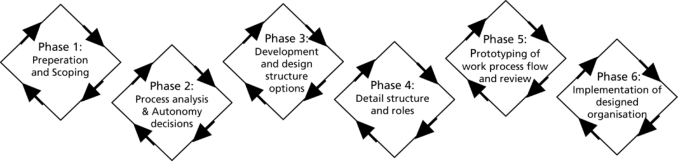
Figure 1: Iterative phases of agile organization design.
The core of the concept is a very flat hierarchy with a high degree of auto- nomy for the employees and the abandonment of assembly lines through the introduction of assembly cells and group work (Berggren, 1993). The hierarchy in production consists of only three levels: Plant Manager, Assem- bly Area Manager and Assembly Team (Ellegård, 2007). In contrast to the serial flow concept propagated in the TPS, in the RPS the vehicles are built in parallel flow to meet the higher flexibility requirements due to contract manufacturing (Ellegård, 2007). An assembly cell consists of a multidiscipli- nary eight-person team. There are eight assembly cells per assembly area and six assembly areas are combined in the entire factory (Sandberg, 2007).
PARTICIPATORY DESIGN OF PHARMACEUTICAL PACKAGING ORGANIZATION In the initial situation the pharmaceutical packaging site faces the challenge of handling increasing order volatility and complexity. The packaging teams as well as the technology were previously designed for the high-volume area because flexibility and agility are not the deciding factors here. At the same time the customer orders must be made through small order quantities in a high variant mix (30% smaller than 500 number of units), the decision was made to create a new organizational unit (15-20 employees) that, in contrast to the highly automated unit, takes care of small order sizes. For this purpose, an organization had to be developed that would be agile, digitally supported, and able to make faster decisions on its own. This is due to the fact that many order changes have to be managed by that unit. Hierarchical information flows are too slow and the separation of decision and execution levels causes further time losses when changes are made. This in turn has an impact on delivery reliability and customer satisfaction.
The project set-up was defined regarding the motivation, targets, expected results and approach. The preferred approach needed to satisfy requests by the management: an open process and high participation of different functi- onal areas and hierarchies, an interdisciplinary team, the consideration of existing corporate strategies and road maps, an iterative and agile way of working, and innovative concepts for organization design. For the design and implementation of a high performing and process-oriented organization in the small volume packaging unit, a participatory method was developed. It inherits six iterative phases depicted in Figure 1.
In phase one, preparation and scoping, the main objective is to get a com- mon and clear understanding of the organization design project. Based on
prior analysis results and strategic decisions the scope was clarified. Further results which have been incorporated into the preparation were results from a production assessment 4.0 which is a systematic way to develop targeted and suitable industry 4.0 solutions (Bauer, Pokorni and Findeisen, 2019), sailboat retrospectives to visualize major challenges (Goncalves and Linders, 2014) and card sort techniques for simple and fast prioritization of relevant trends and topics (Rugg and McGeorge, 1997). Furthermore, the fundamentals of organization design, structures, concepts, trends and industry examples were presented to inspire and foster participation of team members for the upco- ming co-creation activities. In the following open poster workshop session, the objectives, stakeholders, boundaries, risks, and communication strategy for change communication within the operation organization were discussed.
In the second phase the processes in the small volume packaging unit were analyzed to locate existing problems within the work process and define the appropriate autonomy to avoid unnecessary activities and interfaces in the processes. The task of the employees is to package pharmaceuticals. These can be tablets or vials. For this purpose, there are manual packaging work- stations where the packages are assembled and labeled. For slightly larger order quantities, small, automated packaging and labeling machines are used. Furthermore, initialization and testing processes are part of the value stream. All processes are subject to GMP (Good Manufacturing Practice) regulations. The key question in this step is: Which work tasks should be within or out of the own responsibility of the small volume packaging unit in the future? To provide an answer first the main process steps were mapped on a swim- lane diagram. Next the group identified and localized problems along the process. After the identification of the challenges, the detail information such as possible root causes, the impacts, and estimated frequency and duration of getting the problems fixed were discussed and listed. Any challenges that were not mentioned in the process analysis directly are discussed and colle- cted: 1. Key word or key message, 2. Impact and 3. Interface/process partner. Based on the identified challenges the group selected the main tasks that are deeper analyzed in the next step for task allocation. The basic question was here: Should a specific task or subtask be allocated in or out of the respon- sibility of the small volume packaging unit in order to find a suitable level of autonomy? Autonomous teams have the freedom and flexibility to make independent decisions on a range of critical issues (Manz and Sims, 1987), that theoretically should enable autonomous teams to achieve higher levels of performance (Hackman and Oldham, 1976; Seibert, Wang and Courtright, 2011). However, the research evidence to date on the relationship between autonomy and team performance is mixed (Gonzales-Mule et al. 2014). The- refore, a first analysis was performed by expert group work with three to five participants in order to get recommendations for further discussion. The results included task description, arguments, and recommendation for the allocation. Additionally, ideas and possible solutions for tackling the challen- ges can also be documented. The groups presented their results and shared their discussion insights.
The main objectives of the third phase are to define the design guidelines and develop organization forms. In the beginning findings were summarized
Self-Directed Shop Floor Teams for Industry 4.0 53
in an organizational challenges canvas (Olavarria, 2020) which can be used as a visualization tool and leads the group from the analysis phase to a design phase by providing a high-level overview of outputs, outcomes, pro- cess, boosters and obstacles. The last field to be filled in are the field of design guidelines for the future organization and the answer for the question: What should we change in the organization to achieve compliance with the boundaries and our goals? Therefore, in a full day workshop the core team reflected the analysis results and prioritized the most relevant design gui- delines. The guideline suggestions were collected, clustered, confirmed and finally documented as key words with a glossary of explanations to assure a common understanding within the team and for communication with sta- keholders. We developed the following guidelines (in descending order of priority):
Establish high performance capability,
Design the organization as a process-oriented organization,
Increase autonomy and self-organization of employees and implement extensive decentralized decision-making responsibilities,
Create a great work environment,
Develop an adaptable organization,
Role-based work system.
The design guidelines provide the basis for the design task. Before the high- level design started, a short oral presentation and a poster pitch session was provided for showing inspiration, new ideas, examples from other industries and descriptions of innovative organization concepts. Furthermore, poster templates and examples of structural alternatives of organization forms were also provided as tools for the group workshop. After two to three iterations the development of six organization structure alternatives was finalized. At this stage an assessment and selection of the most suitable structural alterna- tive could be made based on the best-fit to design guidelines and argument balances as well as the commitment of the team decision makers. However, a longer reflection phase of approximately three weeks was necessary to reach a common preference and decision.
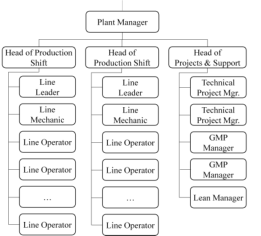
In the fourth phase the detailed design was carried out by the project team. The developed organization (see Figure 2 b) is characterized by one level of hierarchy. This means that the unit head is subordinate to the site manage- ment and all team members of the new unit are allocated under him/her. The organization consists of circles and is role-based. Unlike classic job systems (see Figure 2 a), in the developed model each employee within the unit can take on multiple roles, depending on the situation. The role allocation can be determined by the team itself, as well as the duration of role owner- ship. Each role contains an area of responsibility and allows the employee to further specify and design the role. The role owner is responsible for per- forming the tasks efficiently and effectively. Approximately 15 roles were defined at the beginning. Each role can be assigned to a certain level of complexity to ensure that it fits into the existing payment and employment scheme.
Figure 2: (a) traditional functional organization; (b) developed agile production organization.
For each role the related workload was estimated based on experience and capacity forecasts. Roles are assigned to so called job profiles in order to simplify and integrate them in reasonable job descriptions. Data about current resource utilization were required to estimate the size of roles and respective job profiles in the new organization (the number of FTEs (Full Time Equivalents)) and to ensure that there is sufficient capacity to perform each process. For the definition of roles and responsibilities the RACI tool was used: RACI is an acronym that stands for Responsible, Accountable, Communicated and Informed.
In the fifth phase prototypes for the new organization design were built and tested for operability. Prototyping is a powerful means to facilitate organiza- tional development and change. Applying this less analytical design-based approach to help organizations transform the ways they work is valuable (Coughlan, Suri and Canales, 2007). Therefore, we developed prototype storyboards of the work processes such as the packaging process itself and coordination processes. In a poster workshop with the extended team the new role definitions and descriptions were presented, discussed and commit- ted. The prototypes were presented in storytelling presentations of different scenarios and followed by facilitated group discussions leading to a better common understanding of the new organization design.
The sixth phase is the implementation of the new organization design and the transition plan. This includes the development of an appropriate work- force plan, the identification of headcount targets, identification of legal implications, internal staffing flows, workforce transition requirements and associated costs. Based on the findings and numbers a list of available positi- ons and position descriptions were finalized. The outcome of the project was communicated and the job positions were published. Further elements of the transition plan are the selection and recruitment process, training and deve- lopment and performance management plan. Other critical implementation activities included the monitoring of the progress, regular communication, managing expectations, staying committed, leadership development and ada- pting the organization design according to new changes in the world. An unforeseen challenge was the simultaneous onset of the covid-19 pandemic which hit the implementation phase particularly hard and required overall adjustments.
Self-Directed Shop Floor Teams for Industry 4.0 55
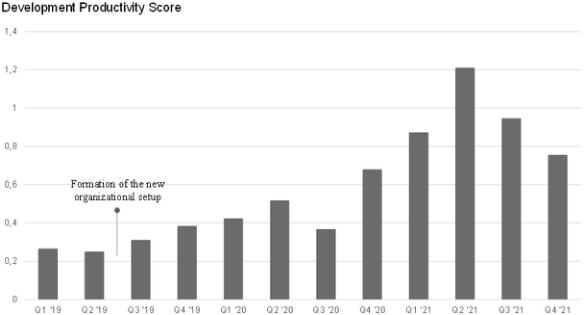
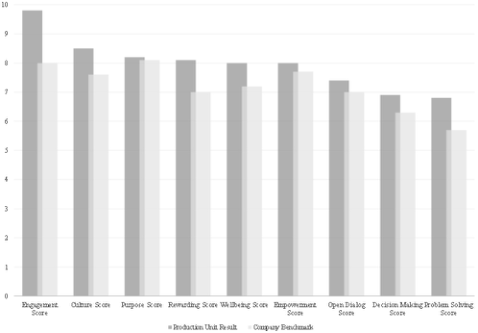
Figure 3: Productivity trend before and after the new established organization.Figure 4: Employee survey overview production unit vs. company benchmark.
PRODUCTIVITY AND WORKER SATISFACTION A few months after the implementation of the new organization, we have already seen increased productivity (units on time). Figure 3 shows the trend in productivity. This could be explained on the one hand by the higher pro- ductivity of the employees and on the other hand by the optimizations in the sense of lean management that the team implemented independently. A decre- ase in quarters three and four 2120 can be explained by the corona pandemic and new projects that were started.
Site-wide employee surveys (3,000 employees) clearly showed (see Figure 4) that employees in the newly created organization scored above the other organizational units at the site in the areas of engagement, culture, pur- pose, rewarding, wellbeing, empowerment, open dialog, decision making, and problem solving.
CONCLUSION AND FURTHER WORK The design of the organization is a critical design task and will remain a central question of the production work of the future. The application of the practical guide presented demonstrated the development and implemen- tation of an innovative organization form in a highly participatory manner. The results achieved demonstrate positive effects on the productivity and on the worker satisfaction. It is also worth mentioning that careful, clear, and understandable communication strategies and practices are decisive factors for success in the development and implementation of organization design. Purposeful communication is also critical when self-directed teams need to practice and adapt previously defined work processes and reflect the outco- mes. Organizational design will be a recurring task for the team within a dynamic environment. Human-centered approaches, mutually agreed design guidelines and easy-to-use tools will enable shop-floor teams to better co- create and implement more innovative solutions leading to higher acceptance by the employees.
REFERENCES
Ansuini, S. (2012) Kaizen Culture: The Continuous Improvement Engine. In: Toyota by Toyota / Obara, Samuel (eds.); Wilburn, Darril (eds.). Hoboken: CRC Press, 2012, pp. 111–126. Bader, S. Barth, T., Krohn, P., Ruchser, R., Storch, L., Wagner, L., Findeisen,
S., Pokorni, B., Braun, A., Ohlhausen, P., Palm, D. (2019) Agile Shopfloor Organization Design for Industry 4.0 Manufacturing (International Conference on Production Research Manufacturing Innovation - Cyber Physical Manufa- cturing <25, 2019, Chicago/Ill.>) In: Procedia manufacturing, Vol. 39 (2019), pp. 756–764 Bauer W., Pokorni B., Findeisen S. (2019) Production Assessment 4.0 – Methods for the Development and Evaluation of Industry 4.0 Use Cases. In: Karwowski W., Trzcielinski S., Mrugalska B., Di Nicolantonio M., Rossi E. (eds) Advances in Manufacturing, Production Management and Process Control. AHFE 2018. Advances in Intelligent Systems and Computing, vol 793. Springer, Cham. https: //doi.org/10.1007/978-3-319-94196-7_46 Berggren, C. (1993) The Volvo Uddevalla Plant. A dead horse or a car dealer’s dream?
An evaluation of the economic performance of Volvo’s unique assembly plant 1989–1992. In: Actes du GERPISA Nr. 9, 1993, pp. 129-143. Birkinshaw, J., Gibson, C. (2004) Building Ambidexterity Into an Organization. MIT Sloan Management Review, 45(5), 47–55. MIT Sloan Management Review. Coughlan, P., Suri, J. F. and Canales, K. (2007) ‘Prototypes as (Design) Tools for
Behavioral and Organizational Change: A Design-Based Approach to Help Orga- nizations Change Work Behaviors’, The Journal of Applied Behavioral Science, 43(1), pp. 122–134. doi: 10.1177/0021886306297722. Ellegård, K. (2007) The creation of a new production system at the Volvo automobile assembly plant in Uddevalla, Sweden. In: Enriching Production - Perspec-tives on Volvo’s Uddevalla plant as an alternative to lean production / Sandberg, Åke (eds.). Stockholm: Avebury, 2007, pp. 37-60. Galbraith, J. R. (2014) Designing Organizations: Strategy, Structure, and Process at
the Business Unit and Enterprise Levels, Jossey-Bass, Third Edition.
Self-Directed Shop Floor Teams for Industry 4.0 57
Goncalves, L., Linders, B. (2014) “Getting Value out of Agile Retrospectives: A Toolbox of Retrospective Exercises”. Leanpub Website. Available at: https://leanpub. com/gettingvalueoutofagileretrospectives (Accessed: 14. February 2022). Gonzalez-Mulé E., Courtright S.H., DeGeest D., Seong J-Y, Hong D-S. (2014)
Channeled Autonomy: The Joint Effects of Autonomy and Feedback on Team Performance Through Organizational Goal Clarity. Journal of Management. 2016;42(7):2018-2033. doi:10.1177/0149206314535443 Gunasekaran, A. (2001) Agile Manufacturing: The 21st Century Competitive Strategy, Elsevier. Hackman, J. R., Oldham, G. R. (1976) Motivation through the design of work: Test
of a theory. Organizational Behavior and Human Performance, 16: 250–279. Kotter, J.P., (2014): Accelerate. Building Strategic Agility for a Faster-Moving World.
Boston: Harvard Business Review Press. Laloux, F. (2014) Reinventing Organizations: A Guide to Creating Organizations Inspired by the Next Stage of Human Consciousness, Nelson Parker. Magalhães, R. (2020) Designing Organization Design: A Human-Centred Approach,
Oxford University Press, p. 23 Manz, C. C., Sims, H. P. (1987). Leading workers to lead themselves: The external leadership of self-managing work teams. Administrative Science Quarterly, 32: 106–128. Olavarria, M. (2020) “Orgazign: Organisationen lebenswert gestalten”, Fachmedien
Otto Schmidt KG; 2nd edition. Oudhuis, M.and Tengblad, Stefan (2020). “The viability of the Scandinavian worklife model and the impact of lean production: The case of Scania.” Economic & Industrial Democracy (2020). https://doi.org/10.1177/0143831X20939137. Plattform Industrie 4.0 (2022). Available at: https://www.plattform- i40.de/IP/Navigation/EN/Industrie40/WhatIsIndustrie40/what-is- industrie40.html (Accessed: 14. February 2022). Rugg, G., McGeorge, P. (1997) The sorting techniques: A tutorial paper on card
sorts, picture sorts and item sorts. Expert Systems 14(2), pp.80–93 Sandberg, A. (2017) http://www.akesandberg.se/vi-behover-ett-nationellt-institutarbetsmiljo/ (Accessed: 14. February 2022). Sanghi, S. (2007) The handbook of competency mapping: understanding, designing
and implementing competency models in organizations, sage publications, 2nd ed., p. 18. Schuh G., Anderl R., Dumitrescu R., Krüger A., ten Hompel M. (2020) Industrie 4.0 Maturity Index. Available at: https://www.acatech.de/publikation/industrie- 4-0-maturity-index-update-2020/download-pdf?lang=en (Accessed: 14. February 2022). Schumacher, S.; Pokorni, B. (2020) Framework kognitive Produktionsarbeit 4.0:
Konzeption und Grobmodell für das Produktionssystem der Zukunft im Future Work Lab, in wt Werkstattstechnik online 110 (2020), Nr.3, S. 108–112 Seibert, S. E., Wang, G., Courtright, S. H. (2011) Antecedents and consequences of psychological and team empowerment in organizations: A meta-analytic review. Journal of Applied Psychology, 96: 981–1003. Sherehiy, B.; Karwowski, W.; Layer, J.K. (2007) A Review of Enterprise Agility:
Concepts, Frameworks, and Attributes, in International International Journal of Industrial Ergonomics 37 (2007) 445–460.
LISTED IN THE AHFE DIGITAL BOOKSTORE CATALOGUE
Explore the complete digital volume
Human Aspects of Advanced Manufacturing
Read this individual research paper free through the original publisher, or explore the full digital proceedings book.
ISBN 978-1-958651-42-1
Explore this ISBN in the AHFE Bookstore ↗Listed in the July 2026 bookstore catalogue; search by ISBN to confirm current availability · Digital book purchase optional