Jean Paul Sebastian Piest, Maria Eugenia Iacob, Marcel Johanna Theodoor Wouterse (2023). Tutorial: Conceptualizing intelligence amplification in human-centred AI applications using the design canvas. In: Human Interaction and Emerging Technologies (IHIET-AI 2023): Artificial Intelligence and Future Applications. AHFE Open Access, vol. 70, pp. 129–138. https://doi.org/10.54941/ahfe1002937
Designing applications that enhance the cognitive abilities of their users is complex and requires involvement of stakeholders from different disciplines. The intelligence amplification design canvas aims to ease and support initial design processes. Currently, a step-by-step tutorial for practitioners is lacking. Extending earlier work regarding the organization of a design canvas workshop, the objective of this paper is to provide such a tutorial. Leveraging the comprehensive design approach for intelligence amplification from earlier work, participants of this tutorial will detail a self-defined idea or existing application using the 13 elements of the intelligence amplification design canvas in four short iterations. Following its four design principles, participants use the intelligence amplification design canvas to emphasize and define human-centred design aspects, the embodiment in the form of a software agent, the use of data driven approaches and computational intelligence, and incorporation of human in the loop. This way, the tutorial contributes to the initiation of new human-centred AI projects as well as the analysis and improvement of existing applications. Furthermore, this tutorial aspires to form a group of researchers and practitioners to collaboratively develop and evaluate human-centred AI applications and case studies. The tutorial can be planned as a half-day or full-day session depending on the target audience. The tutorial requires a room for 4-8 pairs of workshop participants, a large screen or beamer, and laptop for the tutorial presentation. The intelligence amplification design canvas can best be printed on A3 paper for each participant and can be filled in using a pen or post-its. The target audience of the tutorial includes, but is not limited to practitioners, researchers, and students active in the fields of computer science, information systems research, systems design and engineering and human-computer interaction.
Earlier work emphasized challenges regarding the design of Intelligence Amplification (hereafter IA) applications and provided a design canvas for practitioners and comprehensive approach to organize a design canvas work- shop (Piest et al., 2022a). The main goal of the IA design canvas is to ease the design processes related to IA applications, especially during the first stages of design thinking, and improve communication between experts and involved
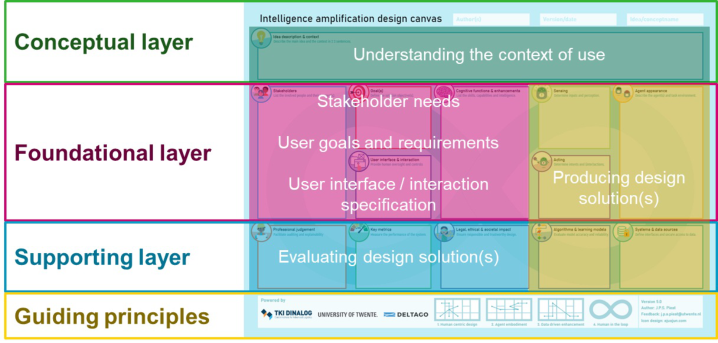
Figure 1: Mapping of the IA design canvas to the ISO 9241-210:2019 standard.
stakeholders. Additionally, the developed comprehensible design approach for IA supports trainers and facilitators to organise a design canvas work- shop (Piest et al., 2022b). Currently, a step-by-step tutorial for practitioners is lacking. This will be the main contribution of this paper.
In this paper, IA is referred to as “the effective use of information techno- logy to enhance human intelligence in a given context” (Piest et al., 2022a). Contrasting IA, Artificial Intelligence (hereafter AI) focuses on “intelligent entities that mimic cognitive functions” (Russell and Norvig, 2002). IA can however use AI methods and techniques. In this case one could argue that IA involves human-centred AI. Human-centred design can be referred to as “an approach to interactive systems development that aims to make systems usable and useful by focusing on the users, their needs and requirements, and by applying human factors/ergonomics, and usability knowledge and techni- ques” (ISO, 2019). Figure 1 shows how the IA design canvas is related to the four design activities of the ISO 9241-210:2019 standard for human-centred design of interactive systems. The IA design canvas can also be related to the six principles for human-centred design as described in the ISO 9241- 210:2019 standard for human-centred design of interactive systems, namely: 1) based on explicit understanding of users, tasks, and environments, 2) user involvement, 3) user-centred evaluation, 4) iterative process, 5) taking into account the whole user experience, and 6) involving a multidisciplinary team.
Extending the above mentioned earlier work, the aim of this paper is to further detail the core of the design canvas workshop in the form of a step- by-step tutorial for practitioners to conceptualize IA in human-centred AI applications using the IA design canvas. This tutorial intends to complement the earlier developed design approach for IA and also support incorporation of the IA design canvas as part of the established design and development processes (e.g., design thinking, design science research methodology, systems engineering, and/or similar). Taken together, the IA design canvas, the design approach, and this tutorial aim to provide a common ground for conceptuali- zing IA in human-centred AI applications as the starting point for new design projects or re-designs.
Conceptualizing Intelligence Amplification 131
This paper is structured as follows. First, the tutorial objectives and appro- ach are summarized. Then, the tutorial contents are discussed, including an overview, detailed description, and duration of the tutorial, as well as requi- rements for a room and materials. Following, the intended target audience for the tutorial is discussed. Lastly, concluding remarks are given including recommendations for future work.
OBJECTIVES AND APPROACH This section presents the primary and secondary tutorial objective and descri- bes the recommended approach for delivering the tutorial and case study research.
The primary objective of this tutorial is to learn and experience first-hand how the IA design canvas is used to emphasize and define a self-defined appli- cation or analysis/improvement of an existing application. Leveraging the comprehensive design approach for IA from earlier work, participants will detail a self-defined or existing application using the 13 elements of the IA design canvas in four short iterations. Following its four design principles, participants use the IA design canvas to emphasize and define human-centred design aspects, the embodiment of AI in the form of a software agent, the use of data driven approaches and computational intelligence, and incorporation of human in the loop principles. This way, the tutorial can contribute to the initiation of new design projects as well as the analysis and improvement of existing applications.
The secondary objective of this tutorials aspires to form a group of rese- archers and practitioners to collaboratively develop and evaluate IA-based human-centred AI applications and case studies. Case study research is com- monly used for demonstration, validation, and evaluation purposes. Single- case mechanism experiments can demonstrate relevance in a specific context and provide initial empirical support. However, single-case mechanism expe- riments are often statistical insignificant and require comparative studies to assess its rigor in different settings and/or using alternative technologies. Uti- lizing the IA design canvas, a common ground can be provided for scholars and practitioners to develop and analyse IA-based human-centred AI appli- cations. This subsequently provides a starting point to develop guidelines for conducting case study research, analysing the results and reporting relevant aspects and issues for replication and comparison. Moreover, this provides a foundation for cross-case analysis and might contribute to generalization of IA-based applications and theorizing design knowledge.
Now that the objectives and approach have been clarified, the next section will focus on the tutorial contents.
TUTORIAL CONTENTS This section first provides an overview of the tutorial contents. Following, the tutorial contents are described in more detail. Next, the duration of the tutorial is discussed and variants are briefly reviewed. Lastly, requirements regarding the room and materials are discussed.
Table 1. Overview of tutorial components and contents (adapted from Piest et al., 2022b).
Table available in the original PDF paper.
Component Contents
Overview of the tutorial
Introduction (10–30 minutes)
Tutorial objectives and approach
IA and human-centred AI applications
IA design canvas: layers, elements, and principles
Emphasize a self-defined idea or application
First iteration (∼30 minutes)
Apply the human-centred design principle
Fill in the seven related elements
Apply the agent embodiment principle
Second iteration (∼20 minutes)
Fill in the three related elements
Complement elements from the first iteration
Apply the data-driven enhancement principle
Third iteration (∼20 minutes)
Fill in the two related elements
Refine goals, metrics and professional judgement
Apply the human in the loop principle
Fourth iteration (∼20 minutes)
Check the consistency and alignment of elements
Refine elements and note down questions / actions
Highlight main results of the four iterations
Summary (10–20 minutes)
Conclude tutorial and recommend next steps
Discussion, questions, and tutorial evaluation
Overview
Table 1 provides an overview of the tutorial components and contents. This overview can be used for the introduction or be incorporated as part of a full day design canvas workshop or similar design approach or process. The tutorial overview provides an indication of the duration, which can be alte- red depending on the target group and prior knowledge, background and/or experience of participants (see subsection: Duration). The next subsection will discuss the tutorial components and contents in more detail.
Description
Table 1 and the instructions and guiding questions, described in earlier work (Piest et al., 2022a), can together be applied to either a self-defined idea or for the analysis/improvement of an existing application. The next paragraphs will subsequently discuss the tutorial contents following Table 1. The exam- ple from earlier work is utilized to illustrate the proposed use of the IA design canvas.
The tutorial starts with a brief introduction to highlight the structure of the tutorial (as presented in the previous subsection) and learning outcomes (Piest et al., 2022b). Next, the objectives and approach are explained (see previous section). For the purpose of the tutorial one idea or application will be used. During a full-day design canvas workshop multiple ideas or
Conceptualizing Intelligence Amplification 133
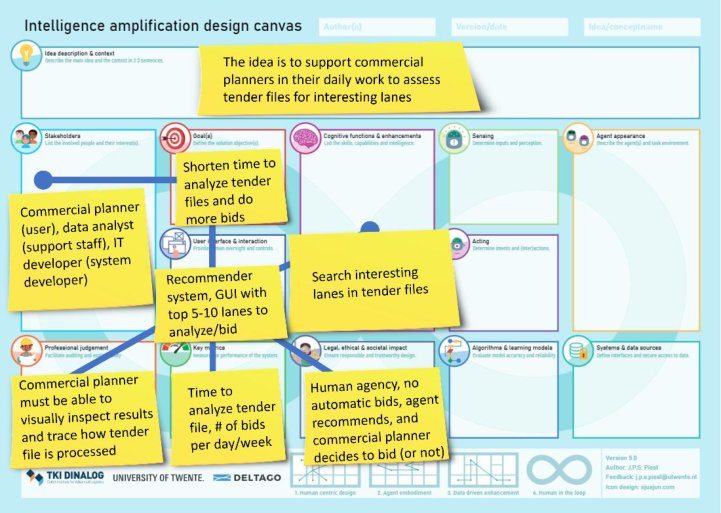
Figure 2: Illustrative use of the IA design canvas during the first iteration.
applications can be ideated. Then, it is recommended to provide definitions for IA and human-centred AI (as provided in the introduction section). Lastly, the IA design canvas should be briefly introduced, in specific its three layers, 13 elements, and four principles (Piest, et al., 2022a). After the introduction, the four iterations can be performed.
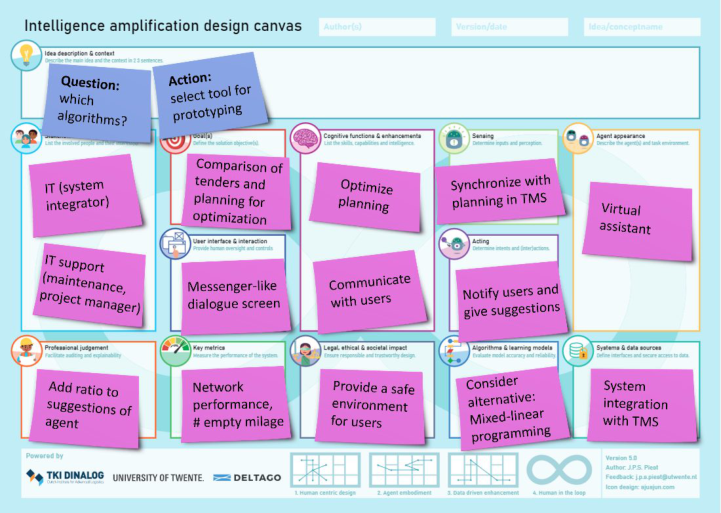
The first iteration focuses on conceptualizing a self-defined idea or exi- sting application for analysis/improvement. First, the conceptual layer of the IA design canvas is utilized to emphasize either a self-defined idea or existing application in 2–3 sentences. Next, the human centric design principle will be applied to fill in seven elements in the foundational and supporting layer of the IA design canvas, as shown in Figure 2. The proposed sequence, instru- ctions, and guiding questions can be used, as described in earlier work (Piest et al., 2022a).
Regarding the cognitive functions and enhancement element, it is impor- tant to first focus on human intelligence and enhancements for the intended users. Here, the presence of domain knowledge is important. The first itera- tion covers the left side of the IA design canvas. Next, the second iteration will focus on the right side of the IA design canvas.
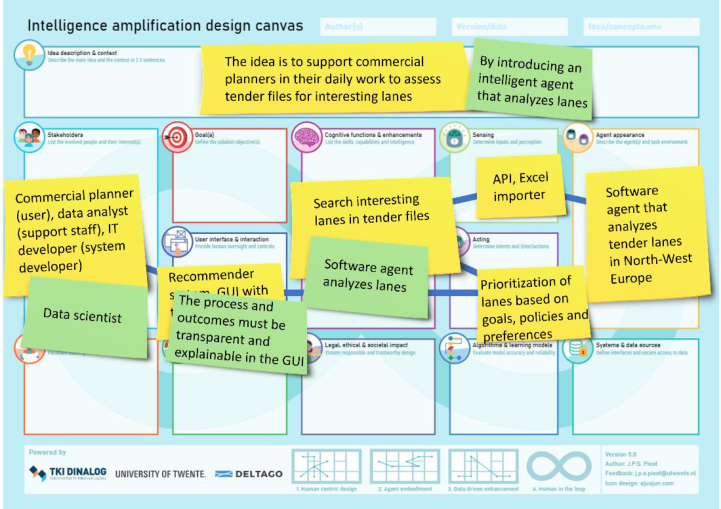
In the second iteration, the remaining three elements in the foundation layer will be filled in using the agent embodiment principle. Consequen- tly, this second iteration will focus on defining the agent, its environment, and envisioned sensing and (inter-)acting capabilities. The concept of intel- ligent agents require clarification depending on the participants knowledge and background. The example, shown in Figure 3, is based on the virtual appearance as a software agent. However, it is also possible to use the IA
Figure 3: Illustrative use of the IA design canvas during the second iteration.
design canvas for physical solutions (e.g., drones, robots, appliances, weara- bles). After completing the three elements on the right side of the IA design canvas, the results from the first iteration can be complemented (as illustrated with green post-its in Figure 3) from a technological perspective. The second iteration filled in the remaining elements in the foundation layer. Next, the remaining elements in the supporting layer will be added.
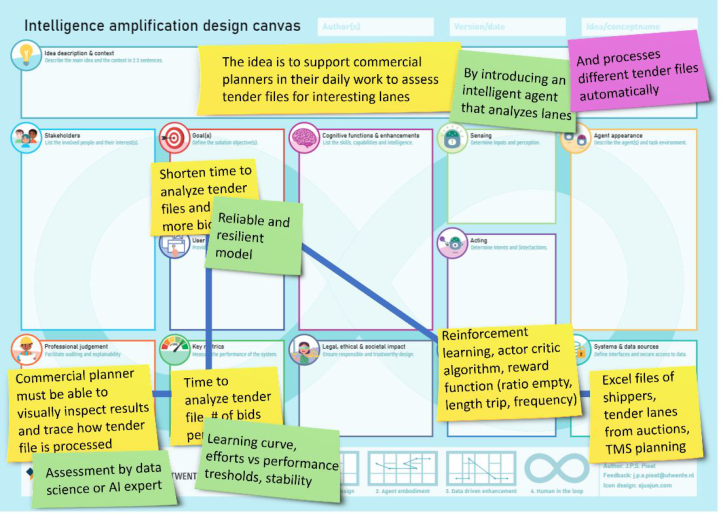
The third iteration focuses on incorporating computational intelligence, integration with source systems, and identifying required data using the data driven intelligence principle, as shown in Figure 4. Here, the presence of expertise regarding algorithms and learning models is important for adequ- ate assessment of solution alternatives. It is recommended to ideate different solution alternatives (e.g., rule-based machine learning, reinforcement lear- ning, statistical learning). During the third iteration, the goals and metrics can be complemented from the perspective of algorithms. Moreover, the initial idea can be further refined.
After completing all elements of the IA design canvas, the fourth iteration focuses on consistency and checking the contents based on the human in the loop principle. Here, participants can use the lemniscate (∞) to assess whether the concepts of IA are incorporated, the elements are aligned well, and if the result is expected to be usable and useful to achieve its intended goals.
Next, the participants can assess the consistency and determine which elements are described sufficiently and which elements may need refine- ment, involvement of experts or verification with stakeholders or intended users. Figure 5 illustrates refinements. Finally, it is recommended to let
Conceptualizing Intelligence Amplification 135
Figure 4: Illustrative use of the IA design canvas during the third iteration.
participants write down questions and/or possible next steps. The fourth iteration concludes the tutorial.
The summary of the tutorial can be provided by revisiting the objecti- ves and highlighting the results and findings from the four iterations. Then, the tutorial can be concluded and recommendations can be given for next steps (e.g., rapid prototyping, solution architecting, setting up a pilot study or project). Lastly, it is recommended to conduct a tutorial evaluation for improvement and follow-up.
Now that the tutorial contents are described in detail, the next subsection will discuss the duration and variants that can be considered.
Duration This tutorial is derived from the design canvas workshop (Piest et al., 2022b) and can be delivered in approximately half a day (3–4 hours) or a full day (8 hours) depending on the prior knowledge, background, and/or experience of the target audience (see next section). Planning a full day provides room for introduction, interaction, and questions. For participants that already did a design canvas workshop, the tutorial can be shortened to 60–90 minu- tes. After deciding which variant is appropriate, a room and materials are required to perform the tutorial. This will be discussed in the next subsection.
Room and Materials The tutorial requires a large room for 4–8 pairs of participants, a screen or beamer, and laptop for the tutorial presentation. A workshop setting fosters interaction between participants. In the case of individual participants,
Figure 5: Illustrative refinements of the IA design canvas during the fourth iteration.
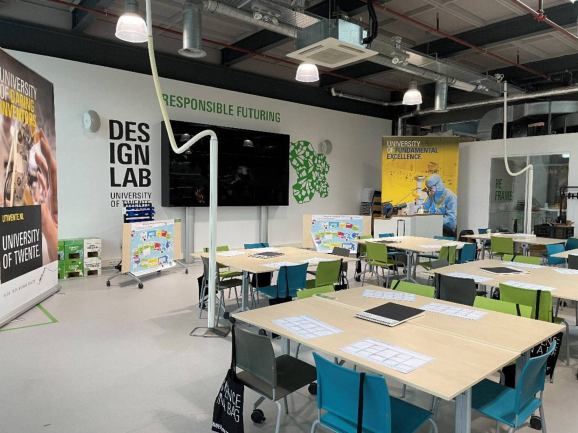
depending on available rooms and the preference of the tutorial speaker, a default classroom setting can be considered. Figure 6 illustrates the set-up that was used by the authors for one of the design canvas workshops.
The IA design canvas (Piest et al., 2022c) can best be printed on A3 paper for each participant. Make sure to bring additional copies. The IA design canvas can be filled in using a pen. Alternatively, post-its can be used instead of writing on the design canvas to facilitate rearrangement. When follow- ing the full-day design canvas workshop approach, the poster with practical guidance to organize a design canvas workshop (Piest et al., 2022d) can be printed on A0 for visualization and guiding of the process. This can also be provided in the form of a hand-out on A4.
Throughout this section, the presence and importance of domain know- ledge specific expertise is mentioned a few times. Therefore, the next section will focus on clarifying the target audience of the tutorial.
TARGET AUDIENCE This section discusses the intended target audience of the tutorial, including the required or desired prior knowledge, and prerequisites.
The target audience of the tutorial includes, but is not limited to, pra- ctitioners, researchers and students active in the fields of computer science, information systems research, systems design and engineering, and human- computer interaction. Deep and profound prior knowledge regarding these subjects is not necessarily required but will contributes to the quality and outcome of the tutorial. The main prerequisite for participants is to either
Conceptualizing Intelligence Amplification 137
Figure 6: Illustrative workshop setting.
prepare a self-defined idea or select an existing application for analysis. For the tutorial speaker, the prerequisite is to prepare a tutorial presentation, arrange a room, and gather the materials.
Ideally participants form pairs to collaboratively conceptualize IA in a human-centred AI application or analyse an existing application together. Participants may nevertheless choose to attend the tutorial individually. However, individual attendance might influence the quality of the outcome because of the multidisciplinary and iterative character of the design appro- ach. Speakers with a multidisciplinary background and/or experience with workshop facilitation can deliver the tutorial on their own. However, it might be needed to involve either a technical expert or a workshop facili- tator. For unexperienced workshop facilitators it is recommended to run a pilot and/or start with a small group of participants. The above obviously depends on the knowledge, experience, and background of the participants and tutorial speaker.
CONCLUSION
This paper presented a step-by-step tutorial for practitioners regarding the use of the IA design canvas to conceptualize IA in a human-centred AI appli- cation or analyse/improve an existing application. The tutorial complements the existing IA design approach and can be incorporated as part of establi- shed design approaches and development processes. This tutorial aspires to form a group of researchers and practitioners to collaboratively develop and evaluate IA-based human-centred AI applications and case studies. Future work can contribute to the development of guidelines for conducting case study research and theorizing design knowledge based on cross-case analysis of different case studies.
TUTORIAL SPEAKER AND AUTHOR BIO The authors have together organized in-company workshops for organiza- tions, several mixed group workshops involving participants from multiple organizations, and presentations and demonstrations during academic con- ferences. This tutorial during IHIET-AI will be delivered by the first author.
Jean Paul Sebastian Piest (tutorial speaker) is currently Researcher and PhD candidate at the Department of Industrial Engineering and Business Infor- mation Systems at the University of Twente. This paper is related to his PhD research in which he aims to develop a design theory for IA. He graduated cum laude for the Professional Doctorate in Engineering (PDEng) program- mes Civil Engineering and Business Information Technology (2022), obtained a double Master degree in Supply Chain Management and Business Admi- nistration (2017) and holds Bachelor degrees in Industrial Engineering and Management (2011) and Human Resource Management (2007). Previously, he worked 10 years in the information technology and services industry and consulted organizations in the logistics and supply chain industry.
ACKNOWLEDGMENT
This research is supported by TKI DINALOG as part of the ICCOS pro- ject (grant no. 2018-2-169TKI). The authors would like to acknowledge Bas Groot for supporting the organization of the design workshops with practi- tioners. Special thanks to Sjusjun for creating illustrations and visualizing the process.
REFERENCES
ISO: International Organization for Standardization (2019). Ergonomics of humansystem interaction — Part 210: Human-centred design for interactive systems (ISO 9241-210:2019). Retrieved from URL (last accessed: 29/01/2023): https://www. iso.org/obp/ui/#iso:std:iso:9241:-210:ed-2:v1:en. Piest, J.P.S., Iacob, M.E., & Wouterse, M.J.T. (2022a). Designing Intelligence
Amplification: a Design Canvas for Practitioners. In Accelerating Open Access Science in Human Factors Engineering and Human-Centered Computing (Vol. 68, pp. 68–76). [8]. DOI: https://doi.org/10.54941/ahfe1002714. Piest, J.P.S., Iacob, M.E., & Wouterse, M.J.T. (2022b). Designing Intelligence Amplification: Organizing a Design Canvas Workshop. In Accelerating Open Access Science in Human Factors Engineering and Human-Centered Computing (Vol. 68, pp. 247–251). [33] DOI: https://doi.org/10.54941/ahfe1002739. Piest, J.P.S., Iacob, M.E., & Wouterse, M.J.T. (2022c). Intelligence amplification
design canvas. DOI: https://doi.org/10.13140/RG.2.2.19863.44966. Piest, J.P.S., Iacob, M.E., & Wouterse, M.J.T. (2022d). Poster: Designing intelligence amplification. DOI: https://doi.org/10.13140/RG.2.2.33285.22245. Russell, S., & Norvig, P. (2002). Artificial intelligence: a modern approach.
LISTED IN THE AHFE DIGITAL BOOKSTORE CATALOGUE
Explore the complete digital volume
Human Interaction and Emerging Technologies (IHIET-AI 2023): Artificial Intelligence and Future Applications
Read this individual research paper free through the original publisher, or explore the full digital proceedings book.
ISBN 978-1-958651-46-9
Explore this ISBN in the AHFE Bookstore ↗Listed in the July 2026 bookstore catalogue; search by ISBN to confirm current availability · Digital book purchase optional