Päivi Heikkilä, Susanna Aromaa, Hanna Lammi, Timo Kuula (2023). Framework of Future Industrial Worker Characteristics. In: Human Interaction and Emerging Technologies (IHIET-AI 2023): Artificial Intelligence and Future Applications. AHFE Open Access, vol. 70, pp. 30–40. https://doi.org/10.54941/ahfe1002927
The ways of working are changing in the manufacturing industry due to new technologies and the merging of physical and virtual environments (e.g., Industry 4.0 [1], Metaverse [2]). Already, work tasks are changing from physical and routine tasks towards intellectual and social activities which often include the use of ICT tools [3]. The pandemic has changed attitudes and ways of working towards hybrid arrangements and therefore, expectations related to flexibility in work may become more pertinent also for manufacturing workers [4]. Novel technologies are being developed to support the industrial worker in the future [5], which can be called augmentation or empowerment of workers [6-8].The World Manufacturing Forum has identified the top ten skills that will be needed in future manufacturing work [9]. In our study, we wanted to add understanding of the skills and characteristics needed in future industrial work and present the results in a format that would support designers of technological tools to consider the perspective of future workers. Our goal was to create a framework of worker characteristics that could guide the design of technological tools to assist workers in work tasks requiring new skills and characteristics. To understand the transformation of work and to create a framework, we conducted a literature review and 10 expert interviews, focusing on the ways emerging technologies are expected to change the nature of industrial work. Based on the results, a framework of future industrial worker characteristics (FIW) was created. The applicability of the framework was tested by applying it in a European research project that develops software solutions for the context of modern, flexible, and data-rich manufacturing. Altogether, 19 novel software solutions that are being developed to support industrial work were mapped using the characteristics of the framework. The mapping experiment provided understanding of the relevance of the worker characteristics and the ways to support them in practice.According to the FIW framework, future industrial work will require smarter operations, which emphasizes worker capabilities in terms of mastering complexity, solving problems, making proactive decisions, and considering sustainability. Transforming work requires resilience that can be strengthened by capabilities such as creativity, the ability to lead oneself, flexibility, and continuous learning. Being interactive will be a vital part of work and can be fostered by communication, collaboration, supporting inclusiveness and interculturality, as well as sharing a safety-oriented mindset and work practices. In addition, health and well-being will have a central role in the future work. A healthy worker can be characterized as feeling motivated, balanced, capable, and focused.The FIW framework can be used by designers and industrial companies to guide the design and acquirement of novel technology solutions to support the characteristics of future industrial work, and in general, to increase understanding on transformation of industrial work from the perspective of worker skills and characteristics. In the future, it would be good to apply the framework in other research cases and industrial contexts to find out the possible development needs and ways to embed the framework in the design or evaluation processes.REFERENCES[1]Henning Kagermann, Wolfgang Wahlster and Johannes Helbig. 2013. Recommendations for Implementing the Strategic Initiative INDUSTRIE 4.0: securing the future of German manufacturing industry. 82.[2]Sang-Min Park and Young-Gab Kim. 2022. A Metaverse: taxonomy, components, applications, and open challenges. IEEE Access [3]Eurofound. 2018. Wage and task profiles of employment in Europe in 2030. [4]Gartner 2023. 9 Future of Work Trends for 2023. Available: gartner.com/en/articles/9-future-of-work-trends-for-2023 [Accessed Feb 15, 2023].[5]David Romero, Johan Stahre, Thorsten Wuest, Ovidiu Noran, Peter Bernus, Åsa Fast-Berglund and Dominic Gorecky. 2016. Towards an operator 4.0 typology: A human-centric perspective on the fourth industrial revolution technologies. CIE 2016: 46th International Conferences on Computers and Industrial Engineering. [6]Eija Kaasinen, Franziska Schmalfuß, Cemalettin Özturk, Susanna Aromaa, Menouer Boubekeur, Juhani Heilala, Päivi Heikkilä, Timo Kuula, Marja Liinasuo and Sebastian Mach. 2020. Empowering and engaging industrial workers with Operator 4.0 solutions. Computers & Industrial Engineering 139, 105678.[7]Roope Raisamo, Ismo Rakkolainen, Päivi Majaranta, Katri Salminen, Jussi Rantala and Ahmed Farooq. 2019. Human augmentation: Past, present and future. International Journal of Human-Computer Studies 131, 131-143.[8]Francisco Betti and Thomas Bohne. 2022. Augmented Workforce: Empowering People, Transforming Manufacturing.[9]The World Manufacturing Forum. 2019. Skills for the Future of Manufacturing.
The ways of working are changing in the manufacturing industry due to new technologies and the merging of physical and virtual environments (e.g., Industry 4.0 (Kagermann et al., 2013), Metaverse (Park and Kim, 2022)). Already, work tasks are changing from physical and routine tasks towards intellectual and social activities which often include the use of ICT tools (Eurofound, 2018). The pandemic has also changed attitudes and ways of working towards hybrid arrangements and therefore, expectations related to flexibility in work may become more pertinent also for manufacturing workers (Gartner, 2023).
Novel technologies (e.g., augmented reality (AR), artificial intelligence (AI)) are being developed to support workers in their work. Romero et al. (2016) and the researchers of the ACE Factories cluster (2019) describe how technologies can support the industrial worker in the future. This support can be called augmentation or empowerment of workers (Kaasinen et al., 2020, Raisamo et al., 2019, Betti and Bohne, 2022). The visions of Romero et al. (2016) and the ACE Factories cluster (2019) are based on the Industry 4.0. paradigm and thus are technology driven. Industry 5.0 complements and extends the paradigm by highlighting three core values: a holistic human- centric approach, emphasising human needs as well as worker skills and rights, sustainability, acknowledging the planetary boundaries, and resilience,
Framework of Future Industrial Worker Characteristics 31
Figure 1: Study process.
referring to the robustness in production (European Commission, 2021). The human-centric approach emphasises also the importance of well-being at work (European Commission, 2021; Kaasinen, Anttila & Heikkilä, 2022). When addressing the industrial work of the future, it is important to consider the both paradigms, the technology-driven Industry 4.0 approach, and the value-driven Industry 5.0 approach, to acknowledge both the impacts of emerging technologies and societal needs (Xu et al., 2021).
The World Manufacturing Forum has identified the top ten skills that will be needed in future manufacturing work (Taisch et al., 2019). In our study, we wanted to add understanding of the skills and characteristics needed in future industrial work and present the results in a format that would support designers of technological tools to consider the perspective of future workers. Our goal was to create a framework of worker characteristics that could guide the design of technological tools to assist workers in work tasks requiring new skills and characteristics.
The paper is structured as follows. First, we describe the study process and methods. Then, we present the results: insights gained from expert interviews, the resulting framework of worker characteristics, and a mapping experiment for applying the framework. Finally, the contribution of our work, limitations and future research needs are discussed.
STUDY PROCESS AND METHODS The goal of this study was to identify what kind of capabilities and skills industry workers will need in the future and to create a framework to illu- strate this approach. The study process included a literature review, expert interviews, creation of a framework and a technology mapping experiment (Figure 1).
To understand the transformation of industrial work, a literature review and ten expert interviews were conducted. The literature review was conducted as a co-learning activity with five human factors researchers, who all had over 20 years of experience on human-centric design. The researchers selected recent and highly cited articles on the topic, reviewed them and shared their insights on them in co-learning meetings. Based on the literature review, the researchers gained a shared understanding of the topic and identified key themes for the expert interviews.
The expert interviews focused on the ways emerging technologies are expected to change the nature of industrial work. The interview themes included the expected transformation of work and work roles, skills nee- ded in future work, and resilience and well-being at work. The interviewed
experts were senior research scientists working in research and development projects in the industrial sector closely with industrial companies. The experts were invited to participate in the interviews based on their expertise, inclu- ding automation and robotics (2 persons), augmented reality/virtual reality (AR/VR), artificial intelligence (AI), additive manufacturing, telepresence, data-based asset management, production processes, learning and education, and the Internet of Things (IoT). The interviews were conducted as online interviews taking 1–2 hours and the results were thematically analysed.
Based on the results of the interviews and the literature review, a frame- work was created describing the characteristics of the future industrial worker. The framework was iteratively designed in online workshops with the five researchers. The main characteristics of the future industrial worker were first identified and then, more detailed worker characteristics were defined. Finally, descriptions of the characteristics were created.
The applicability of the framework was tested by applying it in a European research project that develops software solutions for the context of modern, flexible, and data-rich manufacturing. The solution developers of the project, who represent several European research organisations and manufacturing companies, were invited to participate in a mapping experiment, where they were asked to select the characteristics of the framework that their solution under development supports. In addition, they were asked to fill in brief descriptions of how the solution supports each selected characteristic and to add new characteristics if needed. The developers of 19 solutions participated in the experiment.
RESULTS
This section summarises the main results of the expert interviews, presents the developed framework and describes the results of the mapping experiment applying the framework. In addition to these results, the literature review conducted by the researchers worked as a starting point creating a shared understanding of the transformation of industrial work, with an impact on the themes of the expert interviews and the resulting framework.
Expert Interviews All the expert interviewees considered industrial work to be in a phase of substantial transformation concerning work processes, work roles and ways of working. Industrial work was expected to gradually change from manual operations to maintenance and monitoring, which requires under- standing of processes and systems and problem-solving skills. The work was expected to expand in the direction of information technology, requiring managing several work tasks or even leading to converging work roles, such as operators and programmers. The role of data was expected to increase in decision making, operations and prediction. In addition, sustainability was seen as a key trend that extends to the level of operators and manual workers.
The role of smooth communication, collaboration, and teamwork was expected to increase in industrial work. As work changes from manual operations to maintaining systems, it is more important to understand the
Framework of Future Industrial Worker Characteristics 33
bigger picture at the systems level and the whole production chain, which extends the need for information sharing and collaboration to a new level. Collaboration was also considered important in the efficient utilization of interactive technology, for example collaborative robotics. As work was expected to involve wider networks and workers from different backgrounds, valuing diversity and aiming at inclusion were seen as important. Further- more, communication and collaboration were regarded as necessary when considering daily practices at the workplace, such as safety procedures.
A need for resilience was considered important both as a target for the company and as a characteristic of a worker. On a company level, resilience was connected, for example, to proactive risk management and adaptation to changing customer needs. From the workers perspective, continuous learning, flexibility and a mindset of self-leadership and creativity were regarded as means to support resilience.
Health and well-being were acknowledged as important aspects of future industrial work from the perspectives of ergonomics and safety, but also from the perspective of cognitive load, meaningfulness of work, working conditions and social support. These aspects may have an impact on workers’ motivation, feeling of balance, feeling of capability, and ability to focus on relevant tasks. The transformation of work was expected to have both negative and positive impacts on well-being. For example, managing larger processes can increase the cognitive load while giving technology-enabled context and task -related guidance could reduce it.
Future Industry Worker Characteristics Framework The insights from the expert interviews and the literature review resulted in the creation of the future industrial worker characteristics (FIW) framework. The results emphasized the characteristics of smartness and interactivity in future industrial work. Resilience and well-being were acknowledged as key aspects for organizational success.
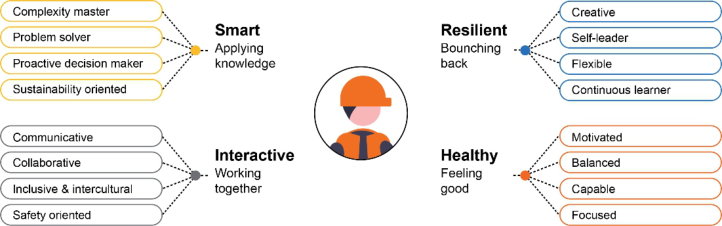
The resulting FIW framework consists of four main sections describing the characteristics of the future industrial worker: smart, resilient, interactive, and healthy (Figure 2). Each characteristic is connected to four sub character- istics that highlight the capabilities needed in the work of the future.
According to the FIW framework, future industrial work will require smarter operations, which emphasises worker capabilities in terms of master- ing complexity, solving problems, making proactive decisions, and con- sidering sustainability. Transforming work requires resilience that can be strengthened by capabilities such as creativity, the ability to lead oneself, flexibility, and continuous learning. Being interactive will be a vital part of work and can be fostered by communication, collaboration, supporting inclu- siveness and interculturality, as well as sharing a safety-oriented mindset and work practices. In addition, health and well-being will have a central role in the future work. A healthy worker can be characterized as feeling motivated, balanced, capable, and focused. All 16 worker characteristics are defined in more detail in Table 1.
The FIW framework highlights characteristics and capabilities that will be beneficial in future industrial work, but it does not propose that one worker should have all the characteristics. The need for specific characteristics is dependent on the work role, and in a work team, characteristics of team members can complement each other. The characteristics can be strengthened by training, on-the-job-learning, an appropriate mindset, and technological tools.
The FIW framework is intended to be used in early design phases of tech- nological solutions, to make designers familiar with worker characteristics that can be supported by features and functionality of novel technology. In addition, the framework may also guide industrial companies in the acquirement of novel tools.
Technology Mapping Experiment To understand if the proposed FIW framework can be applied to solutions that are being developed for industry, a mapping experiment was execu- ted. Software solution developers of a European research project identified which FIW characteristics their solution supports and described the relevant worker roles and how the solution supports them. In total, 19 solutions supporting industrial work were mapped. The solutions included, for exam- ple, an augmented reality -based tool that supports collaborative assembly and inspection tasks, a risk analysis solution that identifies hazards and esti- mates risks, and a dynamic task scheduling solution that focuses on safe and efficient human-robot collaboration.
Based on the mapping experiment, all FIW framework categories were considered relevant, and new categories were not suggested. 16 solutions supported workers to be smart, 12 supported them being resilient, 10 being healthy and 16 being interactive (Table 2). One solution could support many of the FIW characteristics. The same solution could also support different worker roles (e.g., one solution can support operators, developers, and integrators).
Sixteen solutions supported industrial workers being smart in their work. Several different work roles that could benefit from the use of the solutions were identified: operators/workers, integrators, experts, maintenance persons, planners/process engineers, production managers and
Framework of Future Industrial Worker Characteristics 35
Table 1. Descriptions of the worker characteristics of the FIW framework.
Table available in the original PDF paper.
Description Worker characteristic
Smart: Applying knowledge Complexity master Ensuring smooth production by monitoring work processes and systems and managing dependencies and priorities of operations. Problem solver Preparing to solve problems quickly and patiently by utilising evolved practices or guidance created for problem situations. Proactive decision maker
Considering information from different sources when making decisions for example about operations or maintenance of machines. Sustainability oriented
Considering sustainability when making daily decisions, for example related to materials, waste, and maintenance of machines.
Interactive: Working together Communicative Openly sharing task related information, plans, ideas, and potential challenges with others. Collaborative Smoothly collaborating with team members as well as with interactive technology, such as collaborative robots. Inclusive and intercultural
Valuing diversity and including all workers with different backgrounds (e.g., genders, ages, cultures) in joined activities. Safety oriented Following and developing safety procedures and prioritizing safety when completing work tasks.
Resilient: Bouncing back Creative Seeking new solutions to challenges, which may lead to improved work engagement or new innovations. Self-leader Guiding oneself to achieve work objectives, for example by taking initiative, organising work tasks, and following progress. Flexible Seeing changes as opportunities and seeking ways to adapt work tasks to new requirements or unexpected changes. Continuous learner
Acquiring knowledge and competences to expand skills, which benefits current work tasks as well as up- and re-skilling if needed.
Healthy: Feeling good Motivated Making an effort to achieve good results, which is shown in energy, commitment and persistence when completing work tasks. Balanced Feeling balanced with one’s workload and responsibilities as well as balancing the requirements of professional and personal life. Capable Having sufficient resources, skills, and capabilities to complete the work tasks without compromising work ergonomics. Focused Being able to concentrate on the ongoing work task, staying aware of the environment but not getting distracted too easily.
Table 2. Software solutions mapped with the FIW framework categories.
Table available in the original PDF paper.
Worker characteristics Number of solutions supporting FIW category Smart 16
quality inspection persons. It was found that the solutions could help mastering complexity in the planning and design of production, for exam- ple, in designing production workflows, simulations, programming robots and collecting data for use in replanning. The solutions also provided illus- trative guidance on how to solve problems step-by-step. To be able to make proactive decisions, a maintenance person could get alerts of anomalies on the production line. Sustainability oriented behavior could be supported by training workers for work tasks virtually, which reduces the need to travel to the workplace, and the use of real material when making a product.
Twelve solutions supported the resilient characteristic. Similar work roles were identified here: operators, experts, integrators, developers/designers, maintenance persons, production managers and quality inspection persons. Many of the solutions had adaptable features that could be customized by users. Therefore, operators and designers may use their creativity to modify and implement new functionalities in the solutions. The self-leadership characteristic was supported, for example, by giving the operator informa- tion on the progress of work to help task execution. Flexibility was supported by enabling adapting to the changes in the production, e.g., a solution could suggest another resource/actor if needed. A virtual reality technology
Framework of Future Industrial Worker Characteristics 37
-based solution supported workers in learning new work tasks in a simulated environment.
Ten solutions to support healthy characteristics were mainly mapped for shopfloor operators/workers, but also for maintenance and quality inspec- tion persons as well as experts, integrators, and developers. Being focused was supported, for example, by providing a clear list of tasks for an operator, and by providing only the necessary information for completing a task. Being capable of completing the work tasks was supported by offering flexibility through multi-modality, considering worker skills as a basis for balancing work, and by allocating workers for work tasks based on their fit to the tasks as well as their availability. Being balanced was supported by reducing workloads and creating a comfortable work environment, through the quick setup of technology and by using simulations for training. Workers’ motiva- tion was supported by giving feedback on tasks to workers and by reducing repetitive tasks.
Sixteen solutions supported interactivity especially in the work of opera- tors but also in the work of experts, developers, quality inspection persons, integrators, developers/designers, maintenance persons and safety experts. Most of the solutions assisted communication by sharing task-specific infor- mation, for example, visually showing the next steps in a work sequence or presenting other important task-related data. The collaborative characteristic was the most supported by the solutions: the solutions supported data sha- ring in general but also collaboration between workers and between workers and robots. The solutions supported inclusive and intercultural aspects, for example, with a possibility to select different languages and modify prefer- ences in the user interface. To support a safety-oriented mindset, the solutions included features to ensure that operators could perform their tasks safely, avoid collisions with robots and practice future tasks.
The result of the mapping experiment indicates that the FIW framework is applicable to describing the worker characteristics and capabilities that the solutions support in industrial work. In addition to just simply linking the FIW categories into a single solution, the developers listed the relevant worker roles and explained how the linked FIW category supports the worker in practice. These additional remarks explained the chosen categories more profoundly and were thus important in understanding and evaluating the applicability of the framework. As the FIW framework categories as such can provide a general overview of the supported worker characteristics, the additional explanations are obviously relevant and important to provide a deeper understanding. It should be noted that the 19 solutions mapped in the experiment were especially aimed at supporting and improving worker well-being and human-technology interaction. Further experiments need to be conducted in order to develop and validate the framework.
DISCUSSION
The goal of this study was to identify what kind of capabilities and skills industrial workers will need in the future and to create a framework to illu- strate this approach. The resulting FIW framework combines the perspectives
of the technology-driven Industry 4.0 (Kagermann et al., 2013) approach and the more value-driven Industry 5.0 concept (European Commission, 2021). The framework emphasises the characteristics of smartness, interactivity, resi- lience, and well-being at work, and lists more detailed worker characteristics related to these aspects. Based on the mapping experiment, it seems that the proposed FIW characteristics could be suitable for identifying relevant human aspects related to digital solutions developed to support industrial work. In the mapping experiment, no new characteristics were suggested. However, it should be noted that the FIW framework does not provide a complete list of characteristics and skills that industrial work requires, rather it emphasises aspects that are expected to be of more significance in future industrial work.
Previous research includes examples of concepts and digital tools promo- ting one key characteristic, for example interactivity (e.g., Romero et al., 2017; Aromaa et al., 2019) or well-being (e.g., Sun et al., 2020; Heikkilä, Honka & Kaasinen, 2021). The benefit of the FIW model is that it could guide designers to consider several key characteristics in the early design pha- ses, identify the relevant ones, and then, focus on the worker characteristics that the design should support.
The mapping experiment included software solutions targeted at the manufacturing industry and this was the field of industry that was mainly addressed in the expert interviews. In the future, it would be good to apply the framework in other research cases and industrial contexts to find out the possible development needs and ways to embed the framework in the design or evaluation processes.
CONCLUSION
This study was conducted to identify capabilities and skills industry workers will need in the future, and based on this knowledge, a framework of future industrial worker characteristics was created. The resulting FIW framework emphasises the characteristics of smartness, interactivity, resilience, and well- being at work, and connects these to more detailed worker characteristics. The FIW framework can be used by designers and industrial companies to guide the design and acquirement of novel technology solutions to support the characteristics of future industrial work, and in general, to increase under- standing on transformation of industrial work from the perspective of worker skills and characteristics.
ACKNOWLEDGEMENT
This project has received funding from the European Union’s Horizon 2020 research and innovation program under grant agreement No. 873087 (project SHOP4CF). This paper reflects only the authors’ view, and the Commission is not responsible for any use that may be made of the infor- mation it contains. The authors are grateful to all researchers and project partners who have contributed to and supported the work presented in this publication.
Framework of Future Industrial Worker Characteristics 39
REFERENCES
ACE Factories (2019). Human-centred factories from theory to industrial practice.
Lessons learned and recommendations. Available: https://www.effra.eu/news/ace- factories-white-paper [Accessed Feb 3, 2023] Aromaa, S., Tsourma, M., Zikos, S., Kaasinen, E., Kreposna, M., Drosou, A., & Tzovaras, D. (2019, August). User experience of a social media based know- ledge sharing system in industry work. In International Conference on Human Interaction and Emerging Technologies (pp. 117–123). Springer, Cham. Betti, F. & Bohne, T. (2022). Augmented Workforce: Empowering People, Transfor-
ming Manufacturing. Eurofound (2018). Wage and task profiles of employment in Europe in 2030.
Luxembourg. European Commission, Directorate-General for Research and Innovation, Breque, M., De Nul, L., Petridis, A. (2021).Industry 5.0 : towards a sustai- nable, human-centric and resilient European industry, Publications Office. https://data.europa.eu/doi/10.2777/308407 Gartner (2023). 9 Future of Work Trends for 2023. Available: https://www.gartner.com/en/articles/9-future-of-work-trends-for-2023 [Accessed Feb 15, 2023]. Heikkilä, P., Honka, A., Kaasinen, E., & Väänänen, K. (2021). Quantified factory
worker: field study of a web application supporting work well-being and produ- ctivity. Cognition, Technology & Work, 23, 831-846. Kaasinen, E., Anttila, A. H., & Heikkilä, P. (2022). New Industrial Work: Personalised Job Roles, Smooth Human-Machine Teamwork and Support for Well-Being at Work. In Human-Technology Interaction: Shaping the Future of Industrial User Interfaces (pp. 271–301). Cham: Springer International Publishing. Kaasinen, E., Schmalfuß, F., Özturk, C., Aromaa, S., Boubekeur, M., Heilala, J.,
Heikkilä, P., Kuula, T., Liinasuo, M. & Mach, S. (2020). Empowering and enga- ging industrial workers with Operator 4.0 solutions. Computers & Industrial Engineering, 139, 105678. Kagermann, H., Wahlster, W. & Helbig, J. (2013). Recommendations for Implementing the Strategic Initiative INDUSTRIE 4.0: securing the future of German manufacturing industry. Park, S.-M. & Kim, Y.-G. (2022). A Metaverse: taxonomy, components, applications,
and open challenges. IEEE Access. Raisamo, R., Rakkolainen, I., Majaranta, P., Salminen, K., Rantala, J. & Farooq, A.
(2019). Human augmentation: Past, present and future. International Journal of Human-Computer Studies, 131, 131–143. Romero, D., Stahre, J., Wuest, T., Noran, O., Bernus, P., Fast-Berglund, Å. & Gorecky, D. (2016).Towards an operator 4.0 typology: A human-centric perspective on the fourth industrial revolution technologies. CIE 2016: 46th International Conferences on Computers and Industrial Engineering, 2016 Tianjin, China. Romero D., Wuest T., Stahre J., Gorecky D. (2017). Social Factory Architecture:
Social Networking Services and Production Scenarios Through the Social Inter- net of Things, Services and People for the Social Operator 4.0. In: Lödding H., Riedel R., Thoben KD., von Cieminski G., Kiritsis D. (eds) Advances in Produ- ction Management Systems. The Path to Intelligent, Collaborative and Sustainable Manufacturing. APMS 2017. IFIP Advances in Information and Communication Technology, vol 513. Springer, Cham.
Sun, S., Zheng, X., Gong, B., Garcia Paredes, J., & Ordieres-Meré, J. (2020). Healthy operator 4.0: A human cyber–physical system architecture for smart workplaces. Sensors, 20(7), 2020. Taisch, M., Cassidy, M., Despaeisse, M., Luglietti, R., May, G., Morin, T., ... &
Wuest, T. (2019). The 2019 world manufacturing forum report. Skills for the future of manufacturing. Xu, X., Lu, Y., Vogel-Heuser, B., & Wang, L. (2021). Industry 4.0 and Industry 5.0— Inception, conception and perception.Journal of Manufacturing Systems,61, 530–535.
LISTED IN THE AHFE DIGITAL BOOKSTORE CATALOGUE
Explore the complete digital volume
Human Interaction and Emerging Technologies (IHIET-AI 2023): Artificial Intelligence and Future Applications
Read this individual research paper free through the original publisher, or explore the full digital proceedings book.
ISBN 978-1-958651-46-9
Explore this ISBN in the AHFE Bookstore ↗Listed in the July 2026 bookstore catalogue; search by ISBN to confirm current availability · Digital book purchase optional