Matthias Vogel, Giuseppe Strina, Christophe Said, Tobias Schmallenbach (2023). The evolution of artificial intelligence adoption in industry. In: Artificial Intelligence and Social Computing. AHFE Open Access, vol. 72, pp. 139–150. https://doi.org/10.54941/ahfe1003282
Artificial intelligence (AI) in the fourth industrial revolution is a key building block and is becoming more significant as digitization increases.AI implementation in enterprises is increasingly focused on the technological and economic aspects, disregarding the human factors. In this context, the implementation and success of AI technologies depend on employee acceptance. Low employee adoption can lead to poorer performance as well as dissatisfaction. To ensure the expected added value through AI, it is necessary for companies to increase AI acceptance. People see AI as a machine with human intelligence that surpasses employees' capabilities and acts autonomously. Moreover, workers therefore fear that AI will replace humans and that they will lose their jobs in this way. This aspect leads to a distrust of the new technology. This results in a negative attitude towards AI. Since the research field of AI acceptance and its influencing factors have not been sufficiently investigated so far, the aim of this study is to analyze the development of AI acceptance in the industrial environment.In order to achieve the goal of this study, the systematic literature review according to Tranfield et al. (2003) is chosen as the research method, as it draws on previous results and in this way the development of acceptance can be investigated. After discussing the relevance of the topic and the resulting problem, an explanation of the terms that are considered important for the understanding of this study follows. Thereupon the systematic literature research is planned, in which different search terms and databases are determined.In order to analyze the development of the individual aspects, these were then compared with the factors from existing technology acceptance models from earlier years. This provides the insight that the workers without AI experience tend to reject the AI technologies due to the fear of consequences and other factors, therefore, an increase in AI understanding through improved expertise is required. In addition, this work shows that insufficient infrastructure in enterprises slows down AI adoption, which is one of the main problems. Based on the results, a model is established for this purpose, which is compared with the technology acceptance models and the Unified Theory of Acceptance and Use of Technology model to show the similarities and differences of the factors of technology acceptance.
Artificial intelligence (AI) has gained more prominence over time and is an important part of the fourth industrial revolution (Scharre et al., 2018). This is leading to changes in the role of work and personnel must be ready to adapt to it (Skilton & Hovsepian, 2018). The outbreak of the Covid-19 pandemic highlighted the need for new technologies and its adaptability. As a result, digitization in businesses inevitably accelerated (Trenerry et al., 2021). In this context, AI can support companies in phases of crisis, such as during the pan- demic period, to reduce business risks and make production more efficient, which underpins the importance of AI in today’s world (Drydakis, 2022). The introduction of AI in companies is increasingly focused on the technological and economic aspects, with human factors being ignored (Na et al., 2022). In this context, the implementation and success of AI technologies depend on employee acceptance. Low employee acceptance can lead to poorer performa- nce as well as dissatisfaction. To ensure the expected added value through AI, it is necessary for companies to increase AI acceptance (Mlekus et al., 2020). People see AI as a machine with human intelligence that surpasses the capa- bilities of employees and acts autonomously (Walsh et al., 2021). Moreover,
workers therefore fear that AI will replace humans and that they will lose their jobs in this way. This aspect leads to a distrust of the new technology (Cebulla et al., 2022). This results in a negative attitude towards AI. Since the research field of AI acceptance and its influencing factors have not been sufficiently investigated so far (Jöhnk et al., 2021), we want to answer the following question with this study: What factors influence AI acceptance in the industrial environment? In order to achieve the goal of this study, the systematic literature review according to Tranfield et al. (2003) is selected as the research method, since it draws on previous results and in this way the development of acceptance can be examined. The results of our study show that over time the acceptance factors for new technologies, such as AI, have expanded. New factors such as health, safety/cybersecurity, readiness, transparency, and decision making have been added. The commissioning of AI technologies shows potential improvements for companies, and research is also increasingly focusing on AI in industry since the Covid-19 pandemic (Moloi & Marwala, 2021). Based on the results, we develop a model that is compared with the Technology Acceptance Models 1, 2, and 3 as well as the Unified Theory of Acceptance and Use of Technology model to show the similarities and differences of the factors of technology acceptance.
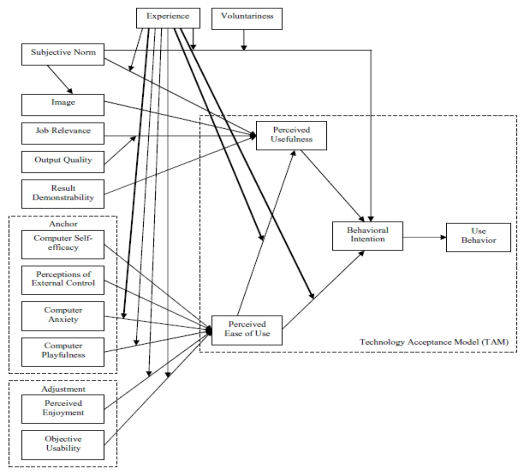
THEORETICAL BACKGROUND Acceptance describes the willingness to acknowledge something and give consent. For something new, such as a new technology, to be established, this requires acceptance (Scheuer, 2020). Since this study is concerned with the acceptance of artificial intelligence, technology acceptance will be con- sidered. To describe the acceptance of technology, Davis (1989) established the Technology Acceptance Model (TAM). Perceived usefulness and percei- ved ease of use were identified as factors influencing the intention to use a technology and thus acceptance. Perceived ease of use, which describes expected effort, and perceived usefulness, which deals with expected benefits, are shaped by external variables (Davis, 1989). Perceived usefulness thereby describes, a person’s perception of the extent to which the technology has an impact on an increase in job performance (Davis, 1989). Perceived ease of use encompasses the extent to which a person perceives technology use to be easy and hassle-free. Here, the degree of work effort involved in use is cru- cial, as it should be as low as possible to ensure ease of use. Perceived ease of use can have a positive impact on perceived usefulness, as a system can be perceived as more useful if it is effortless to use (Davis, 1989).
As technology acceptance research continued, external variables affecting perceived usefulness were identified. By adding these factors, the TAM 1 was further developed into the TAM 2. These variables include social, as well as cognitive-instrumental aspects of influence (Venkatesh & Davis, 2000). Subjective norm, as one of these aspects, is defined by the social influence on a person. Here, the mindset of people is targeted, which a person perceives as important. This mindset contributes to an individual’s decision and thus can influence perceived usefulness as well as intention to use. Under the aspect
The Evolution of Artificial Intelligence Adoption in Industry 141
of voluntariness of use, it is understood that a person has decided on his or her own to use the technology. This is done without coercion. In addition, the voluntariness of the use, as well as the experience of a person affect the use intention of the subjective norm. Furthermore, respected individuals in a social group may contribute to an individual’s use of a new technology, as an individual seeks higher status in the group and therefore considers the opi- nion of such individuals. For this reason, subjective norm affects image and this is related to perceived usefulness (Venkatesh & Davis, 2000). The follo- wing aspects are cognitive-instrumental in nature. One of these influencing factors is work relevance, because when people perceive that a technology can help them with important tasks, there is a higher perceived usefulness. This effect can also be seen when there are good results from the work per- formed. Thus, output quality is related to perceived usefulness. In addition, the demonstrability of the results has an influence on the perceived useful- ness, since people can better recognize the usefulness of the technology if the procedure is transparent. This aspect may also contribute to an improved understanding of the technology (Venkatesh & Davis, 2000).
TAM 3 extends TAM 2 to include the external factors influencing percei- ved ease of use. These factors have been divided into anchor and adjustment factors (Venkatesh, 2000). The aspects of computer self-efficacy, perceived external control, computer anxiety, and computer playfulness are among the anchor factors. Since people rely on general information about a new unfamiliar technology when using it, these aspects are referred to as anchors (Venkatesh, 2000). In this context, computer self-efficacy expresses a per- son’s own assessment of the extent to which a task can be completed through technology use (Compeau & Higgins, 1995). The perceived external control aspect describes a person’s confidence in the availability of resources that con- tribute to the support of technology use (Venkatesh et al., 2003). Computer anxiety refers to the fear of using technology (Venkatesh, 2000). The final anchor aspect is computer playfulness, which expresses the spontaneity of a person’s technology use (Webster & Martocchio, 1992). Adaptability factors arise from accumulated experience in using technology. As a result, users form their own judgments about the usability of a system. Accordingly, perceived enjoyment and objective usability are classified as adaptation aspects. Percei- ved enjoyment occurs when a person perceives the technology experience as positive. Perceived enjoyment focuses on the fun of using the technology. Objective ease of use refers to the effort that is actually involved in perfor- ming tasks compared to other technologies (Venkatesh, 2000). In addition, the factors of computer anxiety and computer playfulness are influenced by practical experience. This is because through increased technology use, the person acquires more information about the technology, which is why the anxiety and also the feeling of playfulness diminish. The user becomes accustomed to using it. Furthermore, the person can better judge the ease of use, because the increased experience also generates more information. This information allows for an improved assessment of perceived usefulness. This shows that experience has a positive effect on the relationship between percei- ved ease of use and perceived usefulness. Further, experience has an impact on the influence of perceived ease of use on behavioral intention because the
Figure 1: Technology acceptance model TAM 3. (Venkatesh & Bala, 2008).
person, through practical experience and the knowledge gained from it, is less likely to let the ease of use influence their behavior of wanting to use a system (Venkatesh & Bala, 2008). The collected information about techno- logy acceptance and its influencing factors was summarized by Venkatesh & Bala (2008) and leads to the following model. This model also illustrates the various effects of the aspects.
METHODOLOGY
In order to investigate how the acceptance of artificial intelligence has deve- loped, a systematic literature review was conducted. This was done according to the principle of (Tranfield et al., 2003). At the beginning, search terms were defined for the search, which were: ‘acceptance AND ai’; ‘ai AND work- place’; “‘technology acceptance model” AND (“artificial intelligence” OR “machine learning” OR “neural network*”)’. These search terms were used to search the Elsevier, EBSCO, EBSCO Host Business Source Complete, Sprin- ger Link, and JSTOR databases. The selection criteria of the articles are based on those in the paper by Hossinger, S. M., Chen, X., Werner, A. (2020). All articles with an appropriate title indicating the desired topic were included in a separate list. In this process, a total of 207 articles from 132 different jour- nals were identified. After reading the abstract, it was again sorted out and 110 articles remained. The quality of the journals has been another selection criterion. The journal rankings of the Association of University Teachers of Business (VHB) and that of the Association of Business Schools (ABS) were used to select the journals, in addition to the impact factor and the H-index, which were taken from the Scimago Journal & Country Rank (SJR). Journals
The Evolution of Artificial Intelligence Adoption in Industry 143
with a rating of C or higher for VHB and 2 or higher for ABS were selected. Journals that did not meet this were also included if they had an impact factor of 3.4 or higher or an H-index of at least 55. The articles whose journals did not meet the above criteria were screened out. Of the 132 journals, 76 met the selection criteria. Thus, the number of articles was reduced to 65. After reading the articles, there were finally 54 articles to be considered. Of the initial 207 articles, 153 did not meet the selection criteria. This represents approximately 76% of the articles identified at the beginning.
The majority of the articles are from 2021 and 2022, where people were forced into contact restrictions by the Covid-19 pandemic and working from home (home office) was prioritized. As a result, there was an increased focus on digitalization in companies (Moloi & Marwala, 2021). The increase in articles in recent years shows that AI has become more important.
RESULTS
The systematic literature review suggests that the aspect of performance/efficiency was addressed most frequently, followed by security/cybersecurity and bias/attitude. This underscores the relevance of these factors. The performance/efficiency and security/cybersecurity aspects, with the health factor, represent the added value of AI technology. It was found that by adopting AI, companies can improve their performance and make their production more efficient. An aid to this is seen in AI-based decision-making, which helps businesses make a decision in high-risk or less-known areas (Haefner et al., 2021). A prerequisite for an increase in per- formance and efficiency, is seen in the corporate infrastructure, which should be adapted to it before the introduction of AI technologies, so that the AI works successfully (Füller et al., 2022). As the previous research makes clear, the lack of infrastructure is one of the main problems in AI implementation (Ulrich & Frank, 2021). In addition to the infrastructure, the corporate cul- ture should also be aligned with AI implementation, which is expressed by the readiness factor (Holmström, 2022). It has also been shown how AI can con- tribute to safety in operations and that this, in combination with error-free systems, leads to an increase in trust among employees (Mezgár & Váncza, 2022). From the highlighted findings, it can be deduced that workers tend to have a negative attitude towards AI. The reason for this is the lack of expertise, from which prejudices arise (Johnson et al., 2021). Staff do not recognize the added value and AI potential. Employees are concerned that AI use will reduce social interaction in the workplace (Smids et al., 2020) and cause errors or disruptions when using the systems (Brauner et al., 2019). In addition, workers are concerned that they may lose their jobs to AI-based systems. These issues lead to a lack of trust (Hornung & Smolnik, 2022). For this reason, it is critical for companies to provide and conduct training for employees. Through training, staff gain the level of knowledge necessary to alleviate their concerns and better understand AI, which impacts attitudes, as well as trust, and therefore AI acceptance. Through training, workers can acquire and develop necessary skills for AI use (Mikalef & Gupta, 2021). In order to deepen the understanding of AI, staff should be involved in the
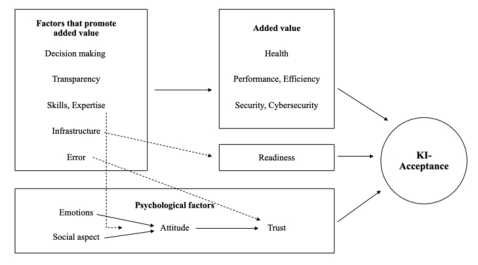
Figure 2: Relationship of AI influencing factors on acceptance (Own illustration).
implementation process. In this way, transparency is increased and emplo- yee adoption increases (Bankins et al., 2022). The literature analysis leads to the conclusion that the factors influencing AI acceptance can be divided into added value, aspects promoting added value and psychological aspects. In this context, the factors of a psychological nature and those of added value can lead to a direct increase in AI acceptance and the aspects that influence added value can lead to an indirect increase. Figure 2 below illustrates how the identified factors are interrelated.
Fig. 2 shows how the individual factors influence AI acceptance. Here, the aspects of decision-making, transparency, skills/expertise, infrastructure as well as those of errors form the factors that promote added value. Health, performance/efficiency, and safety/cybersecurity are summarized as value-added factors. In addition, it can be seen from the literature review that the items of performance/efficiency and security/cybersecurity, which are largely the added value, have the most mentions in the articles, which emph- asizes the importance of added value. The psychological factors consist of the emotions, social aspect as well as attitude and trust. It illustrates that the emotions and the social aspect affect the attitude, which affects the trust. In addition, the point of skills/expertise has an impact on the attitude of the workers, as higher expertise can make them realize the benefits and potenti- als of AI, which can lead to a more positive attitude (Makarius et al., 2020). Furthermore, error-free and error-prone functionality affects trust and can increase or decrease it. Workers lose trust in flawed systems, while they give greater trust to flawless systems (Brauner et al., 2019). The readiness factor cannot be assigned to any of the three domains, which is why it stands alone. Readiness is directly related to AI acceptance (Jöhnk et al., 2021) and is sup- ported by infrastructure. Readiness to implement a new technology follows from a well-adapted infrastructure (Holmström, 2022).
COMPARISON WITH TECHNOLOGY ACCEPTANCE MODELS TAM 1 illustrates that technology acceptance is influenced by expected effort, which is described by perceived ease of use, and expected benefit, which refers
The Evolution of Artificial Intelligence Adoption in Industry 145
to perceived usefulness (Davis, 1989). In the model from Fig. 2, these influ- encing factors are listed under added value. The added value is considered more concretely than in the TAM 1, because in the Fig. 2 the factors that promote the added value were considered. In TAM 1, these aspects are mar- ked as external variables. Furthermore, it has been noticed that in the course of time the external variables have been examined more closely, as confir- med by the results of the literature search. As the research progressed, more attention was paid to AI (Fig. 2), with more aspects impacting AI accepta- nce being identified. This is evident when looking at TAM 2, TAM 3, and Fig. 2. In TAM 2, the perceived usefulness is concretized. For this purpose, its influencing factors are presented. A common feature of TAM 2 and Fig. 2 is the social influence. In the TAM 2, this addresses the fact that other people can influence a person’s perceived usefulness and thus technology accepta- nce (Venkatesh & Davis, 2000), while the social aspect from Fig. 2 is about social interaction with AI technologies, such as robots. This illustrates that the social influence factor is relevant to the acceptance of new technologies. This aspect has changed over time, as now workers are concerned that social interaction in the workplace may be reduced by robots (Smids et al., 2020). Another common feature of the two models (TAM 2 & Fig. 2) is the rele- vance to work in TAM 2. This is highlighted in Fig. 2 under the heading of skills or expertise. The importance of technology knowledge is highlighted, as people with expertise in AI or other technologies, are more likely to accept them than people who lack expertise (Smids et al., 2020). The reason for this finding is that the people who have the necessary technology knowledge reco- gnize the ways in which the technology can support them in their work and the added value they receive from using the technology. In this case, added value is, for example, an increase in the quality of the goods produced. Also in Fig. 2, performance or efficiency is listed as a factor that represents added value. Therefore, the increase in expertise or skills affects the perceived use- fulness, as the latter represents added value. This confirms that the factors of work relevance and output quality from TAM 2 are also currently relevant. Perceived ease of use describes the extent to which a technology is easy to use (Davis, 1989). Therefore, this can be compared to the factor of errors, as workers rate an error-free technology more positively than an erroneous one (Brauner et al., 2019). In addition, the higher the level of expertise, the easier it is perceived to operate a technology. The computer self-efficacy item can be partially mapped to the confidence item from Figure 2, as both items focus on confidence in the technology and its problem-solving ability. Through this study, it is shown that trust in technology can be increased if error-free use and good performance are ensured (Chong et al., 2022). In addition, trust in technology can also be increased through better understanding (Bankins et al., 2022). These points illustrate that the trust aspect remains relevant and has expanded over time. People have become more skeptical of new tech- nologies (Demir et al., 2019), such as AI, so trust is an important factor. Furthermore, computer anxiety can be compared with the aspect of emoti- ons from Fig. 2, as both factors address fear. While computer anxiety is about the fear of using the technology (Venkatesh, 2000), the aspect of emotions concretizes the fear of the potential consequences of the technology. One of
these potential consequences is the loss of the job that people are concerned with (Makarius et al., 2020). This illustrates another change in a technology acceptance factor, because in addition to fear, dissatisfaction as well as worry were characterized under the item of emotions (Hornung & Smolnik, 2022). Perceived enjoyment from the TAM 3 describes an emotion of people when interacting with technology (Venkatesh, 2000). This aspect was listed under emotions through the literature review and is also relevant in today’s world. Another factor which is still relevant to technology acceptance is external control or infrastructure in the company. This is because before introducing a new technology, companies should ensure that the infrastructure supports the technology implementation (Cao et al., 2021 ; Venkatesh et al., 2003). In this way, the adoption of the technology can be increased. In addition, the readiness aspect of Fig. 2 is related. If the infrastructure is prepared for the introduction of technology, this also shows that a company is ready for this changeover. One preparatory measure here is to ensure that sufficient resou- rces are available and that the technical requirements for implementation in the company are met (Füller et al., 2022). In addition, it should be determi- ned in advance for which processes and company areas the technology rollout will be completed and how this will be done (Van Looy, 2022). The factor of external control from TAM 3 is thus similar to the aspect of infrastructure from Fig. 2 and is therefore still valid. This is currently expanded with the point of readiness. Readiness provides the foundation for technology ado- ption (Jöhnk et al., 2021). The various TAMs cite that experience influences various aspects (Fig. 1). This is similar to the skills or expertise factor, as this looks at how increasing expertise can increase technology adoption. This occurs as people gain more information about the technology and develop a better understanding. For this reason, technology benefits can be realized (Smids et al., 2020 ; Makarius et al., 2020). This is expressed in TAMs by the factor of experience. Computer self-efficacy can be compared to confidence from Fig. 2, as individuals trust that the introduced technology can be used to perform work tasks (Compeau & Higgins, 1995 ; Chong et al., 2022). The concept of computer self-efficacy, which was defined in 1995 and adopted into the TAM 3 in 2008, has continued to expand over time. This is because factors influencing confidence in technology were identified by means of the literature review. In Fig. 2, it can be seen that emotions, the social aspect as well as expertise have an impact on people’s attitudes, which influence trust. Furthermore, errors also have an influence on trust. In this context, error-free functionality has a positive effect on trust (Brauner et al., 2019). With incre- ase in experience, computer playfulness is increased as described in TAM 3 by Venkatesh & Bala (2008). This effect can be seen in today’s world through the influence of expertise on workers’ attitudes (Fig. 2). When the technology benefits are recognized through the increase of expertise, then it has a posi- tive effect on workers’ attitude (Turja & Oksanen, 2019). According to the TAM 3, the factor of objective usability is obtained through the increase of usage experience. As people receive more information with continuous use, they can evaluate the technology objectively (Venkatesh, 2000). This effect is similar to the increase in expertise, as workers develop a greater understan- ding of technology as a result, and this affects attitudes toward technology
The Evolution of Artificial Intelligence Adoption in Industry 147
(Makarius et al., 2020). Therefore, the increase in expertise and skills allows for an objective evaluation of the technology. The factor of demonstrability of results was identified by the literature review only in connection with the TAM 3. Therefore, this aspect is given less importance for the present time. In addition, the point of voluntariness of use from TAM 2 is not comparable to any of the identified aspects from Fig. 2. Accordingly, this is considered less relevant. Technology acceptance was found to have expanded to include aspects of decision making, health, safety/cybersecurity, transparency, and readiness. This could be due to the fact that more technologies have been used over time, thus identifying multiple aspects of acceptance. The health and security/cybersecurity aspects were not specifically addressed in the TAMs, but the added value of the technology in terms of perceived usefulness was addressed. The health and security/cybersecurity factors, along with the per- formance/efficiency item, represent added value (Fig. 2). Due to the growth of technological potential, as it is AI, the fear of these new possibilities and ima- ginable consequences developed among workers (Walsh et al., 2021). For this reason, the factors of health and safety/cybersecurity are important as they aim at the well-being of workers. The decision-making factor relates to AI and not technologies in general, so this does not apply in the TAM. Transpa- rency in AI implementation is an important factor in today’s world, as this can improve employee understanding and thus increase adoption (Klumpp et al., 2019 ; Bankins et al., 2022). In the TAMs, this point was not picked up, but the experience aspect was. This is because increasing experience equally increases the understanding of employees, as is the case with high transpare- ncy. Readiness was presented as a consequence of a good infrastructure and is not found in the TAM.
CONCLUSION
The results from this study suggest that employees’ attitudes are negative toward AI and they tend to reject AI technologies because they fear the con- sequences and believe that the infrastructure of companies is not ready for AI implementation. Moreover, the flawless implementation of AI in the enterpri- ses is questioned by the workers, creating distrust, which leads to a negative attitude toward AI. It has been found that workers accept and use a tech- nology when they trust it. AI acceptance has evolved to mean that workers’ understanding of AI must be increased. Only when workers realize the bene- fits and opportunities can negative attitudes change. Improved understanding can be achieved through training and employee involvement in AI adoption and AI processes. In addition, the lack of infrastructure in companies is a problem for AI adoption, as companies cannot take advantage of AI techno- logies for this reason. Other businesses rate the cost of AI implementation as too high and therefore do not adopt this technology. One reason for this is the lack of AI understanding. A higher level of AI understanding among busines- ses can recognize that AI can lead to more efficient operational performance and therefore higher profits, which counteracts the concern of high costs. Workers and operations tend to be cautious and do not want to take risks with AI adoption. This study shows that it is not only individual employees
who need to increase their expertise, but the entire company. In summary, therefore, AI adoption in industry depends on confidence and expertise as well as infrastructure in the enterprise.
REFERENCES
Bankins, S., Formosa, P., Griep, Y., & Richards, D. (2022). AI Decision Making with Dignity? Contrasting Workers’ Justice Perceptions of Human and AI Deci- sion Making in a Human Re-source Management Context. Information Systems Frontiers. Brauner, P., Philipsen, R., Calero Valdez, A., & Ziefle, M. (2019). What happens
when decision support systems fail? — The importance of usability on per- formance in erroneous systems. Be-haviour & Information Technology, 38(12), pp. 1225–1242. Cao, G., Duan, Y., Edwards, J. S., & Dwivedi, Y. K. (2021). Understanding managers’ attitudes and behavioral intentions towards using artificial intelligence for organizational decision-making. Technovation, 106, 102312. Cebulla, A., Szpak, Z., Howell, C., Knight, G., & Hussain, S. (2022). Applying ethics
to AI in the workplace: The design of a scorecard for Australian workplace health and safety. AI & SOCIETY. Chong, L., Zhang, G., Goucher-Lambert, K., Kotovsky, K., & Cagan, J. (2022).
Human confidence in artificial intelligence and in themselves: The evolution and impact of confidence on adoption of AI advice. Computers in Human Behavior, 127, 107018. Compeau, D. R., & Higgins, C. A. (1995). Application of Social Cognitive Theory to Training for Computer Skills. Information Systems Research, 6(2), pp. 118–143. JSTOR. Davis, F. D. (1989). Perceived Usefulness, Perceived Ease of Use, and User Acceptance
of Information Technology. MIS Quarterly, 13(3), pp. 319–340. JSTOR. Demir, K. A., Döven, G., & Sezen, B. (2019). Industry 5.0 and Human-Robot Coworking. Procedia Computer Science, 158, pp. 688–695. Drydakis, N. (2022). Artificial Intelligence and Reduced SMEs’ Business Risks. A
Dynamic Capabilities Analysis During the COVID-19 Pandemic. Information Systems Frontiers. Fuller, J., Hutter, K., Wahl, J., Bilgram, V., & Tekic, Z. (2022). How AI revolutionizes innovation management – Perceptions and implementation preferences of AI-based innovators. Technological Forecasting and Social Change, 178, 121598. Haefner, N., Wincent, J., Parida, V., & Gassmann, O. (2021). Artificial intellige-
nce and innova-tion management: A review, framework, and research agenda*. Technological Forecasting and Social Change, 162, 120392. Holmström, J. (2022). From AI to digital transformation: The AI readiness framework. Business Horizons, 65(3), pp. 329–339. Hornung, O., & Smolnik, S. (2022). AI invading the workplace: Negative emotions
towards the organizational use of personal virtual assistants. Electronic Markets, 32(1), pp. 123–138. Hossinger, S. M., Chen, X., & Werner, A. (2020). Drivers, barriers and success factors of aca-demic spin-offs: A systematic literature review. Management Review Quarterly, 70(1), pp. 97–134. Jöhnk, J., Weißert, M., & Wyrtki, K. (2021). Ready or Not, AI Comes—An Interview
Study of Organizational AI Readiness Factors. Business & Information Systems Engineering, 63(1), pp. 5–20.
The Evolution of Artificial Intelligence Adoption in Industry 149
Johnson, M., Jain, R., Brennan-Tonetta, P., Swartz, E., Silver, D., Paolini, J., Mamonov, S., & Hill, C. (2021). Impact of Big Data and Artificial Intelligence on Industry: Developing a Work-force Roadmap for a Data Driven Economy. Global Journal of Flexible Systems Management, 22(3), pp. 197–217. Klumpp, M., Hesenius, M., Meyer, O., Ruiner, C., & Gruhn, V. (2019). Production
logistics and human-computer interaction—State-of-the-art, challenges and requi- rements for the future. The International Journal of Advanced Manufacturing Technology, 105(9), pp. 3691–3709. Makarius, E. E., Mukherjee, D., Fox, J. D., & Fox, A. K. (2020). Rising with the machines: A sociotechnical framework for bringing artificial intelligence into the organization. Journal of Business Research, 120, pp. 262–273. Mezgár, I., & Váncza, J. (2022). From ethics to standards – A path via respon-
sible AI to cyber-physical production systems. Annual Reviews in Control, 53, pp. 391–404. Mikalef, P., & Gupta, M. (2021). Artificial intelligence capability: Conceptualization, measurement calibration, and empirical study on its impact on organizational creativity and firm performance. Information & Management, 58(3), 103434. Mlekus, L., Bentler, D., Paruzel, A., Kato-Beiderwieden, A.-L., & Maier, G. W.
(2020). How to raise technology acceptance: User experience characteristics as technology-inherent determinants. Gruppe. Interaktion. Organisation. Zeitschrift Fur Angewandte Organisationspsychologie (GIO), 51(3), pp. 273–283. Moloi, T., & Marwala, T. (2021). Artificial Intelligence and the Changing Nature of Corporations: How Technologies Shape Strategy and Operations. Springer International Publishing. Na, S., Heo, S., Han, S., Shin, Y., & Roh, Y. (2022). Acceptance Model of Arti-
ficial Intelligence (AI)-Based Technologies in Construction Firms: Applying the Technology Acceptance Model (TAM) in Combination with the Technology– Organisation–Environment (TOE) Framework. Buildings, 12(2), 90. Scharre, P., Horowitz, M. C., & Work, R. O. (2018). The Artificial Intelligence Revolution (ARTIFICIAL INTELLIGENCE,pp. 3–4). Center for a New American Security; JSTOR, pp. 3–4 Scheuer, D. (2020). Akzeptanz von Kunstlicher Intelligenz: Grundlagen intelli-
genter KI-Assistenten und deren vertrauensvolle Nutzung. Springer Fachmedien Wiesbaden. Skilton, M., & Hovsepian, F. (2018). The 4th Industrial Revolution. Springer International Publishing. Smids, J., Nyholm, S., & Berkers, H. (2020). Robots in the Workplace: A Threat
to—or Opportunity for Meaningful Work? Philosophy & Technology, 33(3), pp. 503–522. Tranfield, D., Denyer, D., & Smart, P. (2003). Towards a Methodology for Developing Evidence-Informed Management Knowledge by Means of Systematic Review. British Journal of Manage-ment, 14(3), pp. 207–222. Trenerry, B., Chng, S., Wang, Y., Suhaila, Z. S., Lim, S. S., Lu, H. Y., & Oh, P. H.
(2021). Preparing Workplaces for Digital Transformation: An Integrative Review and Framework of Multi-Level Factors. Frontiers in Psychology, 12, 620766. Turja, T., & Oksanen, A. (2019). Robot Acceptance at Work: A Multilevel Analysis Based on 27 EU Countries. International Journal of Social Robotics, 11(4), pp. 679–689. Ulrich, P., & Frank, V. (2021). Relevance and Adoption of AI technologies in German
SMEs – Results from Survey-Based Research. Procedia Computer Science, 192, pp. 2152–2159.
Van Looy, A. (2022). Employees’ attitudes towards intelligent robots: A dilemma analysis. In-formation Systems and E-Business Management. Venkatesh, V., & Bala, H. (2008). Technology Acceptance Model 3 and a Research
Agenda on Interventions. Decision Sciences, 39(2), pp. 273–315. Venkatesh, V., & Davis, F. D. (2000). A Theoretical Extension of the Technology Acceptance Model: Four Longitudinal Field Studies. Management Science, 46(2), pp. 186–204. Venkatesh, V., Morris, M. G., Davis, G. B., & Davis, F. D. (2003). User Accepta-
nce of Information Technology: Toward a Unified View. MIS Quarterly, 27(3), pp. 425–478. JSTOR. Walsh, K. R., Mahesh, S., & Trumbach, C. C. (2021). Autonomy in AI Systems. The Journal of Technology Studies, 47(1), pp. 38–47. JSTOR. Webster, J., & Martocchio, J. J. (1992). Microcomputer Playfulness: Development
of a Measure with Workplace Implications. MIS Quarterly, 16(2), pp. 201–226. JSTOR.
LISTED IN THE AHFE DIGITAL BOOKSTORE CATALOGUE
Explore the complete digital volume
Artificial Intelligence and Social Computing
Read this individual research paper free through the original publisher, or explore the full digital proceedings book.
ISBN 978-1-958651-48-3
Explore this ISBN in the AHFE Bookstore ↗Listed in the July 2026 bookstore catalogue; search by ISBN to confirm current availability · Digital book purchase optional