Sijia Wang (2023). Interactive design of water purification products based on modern urban life. In: Artificial Intelligence and Social Computing. AHFE Open Access, vol. 72, pp. 198–205. https://doi.org/10.54941/ahfe1003288
In order to explore innovative interaction methods from the technical level of AI, and further improve the use experience of interactive products, the author proposes the interactive design of AI urban modern life products. The author takes the artificial intelligence technology as the center, and applies the technical means to the product interaction design. After investigation and analysis of the technical means of its application, it summarizes how artificial intelligence drives the development of product interaction design. In addition, it further analyzes the application thinking and performance in the whole design process in combination with specific design cases. The results show that: The people aged 25-30 and 35-49 are undoubtedly the main consumers and users because of their economic foundation and health awareness, the main buyers are men, but women pay more attention to them, it can be seen that women have a strong degree of health awareness and sense of responsibility for their families. According to Maslow's needs theory, human needs are divided into five aspects: Physiological needs, security needs, social needs, respect needs and self-realization needs. At present, water purification products only reach the level of safety requirements, because of the design concept and technical limitations of traditional water purification products, the upgrading of products is slow, it is not comprehensive to simply emphasize the research and development of water purification technology. In the era of consumption upgrading, many water purification products ignore the social needs, respect needs and higher needs of consumers in the competitive environment, that is, the human-computer interaction mode, emotional experience of products and the sense of achievement of product use. The author puts forward the redefinition of multi-dimensional product design concepts such as traditional product interaction design methods, interactive interfaces and information architecture, and envisages the future development direction.
As interaction design matures, we see more and more similarities between it and industrial design. Although graphic design has a long history, it lacks the ability to communicate with people and integrate engineering constraints. On the contrary, industrial design was built on the basis of machinery, ergono- mics, production, market and aesthetics from the very beginning. Therefore, in a sense, human-computer interaction design can be seen as an extension of industrial design in the software industry. The purpose of interaction design is
Interactive Design of Water Purification Products Based on Modern Urban Life 199
to make the information exchange between people and things more scientific, more reasonable and more humanized, so that the information transmission between people and things is more reliable and can reduce the physiological and psychological burden of people. Interaction design applies the research results and methods of ergonomics, psychology and other disciplines to create the most harmonious relationship in human-computer dialogue. Interaction design and industrial design have a lot in common (Zhang et al., 2022). Like industrial design, interactive design integrates engineering, human-computer and market factors to propose solutions to users’ problems. The interaction design still depends on the graphical interface, communicate with people in a feasible way to enable them to complete complex work.
In the human machine interaction of modern life, there is a level, that is, what people call the interface. User interface design is an important part of screen products. The interface exists in the information exchange between people and things, it can even be said that all fields of the information exch- ange between people and things belong to the interface, and its connotation elements are extremely extensive. The interface can be defined as the sum of all information interactions faced and analysed in the design, which reflects the relationship between people and things. Interaction refers to the infor- mation exchange between participants, which aims to achieve a specific goal. Human is one of the main participants in the interaction process, and other participants can be “tangible”or “intangible”objects and their environments. If we regard the participation objects other than people in the interaction as a system, the so-called interaction essentially refers to the two-way information exchange between people and a specific system. Human computer intera- ction originates from cognitive psychology, its theoretical basis is software engineering and design methodology, it is “the science of designing, evalua- ting and implementing interactive computing systems for people to use, and studying the main phenomena in this field”. The scope of interaction design goes beyond the limitations of human-computer interaction and focuses on the interaction between people and systems (composed of products and the entire environment) (Seshia et al., 2022).
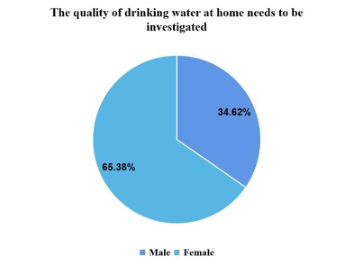
QUESTIONNAIR In the early stage, the survey was conducted in the form of questionnaires, a total of 156 valid questionnaires were collected, most of the users were 25–30 years old and 31–40 years old, since they filled in the questionnaire indepen- dently, we found that female users paid much more attention to this topic than men. In the questionnaire, users’ attention to water quality, demand for pro- ducts, economic capacity and other main information are mainly investigated (Figure 1).
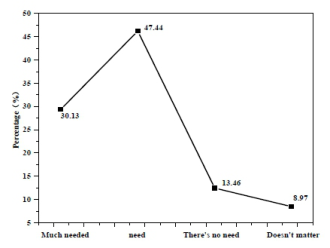
According to the results of the questionnaire, people who need water puri- fication equipment account for half of the total survey population (Figure 2), it can be seen that people’s awareness of water standards or yearning for heal- thy drinking water has gradually increased. As the equipment and process of the waterworks are relatively backward, the standard of direct drinking water cannot be reached by relying on traditional filtering methods. The municipal
200 Wang
Figure 1: Young women pay more attention to water purification products.Figure 2: Investigation on the quality problems of household drinking water to be improved.
tap water is exported to the water tank of the high-rise building, causing a large number of bacteria growing in the water tank and unable to be trea- ted. Residents in the vicinity of water pollution areas have a great demand for water purification equipment, it is self-evident that harmful substances in water pollution will cause harm to the body, including skin texture and PH value in the body (Stock et al., 2021).
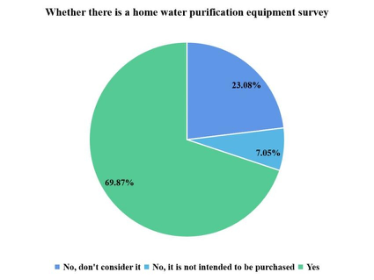
The rise of the water purification industry is due to the different education levels, the progress of ideas, and the impact of living environment and other factors. At present, the development of water purifier industry is gradually entering the fast lane. Through advertising, multimedia and multi-channel marketing, people have gradually cultivated the importance of drinking water and health, this provides a great market prospect for water purification products. According to the results of the questionnaire (Figure 3), most hou- seholds have purchased water purification products, which shows that the acceptance is still high (Gaiardelli et al., 2021; Yi et al., 2021).
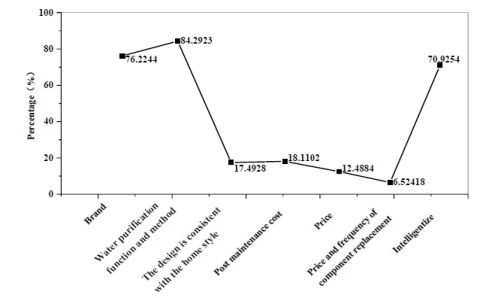
Nowadays, there are many kinds of water purification products, through data analysis, users have outstanding demands on the brand, water purifica- tion functions and methods, and intelligence of water purification products. From the perspective of brands: Midea, Angel, Qinyuan, Haier and other domestic brands have influence. Secondly, the users’ attention to the water
Interactive Design of Water Purification Products Based on Modern Urban Life 201
Figure 3: Investigation on whether there is domestic water purification equipment.
purification function and mode depends on the users themselves, professional characteristics and living environment factors. It can be seen that the function and method of water purification is the first choice for consumers to purch- ase water purification products, and the functionality of water purification products is also determined by the price factor of products. In terms of water purification methods, users prefer such methods as convenient installation, deep filtration, mobility and intelligent water purification. It is also the trend of continuous research and development of the water purification industry.
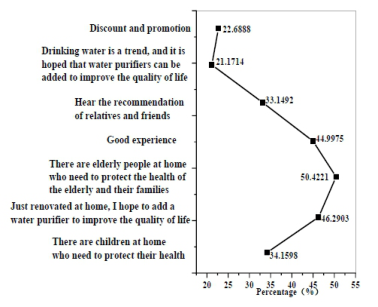
With the development of science and technology, intelligent products are increasingly respected by people. The survey results show (Figure 4) that users’ demand for intelligence is only increasing, facing the impact of intellige- nce everywhere in life, intelligent drinking products are also the development trend in the future, it can provide customized, diversified, humanized and other services for different users, and also use the basic functions of the filter element, water quality, temperature and other water purification products for real-time monitoring, which can provide more intelligent drinking water, milk flushing, pregnant women drinking water and other needs for families in the nest period. Provide more humanized and convenient drinking water for the elderly in the empty nest period (Jacobson and Ranne, 2021).
Figure 4: Factors considered in purchasing water purification equipment.
202 Wang
Figure 5: Demand factors for water purification equipment.
At present, water purifier is the most direct and effective method to improve the quality of household drinking water under the condition of seri- ous pollution of water resources. According to the survey (Figure 5), the drinking water quality of families with infants, the elderly and pregnant women needs more attention. For the elderly, with the growth of age, their physical functions are aging, the risk of various diseases is also increasing, and their immunity is also at a low level. When the scale, impurities and bacteria in the water are too much, the probability of suffering from stones and blood thickening will be increased. Pregnant women have a high demand for food quality and nutrition, pure water is required for daily drinking and eating. Amniotic fluid quality in pregnant women is also an important indicator of fetal health (Mühlhoff, 2020). Therefore, good water quality is very impor- tant for pregnant women. Families with babies need a healthy water quality when they often drink milk and water. The water purifier can not only purify the water quality, but also drink it at any time.
Experience Technology that Changes the Traditional Interaction Form With the development of mobile Internet and artificial intelligence techno- logy, more and more interactive methods such as voice and gesture begin to appear. It can be seen that AI technology will bring earth shaking changes to the form of human-computer interaction.
Speech Recognition Speech recognition, an important AI technology, is a system that can truly understand human voice and even dialect environment, changing the tra- ditional physical manipulation, search and other ways. The core of speech recognition is to make the machine better understand people’s needs, under- stand commands and take specific actions and responses. At present, the existing beverage purifiers in the market still use the traditional physical buttons, touch and other operating modes, although it is the mainstream inte- raction mode at present, the market homogenization is everywhere. Through
Interactive Design of Water Purification Products Based on Modern Urban Life 203
investigation and analysis, the function keys in the display panel of the tradi- tional beverage purifier are relatively complex, in addition, the touch control is not accurate, the panel content is arranged too complex, and the primary and secondary function keys are not highlighted, as well as the same size and other issues, this undoubtedly causes design problems for the elderly. Some drinking water purifiers do not have a reminder to replace the filter element, which leads to a long-term failure to replace the filter element and reduces its service life.
Through the application of speech recognition technology, these problems of traditional drinking machines can be solved and a more humanized solu- tion can be provided. In the design scheme, the visual physical keys are completely replaced, and artificial intelligence speech recognition hardw- are is implanted to meet the needs of different users. The voice recognition system will automatically recognize the voice by the user entering the com- mand to the intelligent beverage purifier, and then make an accurate reply, and perform the next function output. For example: ‘I need a cup of warm water’, ‘OK, I’ll get it for you right away’. In addition, AI technology can be competent for startup, water quality monitoring and even company communication.
Temperature Control The instant heating and temperature regulation function of the intelligent drinking water purifier is the intelligent control of the drinking water puri- fier through the temperature sensor and the microcontroller, which is used to solve the waste of power and water resources caused by the traditional water temperature control, and at the same time, make the drinking water meet the drinking water standard. Through the control chip of artificial intelligence, the temperature sensor can be connected to monitor the temperature control in real time, and the memory storage can be carried out according to the user’s habit of using water frequently. When users go to work or after work, they can automatically discharge water according to their usual drinking habits, and the temperature is appropriate. For example, if the water temperature of pregnant women should not be too high, the 55
water temperature of post- partum infants and the elderly’s habit of drinking hot water, different demand results can be obtained by inputting commands to the drinking machine. The water temperature regulation of the traditional beverage purifier is limited to tea brewing and brewing.
Machine Learning Traditional forms of interaction can be changed through machine learning, so the precondition is that emotional computing must be used to help the mach- ine realize better understanding of dialogue intention and deep semantics. Emotion plays an important role in human decision-making, social inte- raction, perception, memory, learning and creativity. Research shows that 80% of the information in human communication is emotional informa- tion. From the perspective of cognitive science, emotion itself is a part of
204 Wang
intelligence. Because emotion plays an important role in human informa- tion communication, therefore emotion computing is an indispensable part of human-computer interaction. The autonomy based on machine learning continuously accumulates data in real life, such as the collection of data on the time when the elderly take medicine on time, the time when they flush milk, the temperature and times, the demand for water temperature and emo- tional nursing. On the basis of the basic realization of dialogue with people, how to make the drinking machine establish a solution to meet the healthy drinking water and habits of different members of the family through mach- ine learning, or to put forward a personalized service system for special people in a diversified scenario. These are undoubtedly an innovation of traditional water purification product service mode.
CONCLUSION
Based on the analysis and research of artificial intelligence technology and its application, interaction design in the era of artificial intelligence is impe- rceptibly penetrating into various fields of application. Taking artificial intelligence technology to break the boundaries of traditional white electri- city, another attempt is proposed as the theme, and the main case analysis is carried out, a new form of high-end white electricity interaction techno- logy of ‘listening, speaking and natural interaction’ under intelligent machine language is obtained, as well as the multimodal development trend of arti- ficial intelligence technology in various fields. For this reason, the author puts forward a new definition of product interaction design, and the new form of intelligent human-computer interaction technology will be displayed through intelligent voice and image recognition. Intelligence and personali- zation will be the main features of the next generation product interaction design system. The emotional resonance between people and machines will become the main core of human-computer symbiosis in the future, and also the future of human-computer interaction design. Although the current AI is still in its early stage, there are still some defects and deficiencies in the inte- ractive way of emotional communication. However, in the future, with the continuous high integration of AI and product interaction design, no mat- ter in the product interaction design method, mode, information architecture or perception level, the intelligent human-computer interaction mode under multi-channel and multi-dimensional will be developed around the theme of “human-computer emotion, human-computer symbiosis, human-computer form”. This change of intelligent human-computer mode brought by science and technology will also affect the development history of product interaction design.
REFERENCES
Gaiardelli, P., Pezzotta, G., Rondini, A., Romero, D., Jarrahi, F., Bertoni, M., & Cavalieri, S. (2021). Product-service systems evolution in the era of Industry 4.0. Service Business, 15(1), 177–207.
Interactive Design of Water Purification Products Based on Modern Urban Life 205
Hardian, R., Liang, Z., Zhang, X., & Szekely, G. (2020). Artificial intelligence: The silver bullet for sustainable materials development. Green Chemistry, 22(21), 7521–7528. Jacobson, S., & Ranne, J. (2021). Enhanced accessibility: an elevator with an
interactive media surface. Proceedings of the Design Society, 1, 1383–1390. Mühlhoff, R. (2020). Human-aided artificial intelligence: Or, how to run large computations in human brains? Toward a media sociology of machine learning. new media & society, 22(10), 1868–1884. Seshia, S. A., Sadigh, D., & Sastry, S. S. (2022). Toward verified artificial intelligence.
Communications of the ACM, 65(7), 46–55. Stock, G. N., Tsai, J. C. A., Jiang, J. J., & Klein, G. (2021). Coping with uncertainty: Knowledge sharing in new product development projects. International Journal of Project Management, 39(1), 59–70. Zhang, Z., Ning, H., Shi, F., Farha, F., Xu, Y., Xu, J., & Choo, K. K. R.
(2022). Artificial intelligence in cyber security: research advances, challenges, and opportunities. Artificial Intelligence Review, 55(2), 1029–1053. Yi, Y., Yan, Y., Liu, X., Ni, Z., Feng, J., & Liu, J. (2021). Digital twin-based smart assembly process design and application framework for complex products and its case study. Journal of Manufacturing Systems, 58, 94–107.
LISTED IN THE AHFE DIGITAL BOOKSTORE CATALOGUE
Explore the complete digital volume
Artificial Intelligence and Social Computing
Read this individual research paper free through the original publisher, or explore the full digital proceedings book.
ISBN 978-1-958651-48-3
Explore this ISBN in the AHFE Bookstore ↗Listed in the July 2026 bookstore catalogue; search by ISBN to confirm current availability · Digital book purchase optional