Sijia Wang, Xu Qian (2023). School Bus System Redesign Based on Ergonomics—Taking Huazhong University of Science and Technology as an Example. In: Human Factors and Systems Interaction. AHFE Open Access, vol. 84, pp. 182–188. https://doi.org/10.54941/ahfe1003604
The optimization design of the school bus system of Huazhong University of Science and Technology, based on ergonomics, is proposed to adapt to the wave of intelligent development in the information era and enhance safety, efficiency, and comfort. In this design, questionnaire interview, literature search and competition product analysis are used to deeply understand the pain points of the current situation, the development status of public transport system and references of school bus user groups and so on, which determined the school bus system’s function design, the CMF design, the product technology and the modelling key point. This design used Global Positioning System, smart touch screen and other technologies, as well as combined the knowledge of ergonomics and perceptual engineering. After the usability test of the product, the school bus user groups thought that the design had a certain effect.
With the rapid development of China’s economy and the increasing atten- tion of education, most of the domestic universities continue to expand and renovate, so the floor space of the universities is huge. Also, there are many multi-campus school sites, therefore, in the universities, school bus is a neces- sary means of transportation to meet the needs of students and staff in the university.
With the popularization of education, the number of college students and faculty members has increased, and the use level of school buses has been continuously improved (Lin Siyu, Qi Xin, Hao Jiachen, Ma Yumeng, 2021). In the initial stage of its operation, the number of passengers is not saturated, so it can basically meet the needs of the universities. However, with more students entering the campus and the continuous expansion of enrollment in universities, the number of students is increasing, the demand for school buses is gradually increasing, and the requirements for campus buses and related facilities are also gradually improving.
School Bus System Redesign Based on Ergonomics 183
Because of the appearance of the above phenomena, many man-machine problems in the operation of the school buses are becoming more and more prominent, so this paper takes this as the topic to carry out research.
INVESTIGATE AND SURVEY Questionnaire and Interview
It is a necessary step to provide constructive suggestions for the operation adjustment of the school bus system of Huazhong University of Science and Technology and to understand the opinions and needs of teachers and stu- dents. Our team conducted a questionnaire survey and an interview survey, then analyzed the survey result.
The result showed that 32.76% of the respondents have taken the wrong bus or missed the stop, which shows that the current school bus system needs to improve the instructions for school bus routes and stops. 60.98% of the respondents think that it is inconvenient to dictate the station to the driver, indicating that the operation mode of HUST school bus needs to be impro- ved. 68.3% of the respondents can’t find the location of a station quickly, which shows that the readability of the current school bus signs needs to be improved. For the improvement direction obtained by the team through field investigation, such as adding waiting area seats, setting up intelligent signs, distinguishing the appearance of campus buses on different routes, adding route maps in the buses, adding voice arrival prompts, etc. The proportion of adding voice arrival prompts on campus buses is the largest, followed by adding in-bus route maps. Nearly half of the users chose to add seats in the waiting area and distinguish the appearance of the school bus, which can be used as a reference for redesign.
Table 1. Problems and solutions in the redesign of school bus system of HUST.
Table available in the original PDF paper.
Redesign Pain points Solutions Stop Board
Intelligent design. Real-time update of new stations, real-time display of vehicle location and route waiting time
The handwriting is not clear. The man-machine dimension design of the stop board Take the wrong bus. When there are few people, they sit on the bus and do not start. Route update is not timely.
Appearance design
The appearance lacks the characteristics of the school.
man-machine dimension design
Information display is not clear. Enhance the readability of interface information School Bus Station
Lack of seat positions. Not able to shelter from rain and sunlight, etc.
Single appearance and lack of design.
Appearance design, in line with the user’s psychology display screen
Take the wrong train, miss the stop. Inconvenient way to dictate the destination.
Add intelligent information display board in the school bus to display the location and route of the vehicle in real time.
184 Wang and Xu
Pain Points Conclusion Our team members summarized all the problems found in the previous rese- arch and put forward the solutions one by one. After integration, our team finally decided to redesign from three aspects: station signs, platform system and school bus interior (Table 1).
SCHOOL BUS SYSTEM REDESIGN Design Philosophy
The redesign of the supporting facilities of the school bus system should reflect the culture of Huazhong University of Science and Technology (Deng Jun, Tang Dixin, 2020). Our team decided to integrate the elements of HUST campus environment, style characteristics and Panda school bus brand into the school bus system with HUST characteristics. At the same time, conside- ring the man-machine size standard on the existing basis, as well as combining the intelligent display screen and Wechat applet with it, the appearance of an intelligent school bus system facility will be designed.
Design Considerations
1. Structure When designing the structure of the school bus station, it is necessary to ensure that the basic functions of the bus station are complete and to ensure safety. At the same time, the shape of the bus station needs to be combined with the environmental background to enhance the campus environment. 2. Style The design of campus stations should be full of creativity, using a variety of materials and artistic elements to show a unique style for the university. 3. Materials When designing school bus stations, the most important principle is to ensure safety, followed by minimizing costs. In order to achieve this goal, we can choose a variety of different materials and combine them with the actual situation to highlight their texture and visual effects.
Size Calculation of Supporting Facilities of School Bus System
1. Platform system size calculation The man-machine dimensions to be considered for the platform system include the height, width and length of the ceiling, the height and width of the stop board, the height of the billboard, as well as the height, width and length of the seat. If multiple platform systems are combined, the plat- form spacing and platform length shall also be considered. The main target population involved in the mobile phone of the campus car system is col- lege students. Considering the actual age of college students, according to the national standard of Chinese adult body size GB/T 10000 — 1988, the data of 18–25 years old (male and female) are taken to calculate that the cei- ling height is 2700mm. The ceiling width (platform width) is 1398 mm, the ceiling length (platform length) is 3500mm, and the platform seat height is 446 mm.
School Bus System Redesign Based on Ergonomics 185
2. Stop board size calculation Type III product size design is adopted, and the 50th percentile of women is taken as the basis for product size design. After calculation, the height of the bottom line of the interface displayed on the stop board from the ground should be higher than 1479 mm, the width of the board should not exceed 866 mm, and the height should not exceed 783 mm.
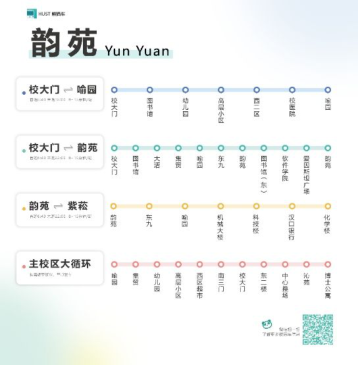
Interface Design of Intelligent School Bus Stop Board The main interface (initial interface) of the stop board is shown in Figure 1. The interface is mainly composed of the school bus brand logo, the station information, the four routes and their station information, as well as the two-dimensional code of the supporting Wechat applet. Use a large, bold font could make it the most eye-catching and visible from a distance. The indications of the four lines are distinguished by four colors, which clearly indicates the basic information of each station. Users could click the corre- sponding buttons of the four routes to view the detailed information of the route.
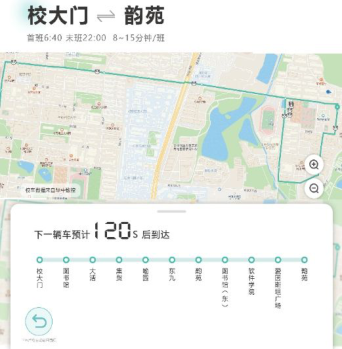
This interface is used to display the detailed information of the route (taking the route of the school gate to Yunyuan as an example), as shown in Figure 2. The information of the school bus route is in large and bold font to make it most eye-catching. The setting of the map can not only provide the information of the bus route, but also inform the user of the driving status of each school bus in real time through the location of the panda icon on the map, so that the user can intuitively understand the real-time information of the school bus. At the same time, the countdown of vehicle arrival time is set to meet the user’s need to know the waiting time, which is more conducive to the user’s reasonable arrangement of the estimated time.
Figure 1: Interface design of stop board 1.
186 Wang and Xu
Figure 2: Interface design of stop board 2.
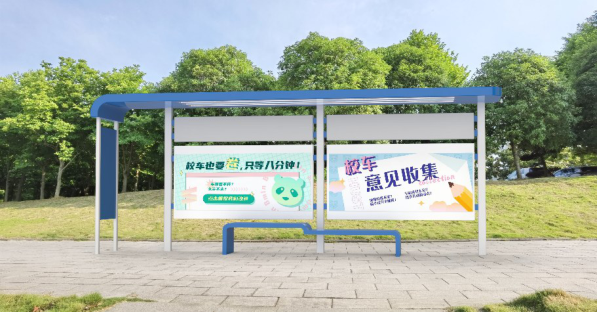
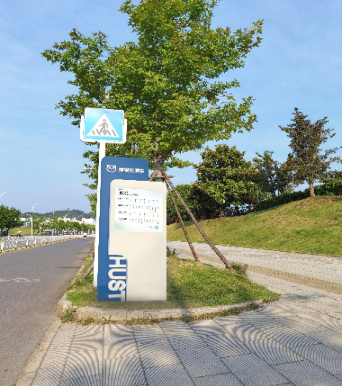
School Bus System Facilities Redesign Scheme effect modelling and rendering are shown in Figure 3 and Figure 4.
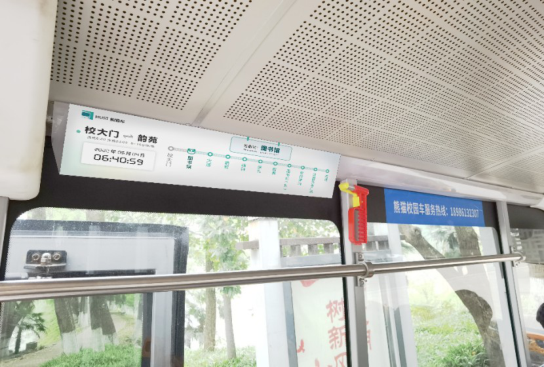
Display Screen Design of School Bus Passengers need to receive clear information during the school bus ride (Zhao Jialu, 2021). A clear direction system and an effective management system are important components of a visual information system (Wang Xin, 2022). In the survey, many users also mentioned the need for real-time understanding of the operation of the school bus during driving, and the team members decided to add a display screen to display the real-time driving situation in the car, as shown in Figure 5.
Figure 3: Model effect drawing of platform redesign 1.
School Bus System Redesign Based on Ergonomics 187
Figure 4: Model effect drawing of platform redesign 2.Figure 5: School bus display screen interface design.
CONCLUSION
Based on the redesign of the interface scheme of the bus stop board, we con- duct experiments to test the feasibility of the redesign scheme. We invited 10 university students and 10 off-campus personnel to participate in this expe- riment. All the 20 subjects were over 18 years old and had normal vision. The test was conducted by recording the time when the subjects searched for the “school hospital” site in the new and old stop signs (both the new and old stop signs have this site). From the results of the experiment, no matter the participant is a university student or an off-campus personnel, the time to find the “school hospital” through the new stop sign is less, which shows that the redesign of the stop sign improves the readability of the stop sign, so the redesign results are effective.
188 Wang and Xu
Through the observation, questionnaires, interviews and other methods, this study analyses the users’ needs in the use of school bus and its rela- ted facilities, redesigns the platform, stop board and the school bus interior appearance. We used the subjective evaluation scale to obtain the highest user evaluation scheme, and used the experimental method to test the feasibility of the optimized scheme. The adjustment strategy of HUST school bus system design in ergonomics is summarized, which provides experimental data sup- port and improvement suggestions for the optimization and improvement of HUST school bus system design.
REFERENCES
Deng Jun, Tang Dixin. Research on urban public guide design based on ergonomics [J]. Packaging Engineering, 2020, 41 (24): 46–52 + 78. DOI: 10.19554/J.CNKI. 1001–3563.2020.24.007. Lin Siyu, Qi Xin, Hao Jiachen, Ma Yumeng. Route Planning and Operation System
of School Bus and Tour Bus in University Campus — — Taking Nanjing Forestry University as an Example [J]. Logistics Engineering and Management, 2021, 43 (03): 115–117. Wang Xin. Research on city brand image based on visual information system [J].
Packaging Engineering, 2022, 43 (02): 221–228. DOI: 10.19554/J.CNki. 1001–3563.2022.02.029. Zhao Jialu. Research on the Application of Dynamic Signs in Metro Guide System [D]. Beijing Jiaotong University, 2021. DOI: 10.26944/d.CNki.Gbfju. 2021.000895.
LISTED IN THE AHFE DIGITAL BOOKSTORE CATALOGUE
Explore the complete digital volume
Human Factors and Systems Interaction
Read this individual research paper free through the original publisher, or explore the full digital proceedings book.
ISBN 978-1-958651-60-5
Explore this ISBN in the AHFE Bookstore ↗Listed in the July 2026 bookstore catalogue; search by ISBN to confirm current availability · Digital book purchase optional