Sijia Wang, Yuqi Li (2023). Early Education Robot for Preschool Children. In: Training, Education, and Learning Sciences. AHFE Open Access, vol. 109, pp. 225–231. https://doi.org/10.54941/ahfe1003169
With the development of society, the rise of education level and the improvement of quality of life, young parents are increasingly willing to provide more abundant and comprehensive preschool education for their children, and preschool education products have gradually become a new trend. Our team will design a children's programming robot for preschool children, to establish programming thinking for children, increase pleasure of learning, and enhance parent-child interaction space. This design adopts the methods of questionnaire survey, user interview and literature retrieval to deeply understand the pain points of children's preschool education, the development status of domestic early childhood education products, and children's preferences, so as to determine the product use process, product function structure and product packaging. The design uses on-chip sensors and priority commands combined with ergonomics and perceptual engineering. Children can play arithmetic games through the combination of the main robot and the control panel, and parents can help children learn and play through mobile application. The product have the ability to cultivate and rich preschool children's scientific way of thinking and problem-solving ability,so that children can use scientific thinking to explain the phenomena and problems in the future, and they can get all-round learning and development at last. After the usability test, the interviewees and their parents believed that the design had certain educational effect.
When designing children’s products, we must take children’s physical and mental development as the basis. We should bring the advantages of existing intelligent products into full play, stimulate children’s curiosity, and cultivate their enthusiasm for learning. The existing intelligent educational products for children pay more attention to providing children with rich knowledge and emphasize the education, but they lack the analysis of children’s cogni- tive characteristics, ignore the interactive experience of children when using the products, and lack the enlightening and sharing educational elements (Wenjing Xu, 2019). We mainly start from two aspects: on the one hand, from the perspective of product design, we mainly consider the influence of product safety, entertainment, interest and other principles on the design. On
the other hand, from the perspective of children, we innovate the shape, color, function and interaction of the product.
Through interviews and questionnaires with 106 parents and kindergar- ten teachers, as well as the analysis of the advantages and disadvantages of twelve competitors, we determined the user of the product we desi- gned and drew up the designing plan of the programming early education robot.
RELATIVE WORK Interview and Questionnaire Survey
We conducted interviews and questionnaires on preschool children’s toys. The subjects were mainly parents of preschool children and kindergar- ten teachers. A total of 106 (including 101 parents of preschool children and 5 kindergarten teachers) were invited to interview, aged 28–50 (most of them aged 30-40). The questionnaire consists of 12 questions, which are divided into four aspects: children’s basic information (age, gender), the kind of the toy (entertainment, physical training, sensory integration training, puzzle, etc.), toy use situation (use frequency, effect, existing pro- blems, etc.) and expectations for programming early education robot (color, function, etc.)
The result showed that 94.1% (95) of the children had used toys, and 64.4% (65) of them had used educational toys. If there was a programming early education robot, 82.2% (83 people) of the respondents would use it. 70.3% (71) of the respondents said that they had some knowledge about children’s educational toys, and 16.8% (17) of the respondents knew nothing about them. If a mobile application is matched with the robot, 82.2% (83) of the respondents are willing to use it.
In terms of product expectations, 65.3% (66) of the respondents like the simple appearance style, and 56.4% (57) of the respondents liked the ove- rall rounded and lovely appearance style. 78.2% (79) of the respondents expected the color of the product to be coral orange, and 80.2% (81) expe- cted the surface material of the product to be safe and non-toxic ABS material.
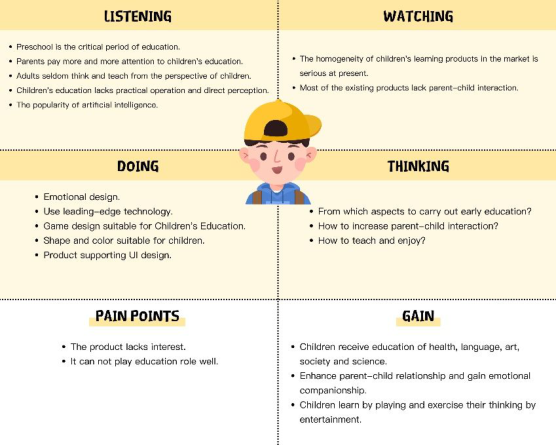
Empathy Map According to the results of the user interview questionnaire, we drew an empathy map of preschool children from four aspects: watching, thinking, listening and doing, and analyzed the pain points and gains (Figure 1).
We mainly summarized two pain points, firstly, most children are very active, the products for preschool children on the market today lack interest. Secondly,most adults and current products can’t play education role well. And we have three gains, Firstly, children receive education about health, language, art, society and science. Secondly, the product should enhance parent-child relationship and gain emotional companionship. Third, children learn by playing and exercise their thinking by entertainment.
Early Education Robot for Preschool Children 227
Figure 1: Empathy map of preschool children.
DESIGN SCHEME Product Function Design
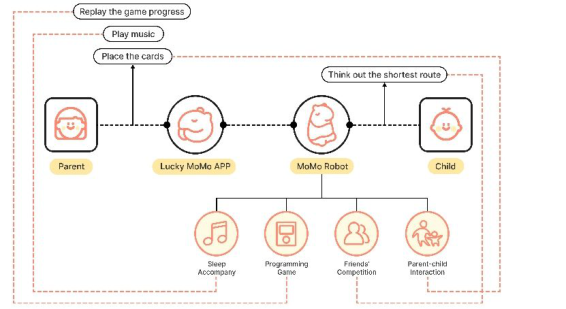
Firstly, we designed the function of the product (Figure 2). To satisfy the needs of children and parents, our products are divided into two parts: robot MoMo and mobile application Lucky MoMo. And the functions of the robot are divided into four parts: programming games, friends competition, slee- ping accompany and parent-child interaction. Parents use Lucky MoMo to place the cards, play music as well as replay the game progress. Chidren need to think out the shortest route and control the movement of MoMo Robot.
Figure 2: Schematic diagram of product functions.
228 Wang and Li
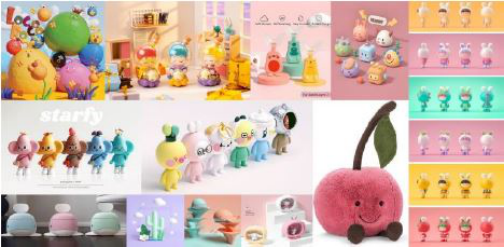
Product Design According to the preliminary research, we made a mood board (Figure 3) based on user preferences and fashion trends, and considered the four key images of “mellow”, “lovely”, “bright” and “soft” to design the product. As our product is a kind of children’s toy with mixed colors, we considered the coordination with the function and form of toys, orange was chosen to be the theme color of our product. The overall color is lively and bright, which meets the visual needs of children (Jia Feng, 2020). Because of the smooth appearance (curves and hook faces) can give people a friendly and accessible feeling (Yanfang Hou, 2021), we widely use curves, hook faces and fillets in modeling design.
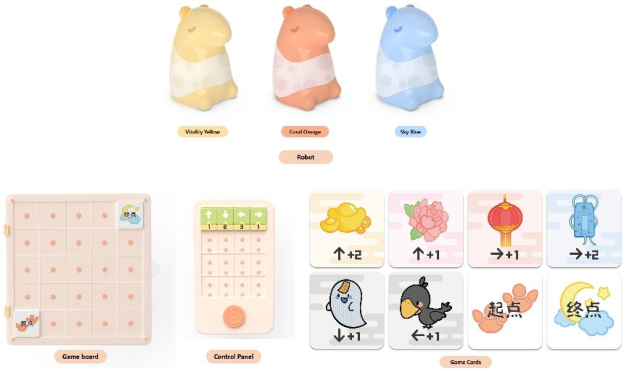
The bionic design method is adopted in the modeling of the robot (Figure 4). The bionic design is based on the tapir. In ancient Chinese legends, the tapir could eat people’s nightmares. Later, it gradually evolved into “eating bad luck and bringing good luck”. The animal was chosen not only for its distinctive appearance, but also for the auspicious meaning of it. The name “MoMo” was adapted from the Chinese pronunciation of tapir. In the
Figure 3: Mood board.Figure 4: Product rendering.
Early Education Robot for Preschool Children 229
game, children will avoid bad luck by planning the route of MoMo, and collect as many good luck cards as possible, so that MoMo can reach the destination faster and protect our dreams. We designed three different colors for the robot: vitality yellow, coral orange and sky blue.
The switch key and music key are located on the two ears of the robot, which is convenient to use. The sound hole and the Type-C charging hole are on the back. The bottom of the robot is equipped with three wheels, that can not only keep balance, but also ensure its 360
rotation.
There are four types of game cards: Lucky Card, Unlucky Card, Star- ting point and End point. Card face design combines elements of traditional Chinese culture. Cloud patterns are used as shading, and the Chinese style illustrations are on the top of the card. Gold ingots, peony flowers, lan- terns and lucky bags are four elements with beautiful meaning, so they are used as the face of the Lucky Card, which can help the robot reach the destination faster. The little ghost and the little crow correspond to the Unlucky Card, and children need to make the robot go around as much as possible.
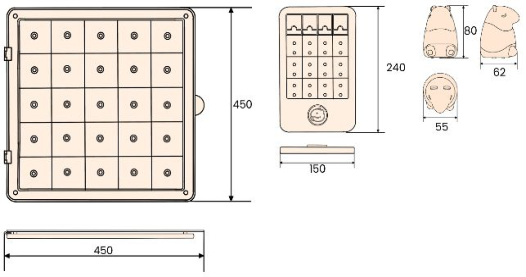
In view of the physical and motor development characteristics of presch- ool children, we should consider the size, structure, material, weight and other indicators of toys according to the height, weight and hand size of chil- dren when designing toys (Fang Li, 2016). According to the body size data of preschool children, we calculate the most appropriate size data of each product component, which is convenient for children to hold and grasp the product.The side length of the game board is 450mm. The size of the control panel 240mm long and 150mm wide. The size of the robot is 62mm long, 55mm wide and 80mm high (Figure 5).
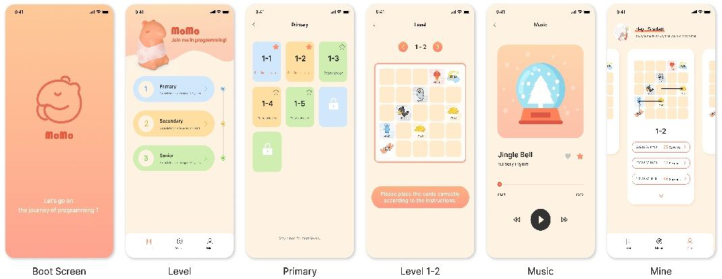
Mobile Application Design According to the user’s needs, the functions of APP include different game levels, music and gaming statistics. The data of the robot is transmitted to the platform through sensors, in order to review the game process more intui- tively and help children to explore the best solution. In this way, the ability of calculation and spatial imagination of preschool children can be exercised.
Figure 5: Product size data.
230 Wang and Li
Parents are the main users of APP, they could guide their children to play pro- gramming games through the guidance of APP, and also increase parent-child interaction (Figure 6).
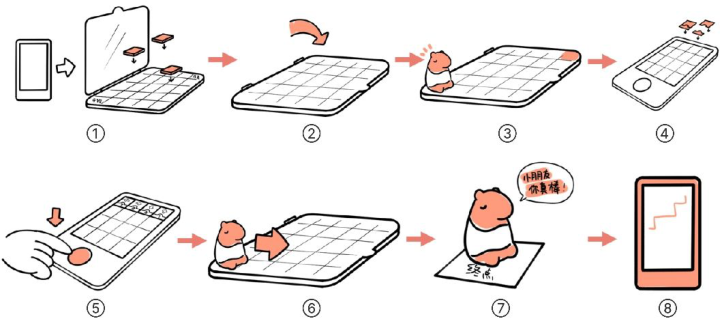
Use Process The whole process of using the product needs children and parents’ coope- ration. First, parents place the Lucky Cards and Unlucky Cards according to Lucky MoMo’s guidance and close the transparent lid of the game board. Then, the child begins to think about the robot’s route of action, and pla- ces the command card on the control panel. After placing the cards, the child can press the round start button, and the robot MoMo will start to move. The moving data will be synchronized on Lucky MoMo. After reach- ing the end point, the robot MoMo will send out a prompt voice. Parent and child can check whether the robot has passed the optimal route through APP (Figure 7).
Figure 6: Display of some application program interfaces.Figure 7: Diagram of use process.
Early Education Robot for Preschool Children 231
CONCLUSION
After the design, we invited some preschoolers and their parents to con- duct a user test, and the feedback showed that most of the children and parents agreed and appreciated the design scheme of game-based learning, parent-child interaction and exercise of arithmetic ability. They thought that the scheme was feasible, and would like to try if the design can be reali- zed. We showed them the model of the robot, and most of the children said that the size of the robot was very suitable, the shape was very cute, and it felt good to use. We also made an interactive prototype for the main interface of the APP and provide it to the users for testing. The feed- back shows that the function of APP can basically meet the needs of the users. The project aims to exercise preschool children’s programming thin- king through game and increase parent-child interaction at the same time. We design this product, and will continually work on future improvement to cultivate children’s creativity, concentration and frustration resistance, as well as improve their ability to solve problems, so that preschool children can get comprehensive development, and gain some help for their future learning life.
REFERENCES
Fang Li. Research on Application of Children’s Behavior Pattern inToy Design[C]. France: Atlantis Press, 2016: 552–554. Feng Jia. (2020). Research on the Design of Modular Educational Toys for Children Based on Developmental Psychology (Master Dissertation, Jiangsu Univer- sity). https://kns.cnki.net/KCMS/detail/detail.aspx?dbname=CMFD202201&file name=1021518380.nh. Hou Yanfang. (2021). Research on Emotional Design of Child Care Robot (Master
Dissertation, Harbin University of Science and Technology). https://kns.cnki.net /KCMS/detail/detail.aspx?dbname=CMFD202201&filename=1021057971.nh. Xu Wenjing. (2019). Design and Research of Children Learning Intelligent Robot (Master Dissertation, Qilu University of Technology). https://kns.cnki.net/KCMS/ detail/detail.aspx?dbname=CMFD201902&filename=1019172938.nh.
LISTED IN THE AHFE DIGITAL BOOKSTORE CATALOGUE
Explore the complete digital volume
Training, Education, and Learning Sciences
Read this individual research paper free through the original publisher, or explore the full digital proceedings book.
ISBN 978-1-958651-85-8
Explore this ISBN in the AHFE Bookstore ↗Listed in the July 2026 bookstore catalogue; search by ISBN to confirm current availability · Digital book purchase optional