Toru Nakata (2023). Japanese Practical Concepts on Human Error Prevention: 3H, 4M, and 5S. In: Human Error, Reliability, Resilience, and Performance. AHFE Open Access, vol. 82, pp. 59–65. https://doi.org/10.54941/ahfe1003554
Environment of Quality Control and Safety Management in Japanese IndustriesThe Japanese customers are, in general, very strict on product quality. They can select products from many competitors, so they will not buy products with minor flaws. In addition, high-technology products are required to have very high reliability, so defects on products are critical. Human errors are not allowed in the production. Historically, Japanese economy has been concentrated on mass-manufacturing since 19th century. In the past, the quality control (QC) of Japanese companies was very weak in general. Most of the Japanese think the low quality resulted in unreliability of weapons in the World War II. After the war, most of Japanese companies adopted scientific QC methods from the United States, which is based on statistical analysis to reduce uncertainty in the productions. Japanese companies have developed other methods to manage product quality and workplace safety, which seem very original concepts developed among Japanese industrial society after the war. This paper introduces the Japanese concepts for QC and safety managements, named "3H", "4M" and "5S". Their theoretical backgrounds are also explained. Risks Prediction with 3H-4MIn safety management, it is very important to predict possible incidents beforehand. In Japanese industrial society, many people use the concepts of 3H and 4M for the purpose. “3H” stands for a triple of Japanese adjectives of “Hajimete” (“for the first time”), “Hisashiburi” (“in quite a while”), and “Henkou” (“change”). In most of incidents, the features of 3H are very likely to appear in the story. The Japanese engineers therefore consider 3H features as bad indications that evoke the accidents. “4M” means major four aspects in production processes, namely “Man”, “Machine”, “Material”, and “Management” [1]. (Some engineers may use the variation of “5M” adding “Method” into the four.) In some Japanese companies, supervisors responsible for safety are trained to doubt whether any of 4M is contaminated with baleful features of 3H. For example, supervisors pay special attention on “a new worker”, “a use of a machine in quite a while”, “a change of the instruction rule”, and other 4M with 3H features. This attitude concentrated on risks of “3H in 4M” is a very efficient way to predict large risks hidden in the workplaces, even though it might pay less attention to other minor aspects. Importance of Apparent Order: 5S “5S” is a group of five Japanese words of “Seiri” (organization), “Seiton” (placing things in order), “Seisou” (cleaning), “Seiketsu” (sanitariness), and “Shitsuke” (compliance to rules). Those five features keep simplicity and safety of workplace, that results in suppression of human errors. The 5S features are superficial and easy to see. Supervisors can quickly judge their condition just by observing the workplace. Most of Japanese industries attach top priority to maintenance of 5S to keep quality and safety. Reference 1. Krzysztof Knop, Krzysztof Mielczarek, “Using 5W-1H and 4M Methods to Analyse and Solve the Problem with the Visual Inspection Process – case study”, 12th International Conference Quality Production Improvement (QPI 2018), 2018.
ENVIRONMENT OF QUALITY CONTROL AND SAFETY MANAGEMENT IN JAPANESE INDUSTRIES Japanese customers generally have high standards for product quality. Given that they can select products from among many options, they will not buy products with minor flaws. In addition, high-technology products must have high reliability, so defects in products are a critical problem. Human error is not allowed in production.
Historically, the Japanese economy has been dominated by mass- manufacturing since the 19th century. In the past, quality control (QC) in Japanese companies was generally fragile because of lack of engineering abi- lity. In fact, many Japanese people blamed low manufacturing quality for the unreliability of weapons during World War II. After the war, most Japanese companies adopted scientific and statistical QC methods from the United Sta- tes that use statistical analysis to reduce uncertainties, particularly regarding metrication errors for parts and products.
Along with QC activities, Japanese companies have developed their own original methods for quality and workplace safety management. These meth- ods are less based on statistics and are instead more related to traditional Japanese customs. At the same time, because many Japanese companies have factories abroad, they have had to adapt their cultural methods to be universally effective for non-Japanese people as well.
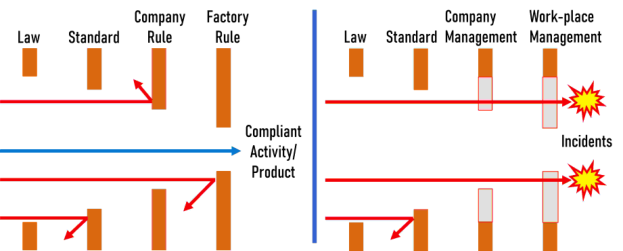
Public regulations, such as laws and industrial standards, represent mini- mum requirements, and they are not enough for practical QC and safety
Figure 1: Public regulations have only minimum requirements. Workplace manage- ment must oversee the implementation of stricter private rules and thus has the most important role in incident prevention.
management (Figure 1). Companies therefore have their own, usually stricter rules at the company level and factory level to control risks in real workpla- ces. Violation of these company-based rules, however, does not constitute breaking the law; because of this, slack supervisors and workers might feel that it is easier to ignore company regulations versus laws. Highly reliable companies ensure that even their own internal rules are followed, whereas problematic companies struggle to implement their own rules, resulting in subpar end products.
This paper introduces the Japanese “3H,” “4M,” and “5S” concepts for company-internal enforcement of QC and safety management.
COGNITION ON ENTITIES IN THE WORKPLACE: 4Ms Workplaces contains many visible as well as invisible objects, and observation of those factors might be complex and confusing. It is important to have a guiding framework to observe many entities.
The SHELL model (Hawkins, 1993) is the most famous framework and includes the categories of software, hardware, environment, and liveware. Safety managers classify various things around the job into those categories and use them to analyze efficiency and safety.
The four Ms (usually written as “4Ms”) model is popular for a similar pur- pose of safety and efficiency (Stolzer, 2016). The 4M concept is particularly well known among engineers in Japanese companies because of the importa- nce of QC in Japan. In QC activities, the Ishikawa diagram, also known as the fishbone diagram (Ishikawa, 1985), incorporates the 4M concept and is often used to analyze the cause of failures.
The 4M model comprises four major factors of production processes:
Man (characteristics, conditions, and history of workers)
Machine
Material (objects to be worked)
Management (organization of group, tutors, supervisors, training, educa- tion, manuals, and communication)
Japanese Practical Concepts on Human Error Prevention: 3H, 4M, and 5S 61
There are many variations of the four factors depending on the field or industry. Some engineers in charge of production quality control prefer to use “Method” rather than “Management” (Krzysztof, 2018). Some engine- ers use a 5M variation that includes “Method” or a 6M variation including “Measurement.”
CONCEPTS TO EVALUATE TODAY’S RISK: 3HS ON 4MS In safety management, it is vital to detect any risks of possible incidents as soon as possible. In Japan, many people use the three Hs (usually writ- ten as “3Hs”) for the risk assessment. 3H stands for the following Japanese adjectives:
Hajimete (“for the first time”)
Hisashiburi (“quite a while”)
Henkou (“change”) When incidents occur, the features of the 3Hs are very likely to appear in process of the incidents. For example, using a new machine “for the first time” has more risk than using a familiar machine. Many incidents have occur- red in situations characterized by the three Hs. Japanese engineers therefore consider 3H features as indications that negative incidents are likely.
In some advanced Japanese companies, supervisors responsible for safety are trained to recognize whether any of the 4Ms are characterized by 3H indi- cators. For example, supervisors pay special attention to “new workers,” “a machine that has been out of use for a long time” “a change in instructions,” and other 4Ms with 3H features.
Concentrating on 3H risks to the 4Ms is an efficient way to predict possible incidents in the workplace, though this approach may neglect other minor aspects. Supervisors and workers should refer to the matrix in Table 1 to detect and monitor risks.
One of the major difficulties in safety management is the management of change. Conditions relating to people, workflows, materials, and workplaces
Table 1. Matrix for observing risks in the workplace and workflow. For safety management, this matrix must be consistently used to observe risks that could appear suddenly on any given day.
Table available in the original PDF paper.
3 Hs For the first time In quite a while Change
Change of workers
4 M’s Man Novice Worker returning from long absence Machine New machine Machine rarely used
Material rarely used
Change of material/product
Change of machines Material New material/ product Management New manual, new leader Leader returning from long absence Change of manuals, leader
62 Nakata
change every day. Some of these changes are intentional, while others might take place unintentionally and without announcement (Olsen, 2022), and even unintentional changes can cause difficulties and incidents. Safety mana- gers must be aware of all changes, but this is almost impossible in practice. Being able to concentrate on key factors is therefore highly beneficial.
RISK OF MANY HS AT ONCE Weinberg (1985), a famous software engineer and consultant, introduced a project management principle named “the Edsel edict,” according to which “if you must have something new, take one, not two.” In other words, this edict warns that a circumstance involving many changes (i.e., many Hs) tends to result in failure. A single change can add uncertainty and difficulty to a task; thus, two or more changes at once greatly compromises a successful outcome.
1) “For the First Time” An example of the risks of change is the severe incident at Fukushima Daiichi Nuclear Power Plant in March 11th, 2021, which was related to many chan- ges. The plant lost its electrical supply and experienced a station blackout (SBO) due to a tsunami. The workers had to keep the reactor cores cool; the standard method for doing this was to connect the reactor core to the iso- lation cooling condenser (IC). However, the directors and workers hesitated to rely on the IC alone for cooling because they had never used the IC, even during drills. At 18:18 of the day (three hours after the SBO), they tried to open the emergency valve to connect the IC and the reactor core, but they were unsure whether the IC was working normally since they did not know that the IC makes steam and noise as part of its normal functioning. At 18:25, they tried to close the valve, believing the IC was out of order. At 21:30, they tried to reopen the valve. It can be regarded as a better idea. Because this was the first time they encountered this situation, they failed to make the correct decisions.
As this example illustrates, the use of equipment should be practiced through drills, even if the equipment is designed only for emergency use.
2) “Quite a While” The last major tsunami attacked the location in 1933, which is 78 years ago. The population in 1933 was very small, so there are few people who can remember the tsunami. The eastern coast of Japan has suffered from a major tsunami approximately once every 100 years, but a century is too long to keep detailed memories in the people.
3) “Changes” In 1933, the location of the power plant was a high tableland, so the tsunami caused little damage. In the 1960s, the construction of the Fukushima Daiichi Nuclear Power Plant started, and the tableland was dug out in order to access
Japanese Practical Concepts on Human Error Prevention: 3H, 4M, and 5S 63
seawater as a coolant; this change made the location dangerously exposed to tsunamis.
In addition, the plants were built using a pre-existing design for power plants intended for the United States, in which the electricity utility systems were underground to avoid tornado hazards. Because of this, when the tsu- nami occurred, the water poured into the floor holding the electricity utility system because it was at such a low level.
Although these changes were carefully reviewed in the 1960s, they were deemed as posing no risks. However, the changes were revealed to be of critical importance to the escalation of the incident 50 years later.
Thus, the 3Hs proved to be of critical importance in the development and outcomes of this incident.
IMPORTANCE OF SUPERFICIAL WORKPLACE ORDER: 5SS The concept of the five Ss (written as 5Ss) attaches importance to the following five features:
Seiri (Classification of objects)
Seiton (Placing things in order)
Seisou (Cleaning)
Seiketsu (Maintaining hygiene)
Shitsuke (Compliance with the rules; taking authorized and standardized actions) These five features thus relate to the orderliness and safety of the work- place. Maintaining the 5Ss prevents human errors by eliminating confusing obstacles, complex environments, and dangerous behaviors. Thus, most Japanese companies prioritize the maintenance of the 5Ss to promote quality and safety.
The most important and convenient characteristic of the 5Ss is that they are easy to observe.
Supervisors can quickly judge 5S conditions just by observing the work- place.
Instructions for workers are simple and easy to carry out. Workers understand what the 5Ss mean and view maintaining them as a basic responsibility.
When a supervisor discovers deviations from the 5Ss (but no incident has happened yet), they can ask workers to fix the problem, thereby preventing any incidents.
Some supervisors scold workers who commit errors and cause incidents. However, according to Kahneman (2012), blaming error-responsible peo- ple does not produce good effects and neither improves human ability nor prevents further errors.
What supervisors and workers do before incident is much more impor- tant. Communication among supervisors and workers about 5S maintenance represents one important means of preventing incidents.
64 Nakata
Rather than scolding someone to fix issues related to the 5Ss, it is better to favor psychological well-being in workplace relationships. Even after inci- dents occur, the 5Ss still play an important role in preventing future issues. For example, the CEO of a large Japanese company sometimes receives reports about factory incidents. Although he reads these reports immediately, it is hard to describe the conditions of the 5Ss completely. He will not be satisfied until he visits the factories actually. There are many items to inspect in the workplace, but the CEO pays the most attention to maintenance of the 5Ss because most of the workplace difficulties can be understood as the results of poor 5Ss upkeep.
INDICATORS OF RISKS TO FOOD PRODUCTION: 3 RE AND 2 BI In addition to the 5Ss, engineers in the food industry in Japan have a similar concept for five risky features called the three REs and two BIs.
More (leaks from machines or tanks)
Tare (drips from machines or tanks)
Yogore (dirt on machines, on workers, or in the workplace)
Sabi(rust on machines)
Kabi (molds on materials and in the workplace) These five features are often viewed as minor issues since they frequently occur in daily life, but they are serious indicators of the absence of food safety control. Hence, safety supervisors in food factories must check for these issues and eliminate them as soon as they are found.
COMPARISON TO OTHER MODERN SAFETY MANAGEMENT Thanks to their simplicity, the 3H,4M,and 5S concepts are widespread across Japanese industries. At the same time, the simplicity of these concepts carries certain disadvantages. These concepts mainly focus on visible and superficial features of the workplace, and they may be less effective in analyzing invisi- ble and/or complex factors. Additionally, communication between workers and supervisors based on such fixed concepts might lack variation and could produce few novel ideas.
To mitigate these problems, workers and supervisors should be spontane- ous and flexible to communicate each other (Weick, 2001), which requires participants’ willingness to become the first person to break the silence.
The 3H, 4M, and 5S concepts are suitable for finding risks and spar- king conversation to help people more deeply consider safety improvement activities.
CONCLUSION
This paper introduced the popular 3H, 4M, and 5S concepts for safety mana- gement in Japanese companies. Reduction of 3H, observation using the 4M categories, and maintenance of the 5Ss are basic practices for workplace safety and human error prevention in many Japanese companies. These concepts focus mainly on superficial features of the workplace and less on
Japanese Practical Concepts on Human Error Prevention: 3H, 4M, and 5S 65
complex factors hidden in workflows. Thanks to this simplicity, the conce- pts help supervisors and workers to maintain workplace safety and product quality.
REFERENCES
Hawkins, F. H., Orlady, H. W. (Ed.). (1993). Human factors in flight. England, Avebury Technical. Ishikawa, K. (1985). What Is Total Quality Control? : The Japanese Way. Prentice
Hall Direct. Kahneman, D. (2012). Thinking, Fast and Slow. Penguin. Krzysztof K., Krzysztof M. (2018). “Using 5W-1H and 4M Methods to Analyse and Solve the Problem with the Visual Inspection Process — case study”, 12th International Conference Quality Production Improvement (QPI 2018). Olsen, E. J. (2022). Management of Change Reviews for Small Modifications,
Chemical Engineering Progress, December 2022, 35—38. AIChE. Stolzer, A. J., Goglia, J. J. (2016). Safety management systems in aviation. Routledge. Weick, K. E., Sutcliffe, K. M. (2001). Managing the Unexpected, John Wiley & Sons. Weinberg, G. (1985). The Secrets of Consulting. Dorset House Publishing.
LISTED IN THE AHFE DIGITAL BOOKSTORE CATALOGUE
Explore the complete digital volume
Human Error, Reliability, Resilience, and Performance
Read this individual research paper free through the original publisher, or explore the full digital proceedings book.
ISBN 978-1-958651-58-2
Explore this ISBN in the AHFE Bookstore ↗Listed in the July 2026 bookstore catalogue; search by ISBN to confirm current availability · Digital book purchase optional