Fred Schoeffler, Joy A. Collura (2023). What Fatality and "Prescott Way" Causal Factors Are Revealed in the July 23, 2013, Deployment Zone News Conference?. In: Human Error, Reliability, Resilience, and Performance. AHFE Open Access, vol. 82, pp. 66–79. https://doi.org/10.54941/ahfe1003555
This is a story that needs to be told - always remembered - truthfully. This semi-inclusive paper examines the alleged wildland fire human factors that existed, contributing to the fatal Granite Mountain Hot Shot (GMHS) tragedy on the June 30, 2013, Yarnell Hill (YH) Fire; derived from the July 24, 2013, GMHS Deployment Zone (DZ) News Conference videos by InvestigativeMEDIA Reporter and author John Dougherty (JD) with Prescott FD (PFD) Wildland Battalion Chief (WBC) Darrell Willis, along with numerous reporters. The videos were then transcribed from the spoken words into a written PDF format using the novel Otter app so you can truly read what WBC and various Reporters are discussing compared to the mostly unreliable "CC - Closed Caption" hit-and-miss versions in the two videos. Rather than use all the Otter-transcribed text, the authors selectively used those WBC ambiguities of established tried-and-true Rules Of Engagement, i.e. LCES, Fire Orders, etc. Being able to read what is said is more revealing and thought-provoking offering new perspectives on this divisive fatal event. Torn and tormented while aware of the real truth, WBC held these young men as Sons - on the annoying horns of a dilemma - feeing obliged to defend them, weakly attempting to share in his alleged illusory-recollected “truth” of why it happened.
From the dual perspectives of a former USFS Hot Shot Supt. and one of the two YH Fire Eyewitness Hikers, turned Human Factors researchers, this paper examines the probable wildland fire human factors that existed and likely added to the fatal GMHS event on the June 30, 2013, YH Fire. You will quickly realize that this is clearly an emotional, and sometimes disori- enting, event for PFD WBC, their immediate supervisor, because this is both personal and professional for him. He literally considered these men as his Sons. The YH Fire and GMHS debacle is both personal and professional for both of the authors as well, but more from a distance, having trained and worked with some of them, including WBC at the AZ Wildfire Academy; and worked with them at Hot Shot Conferences as a Steering Committee
What Fatality and “Prescott Way” Causal Factors Are Revealed in the July 23, 2013 67
Chairman, and as a USFS Hot Shot Supt. and Safety Officer on wildfires. Subsequently, seeking Public Records Requests and conducting interviews, a Staff Ride, and numerous Site Visits, revealed that the YH Fire and GMHS debacle was a clearly predictable and preventable event, and a straightaway permissive conclusion for the primary author and many experienced, infor- med, interested, and knowing others to ultimately declare this as the biggest cover-up, lie, and whitewash in wildland fire history.
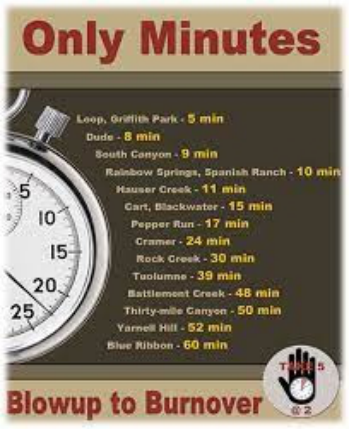
This paper is derived from the two July 24, 2013, GMHS Deployment Zone (DZ) News Conference video links below by InvestigativeMEDIA (IM) (JD, 2013a) author and InvestigativeMEDIA reporter JD with the Prescott FD WBC, and numerous inquisitive, patient, and tolerant National Reporters transcribing the written text from the WBC and Reporter spoken dialo- gues. Historically, the Wildland Fire Agencies have never lost an entire Fire Crew. However, the USFS and the CA Division of Forestry were very close to realizing that on two earlier fires. Inaja (CA-1956), Loop (CA-1966), and South Canyon (CO-1994) (WLF-LLC, 2013-23). So then, why did the PFD, under the auspices of the Arizona State Forestry (ASF), lose 19 out of 20 of its GMHS Crew in its fourth year of operation? (WLF-LLC, 2013-23). For over 25 years, because of various distinct safety reasons, the National Wildfire Coordinating Group (NWCG) has had a continuing and manda- tory recovery period for wildland fire personnel after 28 consecutive days of fighting fire, in place, due to various harmful outcomes (SIIBMH, 2022). The GMHS was listed as “unavailable” due to their repeated days worked on the Prescott NF (PNF); and many of them did what most young WFs and FFs would often do in that case (JD, 2013b). Initially, the Southwestern Regional Coordination Center (SWCC) refused to release the GMHS to the YH Fire because they really had just completed an arduous 28-day tour (JD, 2013b). On the night of June 29-30, 2013, many of them were out celebra- ting their long-awaited mandatory rest period, likely contributing to a lack of mental clarity, while allegedly contributing to them finally losing their lives (IM, YHF, 2015). The AZ Forestry strongly objected and oddly: “e-mailed a resource order to Eric Marsh for [GMHS] C-5.” For some awkward rea- son Marsh accepted the assignment. And the SWCC responded with a classic disavowal: “although officials at the SWCC have declined to confirm or deny that or otherwise comment on why they turned down [the ASF’s] requests” (JD, 2013b). Then, on the June 30, 2013, YH Fire, after their long-drawn-out “discussing our options” Crew Net radio exchanges, the GMHS (Figure 1.) opted to leave their viable Safety Zone (SZ) at the worst possible time to hike down into a known, deadly box canyon, with extremely volatile chaparral fuel (Figure 4a.) At this point, on the horns of a dilemma, Marsh, at the Boul- der Spgs. Ranch (BSR) must have realized that his bad decisions were going to get all his men killed, so he chose to die with his men over living with that guilt. Many current / former WFs/FFs, supervisors, psychologists, family, fri- ends, loved ones, informed, and interested others allege that his “heroically save them,” attempt deliberately caused his own demise.
Now Steed, being the Acting GMHS Supt., acquired the ultimate responsi- bility for his Crew’s safety, health, and welfare. The authors and others allege Steed “allowed” his former Marine Corps code to “follow orders” to take
68 Schoeffler and Collura
Figure 1: (left) Blowup to Burnover poster (2022). Figure 1a. (right) Ten Standard Firefighting Orders and 18 Watch Out Situations (2020). Both courtesy of NWCG.
precedence and was hence too vulnerable to resist or overcome Marsh’s alle- ged overpowering mental manipulation to get him to leave the safe black and hike downhill to their deaths on June 30, 2013 (YHFR, 2018-23). And the Crew overhead had chosen their least skilled and most hungover GMHS – McDonough - as their alleged lookout. “Published reports state at least three [GMHS] were drinking … the evening of June 29 … at the Whiskey Row Pub, …” (IM YHF, 2015). There are discernible dissimilar beliefs and meth- ods when fighting a urban-interface wildland fires related to a Wildland Fire Crew engaging only in wildland fires versus occasionally - like the GMHS - a Municipal-Structural-Wildland Crew. Exponentially deepening the odds of this tragedy, the WBC, next repeatedly and fecklessly attempts to justify that distinction. The authors detail the contrasts between those two and the major causal factors virtually killing the entire HS Crew. The authors, WFs and FFs, and regular individuals, including inquisitive citizen-readers, and news-watchers stated something akin to: ‘there has always been something that bothered me about this fire.’ So, the Oct. 2013 HS AAR reasoned: “this is the final, fatal link in a long chain of bad decisions with good outcomes, we saw this coming for years” (SWA AAR, 2013) as a significant causal factor.
The authors view these bellwether statements as the likely origin of the almost immediate “heroes” frenzy sparking the oft-debated GMHS ‘hero worship:’ “We are going to hallowed ground,’ says Jim Paxon, [ASF] spo- kesman, … leading reporters and TV crews to the … [GMHS DZ]. … They are almost superhuman, … there’s a [GMHS] shirt on a cactus. We would ask that you touch the shirt … in reverence to the loss.” (JD, 2013b). The authors utilized the Otter app (Otter.ai, 2023) in order to transcribe the WBC’s and the Reporters’ discussions, in roughly chronological order, obeying AHFE space-limited, resolute analysis and reviews from support sources to critique
What Fatality and “Prescott Way” Causal Factors Are Revealed in the July 23, 2013 69
and/or support WBC’s comments. The WBC / Reporter discussion quotes, and author sources quotes are generally “italicized,” as well as source quotes, and author comments and sources information will be in everyday text.
Consider now the two-part GMHS Deployment (DZ) Zone Site news con- ference, Yarnell, AZ July 23, 2013, video link for Part One and Part Two respectively; provided for video access at your personal discretion allowing us to fulfil the AHFE firm 10-page allotment. (https://youtu.be/J1lBgicPq5A) and (https://youtu.be/YDQRLXZV1Ro). (JD, 2013a) These three July 2013 News Conference comments from ostensibly expe- rienced WF/FFs are quite telling: Little T (8/7/13), “Chief Willis is obviously over his head as a [WF] and I know he is hurting but he shouldn’t have given the press briefing (see video) after all he’d been through. His pot-bellied associate wandering into this video only compounded the problem.” Another Hotshot (8/7/13) “The more [WBC] … opens his mouth, the more damage he does. These comments are more off base than even those at the memorial. Maybe Joe Public eats this up, but anyone with fire experience is going to see right through his BS. I realize his judgment is clouded with grief, … best to just let the report come out.” LZ (8/7/13) “… I couldn’t help but get angrier as it went on. As a [WF] for many years … I can only tell you I would never trust this man’s judgement on an incident. I couldn’t believe his ill placed rati- onale for [FFs] taking risks to save structures. It’s lives including thier (sic) own) property, natural resources, in that order. I also couldn’t help counting the number of 10 Standards and 13 situations violated. I understand this is a sensitive situation and my heart grieves for those families, but we’ve got to get beyond protecting reputations and tell the truth.” Undeniably, they rightly question WBC’s integrity.
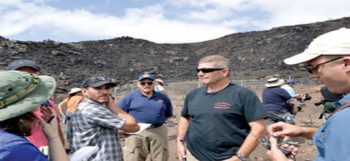
Figure 2: Snippet of Former Prescott (WBC) Darrell Willis (center) and AZ State Forestry Jerry Payne (blue cap and shirt – center left) answering media questions on July 23, 2013, at the deployment site where the GMHS died on June 30, 2013. (JD, 2013a).
PFD WBC Willis defending the GMHS decisions and actions with National Reporters WBC: “My name is Darrell Willis, a Division Chief with the City of PFD. Well, you’ve all made it to the site where 19 GMHS died on June 30. This is exactly the ground that they died on. … we are able to monitor the radio frequencies that they were on. And we heard that they were going to move out and start coming in in a southerly direction based on the fire behavior. … My thought on it... was that they were not they were in a safe location. They were not satisfied and no wildland firefighters (WFs) [are] satisfied sitting there and watching the fire progress without doing... taking some action.
70 Schoeffler and Collura
… I believe that that’s what their intent was when they moved down off of there, and they were moving down to protect this house. That’s my theory on it. They probably saw the fire [there]. And then were looking for a place because they knew that they had fire on both sides of them, they had fire behind them. And now they have fire ahead of them.” (See Figure 3. and Figure 3a.)
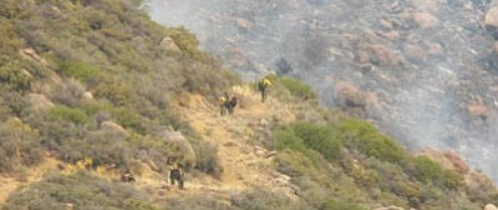
WBC’s “… no [WFs are] satisfied sitting there and watching the fire progress without... taking some action. …” is selectively questionable, and wholly dependent on fire conditions, supporting the Municipal-Structural mindset. According to available public records, the WBC is the sole sou- rce publicly stating: (1) “they’re doing their work all day long.” Consider Figure 3., the official SAIT-SAIR (SAIT-SAIR, 2013, p.28) idealized image caption in Figure 3. And falsely saying (2) GMHS “knew that they had fire on both sides of them, they had fire behind them. And now they have fire ahead of them.” Compare and contrast Figure 3. with Figure 3a. iPhone 4 photo clearly depicting only fire below the GMHS. This photo was taken by ASF Brian Lauber at 1629 (4:29 PM) on 6/30/13, near the Yarnell Ranch House restaurant looking West from Hwy. 89. And it was taken less than nine minutes before the GMHS radio transmissions for help stating: “Yeah, I’m here with [GMHS], our [ER] has been cut off. We are preparing a [DZ] and … burning out around ourselves ….” (SAIT-SAIR, 2013).
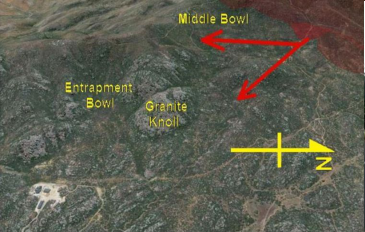
Why did the GMHS expertly pursue a true ER to a SZ, then pervert that ER term, leave their SZ, and fatally hike downhill into chimneys / chutes of unburned chaparral? (Figure 4a.) This became SAIT photo (IMG_1334.JPG), provided to the SAIT Human Factors Investigator. However, excluded from the SAIR, instead using the SAIT-SAIR idealized image Figure 18. suppor- ting their false theory and PFD Willis’ similar claim that the GMHS saw fire “ahead of them” and “behind them.” The authors allege that the SAIT delibe- rately attempts to deceive the reader with this half-truth that “... the middle bowl... funnelled the fire at a rapid rate of spread toward the top of the ridge.” Lauber’s photo invalidates those SAIT collusions. The aggressive fire beha- vior visible in Figure 4a. is the probable result of “Friendly Fire,” a borrowed military proxy of an unsanctioned firing operation, i.e., the Shrine and
Figure 3: Snippet of hiker Collura 6/30/13 photo, “we watched and photographed them most of the day, tossing rocks, taking it easy.” Contrary to the WBC statement about the GMHS productivity with his claim: “And they’re doing their work all day long.” Courtesy of Collura.
What Fatality and “Prescott Way” Causal Factors Are Revealed in the July 23, 2013 71
Figure 4: (left) SAIT-SAIR Figure 18. “Fire splitting with south head entering the middle bowl and north head moving toward the entrapment bowl.” Courtesy of SAIT- SAIR. Figure 4a. (right) IMG 1334.JPG photo June 30, 2013, aggressive fire behavior. This official photo (IMG_1334.JPG) was given to alleged SAIT Human Factors Inve- stigator Brad Mayhew, but never included in the SAIR. Courtesy of ASF Lauber, WantsToKnowTheTruth, Google Earth.
Sesame Corridor (YHFR, 2018-23) See the YFD Chief Anderson video cor- roborating the Shrine-Sesame St. firing operation in his “like they did here” comment (JD, 2013c). See also Schoeffler, Honda, Collura (AHFE, 2020) Fire Credible Evidence Continues to Surface.
Additionally, WBC’s comment (“But we are able to monitor the radio fre- quencies that they were on. And we heard that they were going to move out and start coming in a southerly direction based on the fire behavior.”) (JD, 2013b) contradicts the fabricated Serious Accident Investigation Team and Report (SAIT-SAIR, 2013) claim: (“There is a gap of over 30 minutes in the information available for the [GMHS]. From 1604 until 1637, the Team cannot verify communications from the crew, and we have almost no direct information for them. There is much that cannot be known about the crew’s decisions and actions prior to their entrapment and fire shelter deployment at around 1642”) (SAIT-SAIR, 2013). The Municipal-Wildland FF stance to “protect that structure” kicks in as well, even though openly declared a “bomb-proof SZ” by the Yarnell Structure Protection Specialist (SPGS) at the morning briefing (SAIR, 2013). The SAIT integrity is again suspect with this: “The National Interagency Fire Center (NIFC)... now urges inve- stigators to withhold some findings from the public, and to avoid analyzing whether crews violated fundamental fire-line rules, reports the AZ Republic” (NPR, 2013) because it too confirms the SAIT-SAIR spurious conclusion: “ …found no indication of negligence, reckless actions, or violations of policy or protocol.”
WBC: “And … that’s basically the story of what happened here. You can look around. You can speculate, you can say a lot of things. All I can say … I would have been with that group blindfolded. They could have led me down here. I’d have been with them. I have complete faith and confidence in the leadership, … Marsh, … Steed, the Captain, all the Squad Bosses, very seasoned [FFs], they would have never taken a risk that they didn’t think …it’s a risky business. But they don’t take undue risk, … safety conscious. … one
72 Schoeffler and Collura
of those things that happened. You can call it an accident. I just say God had a different plan for that crew.”
These bold statements were highly controversial, with ongoing intense debate. Far from being an “accident” defined here: “Law - an unforeseen event that occurs without anyone’s fault or negligence” (Collins, 2020). So, clearly there was no “accident” because it never just “happened.” It is alle- ged as the result of clear and convincing years of the GMHS pattern of “bad decisions with good outcomes,” a distinct indication of poor, risky leadership. And the “blindfolded” comments boldly suggesting the odious Groupthink, one of the acknowledged “Hazardous Attitudes” within the required NWCG Incident Response Pocket Guide (IRPG, 2013). Groupthink is also a moun- taineering hazard (Burnette et al., 2012) i.e., “… a failure in group decision making that occurs in highly cohesive groups. … alternative potential form of groupthink in which the group’s cohesiveness results from the shared pur- suit of a collective goal rather than from strong interpersonal bonds between members...’ It is further bolstered here: “Referring to GMHS Marsh, by the June 2013 PFD Chief Fraijo added: ‘he was a person that took his profession to the science level. … if he was here right now, I would do the same thing that most of our people would do — I would follow him anywhere” (Wagner & Sanchez, 2013). Was this the PFD enigmatic, yet unspoken, guiding “Pre- scott Way” principle? Or was it him merely echoing what he had heard the WBC state that day?
As far as trusting Marsh’s leadership, ‘Burning Edge’ author Kyle Dickman, a former USFS WF, wrote that one of the reasons former GMHS Brandon Bunch applied for a transfer to another crew prior to the 2013 sea- son is because he was sick and tired of Marsh always acting like he had “something to prove,” quitting after the May 2013 Thompson Ridge Fire in NM, just before the June 2013 YH Fire. Furthermore, Dickman never intervi- ewed either of the two June 28-30, 2013, eyewitness hikers, nor most of the GMHS family members (Dickman, 2015). Harshly, a former USFS HS Supt and Criminal Investigator feels Marsh is “clearly guilty of 17 counts of mans- laughter according to Arizona law:” (JD, 2016) codified in Arizona Revised Statutes (ARS) 13-1103. Manslaughter; classification (FindLaw, 2022).
Reporter: “… how common it is for a Crew when they go onto a ridge to leave a member as a lookout? If they... when they go into a bowl like this, how common is that? And how does that fit into just general policies and firefighters?” WBC: “In this environment, they wouldn’t have left anybody behind. If they would have left one it would have been two. They made the determination that they were coming this way to go protect that structure. So, they completed their assignment and we’re moving to another location to complete that ... it’s sometime after four. I don’t know exactly.”
The WBC openly permits here the notion it was condoned by the PFD to work in deadly bowls throughout the video. Under YH Fire-like, fire beha- vior conditions, it is NEVER a safe tactic or strategy based on prior burnovers and fatalities (WLF LLC, 2013-23). The Municipal-Wildland FF stance to “protect that structure” is stated 11 times by both parties. The Lookout que- stion/comment always fits squarely into general WF/FF policies as required! “LCES and Other Thoughts” by former Zig Zag HS Supt. Paul Gleason
What Fatality and “Prescott Way” Causal Factors Are Revealed in the July 23, 2013 73
(RiP): “LCES stands for lookout(s), communication(s), escape routes, [ER] and safety zone(s) [SZ]. These are the same items stressed in the Fire Orders and Watchout Situations. I prefer to look at them from a ‘systems’ point of view, … as being interconnected and dependent …r. It is not only impor- tant to evaluate each one of these items individually but also together. A key concept--the LCES system is identified to each firefighter prior to when it must be used. The nature of wildland fire suppression dictates continuously evaluating and, when necessary, re-establishing LCES as time and fire growth progress...”’ (WLF LLC, 2013-23).
Reporter: “It all happened after four o’clock... you mentioned something about them building a fire to protect themselves from the safety... a safety fire to protect themselves from the wildfire that was running. … it’s an interesting strategy I think is very peculiar to [WFs]. WBC: “No, it’s a very common occurrence and in what the backfiring situation was around the [DZ] they didn’t have enough to cut a larger space for a SZ. … And when you’re cutting that stuff, … they’re moving it off to the side. So to give it a larger buffer.” Reporter: So you mentioned that they were coming down likely to protect this structure here with any indication that they felt they were getting in danger as they were heading that way. Were they going for a SZ over here or were they heading for the site to protect that structure? And then they got into trouble here.”
There are several controversial issues here: On the contrary, it’s never, “a common strategy” for WFs, except for the GMHS on the 2012 BLM Hol- loway Fire in NV and OR. According to PFD Public Records, there was a Squad Boss interview with several GMHS being asked about a “leader- ship” example that they favored. They all divulged the 2012 “Nevada Fire.” This is a permissible inference about no Lookout, and they had to “fire out around ourselves” and their Crew Carriers when the fire unexpectedly appe- ared. ‘Everything turned out alright.’ Clearly, again, a distinct pattern of “bad decisions with good outcomes” (YHFR, 2018-23).
WBC: “You know, it’s all speculation at this point in time, but in my heart, I would know that they’re not protecting themselves, they’re gonna go and they’re gonna protect that [BSR]. It’s very visible. I mean, we can look back and say, if you were standing here and you’re a firefighter, where would you go? You’re gonna go there to protect the house... not necessarily protect them- selves. They protected themselves as a last resort. … once you’re committed downhill there’s really no way to make any time going up here. So if they had fire here and they were trying to climb, they would have never made it. Their best option was where they deployed. … There’s a little swale here … there’s a little protection … it comes up and... there’s no doubt in my mind that they chose that point for a reason because that’s going to lift the fire off them a little bit here. … we come up to a kind of a little swale, and then it dips back down, right in the middle there … that’s where they deployed … Eric and Jesse were thinking about that even in the situation that they were in. …” These are very disturbing, anger-inducing, mind-numbing comments here. First, from a former HS Supt. and basic WF perspective, it is NEVER a good place to deploy a fire shelter in a deadly bowl! And his “little swale” … “there is no doubt … they chose that point because that’s going to lift the fire off
74 Schoeffler and Collura
them a little bit here … Eric and Jesse were thinking about that even in the situation that they were in” WBC comments, in the authors’ professional opi- nions, was without a doubt, unequivocally, solely to console, mollify, soften, and placate the grieving traumatized surviving GMHS family, friends, loved ones and emotional others.
WBC: [addressing fire shelter questions] “... I know that after 19 years and five days after Storm King [Fire] this is when this occurred, I know that after that event in [CO 1994 South Canyon Fire], there was a new design for fire shelters, …based on that event … they had the best of equipment... One of those, … [costs] $500 … they’re the best of the best equipment that money can buy…. [discussion of McDonough actions and [ER] options omitted] … the fire had basically flanked them over here. They were picking and choosing their [ER] at that point... due to the wind factor, they had no idea that they were going to be here. … They had no idea what was behind them at this point in time.” There are a few problems here, e.g., they had already used an [ER] to get from a threat to their SZ, so this is a perversion of the specific term; the many “no idea” comments mean they had no Lookout thus failing to follow the Fire Orders and recognize the Watch Outs (IRPG, 2013). The Loop (1966), South Canyon (1994), and Yarnell (2013) Fires all resulted from working above a wildfire. WFs believe - in general – that if you must rely on your Fire Shelter or Air Support to “save you,” then you have sincerely failed. They fatally relied on both. The only protective device capable of maybe saving their lives then would be an onsite, literal shipping container made of ‘black box’ material that protects aircraft voice and data recordings (JD, 2013b). Reporter: “Chief. There’s a photo from 4:04 [Figure 5.] This shows the [FFs] in the black. What’s the risk versus reward the [FFs] balance when they decide to leave the black and go into something like this? A deep crevasse? Have you thought about that risk versus reward? And how typical was their decision to come into something deep like this leaving the black? … What’s the risk versus reward the [FFs] balance when they decide to leave the black and go into something like this? A deep crevasse? Have you.thought about that risk versus reward? And how typical was their decision to come into something deep like this leaving the black?” WBC: “I thought about that a
Figure 5: June 30, 2013, 4:04, GMHS Wade Parker (RiP) photo. Courtesy of SAIR (p. 24).
What Fatality and “Prescott Way” Causal Factors Are Revealed in the July 23, 2013 75
lot. And it’s ingrained in [FF’s] minds. Why do [FFs] run into burning buil- dings? When it’s just property? … These guys... their goal is life and property in life to protect that … vegetation, historical, artifacts and things like that. … it’s ingrained in them. They’re not going to sit up there when there’s potential for people to be at risk somewhere. … a lot of talk about risk management. … the job of [FF, WF] in particular that we’re speaking is inherently dangerous. … They wouldn’t have done that if they thought they were risking their life. They thought that they had the option to make it. It’s a time versus distance thing … It’s a judgment thing that Crews, [are] making those decisions in Montana right now. There’s [HS] Crews that are doing that today. … There was a judgment that they made. … I trusted their judgment. I trust their jud- gment today. It’s a decision that was made at that time and they thought that was the best outcome.”
Those WBC word gyrations of alleged ‘ingrained in FFs to run into bur- ning buildings’ clearly fall within the logical fallacy realm (Utep.edu, 2023) of Equivocation, as well as the “decision-to-outcome” leap (False Cause, Post Hoc Argument). This is “correlation without causation,” and the “not going to sit up there when there’s potential for people to be at risk somewhere” (Affective (emotional) Fallacy), and the purely imaginary ‘judgement thing’ about other FFs-Crews elsewhere allegedly doing the same thing trying to get the Reporters to believe that these are acceptable common practices, at least as GMHS habit. Regarding WBC “trusting” the GMHS, this face-to- face conversation on the morning of June 30, 2013, with two USFS PNF WF supervisors that worked with the GMHS on the Doce Fire the week prior to the YH Fire. Still assigned to the PNF working the Doce Fire and Misc. ABC fires securing lines and mopping up; the GMHS had completed the morning briefing for these wildfires and were notified of their release and “reassign- ment” to the YH Fire. In transit to Yarnell, these men met somewhere, had a brief discussion with Asst. GMHS Supt. Steed: ‘How are things going?’ Steed replied: “The way things are going, [he] is gonna get us all killed.” This bold prophetic reply gives the authors chills since it was insufficient to stop the eventual fatal error chain and insidious Groupthink influence that is so dangerous and so often unheeded.
That disturbing conversation was recounted to us by a former USFS, requ- esting anonymity, on four separate occasions. This is chilling - frightening is more like it! He knew that morning things were bad, and yet he followed stupid and unsafe orders to hike into a Death Trap, taking the GMHS with him. Talk about a “self-fulfilling prophecy!” One wonders, were these two USFS WF Doce Fire supervisors ever interviewed? If so, nothing ever showed publicly.
Undoubtably, these brash WBC statements are one of the most egregious during his time on the DZ site. ALL wildland fire safety rules, guidelines, protocols, procedures, and the like, deal primarily with WF safety first. WBC is clearly promoting the PFD Municipal-Wildland attitude again here. Both US Forest Service and Bureau of Land Management training publications declare: “If firefighters follow the Standard Firefighting Orders and are aler- ted to the 18 Watch Out Situations, much of the risk of firefighting can be
76 Schoeffler and Collura
reduced (NWCG, 2020). The SAIT-SAIR endures with its head-long ema- sculation ploy to discredit them. In 2002, former USFS Fire Director Jerry Williams fully supported that assertion with this defining statement: ‘The Ten Standard Firefighting Orders must be firm rules of engagement”’ (YHFR, 2018-23). From an astute former Army infantryman’s point-of-view, this soldier keenly perceived the GMHS flaws: “This was standard procedure, part of a basic safety system known as LCES. If you can establish and main- tain this procedure…, you should be able to avoid fatal entrapment. … the [GMHS] had walked … along a dirt road … onto a rocky spur overloo- king Yarnell. The obvious was still pushing hard into town. They … started down into a box canyon, heading for [BSR], their [SZ]. With a steep slope on their left, they lost sight of the fire, breaking an important firefighting rule” (Mockenhaupt, 2014).
Reporter: “I know they only had a very short time to pick a spot to deploy their shelters. But can you talk about how optimal spot this is for shelter deployment? I’ve just picked the goal is to try and get as much of a seal around you as you can lose. WBC: The best they had at the time. … based on our thought that the fire was moving up this canyon... [this] canyon is the best that they had at the time there was no other options. There wasn’t an option to escape up hill. This is where they had to deploy. I think they picked the best location in this bowl. You know, you look at it and study it. There’s no place else that they could you know that they could go. I mean, you’re in a box canyon here.” This comment is clearly treacherous: “they picked the best location in this bowl. … no place else that they could … go. … you’re in a box canyon here.” No competent, discerning, WF or FF would ever consider a bowl as a “best location” under any fire conditions, even like the June 30, 2013, YH Fire, fire behavior! Bowls are always exceedingly deadly (WLF LLC, 2013-23)!
Reporter: “… from a gut level... does this spot mean to you? WBC: I’m sickened, you know, ten widows and thirteen kids. I’m saddened for 19 Fri- ends, just heartbroken about losing 19 adopted sons. I’m encouraged that we can all learn from this. I don’t want them to have died in vain. I don’t know what those lessons are right now. In my view, right now, … And is it something that you ever trained for... something changing that quickly? … we always expect the unexpected. We always do that. When you put it in per- spective of thinking, just the normal day-to-day logic you think not Yarnell now, …, this is Payson or Prescott or Show Low or something like that. So to put that in perspective, … we do train for the unexpected. They’ve seen fire behavior and extreme fire behavior before … the Doce Fire two weeks earlier had extreme fire behavior.” More WF disturbing comments. If they ‘always expect the unexpected’ and “train for the unexpected,” having experienced “extreme fire behavior” on the recent Doce Fire on their own turf, then why did they die?
Consider now excerpts from an article about a former ASF official accura- tely and rightly critical of GMHS Supt. Marsh’s YH Fire leadership decisions. Deputy ASF Director Payne was vilified by many within ASF while credited with speaking the truth by most others that supported him for his integrity. Quoting Payne & ASF: Marsh “broke those rules and put those people at
What Fatality and “Prescott Way” Causal Factors Are Revealed in the July 23, 2013 77
risk.’ He added Marsh should have posted a lookout and should have eluded taking his men into a “blind hollow” (bowl) filled with dense, dry vegeta- tion. ‘It was a serious miscalculation, … [ASF] apologizes for Mr. Payne’s inappropriate expression of opinion as fact and unfounded speculation that prejudges the ultimate conclusion of the investigation,’ … [ASF] … Hunt said his agency has taken no position on causes of the deaths pending the outcome of independent investigations” (JD, 2013d) (W & S, 2014). The authors will continue to rail on the final SAIT-SAIR’s “no indication of negligence, reckless actions, or violations of policy or protocol” as bogus, and completely unte- nable (SAIR, 2013, p. 5). So, is it possible to do everything right and 19 PFD FF die in one fell swoop? They completely ignored the Rules of Engagement, so it is utterly beyond reality!
An unfairly-one-sided AZ Horizon (AZ PBS, 2013-14) video interview with Narrator Ted Simons and Jim Paxon, dubious expert, and Public Infor- mation Officer for the AZ Game & Fish (AGF) assigned to the YH Fire, remarks confirm the WBC and PFD accepting the GMHS decisions and acti- ons as entirely acceptable, while considering the SAIT-SAIR as a “good report written by FFs, for FFs” and many other blatant, predictably-Paxon, dutifully patronizing comments. We are instructed to “prove all things” (1 Thess. 5:21) (BG, 2023).
Even failing to mention anything about the probable ‘Friendly Fire’ firing operations, even the across-the-pond British media unhesitatingly accepted this predictable and preventable GMHS tragedy for what it was: “Official blames leader of 19 firefighters who died in Arizona tragedy for ‘serious miscalculation’ that lead men to their deaths (Daily Mail UK, 2013). The leader of the [GMHS] …, the team of 19 [FFs] killed after getting trapped in a fierce [AZ] inferno last month, has been accused of violating wildfire safety protocols.”
“Eric Marsh, together with 18 of his colleagues perished in the [YHF] on June 30. Now the deputy director of the [ASF], Jerry Payne, … believes Marsh, … violated several basic wildfire rules including not knowing the location of the fire, not having a spotter observing the fire and leading his crew through thick, unburned vegetation …” (Daily Mail UK, 2013).
Consider the WBC, GMHS 1994 epic fatality fire site visit that he never discusses at the News Conference: “The [GMHS] had studied those fires and had even once walked the ground at South Canyon, where 14 firefighters had died in 1994, trying to understand what had happened from the [FFs] perspective. They had hiked up the mountainside, on the same steep slopes where the firefighters had tried to outrun the flames, and had stood over the white crosses that now mark the place each one died. “We said we’re never going to let this happen to us,” Willis said, shaking his head. “It was kind of like a commitment: we can’t let this happen to us.”’ (Mockenhaupt, 2014) (Stanton, 2013-14).
JD interviewed ASF Payne in late Aug. 2013, and then it posted online with the Tucson Sentinel and USA Today on Tuesday, July 30, 2013, and the New Times Aug. 21, 2013. During the Payne interview, WBC stated: “… the [GMHS] fought and died as one. ‘The voice of what actually happened, we’ll
78 Schoeffler and Collura
never know,’ he said. ‘I can tell you they died with honor. They stuck toge- ther.”’ (JD, 2013d) Only six days after the July 24, 2013, GMHS DZ News Conference he was further validating the deadly Groupthink “hazardous attitude.”
CONCLUSION
This paper was conceived and then written by a former USFS HS Crew Supt. and one of the two YH Fire Eyewitness Hikers, both wildland fire human factors researchers, striving to reduce the number of inevitable wildland fire mishaps, burnovers, entrapments, shelter deployments, and fatalities due to “incomplete lessons learned” (Vaughan 1996, 2003). Accepting and under- standing that the WBC was clearly in an emotional state of shock from losing 19 “adopted sons,” it was imperative that the authors boldly analyze the News Conference in an Otter app-written PDF format to truly see and then read what was said, allowing a much more comprehensive analysis of this highly predictable and preventable tragedy. Some feel it was being distasteful to assign blame as inaccurate and unfair and so criticizing the dead is frow- ned upon. However, General George Custer was never let off the hook for wiping out his entire U.S. Army 7th Calvary Company due to being an inept egomaniac. In spite of many SAIT-SAIR contradictions and inconsistencies revealed, the WBC stridently defends Marsh’s and the GMHS’s decisions and actions, when it is alleged that Marsh and WBC were both culpable. The flawed SAIT-SAIR “conclusion” brazenly sought to rewrite the Rules of Engagement. The WBC comments and the USFS-funded SAIT-SAIR “conclu- sion” of ‘no blame, no fault’ is especially debateable and shocking, and leaves all of us intentionally deceived and severely lacking, in a “how-and-why-did- this- epic-human-failure-ever-happen” paradox, June 30, 2013, giving rise to 19 GMHS deaths.
ACKNOWLEDGMENT
The authors would like to acknowledge the two Eyewitness Hikers, Joy A. Collura, Sonny Gilligan, Dr. Ted Putnam, John Dougherty, Brian Frisby, BRHS, Barry Hicks, Paul Gauchy, Jerry Williams, Scott Briggs, Gary Olson, WantsToKnowTheTruth, the many GMHS family, friends, and loved ones as we think of those men daily; for they inspire us to continue writing and publishing to do our best to reduce the number of inevitable wildland fire fatalities.
REFERENCES
AZ PBS (2013-14) Yarnell Hill Fire Report & Twitter Analysis of Public Opinion.
YouTube. Bible Gateway (2023) (1 Thess. 5:21) (NKJV) (BG, 2023). Burnette, J. L., Pollack, J. M., & Forsyth, D. R. (2011). Leadership in extreme contexts: A groupthink analysis of the May 1996 Mount Everest disaster. J. Ldrshp. Studies, 4(4).
What Fatality and “Prescott Way” Causal Factors Are Revealed in the July 23, 2013 79
Chappell, B. (2013) Report On [GMHS] Communications Gap. National Public Radio (NPR). Collins English Dictionary (2023) (collinsdictionary.com/us/dictionary/ english/accident) Daily Mail UK (2013) Official blames leader of 19 firefighters who died in Arizona
tragedy. Dickman, K. (2015) On the Burning Edge. Outside online. Dougherty (2016) Wildfire Expert Alleges [ASF] Division Covering Up Yarnell Hill Tragedy. Dougherty (JD) (2013a) GMHS Shelter Deployment Site Part 1 and Darrell Willis
and National Reporters at GMHS Shelter Deployment Site Part 2 news conference videos (7/23/13). FindLaw (2022) Arizona Revised Statutes (ARS) Title 13. Criminal Code § 13-1103.
Manslaughter; classification. InvestigativeMEDIA (IM, YHF) (2015) After years of delay, … [GMHS} autopsy records. JD (2013b) Yarnell Hill Fire: The [GMHS] Never Should’ve Been Dispatched, Moun-
ting Evidence Shows Evidence mounts that [GMHS] shouldn’t have deployed. New Times. JD (2013c) Frmr. Yarnell Chief Andersen Interview (https://youtu.be/UFObh-fNOl8) JD (2013d) Official: Hotshot leader violated safety protocols in fatal [YHF]. Crew chief ‘broke those rules and put...those people at risk’ while fighting [YHF]. Tucson Sentinel. Karels et al. (2013) Serious Accident Investigation Team (SAIT) SAI Report (SAIR). Mockenhaupt, B. (June 2014) Fire on the Mountain. The Atlantic. National Wildfire Coordinating Group (2022) (NWCG) Standards for Interagency
Incident Business Management Handbook PMS-902 (SIIBMH). NWCG (2013) Incident response Pocket Guide (IRPG, 2013–2023) PMS-461 Otter.ai (2023) transcription app. Website: https://otter.ai/ Schoeffler, Honda, Collura (2020) Credible Evidence Continues to Surface Regarding a Likely “Friendly Fire”Incident Along the Sesame Street and Shrine Corridor Area on June 30, 2013. Applied Human Factors and Ergonomics Conference (AHFE, 2020). Southwest Area Hot Shot Crew After-Action-Review (AAR) (2013) WBC discussion,
a Site Visit to the GMHS DZ, and the Integration Phase Discussion at the PNF Fire Center. Stanton, B. (2013-14) 20 Years After the South Canyon Fire. Magic Valley. Univ. of Texas, El Paso (UTep, 2023) Master List of Logical Fallacies. Vaughan, D. (1996 & 2003) Challenger and Columbia Space Shuttle Disasters research. Wagner, D. and Sanchez, Y. W. (W & S) (2013) Remarks on deadly AZ fire lead to
backlash. Published initially in Tucson Sentinel and later in USA Today. Wildland Fire Lessons Learned Center. (WLF LLC, 2013–23). Yarnell Hill Fire Revelations (YHFR) website (2018-2023).
LISTED IN THE AHFE DIGITAL BOOKSTORE CATALOGUE
Explore the complete digital volume
Human Error, Reliability, Resilience, and Performance
Read this individual research paper free through the original publisher, or explore the full digital proceedings book.
ISBN 978-1-958651-58-2
Explore this ISBN in the AHFE Bookstore ↗Listed in the July 2026 bookstore catalogue; search by ISBN to confirm current availability · Digital book purchase optional