Fred Schoeffler, Joy A. Collura (2022). How was it Possible to do Everything Right and yet 19 Prescott Fire Department Firefighters Died in One Fell Swoop on June 30, 2013?. In: Human Error, Reliability, Resilience, and Performance. AHFE Open Access, vol. 33, pp. 130–140. https://doi.org/10.54941/ahfe1001577
On 30 June 2013, nineteen Prescott FD, Granite Mountain Hot Shots, a quasi-military Wildland Fire Crew, died on the Yarnell Hill Fire in Arizona. This tragic Arizona State Forestry (ASF) wildfire was “investigated” by a USDA US Forest Service-funded Serious Accident Investigation Team (SAIT). Their alleged "factual" report (SAIR) concluded they "found no indication of negligence, reckless actions, or violations of policy or protocol." Stated in the positive - they did everything right and yet nineteen men perished. This no blame, no-fault conclusion clearly defies logic and reason. Both USFS and BLM training publications mirror each other: "If firefighters follow the Standard Firefighting Orders and are alerted to the 18 Watch Out Situations, much of the risk of firefighting can be reduced." In 2001 and 2002, former USFS Fire Director Jerry Williams fully supported that joint assertion: “The Ten Standard Firefighting Orders must be firm rules of engagement. … They are the result of hard-learned lessons. Compromis¬ing one or more of them is a common denominator of all tragedy fires. … [where] the Fire Orders were ignored, overlooked, or otherwise compromised.” “Entrapment avoid¬ance must be our primary emphasis and our measure of professional operational success. We must embrace the rules of engagement as a way of doing business - as a professional standard. ... because we owe it to one another. The Fire Orders must become a shared obligation, where the leader’s situational awareness depends on participation by the entire crew and where the crew’s participation is tempered with respect for the leader’s responsibility ..." The SAIT states: "The 10 Standard Firefighting Orders and 18 Watch Out Situations ... [are] the foundation of training in fire suppression operations, ... but they require judgment in application. These principles, ... outline the [SAIT’s] perspective regarding the use and consideration of the 10 and 18 in [the SAIR]." This contradicts the GMHS aftermath.Additionally, other Agency video training sources have made light of this serious subject. “Visualizing The Ten and Eighteen - With Humor” (2004) Kathy Murphy; “WFSTAR: Fire Orders” (2018); and the Wildland Fire LLC - “Honor the Fallen” (2018). In this video, the Standard Fire Orders are denigrated by the USFS Apprenticeship Program Manager: “the truth is that we try to put it into these little boxes in these rules and the 10 and 18 that cannot, they’re not gonna keep us safe, that’s been proven time and time again, we can’t follow our own rule, you know, these rules whatever they are” and states they need to have “luck decision conversation[s],” concluding with “it was good … until it wasn’t.” Did these, and coaching from others, result in the third-year GMHS sole survivor McDonough’s SAIT assertion that Fire Order Ten regarding safely fighting fire, was “hillbilly” and “old”? The documented YH Fire and GMHS tragedy is inaccurate. Indeed, knowing, recognizing, and applying the 10 and 18, and mitigating any Watchout Situations are responsible for saving tens of thousands of WF lives every year! There are no documented cases revealing otherwise.
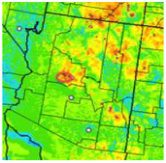
Figure 1: The 2 PM image indicates strong winds (red / purple colors) northeast of the fire.
placed on the critical warning signals of extreme fire weather and fuel condi- tions, leading to an unfortunate loss of lives” (Morrison and Wooten, 2013) (Kaplan et al, 2021). The terrain, covered with a dense carpet of volatile grass from prior wet years; then a prolonged, critical drought, hit by forceful Summer outflows, and gust fronts, adversely affected fire behavior. Kaplan et al’s instructive, in-depth paper noted: “The Yarnell Hill Fire, [fire-front] motion shifted from east–northeastward to southeastward to southward and, finally, southwest-ward over a brief period during the late afternoon of 30 June [2013]” (Kaplan et al, 2021). Cliff Mass, a Univ. of WA Atmospheric Sciences professor, qualified that the June 30, 2013, meteorology upset him the more he dug into it (Mass, 2013). “You can see why I find this disa- ster so unsettling. Hours before the incident it was clear there was a real threat...satellite and radar showed developing convection to the north that was moving south towards the fire.” He at the same moment questioned whe- ther there were meteorologists. “This terrible tragedy needs to be reviewed carefully. … A number of media outlets called the strong winds unpredictable and random. This is [in]correct, as shown by the information I provided ...” (Mass, 2013). Indeed, this readily observable increasing adverse fire weather spawned anomalously extreme fire behavior according to experienced, sea- soned Air Operations personnel witnessing the Boulder Springs Ranch (BSR) area that afternoon; labelled as “flowing like water,” with probable hori- zontal roll vortices, depicted in extreme fire behavior journals (Werth et al, 2011, 2016) Extreme wildfire behavior at this stage should best be deba- ted and researched in terms of buoyancy, fluid dynamics, or fluid mechanics according to studied research scientists familiar with this ongoing, valuable field (Tieszen, 2000). “Buoyancy generated by the fire induces vorticity and instabilities in the flame zone that control the convective heating needed to ignite fuel particles and produce spread.” It’s highly probable there were hori- zontal roll vortices (HRV) occurring (Finney et al, 2015); refer to Figs. 3 & 4 below. Regarding entrapments: “Examination of the historical literature indicated that entrapment potential peaks when fire behaviour rapidly devi- ates from an assumed trajectory, becomes extreme and compromises the use of escape routes, safety zones or both” (Page et al, 2019).
Wildland Firefighting Rules and Guidelines Overview The common firefighter safety rules are the 10 Standard Firefighting Orders; 18 Situations That Shout Watch Out; Common Denominators of Fire
132 Schoeffler and Collura
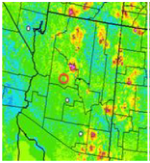
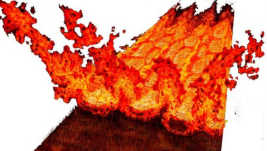
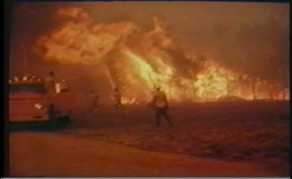
Figure 2: The 4 PM forecast and winds reaching the fire site. Red circle shows fire site, with maximum wind speeds (knots). The model simulated convection and winds that it produced fairly well (NOAA GSL High Resolution Rapid Refresh) – (Mass, 2013).Figure 3: Idealized image of HRV (Finney et al, 2019).Figure 4: 1977 Bass River Fire. NJ State Forestry. Exhibits HRV that killed all the FFs in the photo. (Krohn, NIFC, 1977).
Behavior on Tragedy Fires; Urban Interface Watch Out Situations; Downhill Fireline Construction Guidelines; Lookouts, Communications, Escape Rou- tes, Safety Zones; Aircraft & Tactical Watch Outs; Rules of Engagement; and Trigger Points for the essential goal of Entrapment Avoidance stated by Williams (Williams, 2002) within the Incident Response Pocket Guide (NWCG, 2018). Wildfire mishaps consistently bear this out.
YH Fire and GMHS-Specific Intolerance of WF Rules-Guidelines You will readily notice a clear, ongoing pattern of WFs, FFs - and even the non-wildfire general public - straight away recognizing serious GMHS judgment errors, while remaining inquisitive regarding the Fire Orders and Watch Outs. Former Army infantryman Mockenhaupt, exactly noted: “This was standard procedure, part of a basic safety system known as LCES. If you can establish and maintain this procedure, the theory goes, you should be able to avoid fatal entrapment. … The [GMHS] had walked … along a dirt road and … onto a rocky spur overlooking Yarnell. The obvious was still pushing hard into town. They … started down into a box canyon, heading
How was it Possible to do Everything Right 133
for [BSR], their safety zone. With a steep slope on their left, they lost sight of the fire, breaking an important firefighting rule” (Mockenhaupt, 2018). The SAIT-SAIR acknowledge these decision errors and Fire Order violati- ons, e.g. “They could no longer see the fire, … direction … rate of spread” (p. 40) (Karels & Dudley, 2013). “While they were descending the slope after about 1620, the [GMHS] likely knew or perceived” (1) “The ridge, boulders, and brush sheltered them, so they could no longer see the fire, including its direction and rate of spread.” (2) “They lost the ability to feel or see wind changes.” (3) “They had a limited view of the smoke column, a lagging indi- cator of fire location and fire behavior” (Karels & Dudley, 2013). And SAIT Co-Team Leader Dudley also picked up on these clear errors and Fire Order breaches in the June 20, 2014, Yarnell Hill - Unified Fire Authority YouTube video discussion of the GMHS actions: “As soon as you drop off that saddle, that prominent ridge that runs out along that box canyon blocks your view to the North-northeast and then before you even go part way down that slope you no longer have a view of anything except for the [BSR] until you drop down to the bottom of the canyon. Then you can’t even see the [BSR] (Peterson, 2014). View Wants To Know The Truth’s (WTKTT) explanatory ’crossfade’ ABC15 Helicopter Raw Video fire behavior footage and WF and FF locations; clip number 18 (taken at the YH Fire on June 30, 2013) and the equivalent ’Google Earth’ imager for locations of resources, fire, and instru- ctive, progressively increased aggressive, rapidly to extreme fire behavior (https://www.youtube.com/results?search_query=wantstoknowthetruth). (Wants To Know The Truth, 2015) Dudley noted: The [GMHS] team drop- ped into the box canyon, where their view to the north was cut off, and hiked down to the [eventual] deployment site”(Peterson, 2014). The YH Fire rapidly became hypothetically more deadly fire as the day progressed based on forecast and noticeable, observed weather, and predicted and observed aggressive to exponentially extreme fire behavior (Morrison and Wooten, 2013). Yet, the IMT had a meager grasp of that. This important exponen- tial growth concept is the growth rate - as it is increasing at a greater and greater rate - constantly doubling in size in a set time cycle (Dorner, 2009). Consider flagrantly underrating the 10 & 18 and human factors in the SAIT- SAIR where they concluded that the GMHS did everything right, yet 19 young men died. This is known as cognitive dissonance - a state of tension that occurs when a person holds two ideas or beliefs that are psychologi- cally inconsistent with each other; and it is still producing ongoing immense mental distress issues for YH Fire WFs and FFs. It is troubling because “to hold two contradictory ideas is to flirt with absurdity” (Tavris and Aronson, 2007). Mockenhaupt noted: “The [ASF] commissioned a [SAIT] to deter- mine what had gone wrong in Yarnell. ... After the other big wildfires that had killed multiple firefighters in the past century, survivors had been able to fill in crucial pieces of information about on-the-ground conversations and decision making. But the [GMHS] had died without any eyewitnesses” (2014). Incorrect! Two hikers eyewitnessed and recorded the fire the entire weekend with cell phones, cameras and videos, discerned and heeded those warnings - without radios - and yet they made it safely to their vehicle in Yarnell minutes before the GMHS (Sheff LLC, YHFR, 2018). Mockenhaupt
134 Schoeffler and Collura
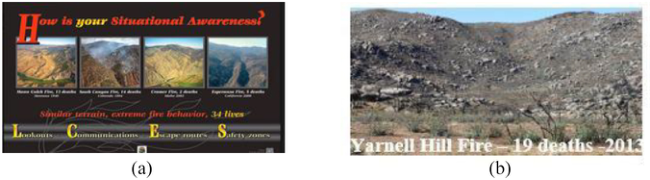
easily surmised: “As hard as they tried, however, the [ADOSH] inspectors were unable to answer the question that had stymied the first investigation team: Why had 19 skilled wildland firefighters left the safety of a burned- over area and hiked into a box canyon overgrown with dense vegetation …? (Mockenhaupt, 2014). PFD BC Willis during a South Canyon Fire Site Visit with “the [GMHS] had studied those fires and had even once walked the ground … where 14 firefighters had died in 1994, trying to understand what had happened from the [FFs’] perspective. ... ‘We said we’re never going to let this happen to us,’ … ‘It was kind of like a commitment: we can’t let this happen to us. I can just see another picture here. … ’ 2013. Yarnell Hill 19.”’ But they did let it happen! PFD Willis admitted “’ … I relive it every day”’ (Mockenhaupt, 2014). It is clearly bolstered by the legendary PFD “Prescott Way” with these assertions: “Like many others … Willis has spent a lot of time asking himself why … ‘They wanted to reengage … Sure, they could sit up there in the black. But if they could try to get back in the game, they were going to. … do we just sit up here and watch it go by? They knew there was an evacuation going on, they knew there were people staying in their houses. So what would the public think? You’re not going to help us? Why did you even show up”’ (2014)? That is clearly the generally accepted and hyped mindset of most municipal firefighters. A fatal wildfires training poster: “How is your Situational Awareness? Similar terrain, extreme fire behavior, 34 lives” is a typical display at wildland fire resource bases natio- nally. Ask yourselves why WFs, and especially these municipal FFs, continue to ignore the lessons learned from working on wildfires in these acknow- ledged death traps. Compare Fig. 3. poster and GMHS DZ and Fatality Site bowl Fig. 3. photos. Conceded at a formal, official October 2013 Southw- est Hot Shot Crew After Action Review, YH Fire Site Visit Integration Phase was this was “The final, fatal link in a long chain of bad decisions with good outcomes, we saw this coming for years” (Schoeffler, 2016). The mystery is why? Or was it “just one of those things that happened, You can call it an accident … they picked the best possible place in this bowl to deploy shel- ters” times when Willis obsequiously blurts it out at the July 2013 GMHS Deployment Zone News Conference (Dougherty, 2013). The people’s right to know is hindered when USFS WF’s interviews were not allowed. Weaving through this legal minefield of the Touhy Doctrine giving Federal Agencies “sole authority to produce documents and authorize employee’s testimony in response to a subpoena or other demand for information” and the archaic 1966, to-the-point 61-word Federal Housekeeping Statute allowed them ple- nary control of Federal evidence in litigation regarding their employees, and their records proved vexing (Daniels, 2016; Sheff LLC YHFR, 2019).
See Fig. 8. and YHFR website post: Schoeffler, F. (2020) “Credible evide- nce of June 30, 2013, “friendly fire”incidents in the Sesame / Shrine Corridor area?” (Sheff LLC, YHFR, 2018) (Schoeffler, 2019) Sound verifiable evidence exists that several local WF-FF groups performed an ad hoc firing operation along the Sesame St. - Shrine corridor areas. And the GMHS, short of compl- ying with required LCES (e.g. - without communicating these actions, minus a designated lookout, nor notifying Air Attack) hiked without pause - dow- nhill toward the allegedly threatened BSR - to their deaths (Sheff LLC, YHFR,
How was it Possible to do Everything Right 135
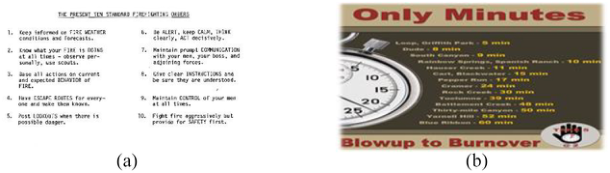
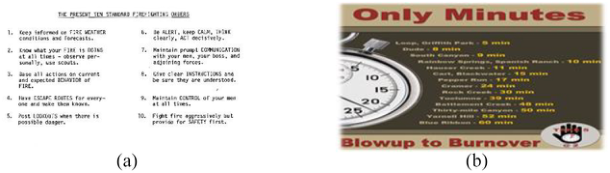
Figure 5: “How is your Situational Awareness?” (left) (MTDC-NWCG) Fig. 5a. (right) YH Fire bowl for a poster titled: “Yarnell Hill Fire, 19 deaths. Arizona 2013” (SAIT-SAIR).Figure 6: (left) April 1980 “Preliminary Report of Task Force on Study of Fatal / Near- Fatal Fire Accidents.” (WLFLLC) Fire Order 4 only covers Escape Routes without Safety Zones. WF Fire Safety Training Annual Refresher Blowup to Burnover poster Fig. 6b. (right). (WFSTAR).Figure 7: Google Earth vertical profile of YH Fire Sesame Street and Shrine Corridor upslope virtual slingshot funneling winds and fire behavior aligned from right to left, NE↔SW, directly into the GMHS deployment site. (Not to scale) Juxtaposing this image with Fig. 6b. (below) will definitely provide clarity and put this important terrain feature into a clearer perspective.
2018) (Schoeffler, 2019). NPS WF Weaver said: “Some in the [wildland fire] community believe WUI played a part in the death of the 19 [GMHS] on the [YHF], who were killed as they made their way to defend a home. … basi- cally in their home unit’ (Wright, 2018). Watch Out #4 was shouting out to them after working the nearby Doce Fire with quasi-prophetic aggressive fire behavior a week prior; but the SAIT-SAIR is silent about any planned-for and executed Sesame-Shrine Area Corridor firing operations (Karels & Dudley, 2013). GMHS Andrew Ashcraft’s mother is resolute about a “back burn:” (“I really think there was a back burn set possibly by the trailers [likely The Shrine])” (Pfingston & Harwood, 2018).
Conspired Efforts to Discredit the Wildland Firefighting Rules and Guidelines - Complicit Wildland Fire LLC and NWCG Author Kyle Dickman exposes a lot: “In January 2014, 11 veteran firefi- ghters from the nation’s biggest fire agencies—the vanguard of fire, as they
136 Schoeffler and Collura
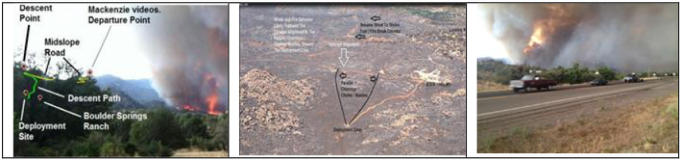
Figure 8: (left) B. Lauber, WTKTT, Google Earth photo - intense fire behavior June 30, 2013 (1629 hrs.) from Assembly of God church along Hwy. 89 with Google Earth overlay - GMHS location, GMHS-descent point, GMHS deployment / fatality site (DZ) and Helms (BSR) (8a.) (middle) Google Earth, Collura. Enhanced Google Earth snippet image using Paint, aligned northwest, Sesame - Shrine Corridor leading to parallel twin chutes funneling upslope to GMHS DZ. (8b.) (right) photo ABC News - very intense, aggressive fire behavior along Hwy. 89 about 1631 hrs. The GMHS then hiked directly down into this furious upslope fire event.
were described to me—met in Yarnell. They hiked along the route the hotsh- ots had likely taken from the ridge into the canyon where the 19 died seven months earlier. They arrived at a startling conclusion. ‘We could see ourselves making the same decision they’d made,’ said Travis Dotson, a member of the WFLLC, a federally funded group that helps [WFs and FFs] improve their performance”’ (Dickman, 2018). Around the time of the field trip, Dotson and others formed an underground group called Honor the Fallen. Included in its couple dozen members were some of the highest-ranking firefighters from the various agencies in the wildland fire business: the [USFS, BLM, and NPS]. Their goal was to make sure [the YH Fire], the most publicized event in wildland firefighting history, forced some much-needed changes to the job’s outdated culture. They tried to spark “an age of enlightenment.” Said Dot- son: “Before Yarnell, it was about getting better at fighting fire. After, it’s been about getting better at accepting death.” And this: “They were trying to save lives,” [so-called SAIT Lead Investigator] Mayhew says: “They knew people were threatened down there. [And it] must have weighed on them” (Dickman, 2018). And former PFD FF McCarty lock-step with his “Prescott Way” drivel; “I can see why those guys would have gone there to try to get to the ranch house, if that’s what they were doing, to try to make a differe- nce”(Lingle, 2020). Carswell also casts doubt on the SAIT-SAIR: “One of the most haunting questions of the [SAIT] commissioned by the [ASF], … is why they moved. But it will remain forever unanswered. … it is very cautiously worded, drawing no strong conclusions about what should have been done differently. … no one will ever know for sure, the report speculated that the hotshots left the safe zone to ‘re-engage’ -- to try to protect houses in the fire’s path” (Carswell, 2014). Groupthink is extolled to support the SAIT-SAIR! Carping on the randomly insipid, yet powerful Natl. Wildfire Coord. Group: “For better or worse, NWCG has taken the position that the 10 Standard Fire Orders are now to be considered guidelines and not absolute orders. … No explanation … why rules that have been in place for 50 years are sud- denly guidelines” (Thuermer, 2014). Predictable, harmful vagaries occurred and continue post-YH Fire.
How was it Possible to do Everything Right 137
Honor the Fallen - Debatably Legitimate “Underground Group” “This video was captured on site of the Yarnell Hill Fire in January 2014. The participants spent the day walking the ground and discussing the chal- lenges facing the wildland fire service as a whole.” On the contrary, this was not from “the wildland fire service as a whole” (WLF LLC, 2014), but an “underground group” which suggests secret societies and subversions. USFS Apprenticeship Acad. Prog. Mngr. Heath Cota stated: “And the truth is that we try to put it into these little boxes and these rules of the 10 and 18s that cannot ... they’re not going to keep us safe. It’s been proven time and time again. We can’t follow our own rule ... you know, these rules, whatever they are ... this environment is way too complex. Ah, we’re really lucky we do a good job at it. And I think that to me, the luck, the whole luck decision conversation, how often is it luck? … The gravity of walking down that [is] where it hit me … Looking down, seeing how close it looks, … how far it is. Scurrying through that is where it hit home for me. ... we can all see the path of the friction, the uncertainty, the fluidity in the environment, and how it just shapes it … where [it] is absolutely feasible and possible. Like … at that time. It was good until it wasn’t” (WLF LLC, 2014). They are alarming statements coming from this unofficial group!
WLF LLC Kelly Woods and USFS PNF (R5) WF Eric Apland “Reading, Reflecting, and Changing Behavior.” Woods and Apland talk about his WLF LLC Incident Review Database task to read all the entra- pment reports. He offered narrow-minded insight on the reports to match the SAIT-SAIR. And most troubling is that there was no mention of the YH Fire or the GMHS debacle or how effective the proven, tried-and-true 10 & 18 are, implying intent (WLF LLC, 2021).
Sesame St. - Shrine Fuel - Fire Break Corridor Firing Operations At least twenty (20) people, including WFs, FFs, and both YH Fire hikers watched a video in July 2013 at the Yarnell, AZ Library of a firing operation; also viewed by one FF on YouTube before abruptly vanishing without a trace, like so much other YH Fire evidence (Sheff LLC, 2018). Former YFD Fire Chief Peter Andersen (RiP) verified: “we built an emergency escape route for Yarnell in case there was a burnout like this … in that area below [and West of] The Shrine, … they had dozers back … so that it would create a fire break, … ” (Dougherty, 2013). Eyewitness hiker Sonny Gilligan said of this firing operation area: ‘We identified it [in the video] by the short rock wall that is seen just by walking a bit above the Shrine and just before the locked gates that were open due to the fire in the [area].’ A key firing operation occurred in this Sesame-Shrine Corridor area (https://youtu.be/ffUfBkSBtmA) (Collura, 2019).
CONCLUSION
Wildfires are profoundly captive to both external and internal forces. Indeed, it was impossible to do everything right and yet 19 Prescott FD FFs die in
138 Schoeffler and Collura
one fell swoop on June 30, 2013. Haughty attorneys claim otherwise about the biggest cover-up, lie, and whitewash in wildland fire history (Sheff LLC, YHFR, 2018). The hikers’ evidence disputed the SAIT-SAIR. False contrived defensive claims thrive: “Lessons from Yarnell continue to echo throughout the wildland [FF] community.” and “The [YHF] remains part of an ongoing discussion on wildland firefighting safety” (Lingle, 2020). Gleason & Robin- son warn: “… failing to learn the lessons of the past dooms us to reliving those lessons, then we must either impress indelibly into the minds of fire- fighters the lessons of the South Canyon Fire or we will again experience its tragic outcome” (Close, 2005). Student of Fire commenter #19 Matt pre- cisely noted: “It is unforgivable that we allow sentiment and tradition [to] prevent us from learning anything from … Yarnell because we continue to be blinkered … in our eagerness to ‘not speak ill’ of the dead. It is nothing short of astonishing that the official conclusion was that everybody involved in the YHF] did everything right. … Covering up facts because they make us uncomfortable dishonors the dead, and ensures the same mistakes will be made in the future” (Woodbridge, 2014). The danger to us all comes from contrived SAIT et al and sycophants’ accounts and the sham musings of an “[un] official Agency effort” Underground Honor the Fallen. Wildfire dea- ths will likely endure because of this aberrant movement’s need to hide these known causal factors!
RECOMMENDATIONS (1) Create a valid week-long AZ Wildland Incident Management Academy (AWIMA) sanctioned course for trustworthy YH Fire and GMHS site visits and Staff Rides. The heartland of this epic tragedy is purposely sterile about the falsely espoused “Lessons Learned.” (2) Use truth as an anchor point to honor both the living and the fallen. (3) Stress that WFs and FFs are different than the military with no acceptable losses. (4) Require the YH Fire USFS WFs, and untold other WFs, FFs, and citizens holding a lot of valid evidence about this epic, tragic wildfire inside, to come forward in order to heal and release their internalized demons for “complete lessons learned.” (5) Com- pel strict Ten Standard Fire Orders diligence and mitigating any Watch Out Situations. (6) As difficult as it is, require GMHS autopsy reports analyses in annual RT-130 Critical Trainings so that WFs and FFs will know the poten- tial outcomes of dying by fire. (7) Within the GMHS Family Staff Ride (2016) guide’s attempt to mollify and justify rash GMHS decisions and actions and fatal outcome, the grave 1930 essay beckons removal as it seeks GMHS validation: “The Courage to Be” (Lejeune): “ …unquenchable courage and unconquerable determination crush out fear, and death becomes preferable to defeat and dishonor” (Dougherty, 2016). (8) The “[un]official Agency effort” of the ambiguous Underground Honor the Fallen faction falls within the “group dynamics” class. That key scheme holds that groups have toxic psychological traits independent of the single members. In groups, people find themselves behaving in ways they never would if left to their own devi- ces (Davies, 2020). Such is the case of the June 30, 2013, YH Fire and GMHS debacle; the biggest cover-up, lie, and whitewash in all wildland fire history.
How was it Possible to do Everything Right 139
And so, the authors believe it is of utmost import to insist upon denying these unsanctioned groups their perverse coveted moral validity.
ACKNOWLEDGEMENT
The authors express their sincere gratitude to: Dr. Ted Putnam; John Dou- gherty, InvestigativeMEDIA; both Yarnell Hill Fire Eyewitness Hikers; Barry Hicks; those employees defying ordered Agency gag ‘direction’ & ‘guidance.’ To those who lost family, friends, and loved ones, the authors engage in battle for those men daily, inspiring us to research and write toward exposing these truths to reduce fatalities.
REFERENCES
Carswell, C. (2013) Why are the conclusions of the Yarnell Hill Fire investigation so timid? High Country News (online) Close. K. (2005) Fire Behavior vs. Human Behavior. 8th Intl. WF Safety Summit Collura, J.A. (2019) The Shrine Area - Yarnell, Arizona - (Waltraud) Rock Wall -
Yarnell Hill Fire. YouTube. Available at: https://youtu.be/ffUfBkSBtmA Daniels, W.A., Esq. (2016) The Touhy Trap. Daniels Law (online) Davies, W. (2020) What’s Wrong With WhatApp? The Guardian Dickman, K. (2018) What We Learned from the Yarnell Hill Fire Deaths. Outside Dorner, D. (2009) The Logic of Failure. New York Dougherty, J. (2013) GMHS DZ Site News Conference. Yarnell, YouTube (2013) Dougherty, J. (2013) Former Yarnell Hill Fire Chief Peter Andersen (RiP) Interview Oct. 8, 2013. YouTube. Available at: https://youtu.be/UFObh-fNOl8 Dougherty, J. (2016) Wildfire Expert Alleges Arizona Forestry Division Covering Up
Yarnell Hill Tragedy. New Times (online). Finney, M.A., Cohen, J.D., Forthofer, J.M., McAllister, S.S., Gollner, M.J., Gorham, D.J., Saito, K., Akafuah, N.K., Adam, B.A., English, J.D. (2015) Role of buoyant flame dynamics in wildfire spread. PNAS. Kaplan, M., James, C.N., Ising, J., Sinclair M.R., Lin, Y.L., Taylor, A., Riley, J.,
Karim, S.M.S., Wiles, J. (2021) The Multi-Scale Dynamics Organizing a Favora- ble Environment for Convective Density Currents That Redirected the YH Fire. Climate, 9 Available at: https://www.mdpi.com/2225-1154/9/12/170 Karels, J., and Dudley, M. (2013) Yarnell Hill Fire Serious Accident Investigation Team (SAIT) Yarnell Hill Fire Serious Accident Investigation Report (SAIR). Lingle, B. (2020) Friends, Family Remember the Granite Mountain 19 Seven Years
After the Tragic Accident. Black Rifle Coffee Company. Coffee or Die. Mass, C. (2013) The Yarnell Hill Fire: The Meteorological Origins. Cliff Mass Weather Blog Available at: https://cliffmass.blogspot.com Mockenhaupt, B. (2014) Fire on the Mountain. The Atlantic. Morrison P.H. Wooten, G. (2013) Analysis and Comments on the Yarnell Hill Fire
in Arizona and the Current Fire Situation in the United States. Pacific Biodiversity Institute. Winthrop, WA. NWCG: Incident Response Pocket Guide (IRPG). PMS 461, NFES 001077 (2018) Page, W.G., Freeborn, P.H., Butler, B.W., Jolly, M. (2019) A review of US wildland firefighter entrapments Intl. J. Wildland Fire. 551–569 Peterson, F. (2014) SAIT Co-Team Leader M. Dudley. Unified Fire Authority
YouTube. Pfingston, D. and Harwood, D. (2018-2019) Our Investigation, Our Truth podcast.
140 Schoeffler and Collura
Schoeffler, F.J. (2016) Human Factors Influenced the 30 June 2013 YH Fire Fatalities.
CAWRT, RT-130 Refresher. PDF. Available at: http://.www.academia.edu. Schoeffler, F., Honda, L., Collura, J. (2019) Credible Evidence Continues to Surface Regarding a Likely “Friendly Fire” Incident Along the Sesame Street and Shrine Corridor Area on June 30, 2013. Available at: https://scholar.google.com/citatio ns?user=WeaMSJkAAAAJ&hl=en Sheff LLC and Joy A. Collura (2018) YH Fire Revelations available at: www.yarnel
lhillfirerevelations.com Tavris, C. and Aronson, E. (2007) Mistakes Were Made (But Not By Me) Pinter & Martin Ltd. London. Thuermer, A.M. (2014) WyoFile Fire. Wildland Colleagues in Danger (2014). Tieszen, S.R. (2000) On the Fluid Mechanics of Fires. Sandia National Laboratories. WantsToKnowTheTruth. Several Informative Cross-fade Google Earth overlays.
YouTube Available at: https://www.youtube.com/results?search_query=wantsto knowthetruth Werth, P. (2011, 2016) Synthesis of Knowledge of Extreme Fire Behavior. Volumes 1 & 2 Pacific NW Research Station. PNW-GTR-854 https://www.fs.fed.us/pnw/pu bs/pnw_gtr891.pdf Wildland Fire Lessons Learned Center (LLC) Honor the Fallen. YouTube (2014) Inci-
dent Reviews, Online (2018) Reading, Reflecting, and Changing Behavior podcast (2021). Williams, J. (2002) Next Steps in Wildland Fire Mgmt. (2002) Fire Mgmt. Today, 62, 4, Fall Woodbridge, J. (2016) Student of Fire. On The Road: Yarnell (Facebook, “PHP
installation for the MySQL extension which is required by WordPress”) Available at: https://www.facebook.com/Studentoffire [accessed 2021] Wright, C. (2018) The Real Toll of the West’s Battle with Fire. Gear Patrol LLC.
LISTED IN THE AHFE DIGITAL BOOKSTORE CATALOGUE
Explore the complete digital volume
Human Error, Reliability, Resilience, and Performance
Read this individual research paper free through the original publisher, or explore the full digital proceedings book.
ISBN 978-1-958651-09-4
Explore this ISBN in the AHFE Bookstore ↗Listed in the July 2026 bookstore catalogue; search by ISBN to confirm current availability · Digital book purchase optional