Jing Wen, Pengcheng Li (2022). The Formation Mechanism of Team Decision-making Errors in Digital Nuclear Power plants. In: Human Error, Reliability, Resilience, and Performance. AHFE Open Access, vol. 33, pp. 91–98. https://doi.org/10.54941/ahfe1001572
In order to identify the mechanism of team decision-making errors (TDMEs), firstly, the concept of TDMEs is defined, and on the basis of on-site observations and simulation experiments, the team decision-making behaviors in the digital main control room of nuclear power plants (NPPs) are analyzed when facing event of an accident . Then, the specific classifications of behaviors and errors of team decision-making (TDM) are conducted, the contextual factors confronted with TDM are analyzed and classified specifically also. Furthermore, identifying the effects of contextual factors on team decision-making so as to extract the main influencing factors. Finally, the interactions between the influencing factors of TDMEs and their priorities are recognized through Interpretative Structural Modeling(ISM) methods, and a causal conceptual model is developed to reveal the formation mechanism of team decision-making errors(TDMEs), which provides theoretical basis for preventing TDMEs in digital NPPs.
For nuclear power plants with complex industrial system, the monitoring of normal system operation and the successful handling of abnormal con- ditions are normally performed by the team members together, and the safety of NPPs depends more on the precise performance of team members than on individual performance (Banbury and Tremblay, 2004). When an abnormal situation occurs in a nuclear power plant, to successfully mitigate the accident, the manipulation team needs to collect information, process information, diagnose system status, make decisions, and finally execute deci- sions (Lee et al., 2008; Chang and Mosleh, 2007). Therefore, the precise team decision-making is of vital significance for team cognitive behaviors, and catastrophic consequences (Burke et al., 2008) might be caused if the team made some wrong decisions. One example was Chernobyl accident that occurred in the former Soviet Union. In fact, Team Decision Making (TDM) is a process (Kerr and Tindale, 2004; Highhouse et al., 2013) that team members work together to evaluate a situation, reach consensus, form
a plan and finally make a decision. All the members of operation team in NPPs work together to analyze the problem, create and evaluate courses of action, and select a solution from alternatives to resolve an abnormal event (O’Hara et al., 2000). When incident occurs, although NPPs provide proto- cols to guide the operator’s response, years of practice and a large number of cases have shown that operators still make a variety of human errors in the decision-making process, such as operating violations, passing the wrong pro- tocols, and mismatching protocols with system states. The results of human event analysis in NPPs indicate that TDMEs is one of the key causes for those unexpected accidents. Therefore, TDM is of critical importance to the successful execution of team tasks.
For high-risk systems like nuclear power plants, currently there is more research on individual decision-making. Little has been conducted on TDM. Research on the influencing mechanisms of TDM is mainly focused on the area of natural decision-making. Zsambok et al. (Zsambok et al, 1992) developed a model of TDM (called the 1.0 version), which argues that TDM is influenced by three main factors, including team identity, team conceptual level, and team self-monitoring. Klinger and Klein developed a decision-making strategy (Klinger and Klein, 1999) based on this model for application in NPPs. Subsequently, Thordsen et al. (Thordsen et al., 2002) developed a 2.0 version of the Advanced Team Decision Making (ATDM2.0) model based on the first model. The newly proposed model considers the dynamic process of team decision-making in an operational environment, mainly influenced by team resources, team roles, team cognition, and team meta-cognition. Sonesh et al. (Sonesh et al., 2013) proposed a model of team decision-making in a natural dynamic environment, identified the factors affecting decision quality, and mapped the input-output relationships. Mar- shall (Marshall, 2014) developed a TDM model under pressure conditions, including the perceived accuracy of team members, the mental model accu- racy, shared team member mental model accuracy, cognitive processes, team processes, and team decision quality, all of which interact with each other and ultimately determine the quality of team decisions. In a nuclear power plant, Chang and Mosleh (Chang and Mosleh, 2007) analyzed the influe- ncing factors of team diagnosis and decision-making, including internal and external influencing factors. While the models above considered the TDM process in a specific scenario, the TDM influencing factors have not been classified, the influencing factors external to the team and their influencing relationships have not been considered, and the failure mechanism of TDM has not been recognized from the perspective of complex socio-technical systems.
ANALYSIS OF THE FACTORS AFFECTING TDM Factors in the work environment that have an impact on human behavior are uniformly described as performance shaping factors (PSFs) or performa- nce influencing factors (PIFs), and poor PIFs can negatively affect human reliability, increasing the probability (Li et al., 2019) of human errors. In recent decades, human reliability analysis (HRA) techniques have been widely
The Formation Mechanism of Team Decision-making Errors in Digital Nuclear Power Plants 93
Table 1. Classification of factors influencing TDM.
Table available in the original PDF paper.
Organizational factors Situational factors Team factors Individual Factors Mental state; Physiological state; Memorized infor- mation; Qualities and abilities Team knowledge and Experience level; Team stress level; Team working attitude; Team communication and cooperation level
Technology system; Man-machine interface; Task; Protocol; Working environment; Information display level
Goals and strategies; Organizational structure; Organizational resources; Organizational management; Education/Training; Organizational culture; Organization plan /design
studied as a systematic approach to analyze personnel reliability in NPPs in order to prevent the occurrence of human errors, which can effectively reduce the accident rate. By reviewing some representative HRA methods, it is found that various PIFs are identified in different HRA methods with different approaches and different human reliability influencing factors con- sidered. Despite the development of various PIFs and their taxonomies by HRA methods, the main problem with the existing taxonomies of PIFs is that some taxonomies are not comprehensive and do not include certain pro- ven important PIFs, especially the relationship between organizational factors and human errors is not considered, while some taxonomies include too many unmeasured and overlapping factors. As a result, there lacks a more comprehensive and uniform classification of factors influencing decision- making in the workgroup. The organization-oriented human error analysis technique refers to the fact that the factors influencing TDM in nuclear power plants only consider internal organizational factors and not exter- nal organizational factors (Li et al., 2018). According to this technique, TDM is influenced by four types of factors, i.e. organizational factors (inclu- ding goals and strategies, organizational structure, organizational resources, organizational management, education/training, organizational culture and organizational planning/design), situational factors (including technology system, man-machine interface, task, protocol, working environment, infor- mation display level), team factors (including team knowledge and experience level,team stress level, team working attitude, team communication and coo- peration level) and individual factors (including mental state, physiological state, memorized information and qualities and abilities) (Li et al., 2018) (see Table 1). The specific connotations and detailed classification of the influencing factors are listed in the references (Li et al., 2018; 2011).
THE IMPACT MECHANISM OF TEAM DECISION-MAKING FAILURE In order to identify the influencing mechanisms of team decision-making failure, this paper uses the Interpretative Structural Modeling as analysis method. The Model was proposed in 1973 by J. N. Warfelt, an American system engineering theorist, as a method for analyzing structural models of
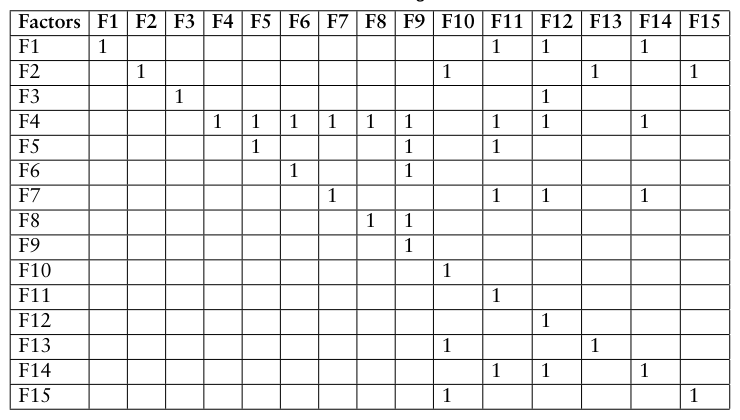
Table 2. Reachable matrix of the main influencing factors of TDM.
complex systems (Su et al., 2021). The ISM method can effectively decompose a complex system into several subsystems, and then construct a multilevel recursive model of the overall system structure based on the interrelationships between the factors (Yan, 2007).
Identification of the Main Influencing Factors Due to their complex correlations, the number of factors influencing TDM in the digital main control room of NPPs is relatively large. Through lite- rature and human event report analysis, the key factors causing TDMEs have been clarified and filtered out. Details are as follows: organizatio- nal management (F1), education/training (F2), organizational culture (F3), organizational design (F4), technology system (F5), man-machine interface (F6), tasks (F7), protocols (F8), information display level (F9), team kno- wledge and experience level (F10), team stress level (F11), team working attitude (F12), team communication and cooperation level (F13), mental state (F14), and quality and ability (F15).
Adjacency Matrix and Reachable Matrix Based on the above list of influencing factors, four experienced operators of npps and two experts were invited to conduct expert interviews on the above fifteen factors, as well as the interactions between factors. The results of the interviews were summarized, and the binary relationships between factors were established by combining the characteristics of the factors and the experts’ opinions. The built adjacency matrix and the reachability matrix is built (see Table 2).
Hierarchy of Influencing Factors The reachable set R, the prior set A and the common set (T = R ∩A) of each factor are calculated separately according to the reachable matrix of
The Formation Mechanism of Team Decision-making Errors in Digital Nuclear Power Plants 95
Table 3. Hierarchical sorting of factors influencing decision-making in the team.
the table, and if the reachable set R of a factor is the same as the common set T, the factor belongs to this layer. The first sorting results are shown (see Table 3).
From Table 3, four factors (F1, F2, F3 and F4) are in the first layer of the hierarchy (common set is equal to prior set). After removing the four factors and remaking the hierarchical combing table, a different layer table was made and the hierarchy results of the factors influencing team decision failure was obtained (see Table 4).
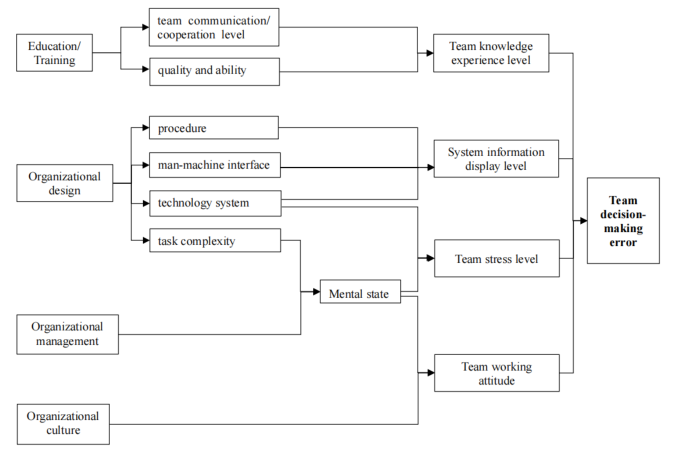
Recursive Structural Relationship Model of the Factors Influencing Team Decision Failure Based on the results of the hierarchical division of the Table 3 and the mutual relationship between the factors in the reachability matrix, a recursive stru- ctured relationship model of the main factors influencing decision failure in the digital control room team of NPPs is constructed (see Figure 1).
The model in Figure 1 analyzes the levels and influencing paths of each factor in TDM more intuitively. The influences on decision-making errors in the work group can be divided into 4 levels. Factors in the first level include organizational management (F1), education/training (F2), organizational cul- ture (F3), and organizational design (F4); the second level include: technical
Figure 1: Recursive structural relationship model of factors influencing decision failure in digital NPPs team.
system (F5), human-machine interface (F6), tasks (F7), protocols (F8), team communication and cooperation level (F13), and quality and competence (F15). Factors located in the third level include: level of information display (F9), level of knowledge and experience of the team (F10), and psychologi- cal state (F14). The fourth level include: team stress level (F11), and team work attitude (F12). Among them, information display level (F9), team kno- wledge experience level (F10), team stress level (F11), and team work attitude (F12) have a direct impact on team decision-making failure. From the above analysis, it can be easily found that education/training affects the level of com- munication and cooperation of the team as well as the quality and ability of individuals, which further affects the level of team knowledge and experience. Organizational design affects the design of protocols, man-machine interfa- ces, technology systems(e.g. available time), tasks complexity, the first three of which further affects the level of information display of the system. Tasks complexity and organizational management (a high level of organizational management allows work to be carried out in an orderly manner) affects the psychological state of the manipulator (e.g. increases psychological stress), which towards affects the stress level in the team. A good organizational cul- ture will make the manipulation team have a good questioning attitude, risk awareness and difficult to violate, which are part of team working attitude. At the same time, an unstable mental state (e.g. high psychological stress) will easily lead to manipulator violated. Organizational culture and mental state have co-influence on team working attitude.The established recursive structural relationship model of the factors influencing decision failure in the digital nuclear power plant team illustrates the influencing mechanism of TDM failure.
The Formation Mechanism of Team Decision-making Errors in Digital Nuclear Power Plants 97
CONCLUSION
In the main control room of a digital NPP, incident response is usually done by the teammates, and the preciseness of TDM is closely related to the safety of NPP. However, the influencing factors and their influencing relationship with TDM is quite complex. In term of this issue, this paper analyzes the factors influencing team decision failure, adopts the ISM method to explore the mechanism of TDMEs, establishes the recursive structure relationship model of the influencing factors of TDMEs in digital NPPs, and at last reve- als the influencing mechanism of TDMEs. In short, the results of this study provides the theoretical basis for the prevention and control of TDMEs in NPPs.
ACKNOWLEDGMENT
The authors would like to acknowledge the National Natural Science Foun- dation of China (Grant No. 51674145) and Natural Science Foundation of Hunan Province (Grant No. 2017JJ2222, 2021JJ30583), Special Fund for Popular Science of Hunan Province (Grant No. 2020ZK4031). Philosophy and Social Science Foundation of Hunan Province (Grant No. 21YBA104) and Social Science Achievement Review Committee Project of Hunan Provi- nce (Grant No. XSP20YBC144).
REFERENCES
Banbury S., Tremblay S. (2004) A cognitive approach to situation awareness: theory and application. London: Routledge. Burke C.S., Priest H.A., Salas E., et al. (2008) Stress and teams: How stress affects
decision making at the team level. In Hancock P.A., Szalma J.L. (Eds.), Performa- nce under stress. Aldershot, Hampshire: Ashgate Publishing. pp. 181–208. Chang Y.H.J., Mosleh A. (2007) Cognitive modeling and dynamic probabilistic simulation of operating crew response to complex system accidents—Part 1: Overview of the IDAC Model. Reliability Engineering and System Safety. Volume 92, NO. 8, pp. 997–1013. Chang Y.H.J., Mosleh A. (2007) Cognitive modeling and dynamic probabilistic simu-
lation of operating crew response to complex system accidents—part 2. IDAC performance influencing factors model. Reliability Engineering and System Safety. Volume 92 NO. 8, pp. 1014–1040. Highhouse S., Dalas R.S., Salas E. (2013) Introduction to judgment and decision making. Judgment and Decision Making at Work. New York: Routlege. 1–9 Kerr N.L., Tindale R.S. (2004) Group performance and decision making. Annual
Review of Psychology. Volume 55 NO. 8, pp. 623–655. Klinger D., Klein G. (1999) An accident waiting to happen. Ergonomics in Design: The Quarterly of Human Factors Applications. Volume 7 NO. 3, pp. 20-25. Lee S.J., Kim M.C., Seong P.H. (2008) An analytical approach to quantitative effect
estimation of operation advisory system based on human cognitive process using the Bayesian belief network. Reliability Engineering and System Safety. Volume 93 NO. 4, pp. 567–577. Li P.C.,Li X.F., Zhang L, et al. (2019) A study on team situation awareness errors in digital nuclear power plant. Industrial Engineering and Management. Volume 24 NO. 2, pp. 183–189+197 .
Li P.C., Zhang L, Dai L.C., et al. (2018) A new organization-oriented technique of human error analysis in digital NPPs: Model and classification framework. Annals of Nuclear Energy. Volume 120 pp. 48–61. Li P.C. (2011) Study on human error and reliability in digital control system of
nuclear power plant. Doctor Dissertation, South China University of Technology, Guangzhou, Guangdong, China. Marshall A.D. (2014) Toward a model of team decision making under stress.
University of Central Florida, Orlando, USA. O’Hara J.M., Higgins J.C., Kramer J. (2000) Advanced information systems design: technical basis and humans review guidance. NUREG/CR-6633. Sonesh S., Rico R., Salas E. (2013) Team decision making in naturalistic environ-
ments: A framework for and introduction to illusory shared cognition. Judgment and Decision Making at Work. New York: Routlege. pp. 199–227. Su L.L., Zhu Y.Y., Ni J.J. (2021)Analysis on Influencing Factors of Material Bidding Procurement Quality of Power Engineering Based on Interpretation Structure Model. Tianjin science & Technology. Volume 48 NO. 10, pp. 14–19. Thordsen M. L., Kyne M. M., Klein G. (2002) A model of advanced team decision
making and performance: Summary report. Fairborn, OH: Klein Associates Inc. Yan R.Q. (2007)Optimising the structure of investment in science and technology, Improving the efficiency of the use of funds in research institutions. Chinese Health Economics Magazine. Volume 26 NO. 10, pp. 51–52. Zsambok C.E., Klein G., Kyne M.M., Klinger D.W. (1992) Advanced team decision
making: A developmental model. AD-A259 512.
LISTED IN THE AHFE DIGITAL BOOKSTORE CATALOGUE
Explore the complete digital volume
Human Error, Reliability, Resilience, and Performance
Read this individual research paper free through the original publisher, or explore the full digital proceedings book.
ISBN 978-1-958651-09-4
Explore this ISBN in the AHFE Bookstore ↗Listed in the July 2026 bookstore catalogue; search by ISBN to confirm current availability · Digital book purchase optional