Mamiko Murahashi, Yusaku Okada (2023). Method for Enhancing Evaluation of the Human Error Probability in Disaster Risk Assessment for Industrial Plants. In: Human Error, Reliability, Resilience, and Performance. AHFE Open Access, vol. 82, pp. 80–86. https://doi.org/10.54941/ahfe1003556
An important part of considering countermeasures for disasters in industrial plants is to conduct an accurate risk assessment. In general, we assess risk based on two indicators: the harm severity and the probability. We first select candidate countermeasures based on the harm severity. Next, the specifications of countermeasures such as the scope of application, expected lifetime and cost are determined, taking into account of the probability. As a result, we introduce appropriate countermeasures in the field that can control risks within acceptable limits.Various countermeasures for disasters caused by human error are considered similarly and introduced in the field. It is necessary to analyze the factors related to human error, which are called performance shaping factors, in order to evaluate the human error probability. For this purpose, workers with appropriate knowledge and ability of human factors must be assigned to the risk assessment team. However, it is difficult for many industrial plants to secure the required number of workers who can accurately analyze and evaluate the effects of human factors. At the accident level, it is possible to invite human factor experts to the analysis team because the budget for the analysis is large. On the other hand, the budget for an incident analysis is limited because of the large number of incidents. The purpose of this study is to support the enhancement of incident-level disaster risk assessment. We examine the assessment method of the human error probability that can be conducted by those with limited knowledge of human factors.We attempted to evaluate on a scale of six (5: Certain, 4: Likely, 3: Possible, 2: Unlikely, 1: Rare, and 0: Eliminated), which are commonly used in risk assessments, rather than to calculate detailed values such as the human error probability.First, we organized and classified factors related to the occurrence of human error by text mining of disaster incident cases over the past 20 years. Second, we referred to a number of past studies on performance shaping factors and constructed [the database of factors influencing on human error risk]. Finally, we developed a system to evaluate the human error probability by extracting keywords and sentences from incident reports of industrial plants and matching them with [the database of factors influencing on human error risk]. The system consists of the following functions.(1)Extract keywords w_i and sentence data S_j=(w_1,w_2,…,w_k) that keywords are concatenated from an incident report.(2)Check S_j against [the database of factors influencing on human error risk] to estimate the influence on the human error probability. The estimated impact for S_j is x_i.(3)Comprehensively evaluated x_i. This overall impact evaluation value is denoted as Y.(4)Indicate the human error probability by a 6-level value based on Y.(5)Adapt the estimated human error probability and the harm severity entered separately to a commonly used risk matrix.We proposed a method that can be adapted to the risk matrix used in general disaster risk assessment. This method was validated by several safety administrator in an industrial plant and its validity and feasibility were confirmed. However, it is a problem for practical application to link with the incident report design because it is sometimes difficult to adapt to this method depending on the incident report design.
The following three points are necessary to incorporate the impact of human factors in a risk assessment.
(i) Identification of the success scenario for the subject work (ii) Identification and analysis of factors in the failure scenario (including PSF analysis) (iii) Determination of the impact of the factors on human error (i) is performed in a current risk assessment. (ii) is performed by Root Cause Analysis (RCA), etc. For (iii), Success Likelihood Index Method (SLIM), Pair Comparison, and other methods are studied but there is no simple method that can be used practically. The purpose of this study is to support the enhancement of incident-level risk assessment. We examine the assessment method of human error probability that can be conducted by those with limited knowledge of human factors.
INTRODUCTION
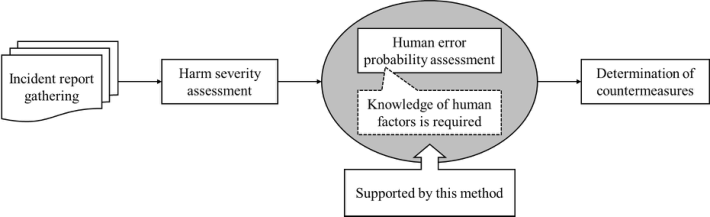
Figure 1 shows a current risk assessment flow. In general, risk is assessed based on two indicators: harm severity and probability. First, candidate coun- termeasures are selected based on harm severity. Next, the specifications of
Method for Enhancing Evaluation of the Human Error Probability 81
Figure 1: Relations between this method and a practical risk assessment.
countermeasures such as the scope of application, expected lifetime and cost are determined, considering probability. As a result, appropriate countermea- sures are introduced in the field that can control risks within acceptable limits. Various countermeasures for accidents caused by human error are considered similarly and introduced in the field. In order to evaluate human error pro- bability, it is necessary to analyze the factors related to human error, which are called Performance Shaping Factor (PSF). However, it requires advanced knowledge of human factors.
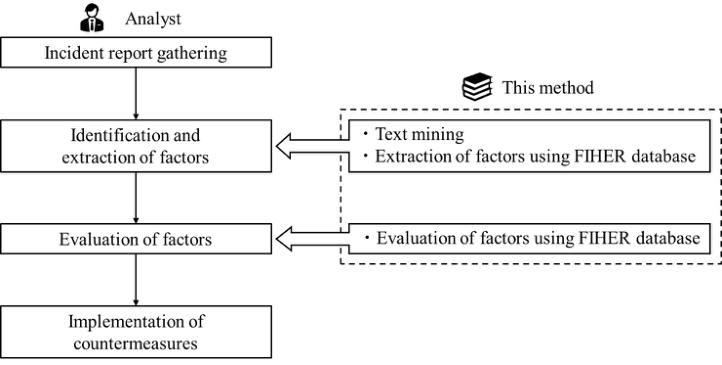
Figure 2 shows the work of an analyst. Among them, “Identification and extraction of factors” and “Evaluation of factors” require a high level of knowledge, time and effort. Therefore, this study aims to support these two processes by text mining and creating FIHER database.
In Human Reliability Analysis (HRA), human error probability is evalu- ated by modifying the Basic Human Error Probability (BHEP) to a value that takes PSF into account. One of the methods is the Cognitive Reliability and Error Analysis Method (CREAM), which is called 2nd generation HRA. CREAM is characterized by the fact that it evaluates the characteristics of the situation/environment based on the following nine concepts called Common Performance Condition (CPC).
Figure 2: Workflow of an analyst.
82 Murahashi and Okada
Adequacy of organization
Working conditions
Adequacy of MMI and operational support
Availability of procedures/plans
Number of simultaneous goals
Available time
Time of day
Adequacy of training and preparation
Crew collaboration quality However, CREAM is not suitable for the analysis of incidents in daily work, which is the subject of this analysis. This is because CREAM targets operations in which the result of human error leads to an accident. The pur- pose of this study is to support incident-level risk assessment in daily work by simplifying the concept of human reliability analysis considering PSF.
We attempted to evaluate human error probability on a scale of six (5: Certain, 4: Likely, 3: Possible, 2: Unlikely, 1: Rare, and 0: Eliminated), which are commonly used in a risk assessment, rather than to calculate detailed values.
PROPOSAL OF THE METHOD Reference lists of PSF are prepared for various industries but they contain industry-specific items and lack comprehensiveness. Therefore, we crea- ted “the database of Factors Influencing on Human Error Risk” (FIHER database). FIHER database consists of three columns: “PSF item column”, “influence column” that indicates the influence of each PSF item on human error, and “standard state column” that indicates the state with an influence of 1.
Organize PSF Items We surveyed previous studies and collected 392 PSF items. These were organi- zed and 85 PSF items were extracted. We collected “constant factors”, which are present in work regularly because this study focused on daily work. Spe- cifically, temporary physiological factors such as hunger, drowsiness, and non-routine factors such as an emergency work, temporary shortage of per- sonnel were excluded. Finally, 85 PSF items were classified into 15 major categories and defined as “PSF item column” in FIHER database.
Determine the Degree of Influence on Human Error An index xi indicating the influence of each PSF was assigned based on Human Error Assessment and Reduction Technique (HEART) and Tecnica Empirica Stima Errori Operatori (TESEO). These were defined as “influence column” in FIHER database.
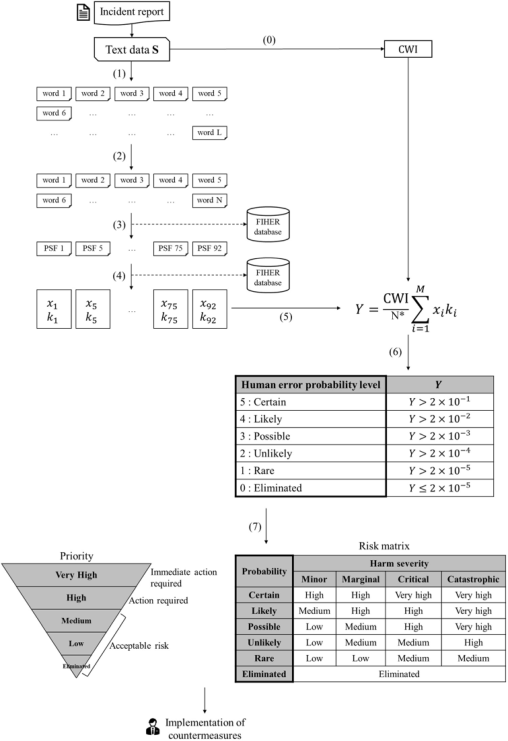
We built a system to evaluate the likelihood of human error by matching keywords extracted from incident reports with FIHER database. The system consists of the functions shown in Figure 3. A specific explanation of Figure 3 follows.
Method for Enhancing Evaluation of the Human Error Probability 83
Figure 3: Procedures of the method. (0) Define the variables.
CWI (Characteristic of the Work Index): A value representing the characteristics of the work. Select from Table 1.
M: Number of PSF items present in the FIHER database. (M = 85 now)
xi (1 ≤i ≤M, i is a natural number): The influence of the i-th PSF.
ki (1 ≤i ≤M, i is a natural number): The state of the i-th PSF. (i-th PSF not exists: ki = 0, i-th PSF exists: ki > 0)
Table 1. Value of CWI.
Table available in the original PDF paper.
Characteristic of the work CWI Totally unfamiliar 0.55 Required high skills 0.16 Not required high skills 0.02 Completely familiar 0.0004
84 Murahashi and Okada
PM
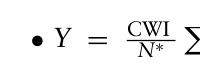
Equation reproduced from the original PDF.
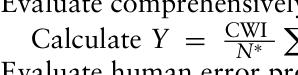
i = 1 xiki: human error possibility index N∗ (1) Text mining Text data S is text-mined to obtain L words. (2) Data formatting
In order to analyse easily, reduce L∗words by grouping synonyms and deleting words unnecessary for analysis and obtain N = L −L∗ words. (3) Extraction of PSF items
From the N words, select N∗PSF items by referring to PSF item column of FIHER database. (4) Evaluation of PSF For the selected N∗PSF items,
refer to “influence column” of FIHER database and obtain xi.
determine state index ki with the standard state written in “standard state column” as 1. (5) Evaluate comprehensively
PM
Equation reproduced from the original PDF.
i = 1 xiki. (6) Evaluate human error probability level Based on the result of Y, evaluate human error probability level (HEP level) on a scale of six (5: Certain, 4: Likely, 3: Possible, 2: Unlikely, 1: Rare, and 0: Eliminated). (7) Adapt to risk matrix
Adapt HEP level and the separately entered harm severity to a com- monly used risk matrix and determine countermeasures according to the magnitude of risk.
VERIFICATION We applied this method to 8 incident reports as test data written in Japanese collected at an oil plant X. The result is shown in Table 2. Combining these results with risk matrix will help determine the priority of countermeasures.
Table 3 shows the factors extracted in X’s current risk assessment and in the risk assessment applying this study. In a current risk assessment, factors are specific to individuals and the work environment. It is impossible to evalu- ate organizational problems or problems with other organizations. However,
Table 2. Result of application.
Table available in the original PDF paper.
Text data Number of characters Number of PSF extracted Y HEP level Text data 1 188 5 3.4 ×10⁻³ 3 Text data 2 216 1 1.2 ×10⁻³ 2 Text data 3 115 1 1.6 ×10⁻¹ 4 Text data 4 150 2 2.2 ×10⁻³ 3 Text data 5 134 1 6.0 ×10⁻² 4 Text data 6 209 1 4.8 ×10⁻¹ 5 Text data 7 48 1 2.8 ×10⁻³ 3 Text data 8 181 1 3.2 ×10⁻² 4
Method for Enhancing Evaluation of the Human Error Probability 85
Not visualize the results or the situation well in advance of the action
Actions or checks during the procedure in a cursory manner
Problems with work distribution, ability, or spare capacity
Insufficient meetings, preparation, and organization Risk assessment applying this study
Too dark lighting
Narrow area
High temperature
Weather conditions
Low oxygen level
Not maintained equipment
Lack of organization
Inexperienced partner
High time pressure
Insufficient equipment
Impatience
Unclear scope of work
analysis applying this study makes it possible to extract factors that could not be evaluated. Some examples are shown below.
(Example 1) Request another department. Not get through to the person in charge and suspected a miscommunication.
Extracted factor: inexperienced partner The factor related to the relationship with other departments was extra- cted. This enables to work with consideration of the possibility that they may not be able to communicate with the other party properly.
(Example 2) The inventory is reduced to zero unconsciously because the department that frequently uses consumables and manages them is different.
Extracted factor: Unclear division of roles Organizational factor was extracted.
CONCLUSION
We attempted to support a risk assessment in industrial plants by exami- ning human probability evaluation methods that even an analyst with limited knowledge of human factors can use. For the evaluation, we simplified the quantitative evaluation method of PSF in human reliability analysis and cre- ated database to refer to “PSF items,” “influence,” and “standard state”. We built a system to evaluate human error probability by matching keywords extracted from incident reports with FIHER database. When this system was applied to incident reports collected at an oil plant, it became possible to evaluate factors that could not be evaluated by a current risk assessment. However, it is a problem for practical application to link with the inci- dent report design because it is sometimes difficult to adapt to this method depending on the incident report design.
86 Murahashi and Okada
REFERENCES
Chandler F. T., Chang Y. H. J., Mosleh A., Marble J. L., Boring R. L., and Gertman D. I. (July 2006). Human reliability analysis methods: selection guidance for NASA, NASA/OSMA Technical Report, Hollnagel E. (1998). Cognitive Reliability and Error Analysis Method (CREAM),
Elsevier. K Okudaira, C Kojima, S HEMMI, T Takemoto. (2020) “A Study of Identify the Occurrence Factors for Prevention of Seafarer’s Disasters” (in Japanese), The Journal of Japan Institute of Navigation, Vol. 142, pp. 45–52 Swain A. D. and Guttmann H. G. (1983). Handbook of Human. Reliability Analysis
with Emphasis on Nuclear Power Plant Applications Final Report, NUREG/CR- 1278, U. S. Nuclear Regulatory Commission. T Takemoto, N Mitomo, K Hikita, K Yoshimura. (2012) “A Study on Human Factors Analysis for Possible Factors of Marine Accident -Modifying CPC for Marine Accident Analysis-” (in Japanese), The Journal of Japan Institute of Navigation, Vol. 127, pp. 95–101. T Yukimachi and M Nagata. (July 2004) “Reference List on Basis of GAP-W
Concept and a Case Study” (in Japanese), Human Factors in Japan, Vol. 9, No. 1, pp. 46–62.
LISTED IN THE AHFE DIGITAL BOOKSTORE CATALOGUE
Explore the complete digital volume
Human Error, Reliability, Resilience, and Performance
Read this individual research paper free through the original publisher, or explore the full digital proceedings book.
ISBN 978-1-958651-58-2
Explore this ISBN in the AHFE Bookstore ↗Listed in the July 2026 bookstore catalogue; search by ISBN to confirm current availability · Digital book purchase optional