Olugbenga Gideon, Thomas Ulrich (2023). User Need Assessment Using Simulator Feature Framework. In: Human Factors and Simulation. AHFE Open Access, vol. 83, pp. 168–173. https://doi.org/10.54941/ahfe1003574
Full-scope nuclear control room simulators were developed to address operator skill deficits associated with several high-profile accidents occurring in the 1980s. Full-scope simulators are increasingly used to support plant modernization and advanced reactor research and development. New digital control room designs use full-scope simulators to develop and evaluate new concept of operations to support regulator required Human Factors Engineering Program Review Model (HFEPRM) activities. Modern simulator designs require more diverse and robust capabilities to serve the diverse needs of multiple user groups including researchers and educators. A common framework for evaluating features to support training, research, and education is critical to ensure future simulators enable research to support immediate and future plant modernization and advanced reactor deployment needs. An initial framework comprised of eight feature categories was developed by reviewing published simulator-based research and analyzing simulator features against research objectives and results (Gideon and Ulrich, 2022). A survey was administered to simulator users to evaluate the suitability of eight critical capabilities of a modified version of the framework to characterize and differentiate simulators across training, research, and education uses (n = 21). The results demonstrate the framework's effectiveness as a baseline for assessing the functionalities of simulators in line with their specific needs. Future work aims to validate the framework within a regulatory HFEPRM process to demonstrate its use as a tool to identify missing capabilities of existing simulators or to specify requirements for new simulators.
The public perception toward nuclear power negatively swayed following several high-profile nuclear accidents during the end of the twenty-first cen- tury. In addition to public safety concerns, cheaper alternative power sources made nuclear energy less desirable. There was renewed interest in nuclear power in the early 2000s, an event generally referred to as a “nuclear renais- sance.” The nuclear renaissance was primarily driven by heightened public awareness of the danger of carbon emission, its direct observable impacts on climate change, and the more devastating potential negative projections if unchecked. The U.S. net-zero greenhouse gas emission goal is to generate 100 percent clean electricity by 2035 (Waldman, 2021). Nuclear power plants
User Needs Assessment Using Simulator Feature Framework 169
produce about 20 percent of the electricity generated in the U.S. (Ulrich et al., 2017) and account for about 40 percent of the total clean energy on the U.S. electric grid (Waldman, 2021). Therefore nuclear power is critical to achieving the net-zero greenhouse gas emission target.
The U.S. Nuclear Regulatory Commission (NRC) granted license extensi- ons to commercial fleets approaching the end of life from the original 40 years to 60 years (Boring et al., 2013). Plant modernization is a critical requirement for life extension. Enhancing existing plant instrumentation and technology and outright replacing others is pivotal for the sustainable ope- ration of nuclear plants with life extensions. The U.S. NRC in the Human Factors Engineering Program Review Model (HFEPRM; O’Hara et al., 2012) lays out guidelines to ensure human factors principles in the implementation of new interface designs or redesigns of existing ones in nuclear power plant (NPP) main control rooms (MCRs). Human factors issues relating to the design and evaluation of MCR interfaces are stipulated in the guideline. Simu- lators support the rapid design, usability testing, verification, and validation that are mandated to meet the Human Factors Engineering (HFE) program review requirements for a license amendment submission. Therefore, control room simulator-based research is an efficient and expedient strategy to shor- ten design timelines for digital instrumentation and control and allows for flexible, iterative development and validation.
Full-scope simulators are increasingly used to support plant moderniza- tion and advanced reactor research and development beyond their traditional use in operator training. New digital control room designs use full-scope simulators to develop and evaluate new concepts of operation to support regulator-required HFEPRM activities and for teaching in higher education institutions. The Simulator Feature Framework was developed as a common framework for evaluating simulator features to support the broad needs of training, research, and education (Gideon & Ulrich, 2022). The aim of this study is to evaluate the suitability of the Simulator Feature Framework to cha- racterize and differentiate simulators across training, research, and education use cases.
SIMULATOR FEATURE FRAMEWORK The Simulator Feature Framework provides a common framework for eva- luating simulator features to support training, research, and education for immediate and future plant modernization and advanced reactor deployment needs (Gideon and Ulrich, 2022). The initial framework is comprised of eight feature categories, developed by reviewing published simulator-based research and analyzing simulator features against research objectives and results.
Feature of the Simulator Capability Framework According to the Simulator Feature Framework, eight features are impor- tant for enabling training, research, and education use cases toward ensuring
170 Gideon and Ulrich
future simulators support research for immediate and future plant moderni- zation and advanced reactor deployment needs. The features include recon- figurable simulator software; open-source software development model; integrated human performance measurement system; remote access; cyber- security support; representation of advanced reactor concepts; human reli- ability analysis; and scenario configurability across all plant states (Gideon and Ulrich, 2022).
MATERIAL AND METHOD A qualitative survey was administered to simulator users (n = 21) to evalu- ate the suitability of a modified version of the Simulator Feature Framework in characterizing and differentiating simulators across training, research, and education uses. In the modified version, two features of the initial framework – open software development and human reliability analysis – were substituted for data monitoring and logging, and interfacing using Application Programming Interface (API). Participants include researchers, operators, trainers, college students, and software developers of nuclear rea- ctor utilities (n = 10, 2, 3, 3, and 3, respectively). The participants only provided information related to their use of the simulator. No demographic or identifying information was collected. Participants were recruited by word of mouth. Participation was voluntary and uncompensated. The survey was approved by the Institutional Review Board of Idaho National Laboratory.
The survey instrument consisted of a 30-item web-based questionnaire administered via Qualtrics. In the survey, participants were presented with questions relating to the feature categories of the Simulator Feature Frame- work containing thirty different capabilities. For each question, participants selected one of five options presented on a 5-point Likert-type scale from 1 (“strongly disagree) to 5 (“strongly agree). Participants ranked each simu- lator capability based on its relative importance to them (“importance”) and the extent to which the capability is supported by simulators currently in use by the participants (“support”). The average cumulative score of “importa- nce” and “support” of all participants on a simulator feature category and its corresponding capabilities was calculated with average score >3.0 used as a threshold of significance.
RESULTS
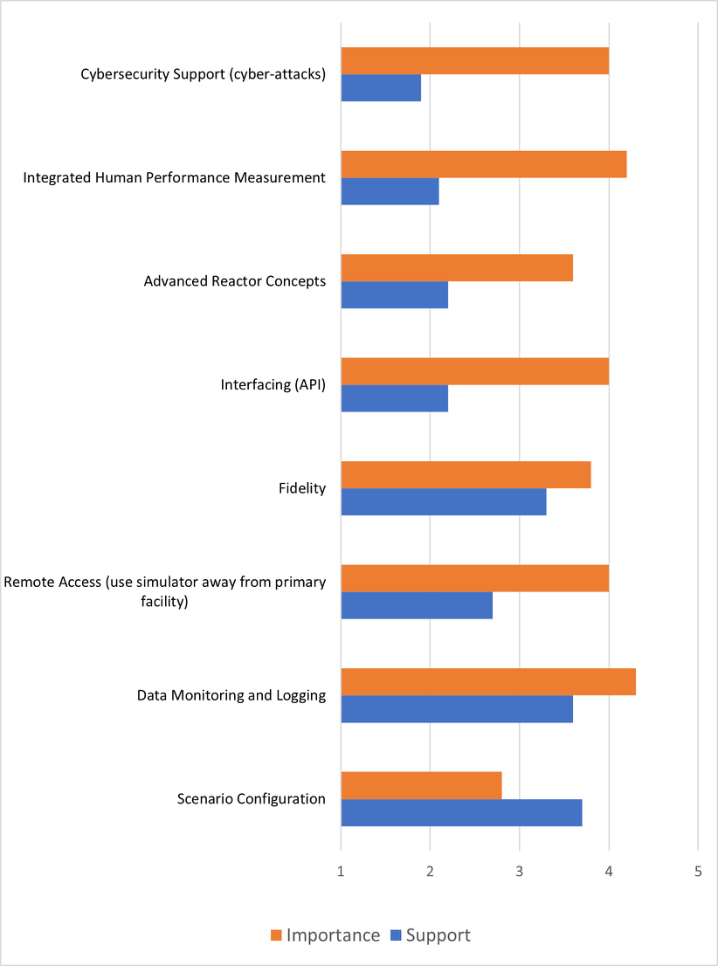
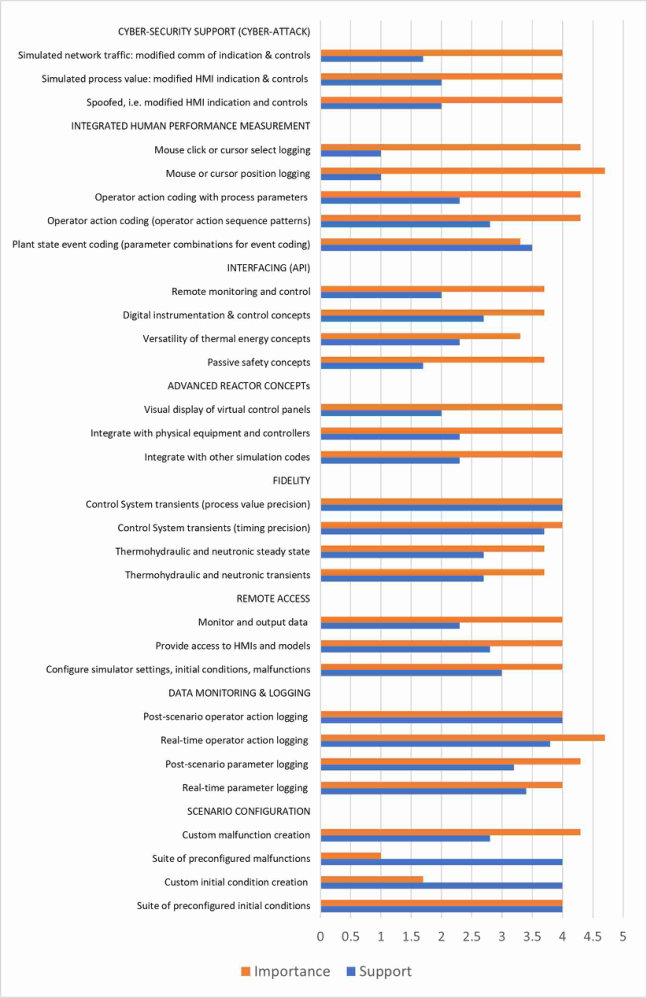
The result shows that participants ranked 7 out of 8 simulator feature catego- ries above the 3.0 threshold of importance (Figure 1). In the feature category, only “scenario configuration” ranked below the threshold in importance. Furthermore, 7 out of 8 features had remarkably higher importance than support. The result also shows that participants ranked 27 out of 30 simula- tor capabilities above 3.0 in importance (Figure 2). Of the three capabilities ranked below 3.0, two were in the “scenario configuration” and one in the “integrated human performance measurement” feature categories. Only nine capabilities ranked above 3.0 in the extent to which current simulators support those capabilities.
User Needs Assessment Using Simulator Feature Framework 171
Figure 1: Importance versus support of simulator feature categories.
DISCUSSION
Simulators are increasingly used for research and education purposes beyond their traditional use for NPP MCR operator training. The Simulator Fea- ture Framework is a common framework for evaluating simulator features to support the broad needs of training, research, and education across eight feature categories. We hypothesized that the different simulator user groups
172 Gideon and Ulrich
Figure 2: Importance versus support of simulator capabilities.
would find the framework’s features suitable and effective in characterizing and differentiating simulators across training, research, and education use cases. Results from this study show that participants’ average importance score of 7 out of 8 simulator feature categories ranked above the thresh- old (>3.0). The ranking of most simulator features as important indicates the
User Needs Assessment Using Simulator Feature Framework 173
relevance of these features to the identified user groups. On the contrary, only 3 features (fidelity, remote access, and scenario configuration) ranked above 3.0 in the extent to which existing simulators support them. The result sugge- sts that current simulators ineffectively enable use cases required by these user groups. The wide gap between the importance of simulator features and the degree to which these features are supported underscores the need to adopt a framework in simulator design to ensure future simulators enable research to support immediate and future plant modernization and advanced reactor deployment training, research, and education needs.
CONCLUSION
The results of this study provide preliminary evidence to demonstrate the Simulator Feature Framework’s effectiveness as a baseline for assessing the functionalities of simulators in training, research, and education. Future work aims to validate the framework within a regulatory HFEPRM process to demonstrate its use as a tool to identify missing capabilities of existing simulators or to specify requirements for new simulators.
ACKNOWLEDGMENT
This work of authorship was prepared as an account of work sponsored by Idaho National Laboratory (under Contract DE-AC07-05ID14517), an age- ncy of the U.S. Government. Neither the U.S. Government, nor any agency thereof, nor any of their employees makes any warranty, express or implied, or assumes any legal liability or responsibility for the accuracy, completeness, or usefulness of any information, apparatus, product, or process disclosed, or represents that its use would not infringe privately owned rights.
REFERENCES
Boring, R. L., Agarwal, V., Fitzgerald, K., Hugo, J., & Hallbert, B. (2013). Digital fullscope simulation of a conventional nuclear power plant control room, phase 2: installation of a reconfigurable simulator to support nuclear plant sustainability (No. INL/EXT-13-28432). Idaho National Lab. (INL), Idaho Falls, ID (United States). Gideon, O., Ulrich, T. A. (2022). Simulator Capability Framework. [Unpublished
Manuscript]. O’Hara, J. M., Higgins, J. C., Fleger, S. A., and Pieringer, P. A. (2012). Human Factors Engineering Program Review Model, NUREG-0711. Washington, DC: U. S. Nuclear Regulatory Commission. Ulrich, T. A., Lew, R., Werner, S. and Boring, R. L. (2017). Rancor: a gamified micro-
world nuclear power plant simulation for engineering psychology research and process control applications. In Proceedings of the Human Factors and Ergono- mics Society Annual Meeting (Vol. 61, No. 1, pp. 398–402). Sage CA: Los Angeles, CA: SAGE Publications. Waldman, S. (2021). Biden’s infrastructure plan would make electricity carbon-free by 2035. Scientific American, 1.
LISTED IN THE AHFE DIGITAL BOOKSTORE CATALOGUE
Explore the complete digital volume
Human Factors and Simulation
Read this individual research paper free through the original publisher, or explore the full digital proceedings book.
ISBN 978-1-958651-59-9
Explore this ISBN in the AHFE Bookstore ↗Listed in the July 2026 bookstore catalogue; search by ISBN to confirm current availability · Digital book purchase optional