Olugbenga Gideon, Ronald Boring (2023). A Graded Approach to Simulators: Feature Requirements Mapping to Simulator Types for Nuclear Plant Control Room Research Use Cases. In: Augmented, Virtual and Mixed Reality Simulation. AHFE Open Access, vol. 118, pp. 196–206. https://doi.org/10.54941/ahfe1004454
Simulators function as test platforms for validating a broad spectrum of nuclear power plant operations. This spectrum encompasses tasks ranging from updating existing control rooms to fundamentally designing new ones, incorporating innovative operational concepts. The Simulator Feature Framework introduces a generic list of features to ensure that future simulators facilitate research endeavors that cater to both immediate plant modernization needs and the future deployment of advanced reactors (Gideon and Ulrich, 2023). Conducting research via control room simulators requires different simulator types, each varying in fidelity. Integrating the complete set of features outlined in the Simulator Feature Framework into all simulator types could escalate acquisition costs and decrease their commercial appeal for research purposes. A nuanced strategy is required to align simulator types with specific features that adequately underpin the intended research applications. This paper maps five simulator types to the feature categories within the Simulator Feature Framework. By connecting feature categories with simulator types, simulator vendors can incorporate capabilities suitable for distinct simulator tasks without obligatory inclusion of all features. This graded approach harmonizes the cost of simulator acquisition with the anticipated research benefits. Moreover, this alignment equips researchers with a foundational standard for assessing simulators' compatibility with research objectives across varying levels of fidelity. Two use cases are provided to consider simulators for advanced control room development and human reliability analysis data.
The light water reactor (LWR) is the predominant design of nuclear power plants (NPPs) in the U.S., with most plants commercialized between the early1970s into the early 1990s. The U.S. Nuclear Regulatory Commission (NRC) has granted operating license extensions from the original 40 years to enable continued operation for another 20–40 years (Boring et al., 2013). Control room modernization is critical to support nuclear plant life exten- sion. The U.S. Department of Energy (DOE) Light Water Reactor Sustainabil- ity (LWRS) program supports general research to enable plant life extension
A Graded Approach to Simulators: Feature Requirements Mapping 197
and control room modernization. Digital instrumentation and control tech- nologies play a significant role in control room modernization. Therefore, the DOE LWRS program supports research to enable enhancement and outright replacement of control rooms.
Overcoming heavy upfront capital investment for building nuclear power plants and the negative public perception towards nuclear safety are the pri- mary drivers of new advanced nuclear reactor designs. Advanced nuclear reactors are nuclear fission reactors with significant improvements over the most recent generation of nuclear fission reactors (Arostegui and Holt, 2019). The basis of improved advanced reactors includes enhanced safety, security, waste management, and versatility, as well as reduced reactor size and devel- opment cost. The Bipartisan Infrastructure Law (BIL), adjudged the single most significant investment commitment of the U.S. federal government to energy system modernization and decarbonization (Steinberg et al., 2023), is a recent example of legislative policy support to overcome investment barriers to clean energy research and development. With nuclear energy as the largest source of carbon-free electricity in the U.S., developing advanced reactors and modernizing existing nuclear power plants to support life extension will be critical to ensuring BIL programs yield the expected return on investments.
Simulators serve as testbeds for validating broad aspects of operations ranging from modernizing existing control rooms to the outright design of new ones using novel concepts of operations. The need for empirical research on the safety and efficiency of control room modernization and advanced concepts of operation is a critical imperative. Hence, simulators with adequate capabilities are needed to support control room simulator- based research. Here, research refers to both academic human-in-the-loop studies to explore control room concepts and applied operator studies that validate features of control rooms being deployed.
The Simulator Feature Framework is an initial effort to develop a generic list of features to ensure future simulators enable research to support imme- diate and future plant modernization and advanced reactor deployment needs (Gideon and Ulrich, 2023a). Results from a preliminary validation study show the Simulator Feature Framework’s effectiveness as a base- line for assessing the functionalities of simulators in NPP control room research (Gideon and Ulrich, 2023b). However, control room simulator- based research requires different types of simulators with varying levels of fidelity. Designing all types of simulators to include the entire feature set spec- ified in the Simulator Feature Framework may increase the acquisition cost and decrease their commercial appeal for research purposes. There is a need for a graded approach to map simulator types to specific features adequate to support intended research use cases. In this paper, five types of simulators are characterized and mapped to specific feature categories of the Simulator Feature Framework.
TYPES OF SIMULATORS Simulators mimic real processes in part or in full using devices to repre- sent the physical, dynamic, operational, and decision-making elements of the
198 Gideon and Boring
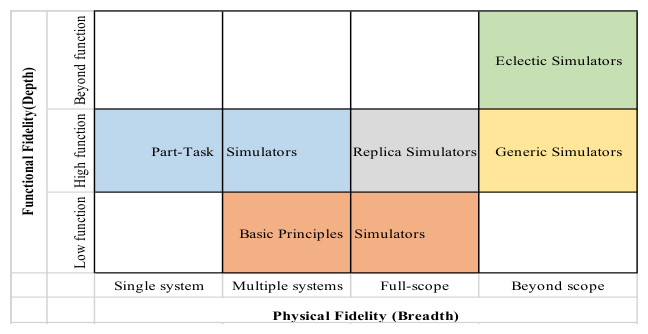
modeled system (Stanton, 1992). Three common characteristics of simulators include an attempt to represent, control, and omit non-essential elements of a real system (Gagne, 1962). The fidelity of a simulator refers to its degree of similarity to the simulated equipment. There are two dimensions of fidelity, namely physical fidelity, and functional fidelity (Stanton, 1996). Physical fidelity, sometimes referred to as the simulator scope, is the degree to which the simulator looks like the real equipment. Functional fidelity is the degree to which the simulated equipment acts like the operational system. Physi- cal and functional fidelity may be conceptualized as breadth and depth of representation of the original equipment, respectively. The breadth of repre- sentation refers to the number of systems of the real equipment included in the simulation. The depth of representation is the degree to which a repre- sented system behaves like the real operational system. Breadth and depth of representation are orthogonal dimensions and may be combined to varying degrees in different types of simulators.
There are five major types of simulators based on the degree of represen- tation of the real world (Clymer et al., 1981):
Replica simulator: A replica simulator has full scope and high func- tional fidelity. This type of simulator is an exact representation of the human-machine interface (HMI) of a specific NPP control room with cor- responding multisensory environmental elements. Replica simulators go by other names, such as plant-specific, full-scope, full-scale, or full-task simulators.
Generic simulator: A generic simulator has a high level of functional fidelity but has physical systems representative of a generic class of simulators rather than a replica of a given plant control room design.
Eclectic simulator: An eclectic simulator is closely representative of a spe- cific NPP control room but includes non-representative features. It has physical and functional fidelity that goes beyond that of the specific con- trol room that it represents. For this reason, eclectic simulators are also referred to as other-than-full-scope simulators.
Part-task simulator: A part-task simulator represents only specific tasks relevant to aspects of a given plant operational system. For example, a part-task simulator may exist for demonstrating a subsystem of the plant such as the turbine control system. Part-task simulators have a low level of physical fidelity and a high level of functional fidelity.
Basic principles simulator: A basic principles simulator demonstrates fun- damental plant behavior as an overview. A basic principles simulator depicts high-level system functions via plant overview displays showing operating modes of the main plant systems only, with little or no detailed representation of underlying systems. These types of simulators have a high-level of physical fidelity and a low level of functional fidelity.
The characterization of the five types of simulators may be expanded to include graded levels of physical and functional fidelity (see Table 1). Con- temporary simulators primarily consist of underlying software simulation models driving the HMI. The software models may range from reduced order models (ROMs) to full physics-based simulations. Boring et al. (2023)
A Graded Approach to Simulators: Feature Requirements Mapping 199
highlight that simulators are fundamentally different from simulations in that simulators are designed for training with human operators, requiring synchronous interactivity between operators and models. Simulations are primarily asynchronous models that do not respond to real-time emerging contexts and are not suitable for training purposes. Synchronous interactivity with operators is a requirement for simulators.
Table 1. Types of simulators based on a graded level of physical and functional fidelity.
REQUIREMENTS MAPPING TO SIMULATOR TYPES The Simulator Feature Framework is an initial effort to develop a generic list of features to ensure future simulators enable research to support immedi- ate and future plant modernization and advanced reactor deployment needs (Gideon and Ulrich, 2023a). The framework is comprised of eight feature cat- egories and thirty supporting capabilities developed by reviewing published simulator-based research. The reader is referred to Gideon and Ulrich (2023a) for more in-depth discussions of the simulator features. This section high- lights a graded approach that maps simulator types to specific features of the Simulator Feature Framework (Table 2). Designing all types of simulators to include the entire feature set specified in the Simulator Feature Framework may increase the cost of acquisition and decrease their commercial appeal for research purposes. A graded approach to map simulator types to specific fea- tures adequate to support intended research use cases presents an opportunity to tailor simulators to the diverse research needs of users. Mapping feature categories to simulator types enables simulator vendors to include capabilities adequate for different simulator types without necessarily including all fea- tures, thereby making simulator acquisition cost commensurate to intended research benefits.
RESEARCH USE CASE MAPPING TO FEATURE CATEGORIES For the sake of this paper, research use cases mapped to two simulator feature categories are discussed: representation of advanced concepts of operation and human reliability analysis (HRA).
200 Gideon and Boring
Representation of Advanced Concepts of Operation Contrary to projections in the wake of the nuclear renaissance of the early 2000s, nuclear power output as a percentage of global electrical energy gen- erated has declined from 17.5% in 1996 to 10% in 2019 (Schneider and Froggatt, 2020). Traditional nuclear power plants are economically less com- petitive than alternative carbon-neutral energy sources such as renewables. The combined effect of the fitfulness of renewable energy sources and a lack of cost-effective storage systems presents an opportunity for nuclear energy as a complementary counterpart. However, substantial upfront capital invest- ment cost and the inability of nuclear power plants to ramp power generation up and down in response to grid dynamics (i.e., load following) continues to pose significant economic barriers. NPP vendors and utilities are responding to this challenge with greater plant flexibility, including non-electrical uses during periods of reduced grid demand.
Table 2. Feature requirements mapping to simulator types.
Table available in the original PDF paper.
In the U.S., the combined effect of the high demand for electricity and the quest for clean energy gives the impetus to maintain the existing fleet of NPPs. At the same time, efforts continue to ramp up toward more effective and economically viable designs in the form of advanced reactors. Economic competitiveness is at the core of most advanced reactor designs, including enhanced safety, security, waste management, versatility, and reduced reac- tor size and cost. In particular, reducing the size of reactors will enable offsite assembly, thereby driving down upfront capital investment costs. Process automation and remote operations, common operational features of advanced reactors, are anticipated to reduce staffing costs and oper- ational overhead significantly. Ultimately, reduced capital investment and operational cost, which constitute significant cost drivers in nuclear energy economics, will shorten investment break-even time and bolster the economic
A Graded Approach to Simulators: Feature Requirements Mapping 201
competitiveness of smaller-sized reactors. Small modular reactors (SMRs), microreactors, and fission batteries are advanced reactor designs with sig- nificant size reduction. Several other advanced reactor designs are in the works (International Atomic Energy Agency, 2020) with capabilities to use nuclear steam as process heat for industrial processes like hydrogen pro- duction (Ulrich et al., 2021a), load following, and diverse novel capabilities creating the groundwork for integrating advanced reactors into a modernized national electricity generation system.
There is a major shift in the concepts of operation of advanced reactors in many dimensions. Boring (2023) highlighted eleven major changes in the con- cepts of operation of advanced reactors and the shift in the role of operators. Unfortunately, the human factors component of advanced reactor control room design has not received as much attention as core technology. Given the limited budget of reactor vendors, which include many new start-ups, it might seem plausible from a business point of view to prioritize reactor technology design above and beyond human factors engineering (HFE), defer- ring the development of control room concepts of operation to support these advanced reactors to the later stages of the design process. The potential long-term cost of deferring the design of advanced concepts of operation may outweigh the perceived benefits driving such a development approach, as the cost of addressing HFE deficiencies at a later stage may be substantial. The focus, then, should be how to balance the parallel design of advanced reactors and their supporting concepts of operation cost-effectively.
A graded approach to simulators presents an opportunity for parallel and iterative design verification of control concepts, preventing potential costs associated with rework during late development and licensing appli- cations. Basic principles simulators may serve as effective tools for verifying advanced concepts of operations in the early phase of advanced reactor development in a cost-effective manner while deferring integrated system val- idation (ISV) using full-scope simulators to later stages. For example, the Rancor Microworld Simulator, a ROM basic principles nuclear control room simulator, has been demonstrated to be effective in supporting basic human factors and reliability research (Ulrich, 2017). In an ongoing effort at Idaho National Laboratory (INL), Rancor is supporting the development and veri- fication of advanced reactor concepts involving extraction of excess nuclear heat through a thermal power dispatch (TPD) system to support a secondary industrial process such as hydrogen production (Ulrich et al., 2021b). Fur- ther down the development life cycle, the full-scope simulator at the Human System Simulation Laboratory (HSSL) at INL may be used for operator-in- the-loop ISV on a much larger scale. Using a graded simulator categorization scheme enables reactor vendors to choose different simulator types contain- ing unique features required to support the development and verification of advanced concepts of operation across the entire development life cycle of advanced reactors.
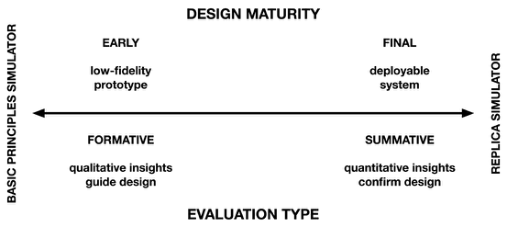
Figure 1 illustrates a continuum of control room development activities that make use of simulators (Boring, Ulrich, & Lew, 2022). At the con- ceptual or formative phases of development (i.e., the so-called As Low As Reasonable Assessment or ALARLA phase), the main goal may be to derive
202 Gideon and Boring
qualitative insights to inform the early design. This phase can generally make use of a low fidelity simulator. Appropriately, a low fidelity simulator can be more easily developed, ensuring control room design can be developed early in parallel with design engineering activities. At the other end toward the completion of design activities (i.e., the so-called Nuclear Oriented Detailed Operator-System Evaluation or NODOSE phase), high functional and physi- cal fidelity are necessary to support quantitative validation activities. Overall, the simulator serves as a prototype for the control room, and the design phase determines the requirements for the simulator.
Figure 1: Design maturity vs. evaluation type (after Boring, Ulrich & Lew, 2022).
Simulators for Human Reliability Analysis Collecting operator performance data is an essential activity for HRA mod- eling to understand the evolution of operator actions during event scenarios and to establish error rates for such actions. Despite the importance of data, such data have been elusive to collect. One challenge is the need for large sam- ples of operators for typically low-frequency events. For example, an HRA method may predict a human error probability (HEP) equal to 0.001, mean- ing an error is posited every 1000 occurrences of a task. To validate this HEP, does that mean collecting data on 1000 runs of operators in a simula- tor to expect to see the error occur organically? Does it mean running 1000 crews of operators? Both would require extensive and unrealistic data collec- tion efforts. Another approach to reduce the sample size is to seed an error (Boring et al., 2016) by setting up a context that more frequently leads to errors, potentially introducing confounds in the data and removing the goal of measuring organic errors.
Two large-scale data collection efforts exist for such purposes, among smaller efforts (Chang et al., 2022). The U.S. Nuclear Regulatory Commis- sion leads a research effort called Scenario Authoring, Characterization, and Debriefing Application (SACADA; Chang et al., 2014) that collects operator performance data from NPP training simulators. Training objective elements (TOEs) are defined by the trainers at the plants and then classified as human errors when they are performed in an unsatisfactory manner. In addition to classifying TOEs as successful or erroneous outcomes, additional contex- tual information like performance influencing factors is cataloged, allowing
A Graded Approach to Simulators: Feature Requirements Mapping 203
mapping between contexts and error outcomes. By aligning with routine training, SACADA serves as a way to collect data over time, and human performance data are logged in a database to establish HEPs according to specific operational contexts.
Another large-scale HRA data collection effort is undertaken by the Korea Atomic Energy Research Institute. The Human Reliability data Extraction (HuREX; Jung et al., 2020) framework collects data from various full- scope training simulators in South Korea. The process of collecting data involves analysts reviewing video recordings, simulator logs, questionnaires, and operating procedures. Procedural tasks are classified according to a cog- nitive framework that ultimately catalogs basic human actions, contextual influences, and error rates.
Chang et al. (2022) compares some of the tradeoffs of SACADA and HuREX. SACADA is suitable for integration into plant training, but its data may exhibit some inconsistencies due to how training personnel subjectively categorize the TOEs and errors. HuREX, in contrast, has greater data consis- tency because of its use of a team of highly trained analysts to record the data. However, this process is labor intensive and best suited for specific research topics rather than long-term data collection. For example, HuREX has been used extensively for collecting human performance data specific to digital control interfaces in NPP control rooms. For both SACADA and HuREX, there is the challenge that the data collected do not match the traditional unit of analysis in HRA, namely, the human failure event (HFE). Rather, the data are more fine-grained at the task level. This challenge has been previ- ously identified as an issue (Boring, 2014) in the emergence of dynamic HRA approaches like the Human Unimodel for Nuclear Technology to Enhance Reliability (HUNTER; Boring et al., 2022). Dynamic HRA, which uses simu- lation approaches, operates at the task rather than the HFE level. While there are challenges translating simulator data efforts like SACADA and HuREX to HFEs used in conventional HRA, these data sources are actually perfectly suited to dynamic HRA applications.
From a simulator perspective, both SACADA and HuREX are challenged by the use of full-scope simulators with operating crews. While this approach clearly produces the most generalizable results, it also remains data-limited in the complexity of collecting large data samples. As of 2022, SACADA and HuREX had collected approximately 18,000 and 45,000 data points, respectively (Chang et al., 2022). These data are a tremendous asset toward validating HEPs. However, it is possible to collect more data by simplify- ing the simulator to allow student operators, such as in a recent study using the Rancor Microworld Simulator. For example, a single study involving 20 students and 20 operators collected 16,675 human performance data points (Park et al., 2022a), which have subsequently been used to inform the mod- eling of scenarios in the HUNTER framework and to validate results (Park et al., 2022b). While there remain differences between the HRA data gener- ated by the simplified simulator vs. the full-scope simulators, understanding the possibility of having different types of simulators for HRA research holds considerable promise toward collecting the data necessary to validate HEPs, overcoming the decades-old challenge of data paucity in the field.
204 Gideon and Boring
CONCLUSION
It is important to remember that not all simulators are used for research. The majority of simulators in NPPs are used for training of reactor operators. However, there is a strong need for research applications, from first principles research on human-system interaction in control rooms to design validation work for control room modernization or advanced concepts of operation. Some research will support training development and design objectives, while other research may support larger research questions like the causes and frequency of human errors in complex operational contexts. Accordingly, there is no one-size-fits-all solution to simulators for research needs. The Simulator Feature Framework helps to classify different simulator require- ments to ensure that the simulator type is commensurate with the ultimate research need. This alignment ensures that research is not forestalled due to the unavailability of the perfect simulator solution. It also helps to ensure that simulator costs can be kept in check appropriate to the type of research activity being performed. The two use cases provided in this paper illustrate the graded approach for simulator use in research. The first use case demon- strated how different types of simulators support different stages of control room development, from lower fidelity during the formative stages to full- scope during the final design evaluations. The second use case showed how different simulators could be used to address the tradeoffs of data collection for HRA. A major takeaway is that simplified simulators are of particular value in areas where using full-scope simulators is not cost-effective, realistic, or otherwise practicable.
ACKNOWLEDGMENT
This work of authorship was prepared as an account of work sponsored by Idaho National Laboratory (under Contract DE-AC07-05ID14517), an agency of the U.S. Government. Neither the U.S. Government, nor any agency thereof, nor any of their employees makes any warranty, express or implied, or assumes any legal liability or responsibility for the accuracy, completeness, or usefulness of any information, apparatus, product, or process disclosed, or represents that its use would not infringe privately owned rights.
REFERENCES
Arostegui, D. A., and Holt, M. (2019, April). Advanced nuclear reactors: technology overview and current issues. In Congressional Research Service Report for Congress, Washington, DC, Report (No. R45706). Boring, R. L. (2014). Top-down and bottom-up definitions of human failure events
in human reliability analysis. Proceedings of the Human Factors and Ergonomics Society 58th Annual Meeting, pp. 563–567. Boring, R. (2023). Human Factors for Advanced Reactors. Human Factors in Software and Systems Engineering, Vol. 94, 2023, 156–165 Boring, R. L., Agarwal, V., Fitzgerald, K., Hugo, J., and Hallbert, B. (2013). Digital
Full-Scope Simulation of a Conventional Nuclear Power Plant Control Room, Phase 2: Installation of a Reconfigurable Simulator to Support Nuclear Plant Sustainability, INL/EXT-13-28432. Idaho Falls: Idaho National Laboratory.
A Graded Approach to Simulators: Feature Requirements Mapping 205
Boring, R., Lew, R., Ulrich, T., and Savchenko, K. (2016). When human error is good: Applications of beneficial error seeding. 13th International Conference on Probabilistic Safety Assessment and Management (PSAM 13), Paper A-532, pp. 1–7. Boring, R., Ulrich, T., Ahn, J., Heo, Y., and Park, J. (2022). Software Implemen-
tation and Demonstration of the Human Unimodel for Nuclear Technology to Enhance Reliability (HUNTER), INL/RPT-22-66564. Idaho Falls: Idaho National Laboratory. Boring, R., Ulrich, T., Lew, R., Park, J. (2023). Synchronous vs. Asynchronous Coupling in the HUNTER Dynamic Human Reliability Analysis Framework. Human Error, Reliability, Resilience, and Performance, Vol. 82, 43–52 Chang, Y. J., Bley, D., Criscione, L., Kirwan, B., Mosleh, A., Madary, T., Nowell,
R., Richards, R., Roth, E. M., Sieben, S., and Zoulis, A. (2014). The SACADA database for human reliability and human performance. Reliability Engineering & System Safety, 125, 117–133. Chang, Y. H. J., Kim, Y., Park, J., and Criscione, L. (2022). SACADA and HuREX: Part 1. The use of SACADA and HuREX systems to collect human reliability data. Nuclear Engineering and Technology, 54(5), 1686–1697. Clymer, A. B., Rubin, A. I., Wade, W. D., Chen, W., and Clifford, W. (1981). Simu-
lation for training and decision making in large scale control systems. Automated process control. London: Arbor. Environment. University of Idaho. Gangne., R. M. (1962) Simulators. In Glaser, R. (ed.), Training Research and Education. New York: Wiley. Gideon, O. and Ulrich, T. A. (2023a). Simulator Capability Framework: Requirement
to Support Training, Research, and Education. In Proceedings of the Human Fac- tors and Ergonomics Society Annual Meeting. Sage CA: Los Angeles, CA: SAGE Publications [Accepted for Publication]. Gideon, O. and Ulrich, T. (2023b). User Need Assessment Using Simulator Feature Framework. In: Julia Wright and Daniel Barber (eds) Human Factors and Simula- tion. AHFE (2023) International Conference. AHFE Open Access, vol 83. AHFE International, USA. https://doi.org/10.54941/ahfe1003574. International Atomic Energy Agency. (2020). Advances in Small Modular Reactor
Technology Developments, A Supplement to: IAEA Advanced Reactors Infor- mation Systems (ARIS), 2020 Edition. Vienna: International Atomic Energy Agency. Jung, W., Park, J., Kim, Y., Choi, S. Y., and Kim, S. (2020). HuREX – A framework of HRA data collection from simulators in nuclear power plants. Reliability Engineering & System Safety, 194, 106235. Park, J., Boring, R. L., Ulrich, T. A., Lew, R., Lee, S., Park, B., and Kim, J. (2022a).
A framework to collect human reliability analysis data for nuclear power plants using a simplified simulator and student operators. Reliability Engineering & System Safety, 221, 108326. Park, J., Boring, R. L., Ulrich, T. A., Yahn, T., and Kim, J. (2022b). Human Unimodel for Nuclear Technology to Enhance Reliability (HUNTER) Demonstration: Part 1, Empirical Data Collection of Operational Scenarios, INL/RPT-22-69167. Idaho Falls: Idaho National Laboratory. Schneider, M., and Froggatt, A. (2020). The World Nuclear Industry Status Report.
Mycle Schneider Consulting, Paris, France, Technical Report. https://www.worl dnuclearreport.org/.
206 Gideon and Boring
Stanton, N. (1996). Simulators: a review of research and practice. Human Factors in Nuclear Safety, pp. 122–145. Stanton, N. A. (1992) Human Factors Aspects of Alarms in Human Supervisory
Control Tasks. Birmingham: Applied Psychology Group, Aston University. Steinberg, D. C., Brown, M., Wiser, R., Donohoo-Vallett, P., Gagnon, P., Hamilton, A.,... and Prasanna, A. (2023). Evaluating Impacts of the Inflation Reduction Act and Bipartisan Infrastructure Law on the US Power System (No. NREL/TP-6A20- 85242). National Renewable Energy Lab. (NREL), Golden, CO (United States) Ulrich, T. A. (2017). The Development and Evaluation of Attention and Situation
Awareness Measures in Nuclear Process Control Using the Rancor Microworld Environment. PhD Dissertation. University of Idaho Ulrich, T. A., Lew, R., Hancokc, S., Westover, T., Hall, A., Boring, R., Thomas, K., Medema, H., Werner, S., Terry, L., Minard, N., Michael, A., Alivisatos, C., and Mortenson, T. (2021a). Dynamic Human-in-the-Loop Simulated Nuclear power Plant Thermal Power Dispatch System Demonstration and Evaluation Study, INL/EXT-21-64329. Idaho Falls: Idaho National Laboratory. Ulrich, T. A., Lew, R., Mortenson, T., Medema, H., Boring, R. L., Werner, S., Terry,
L., and Minard, N. (2021b). “A Dual Full-Scope and Reduced-Scope Microworld Simulator Approach to Evaluate the Human Factors of a Coupled Hydrogen Pro- duction Concept of Operations.” In International Conference on Applied Human Factors and Ergonomics, 179–186. Springer, Cham. https://doi.org/10.1007/978- 3-030-79763-8_21
LISTED IN THE AHFE DIGITAL BOOKSTORE CATALOGUE
Explore the complete digital volume
Augmented, Virtual and Mixed Reality Simulation
Read this individual research paper free through the original publisher, or explore the full digital proceedings book.
ISBN 978-1-958651-94-0
Explore this ISBN in the AHFE Bookstore ↗Listed in the July 2026 bookstore catalogue; search by ISBN to confirm current availability · Digital book purchase optional