Ilaria Lombardi, Victor Fernando Muñoz Martínez, Vincenzo Paolo Senese, Sonia Capece (2023). Design, Human Factors and Neuroergonomics for safety in manufacturing. In: Human Factors in Accessibility and Assistive Technology. AHFE Open Access, vol. 87, pp. 51–61. https://doi.org/10.54941/ahfe1003653
Occupational safety research has been directed toward defining the areas of most significant concern in identifying specific areas of psychosocial risk. Modern workplaces need to address the complex relationship between work, technology, health, and well-being. The Operator 4.0 must retain a high level of attention, reactivity, and accuracy while interacting physically with machines and robots that do intellectual activities. Proper design of work activities and workstations must consider the cognitive load and anthropometry of the worker by involving the worker in the risk assessment to improve occupational safety through neuro-ergonomics approaches and measuring neural signatures of performance with various neuroimaging techniques, including functional near-infrared spectroscopy (fNIRS) and electroencephalogram (EEG). Based on international standards and literature research on the main databases, the analysis and characterization of interaction performance parameters is carried out by bringing together the principles of neuroergonomics, User Centred Design and New Human Factors including performance shaping factors (PSF). Specifically, the research work compares a collection of studies focusing on technologies for sensing brain parameters through neuroimaging in a laboratory setting to provide the tools to structure a reliable, adaptable, and easily replicable testing protocol through a multidisciplinary approach. It’s necessary to develop guidelines for the neuro-ergonomic design of human-machine-robot interaction in Industry 4.0 environments to improve operator safety and health by defining good practices.
Modern workplaces can be considered as socio-technical systems (Lombardi et al., 2022), where the social, organizational, and technical levels are closely and dynamically interrelated, (K¨orner et al., 2019) to solve the complex rela- tionship between work, technology, health, and well-being. In recent years, the development of occupational safety research has been oriented towards defining the areas of most significant concern to identify specific psychosocial risk areas and align existing tools with contextualised measures, operational resources and advanced technologies in line with worker-user needs. Industry 4.0, thanks to the integration of cyber-physical systems, has increased interest
in the proper design of human-machine/robot interaction,which optimizes user contact and communication with technology (Song & Awolusi, 2020). Indeed, the 4.0 operator must handle complex information processing while maintaining high levels of focus, responsiveness, and accuracy. Continuous cognitive work results in mental fatigue, which can impair performance since it requires high levels of attention, multitasking abilities, cognitive flexibi- lity, and situational awareness (Lombardi et al., 2022; Lai et al., 2014). Measurements of mental workload can be categorized according to perfor- mance, in relation to the process of subjective self-evaluation, or in response to psychophysiology or neurophysiology (Dehais et al., 2020).
OSHA accident reports, such as OSHA Accident Report, 202475737 from 2009, have showed that several fatal and non-fatal injuries connected to indu- strial robots and machines are partially caused by workers’ inadequate safety awareness and excessive cognitive load (Lombardi et al., 2022). Therefore, it is useful to understand the mental stress or safety awareness of workers in order to improve safety conditions during interaction with machines and robots. Until today, numerous approaches for assessing people’s mental stress or safety awareness have been proposed and applied in the literature, as direct and indirect physiological measurements (Lu et al., 2022).
The evolution of technical standards and national and international stan- dards has made compliance with ergonomic criteria a requirement for the acceptance of workstations and workspaces, industrial equipment, and equi- pment for production processes. A proper design of work activities and workstations must take consideration of the cognitive load and anthropo- metry of the operator. Also, to address the issues exposed, it is important to estimate workers’ awareness of their own safety (Körner et al., 2019) and relate it to the state of mental stress and fatigue in order to improve and make safe interaction with machines and robots. Over the past three deca- des (Parasuraman & Wilson, 2008), there has been a revolution in how we understand the brain processes that regulate human performance and atten- tion. The creation of sophisticated, portable neuroimaging tools that enable non-invasive examination of the “brain at work” has fuelled advancements in the discipline (Dehais et al., 2020).
Here we present a literature review that aims to define a framework for analysing theories and tools of experiments for evaluating the perceptual and cognitive processes of users-operator in the interaction with industrial machines/robots in order to understand and mitigate human error, through neuroergonomics’ approaches.
Neuroergonomics Approach for Human Factors Evaluation In recent years, researchers have shown that the principles of neuro- ergonomic design in human-machine/robot interaction within Industrial Environments 4.0 need to be further developed in order to enable the impro- vement of operator safety and health. This is because, according to the state of the art, the aspects related to human reliability, fatigue, and physical/cognitive stress during the use of machines are not currently adequately investiga- ted. Human Factors methodologies analyse mental workload by performing
Design, Human Factors and Neuroergonomics for Safety in Manufacturing 53
two main functions: (a) measuring the exchange of information between operators and a set of operational rules, technological systems, or task requi- rements and (b) estimating the probability of performance degradation in operational scenarios that might be safety-critical (Lu et al., 2022).
As defined in ISO 10075-3:2005 - Ergonomic Principles Related to Mental Workload - assessment and measurement must refer to different process steps:
1. the assessment of working conditions that produce mental stress; 2. the assessment and measurement of mental strain, produced by mental stress (e.g., to ascertain tolerability); 3. the measurement of the effects of strain on the worker (e.g., fatigue, monotony, saturation, or reduced vigilance).
Thus, the introduction of neuroergonomics refers to a multidisciplinary approach widely defined as the study of the human brain in relation to performance at work and in everyday contexts (Parasuraman & Rizzo, 2007). The neuroergonomic approach emphasizes a switch from the characte- rization of poor human performance and associated states in relation to neurobiological mechanisms, instead of inadequate cognitive resources. Ergo, the term neuroergonomics is used to describe a multidisciplinary approach that basically refers to the investigation of how the human brain is related to task/work performance (Parasuraman & Rizzo, 2007). The neuroergonomic method focuses a change from the characterization of impaired human per- formance and associated states in relation to neurobiological mechanisms, rather than inadequate cognitive resources.
Neuroimaging, or brain imaging, which employs several techniques to map the structure, function, or physiology of the nervous system directly or indirectly, emphasizes technologies for identifying neuroergonomic events. By recognizing the mental stress and safety awareness of employees (Körner et al., 2019), these technologies make it possible to involve the crucial ope- rator in risk assessment and interaction, improving safety conditions when engaging with machines and/or robots. Neuroimaging methods are divided into two categories: those that reflect metabolic brain processes associated with neural activity, like functional magnetic resonance imaging (fMRI) and transcranial Doppler sonography (TCD), and the ones that directly mea- sure neural activity, like electroencephalography (EEG) and event-related potentials (ERPs) (Parasuraman & Wilson, 2008). The advantages and disa- dvantages of those techniques can be considered in terms of three criteria: (a) spatial resolution in localising neural activity within the brain; (b) tem- poral resolution in identifying the timing of neural processing; (c) ease of use.
In the literature, EEG, a method that detects electrical activities produced by the brain and produces an effective signal to represent changes in the auto- nomic nervous system, is the neuroimaging technology that is most frequently used for analysing and evaluating cognitive load during task performance. The level of mental stress is frequently reflected by an increase or reduction in brain activity in the frequency band. Some experimentations use math problems as a stimulo to cause various levels of mental stress, which could
then be categorised based on EEG data (Al-Shargie et al., 2016). Instead, the non-invasive functional neuroimaging technique known as functional near-infrared spectroscopy (fNIRS), which is frequently employed to identify physiological elements connected to brain activity. It has a better temporal resolution than functional magnetic resonance imaging and a higher spatial resolution than EEG. The light intensity is measured by NIRS technology after it has passed through a tissue (Song et al., 2020; Perrey et al., 2010; Varandas et al., 2022; Suzuki et al., 2010).
Each neuroimaging technologies mentioned before has specific strengths and weaknesses and the sensitivity of each type of measurement may change depending on the level of workload experienced by the operator (Dehais et al., 2020). Compared to current neuroimaging methods, NIRS measurement is thought to place far less physical and psychological strain on the user (Doi et al., 2013).
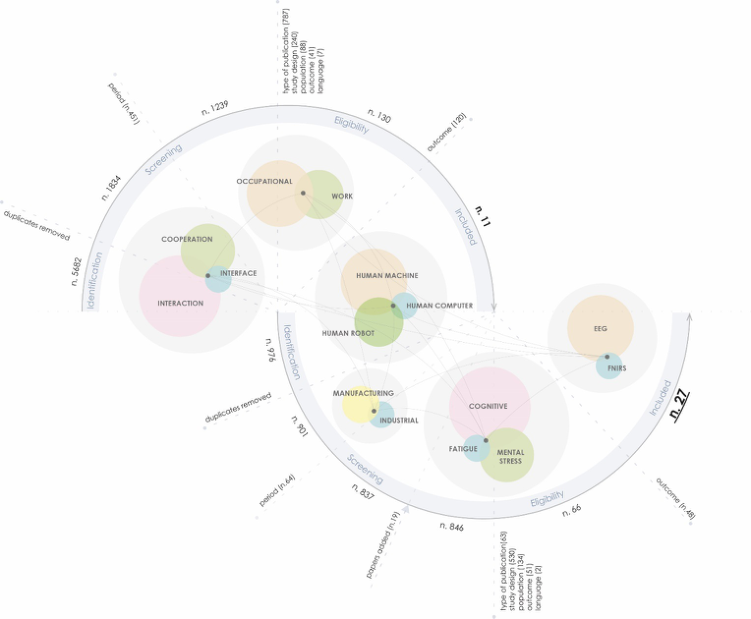
METHODS AND RESULTS By setting the database’s parameters to English and research type, refere- nces were screened (original articles published in the peer-reviewed journal). PubMed, Scopus, Web of Science, and Embase were searched for studies published between January 2000 and March 2023. The paper is based on a literature review focused on workplace safety in the manufacturing sector. The following keywords (MESH and non-MESH terms) were used: ‘Human-machine’ OR ‘Human-robot’ OR ‘Human-computer’ AND ‘Intera- ction*’ OR ‘Interface*’ OR ‘Cooperation’ AND ‘Occupational’ OR ‘Work*’ AND ‘Cognitive’ OR ‘Mental Stress’ OR ‘Fatigue’ AND ‘Neuroergonomics’ AND ‘EEG’ OR ‘fNIRS’. The citations (title and abstract) found in all sou- rces were checked by a reviewer. The final collection of acceptable research was then selected through a full-text article review. Discussions with the other authors helped to settle disagreements. It was decided which vari- ables to extract using a data extraction form. The following items were included: article identifiers (authors, year of publication); study identifi- ers (setting, technologies, design); the parameters included for the analysis. This is a qualitative summary of the studies that were included. The key conclusions are summarized in the Figure 1, where is possible to identify all the papers considered and to visually quantify the amount of studies for each keyword. The state of the art on accidents in the workplace is integrated with the one on measurements of the cognitive and physi- cal strain of operators in the manufacturing sector, using neuroimaging technologies. Free software was used in the selection process (Zotero, Ray- yan). We adhered to the PRISMA-ScR principles for conducting systematic scoping reviews (Tricco, 2018). Twenty-seven papers were examined and analysed.
Results and Discussion
The twenty-seven selected studies were systematised to construct a frame- work of the trials. This framework synthesises and compares all the trials
Design, Human Factors and Neuroergonomics for Safety in Manufacturing 55
Figure 1: Freely re-interpreted and integrated scheme. (Lombardi et al., 2022).
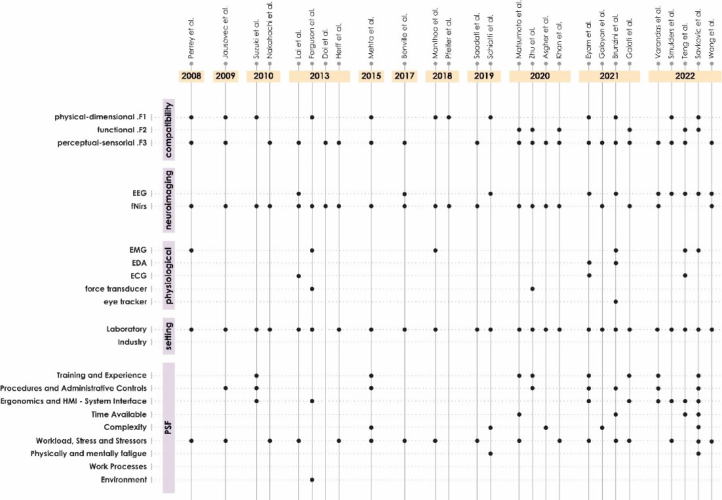
by characterising them according to the compatibility examined (physical- dimensional [F1]; functional [F2] and perceptual-sensorial [F3]), the neuroi- maging and physiological technologies used to monitor the user-operator, the experimental setting and the performance shaping factors (PSF) analysed.
From the analysis of the studies, we can affirm that conventional approa- ches like questionnaires don’t capture real-time activity in the cognitive state, determining the relative influence of mental workload and psychological stress when performing complicated tasks. The creation of intelligent ada- ptive systems, which in turn can help reduce the harmful effects of human error when doing complicated tasks, depends on a sensitive and accurate col- lection of metrics to identify between various levels of mental exertion and psychological stress in real time (Parent et al., 2019).
The combination of measurements of brain and physiological parameters is particularly helpful for emotional studies, providing a method for exami- ning the theoretical process of fatigue, being uncontaminated by technical interference as both detection methods are based on different working pri- nciples, as shown in the summary table (see Figure 2) of the case studies identified and analysed (Perrey et al., 2008; Lai et al., 2013; Farguson et al., 2013; Manthoo et al., 2018; Matsumoto et al., 2020; Eyam et al., 2021; Brunzini et al., 2021; Teng et al., 2022; Savkovic et al., 2022).
Figure 2: Framework’s table of the reviewed studies.
In fact, as shown in studies using the measurement of physiological para- meters as feedback of cognitive activity, heart and breathing rate variability are influenced by both acute stress and mental workload. Therefore, phy- siological measurements are objective and not subject to desirability and other biases that influence questionnaires and self-assessments. The analy- sis shows that the common approach is to study peripheral manifestations of high mental stress such as cardiovascular responses, while more direct mea- sures of brain activity such as electroencephalography (EEG) or functional near-infrared spectroscopy (fNIRS) are recorded.
The ability of EEG to measure spatial resolution is constrained, even though that it has several outstanding characteristics for assessing mental workload, including superior temporal resolution (Li et al., 2022). In addi- tion, setup time and tolerance to motion artifacts must be considered as well for a less intrusive solution. Techniques for optical imaging provide a wor- kable substitute for taking note of the operator’s mental state. Functional near-infrared spectroscopy (fNIRS), on the other hand, provides a potential portable system for measuring mental workload under field conditions. The spatial resolution capability of fNIRS has important advantages for measu- ring mental workload in neuroergonomic studies while people perform or develop skills in task (Li et al., 2022). Both technologies have limitations (for example external disturbance factors, motion artefacts, etc.), so the combi- nation of EEG-fNIRS revealed better results, indicating that additional data sources may be useful for the detection of cognitive fatigue. For example, it’s demonstrated that a hybrid system (EEG + fNIRS) allows higher classifica- tion accuracy for mental workload than using the two technologies alone.
Design, Human Factors and Neuroergonomics for Safety in Manufacturing 57
Using combined EEG and fNIRS, a recent study distinguished between stres- sful and non-stressful settings during a mental arithmetic test with over 90% accuracy (Al-Shargie et al., 2016; Parent et al., 2019).
The functional neuroanatomy of task performance may evolve, according to current concepts of automaticity associated to the growth of competence in particular activities, supporting continuing assessments of cognitive effort (Tanida et al., 2004). Operator skill and mental workload typically have an inverse relationship. The accuracy and interpretation of psychophysiological variables as markers of mental workload are impacted by this inverse relati- onship between skill and cognitive demand for a specific task. Stress (anxiety) is viewed as an inefficient expenditure of energy that does not sustain perfor- mance but instead results in unpleasant feelings like worry (Lu et al., 2022). Mental strain, interpreted as mental effort, is characterized as an efficient expenditure of energy, enhancing or sustaining performance.
Neuroimaging technologies are used to analyse human factors based on a pipeline that includes the signal acquisition phase, the signal-to-noise ratio- improving step, the feature extraction stage, the classification step to identify the current mental states, and the adaptation step (Pfeifer et al., 2018; Li et al., 2022). At this final step, explicit decision-making units are put into place in order to dynamically close the loop by invoking the most suitable cognitive countermeasures. The classification of mental workload and psychological stress, which is connected to inter-individual variability, is another issue rai- sed in the numerous studies. When estimating mental states, physiological measures must consider the fact that different people may respond psycholo- gically and physiologically in various ways to workload or stress. In addition to task complexity, prefrontal brain activations are also connected to each person’s level of mental effort (Parent et al., 2019). Therefore, it is appropri- ate to define not only the psychophysiological indicators but also those that relate to the person’s personality, a requirement for identifying factors that cause mental stress/strain while doing a task.
CONCLUSION
It is necessary to approach the study of Human Factors from a neuroscience perspective, looking forward at the new paradigms of Industry 5.0 and focu- sing on the operator and his capabilities because aspects related to human reliability, fatigue, and physical/cognitive stress (Perrey et al., 2010) during the use of machinery have not yet been adequately investigated. As a result, guidelines for the neuro-ergonomic design of human-machine/robot intera- ction in Industry 4.0 environments are needed. These recommendations will enable us to take action to improve operator safety and health by outli- ning the key requirements, safe operating procedures, and best practices for interactions between humans, machines, and robots that are physical (F1), functional (F2), and perceptual (F3) in nature. The almost all of neuroada- ptive experimental studies have concentrated on human-machine/robot dyad situations, which may open up promising perspectives for improving tea- ming such as human-human, human-machine, and human-robot interactions thanks to hyperscanning, physiological synchrony, and collaborative BCI.
In conclusion, both mental and physical workload and psychological stress are common in work environments, and these concepts can have a mutual influence on each other (Parent et al., 2019). Due to environmental factors, task complexity or repetitiveness, and work organization, the 4.0 opera- tor is exposed to significant cognitive load. Therefore, correct design of work activities and workstations must ensure total operator involvement, risk assessment, and interaction to improve safety. Through a proper analy- sis of Performance Shaping Factors (PSF) and the identification of weak points, it is possible to maximize desirable effects (e.g., performance, lear- ning) by improving operator safety conditions and mitigating the risk of errors. The development of integrated and adaptive systems could substan- tially improve safety conditions in working environments by ensuring better quality of productivity, well-being, and proactive safety measures.
REFERENCES
Al-Shargie, F. M., Tang, T. B., Badruddin, N., & Kiguchi, M. (2016). Mental stress quantification using EEG signals. IFMBE Proceedings, 56, 15–19. https://doi.org/ 10.1007/978-981-10-0266-3_4 Asgher, U., Khalil, K., Ayaz, Y., Ahmad, R., & Khan, M. J. (2020). Classification of
Mental Workload (MWL) using Support Vector Machines (SVM) and Convoluti- onal Neural Networks (CNN). 2020 3rd International Conference on Computing, Mathematics and Engineering Technologies: Idea to Innovation for Building the Knowledge Economy, ICoMET 2020. https://doi.org/10.1109/ICOMET48670. 2020.9073799 Ayaz, H., Shewokis, P. A., Bunce, S., Izzetoglu, K., Willems, B., & Onaral, B.
(2012). Optical brain monitoring for operator training and mental workload assessment. NeuroImage, 59(1), 36–47. https://doi.org/10.1016/J. NEUROI- MAGE.2011.06.023 Balconi, M., & Molteni, E. (2016). Past and future of near-infrared spectroscopy in studies of emotion and social neuroscience. Journal of Cognitive Psychology, 28(2), 129–146. https://doi.org/10.1080/20445911.2015.1102919 Banville, H., Gupta, R., & Falk, T. H. (2017). Mental Task Evaluation for
Hybrid NIRS-EEG Brain-Computer Interfaces. Computational Intelligence and Neuroscience, 2017. https://doi.org/10.1155/2017/3524208 Brunzini, A., Grandi, F., Peruzzini, M., & Pellicciari, M. (2021). Vir- tual training for assembly tasks: A framework for the analysis of the cognitive impact on operators. Procedia Manufacturing, 55(C), 527–534. https://doi.org/10.1016/J. PROMFG.2021.10.072 Dehais, F., Lafont, A., Roy, R., & Fairclough, S. (2020). A Neuroergonomics Approach to Mental Workload, Engagement and Human Performance. Frontiers in Neuroscience, 14. https://doi.org/10.3389/FNINS.2020.00268 Doi, H., Nishitani, S., & Shinohara, K. (2013). NIRS as a tool for assaying emoti-
onal function in the prefrontal cortex. Frontiers in Human Neuroscience, NOV. https://doi.org/10.3389/FNHUM.2013.00770 Eyam, A. T., Mohammed, W. M., & Martinez Lastra, J. L. (2021). Emotion-driven analysis and control of human-robot interactions in collaborative applications. Sensors, 21(14). https://doi.org/10.3390/S21144626 Ferguson, S. A., Allread, W. G., Le, P., Rose, J., & Marras, W. S. (2013). Shoul-
der muscle fatigue during repetitive tasks as measured by electromyography and near-infrared spectroscopy. Human Factors, 55(6), 1077–1087. https://doi.org/ 10.1177/0018720813482328
Design, Human Factors and Neuroergonomics for Safety in Manufacturing 59
Galati, A., Schoppa, R., & Lu, A. (2021). Exploring the SenseMaking Process through Interactions and fNIRS in Immersive Visualization. IEEE Transactions on Visualization and Computer Graphics, 27(5), 2714–2724. https://doi.org/10. 1109/TVCG.2021.3067693 Galoyan, T., Betts, K., Abramian, H., Reddy, P., Izzetoglu, K., & Shewokis, P. A.
(2021). Examining Mental Workload in a Spatial Navigation Transfer Game via Functional near Infrared Spectroscopy. Brain Sciences 2021, Vol. 11, Page 45, 11(1), 45. https://doi.org/10.3390/BRAINSCI11010045 Herff, C., Heger, D., Putze, F., Hennrich, J., Fortmann, O., & Schultz, T. (2013). Classification of mental tasks in the prefrontal cortex using fNIRS. Proceedings of the Annual International Conference of the IEEE Engineering in Medicine and Biology Society, EMBS, 2160–2163. https://doi.org/10.1109/EMBC.2013.6609962 Jaušovec, N., & Jaušovec, K. (2009). Gender related differences in visual and audi-
tory processing of verbal and figural tasks. Brain Research, 1300, 135–145. https://doi.org/10.1016/J. BRAINRES.2009.08.093 Körner, U., Müller-Thur, K., Lunau, T., Dragano, N., Angerer, P., & Buchner, A.
(2019). Perceived stress in human–machine interaction in modern manufacturing environments—Results of a qualitative interview study. Stress and Health, 35(2), 187–199. https://doi.org/10.1002/SMI.2853 Khan, R. A., Naseer, N., Saleem, S., Qureshi, N. K., Noori, F. M., & Khan, M. J.
(2020). Cortical Tasks-Based Optimal Filter Selection: An fNIRS Study. Journal of Healthcare Engineering, 2020. https://doi.org/10.1155/2020/9152369 Lai, V., Theppitak, C., Makizuka, T., Higuchi, Y., Movahed, M., Kumudini, G., Izumi, H., & Kumashiro, M. (2014). A normal intensity level of psycho-physiological stress can benefit working memory performance at high load. International Journal of Industrial Ergonomics, 44(3), 362–367. https://doi.org/10.1016/J. ERGON.2013.11.015 Li, R., Yang, D., Fang, F., Hong, K. S., Reiss, A. L., & Zhang, Y. (2022).
Concurrent fNIRS and EEG for Brain Function Investigation: A Systema- tic, Methodology-Focused Review. Sensors (Basel, Switzerland), 22(15), 5865. https://doi.org/10.3390/s22155865 Lombardi, I., Capece, S., Monaco, M. G. L., & Buono, M. (2022). Human-Machine Interaction Safety in Manufacturing: a Scoping Review. Safety Management and Human Factors, 64. https://doi.org/10.54941/AHFE1002649 Lu, L., Xie, Z., Wang, H., Li, L., & Xu, X. (2022). Mental stress and safety awa-
reness during human-robot collaboration - Review. Applied Ergonomics, 105. https://doi.org/10.1016/J. APERGO.2022.103832 Mantooth, W. P., Mehta, R. K., Rhee, J., & Cavuoto, L. A. (2018). Task and sex differences in muscle oxygenation during handgrip fatigue development. Ergonomics, 61(12), 1646–1656. https://doi.org/10.1080/00140139.2018.1504991 Matsumoto, M., Sakurada, T., & Yamamoto, S. I. (2020). Distinct bilateral prefron-
tal activity patterns associated with the qualitative aspect of working memory cha- racterized by individual sensory modality dominance. PLoS ONE, 15(8 August). https://doi.org/10.1371/JOURNAL. PONE.0238235 Mehta, J. P., Lavender, S. A., Jagacinski, R. J., & Sommerich, C. M. (2015). Exploring the effects of seated whole body vibration exposure on repetitive asymmetric lif- ting tasks. Journal of Occupational and Environmental Hygiene, 12(3), 172–181. https://doi.org/10.1080/15459624.2014.960573 Nakahachi, T., Ishii, R., Iwase, M., Canuet, L., Takahashi, H., Kurimoto,
R., Ikezawa, K., Azechi, M., Kajimoto, O., & Takeda, M. (2010). Frontal cortex activation associated with speeded processing of visuospatial working memory revealed by multichannel near-infrared spectroscopy during Advanced
Trail Making Test performance. Behavioural Brain Research, 215(1), 21–27. https://doi.org/10.1016/J. BBR.2010.06.016 Parasuraman, R., & Rizzo, M. (Eds.). (2007). Neuroergonomics: The brain at work.
Oxford University Press. Parasuraman, R., & Wilson, G. F. (2008). Putting the brain to work: neuroergonomics past, present, and future. Human Factors, 50(3), 468–474. https://doi.org/10.1518/001872008X288349 Parent, M., Peysakhovich, V., Mandrick, K., Tremblay, S., & Causse, M. (2019). The
diagnosticity of psychophysiological signatures: Can we disentangle mental wor- kload from acute stress with ECG and fNIRS? International Journal of Psychophy- siology : Official Journal of the International Organization of Psychophysiology, 146, 139–147. https://doi.org/10.1016/J. IJPSYCHO.2019.09.005 Perrey, S., Thedon, T., & Rupp, T. (2010). NIRS in ergonomics: Its application in industry for promotion of health and human performance at work. International Journal of Industrial Ergonomics, 40(2), 185–189. https://doi.org/10.1016/J. ERGON.2008.11.002 Pfeifer, M. D., Scholkmann, F., & Labruyère, R. (2018). Signal processing in functional near-infrared spectroscopy (fNIRS): Methodological differences lead to different statistical results. Frontiers in Human Neuroscience, 11, 641. https://doi.org/10.3389/FNHUM.2017.00641/BIBTEX Rayyan, (Last access 28 February 2022). The Rayyan’s website: www.rayyan.ai Saadati, M., Nelson, J., & Ayaz, H. (2019). Mental Workload Classification from
Spatial Representation of FNIRS Recordings Using Convolutional Neural Netw- orks. IEEE International Workshop on Machine Learning for Signal Processing, MLSP, 2019-October. https://doi.org/10.1109/MLSP.2019.8918861 Savkovi´c, M., Caiazzo, C., Djapan, M., Vuki´cevi´c, A. M., Pušica, M., & Maˇcuži´c, I. (2022). Development of Modular and Adaptive Laboratory Set-Up for Neuro- ergonomic and Human-Robot Interaction Research. Frontiers in Neurorobotics, 16, 92. https://doi.org/10.3389/FNBOT.2022.863637/BIBTEX Schiatti, L., Barresi, G., Tessadori, J., King, L. C., & Mattos, L. S. (2019). The Effect
of Vibrotactile Feedback on ErrP-based Adaptive Classification of Motor Imagery. Proceedings of the Annual International Conference of the IEEE Engineering in Medicine and Biology Society, EMBS, 6750–6753. https://doi.org/10.1109/EMBC .2019.8857192 Smulders, M., van Dijk, L. N. M., Song, Y., Vink, P., & Huysmans, T. (2023). Dense 3D pressure discomfort threshold (PDT) map of the human head, face and neck: A new method for mapping human sensitivity. Applied Ergonomics, 107, 103919. https://doi.org/10.1016/J. APERGO.2022.103919 Song, S., & Awolusi, I. (2020). Industrial Safety Management Using Innovative and
Proactive Strategies. Song, X., Chen, X., Chen, L., An, X., & Ming, D. (2020). Performance Improvement for Detecting Brain Function Using fNIRS: A Multi-Distance Probe Configura- tion With PPL Method. Frontiers in Human Neuroscience, 14. https://doi.org/10. 3389/FNHUM.2020.569508 Suzuki, S., Harashima, F., & Furuta, K. (2010). Human control law and brain activity
of voluntary motion by utilizing a balancing task with an inverted pendulum. Advances in Human-Computer Interaction, 2010. https://doi.org/10.1155/2010/ 215825 Tanida, M., Sakatani, K., Takano, R., & Tagai, K. (2004). Relation between asymmetry of prefrontal cortex activities and the autonomic nervous system during a mental arithmetic task: near infrared spectroscopy study. Neuroscience letters, 369(1), 69–74. https://doi.org/10.1016/j.neulet.2004.07.076
Design, Human Factors and Neuroergonomics for Safety in Manufacturing 61
Teng, Y., Sun, Y., Chen, X., & Zhang, M. (2022). Research on effective recognition of alarm signals in a human-machine system based on cognitive neural experiments. International Journal of Occupational Safety and Ergonomics : JOSE. https://doi. org/10.1080/10803548.2022.2085428 Tricco, A. C., Lillie, E., Zarin, W., O’Brien, K. K., Colquhoun, H., Levac, D., Moher,
D., Peters, M. D. J., Horsley, T., Weeks, L., Hempel, S., Akl, E. A., Chang, C., McGowan, J., Stewart, L., Hartling, L., Aldcroft, A., Wilson, M. G., Garritty, C., Lewin, S., Godfrey, C. M., Macdonald, M. T., Langlois, E. V., Soares-Weiser, K., Moriarty, J., Clifford, T., Tunçalp, Ö., Straus, S. E., (2018) “PRISMA Exten- sion for Scoping Reviews (PRISMA-ScR): Checklist and Explanation”. Annals of internal medicie, Volume 169 No.7, pp. 467–473. ISSN 0003–4819. Varandas, R., Lima, R., Badia, S. B. I., Silva, H., & Gamboa, H. (2022). Automatic Cognitive Fatigue Detection Using Wearable fNIRS and Machine Learning. Sensors, 22(11). https://doi.org/10.3390/S22114010 Zhu, Q., & Du, J. (2020). Neural Functional Analysis in Virtual Reality Simulation:
Example of a Human-Robot Collaboration Tasks. Zotero, (Last access 31 January 2022). The Zotero’s website: www.zotero.org
LISTED IN THE AHFE DIGITAL BOOKSTORE CATALOGUE
Explore the complete digital volume
Human Factors in Accessibility and Assistive Technology
Read this individual research paper free through the original publisher, or explore the full digital proceedings book.
ISBN 978-1-958651-63-6
Explore this ISBN in the AHFE Bookstore ↗Listed in the July 2026 bookstore catalogue; search by ISBN to confirm current availability · Digital book purchase optional