Pi-Jung Hsieh, Hui-Min Lai, Wen-Tsung Ku (2023). Investigating Health-Care Consumers’ Intention to Use Patient Decision Aids: An Empirical Study. In: Human Factors in Accessibility and Assistive Technology. AHFE Open Access, vol. 87, pp. 1–10. https://doi.org/10.54941/ahfe1003647
Patient decision aids (PDAs) are designed to help patients participate in making specific choices concerning their care options in shared decision-making (SDM). Even though some practitioners and academics have emphasized how SDM enables hospitals to improve patient safety, the overall adoption of PDAs by patients remains low. This study developed an integrated model to explain health-care consumers’ intention to use PDAs. This theoretical model was empirically validated using online survey data from Taiwanese citizens aged at least 20 years. The structural equation model was used to examine the data. The 2,513 valid questionnaires obtained by this study constituted a response rate of 83.76%. The results revealed that e-health literacy had a positive influence on self-efficacy. The findings also indicated that self-efficacy, e-health literacy, functional value, social value, and emotional value had a positive effect on health-care consumers’ intention to use PDAs in SDM. The results of this study provide constructive suggestions to researchers, hospitals, and the government to increase the likelihood of SDM participation.
Thoughtful and empathetic consideration of patients’ expectations, values, and preferences is an important component of clinical care (Sackett, 1997). Shared decision-making (SDM) can be used to assist patients in participa- ting in decision-making processes about the most appropriate treatments or medical care options for them according to their values, expectations, and preferences (Krones et al., 2010). In the SDM process, patient decision aids (PDAs) are intervention tools designed to assist patients in participating in making specific choices regarding treatment and medical care possibilities (Hsieh, 2022). Thus, when SDM is supported by PDAs, it may increase pati- ents’ ability to participate, thereby facilitating doctor–patient communication and decisions about appropriate care (Coulter, 2018). In 2016, the Joint
Commission of Taiwan (JCT) devised a national implementation plan for SDM under the aegis of the Taiwan Ministry of Health and Welfare (MOHW) that incorporated multiple approaches, such as developing PDAs, executing the Medical Decision Aids campaign, establishing an SDM platform, and integrating SDM in medical care practice. To realize resource sharing, the MOHW commissioned the JCT to build an SDM platform. In 2016, the JCT invited medical care teams from hospitals to develop 174 PDA tools, eventually approving 57 of them. It then uploaded these PDAs and 22 pri- ority themes to an SDM platform for download and utilization by medical personnel across the country (Coulter, 2018). Furthermore, the MOHW has established an accreditation scheme called Healthy Hospitals, a program that combines elements of health literacy, SDM, and patient engagement as well as a patient-centered approach. As of the end of 2020, a total of 203 hospi- tals in Taiwan have been certified, including 22 medical centers, 84 regional hospitals, and 97 district hospitals, with coverage rates of 100%, 96.70%, and 27%, respectively (Taiwan Health and Welfare, 2022). In the care pro- cess, using PDAs can enhance evidence-based practice, reduce medication errors, and improve the efficiency and accuracy of clinical care. Although SDM enables health-care providers to respect patient autonomy and improve the quality of care, the overall adoption of PDAs by patients remains low. To realize the benefits of these tools, patient participation is especially important.
Hsieh (2022) indicated that the function of PDAs in the SDM process is to assist the communication between doctors and patients, which can make medical decisions suitable to patients’ preferences and values. Therefore, pati- ents’ perceived values and individual characteristics may affect their choice decisions regarding the health-care service as well as their intentions to adopt the tools in question. Previous studies have investigated the factors that influ- ence patients’ behavioral intentions regarding SDM (Reychav et al., 2018), nursing staff’s attitudes toward SDM (Hsu et al., 2021), and knowledge- sharing intentions linked to the SDM platform (Hsieh, 2022). However, the literature on the role of patients’ perceived values and individual characte- ristics in the intention to adopt PDAs is limited. A variety of behavioral theories can be used to explain users’ technology adoption. One of these— consumption value theory (CVT) (Sheth et al., 1991)—has proven successful in exploring consumers’ adoption and continuance behavior across various mobile technologies (Yang and Lin, 2017; Carlson et al., 2018). Considering that SDM is a collaborative care process in which decisions are made by the patient and their medical staff, the most appropriate care option is determi- ned on the basis of the patient’s preferences, expectations, and values (Krones et al., 2010). Patients’ values may affect their medical decision-making beh- avior. Therefore, CVT offers a useful way to link consumption values and patients’ PDA adoption behavior in an integrated model. We anticipate that identifying critical value factors will assist in synergizing health care and technology for the successful use of PDAs in the medical care process.
Malloy-Weir et al. (2015) suggested that health literacy is an important factor affecting the use of PDAs in clinical treatment decisions. Because health literacy is a prerequisite for making informed health-care decisions, patients must have a certain degree of it to effectively use PDAs. Previous studies have
Investigating Health-Care Consumers’ Intention to Use Patient Decision Aids 3
noted that e-health literacy affects the decision-making consensus between doctor and patient because a low level of such literacy hinders communica- tion and interaction between the two parties (Kim et al., 2015). Furthermore, patients with low e-health literacy are less likely to feel confident in their ability to access and understand health-related information, which makes them less willing to participate in the health-care decisions that affect them. The purpose of this study is to investigate whether consumption values, self-efficacy, and e-health literacy significantly influence patients’ behavioral intentions to use PDAs. Compared to previous studies, considering patients’ consumption values and individual characteristics enables this study to pro- vide a useful theoretical model to identify the key antecedents influencing the behavioral intention to adopt PDAs. This study contributes to medical insti- tutions and health authorities by offering unique insights into the promotion of PDA tools in SDM, which will, in turn, encourage patient participation in decision-making for disease treatment and health management.
LITERATURE REVIEW
Consumption Value Theory CVT proposes that a consumer’s choice decision is a function of multiple con- sumption values, each of which exerts different influences in different choice situations and is independent of the others (Sheth et al., 1991). According to CVT, five types of consumer values affect the choice decision of a service: social, functional, epistemic, emotional, and conditional values. These values determine consumers’ decision-making choices (Sheth et al., 1991). Social value refers to the perceived utility obtained from the association of an alter- native with a specific group. Functional value is the perceived utility derived from the practical, functional, or physical performance capabilities of the alternatives. Emotional value consists of the perceived utility gained from the ability of an alternative to evoke an emotion or affective state. Epistemic value refers to the perceived utility obtained from the ability of alternatives to stimulate curiosity and provide novelty. Conditional value is the perceived utility derived from alternatives as a result of a particular situation faced by the chooser. Prior studies have found that these five values can explain an individual’s intention to use various technologies (Hallem and Barth, 2011; Carlson et al., 2018; Fathima et al., 2022). Since the context of our study is the use of PDAs for disease treatment decision-making, patients may not be able to distinguish between original value and enhanced value or the obtai- ned utility of innovations. Therefore, this study considers social, functional, and emotional value, but not epistemic and conditional value, to explain an individual’s intention to use PDAs.
Self-Efficacy and E-Health Literacy Self-efficacy is an individual’s confidence in his or her ability to perform a particular action (Bandura, 1997). According to social cognitive theory, when individuals are confident in their ability to use a certain type of health tech- nology, they are more likely to use it. Thus, high self-efficacy leads to a high
likelihood of adopting recommended health actions (Melzner et al., 2014). Prior studies have suggested that self-efficacy affects individuals’ use of infor- mation technology to seek useful health information (Deng and Liu, 2017). Patient health literacy is an important factor in implementing PDA usage in clinical practice since patients need to be health literate to use decision aids effectively (Malloy-Weir et al., 2015). E-health literacy is the ability to find relevant information from electronic sources, assess its reliability, and use it to make health-related decisions (Hirvonen et al., 2016). Low levels of e-health literacy may hinder the ability to make informed health decisions. Previous studies have suggested a positive relationship between e-health lite- racy, health information behaviors, and self-efficacy (Kim et al., 2015; Deng and Liu, 2017). For this reason, this study considers self-efficacy and e-health literacy as key factors to explain individuals’ intention to use PDAs for SDM.
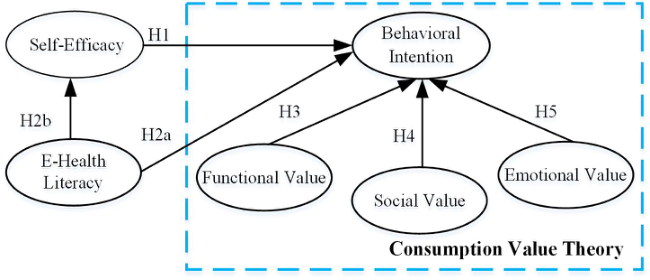
RESEARCH MODEL In this study, we use three CVT constructs—functional value, social value, and emotional value—and two individual characteristics—self-efficacy and e-health literacy—to identify the behavioral intentions of patients. Figure 1 presents the proposed research model.
In this study, self-efficacy refers to an individual’s confidence in their abi- lity to perform health-related actions (Kim et al., 2015). Patients with high self-efficacy have been found to be more likely to take the recommended health action; thus, self-efficacy has a positive influence on their behavioral intention (Deng and Liu, 2017). If patients have a high degree of confidence in using PDAs in SDM, their behavioral intention to use such tools will be enhanced. Thus, we propose the following hypothesis: H1. Self-efficacy has a positive impact on individuals’ intention to use PDAs.
Smith et al. (2009) suggested that health literacy can limit a patient’s abi- lity to participate in decision-making. Malloy-Weir et al. (2015) indicated that PDAs developed for patients with high health literacy may not be able to meet the needs of patients with low health literacy, since the latter experience complex communication difficulties, including limited problem-solving skills
Figure 1: Research framework.
Investigating Health-Care Consumers’ Intention to Use Patient Decision Aids 5
and confusion caused by new information (Smith et al., 2009). Furthermore, Kim et al. (2015) suggested that people with low e-health literacy have less confidence in their ability to obtain, process, and understand online health information. Therefore, e-health literacy affects not only behavior intention but also self-efficacy. Kim et al. (2015) confirmed that personal e-health lite- racy has a positive impact on self-efficacy. In this study, low e-health literacy was found to hinder information communication and interaction between doctors and patients, and people with insufficient e-health literacy in particu- lar do not find it easy to understand medical diagnoses and treatment advice, misunderstand doctors’ prescriptions, and may be more dissatisfied or fail to use medical services properly. Therefore, the following two hypotheses are proposed: H2a. E-health literacy has a positive impact on individuals’ intention to use PDAs.
H2b. E-health literacy has a positive impact on individuals’ self-efficacy. Functional value refers to the rational individual’s evaluation of the qua- lity of the service use (Sheth et al., 1991). This evaluation includes an appraisal of the access to helpful or useful information (Carlson et al., 2018). In this study, when patients felt that the use of PDAs could pro- vide useful, practical empirical medical evidence on their treatment, they were more willing to use them. Previous studies on individuals’ adoption of technology have also found a correlation between functional value and behavioral intention (Yang and Lin, 2017). Thus, we propose the following hypothesis: H3. Functional value has a positive impact on individuals’ intention to use PDAs.
Social value is defined as social identity and the enrichment of an indivi- dual’s image in society (Sheth et al., 1991). In this study, patients’ use of PDA tools helped the consensus and the relationship between doctor and patient in terms of solving problems related to treatment options. In turn, this promo- ted patients’ intention to use PDAs. Previous studies of individuals’ adoption of technology have also found a correlation between social value and beh- avioral intention (Yang and Lin, 2017). Thus, we propose the following hypothesis: H4. Social value has a positive impact on individuals’ intention to use PDAs.
Emotional value refers to the emotional utility derived from a service. This type of value may be generated when a service stimulates consumers’ feelings or sentiments (Sheth et al., 1991). In this study, when patients had health or treatment problems, they used PDAs to understand the significance of the disease, clinical process, and treatment options. As a result, they felt protected, comfortable, calm, and reassured in terms of their physical health, which enhanced their intention to use such tools. Carlson et al. (2018) also confirmed that emotional value has a positive impact on usage intention. Therefore, this study proposes the following hypothesis: H5. Emotional value has a positive impact on individuals’ intention to use PDAs.
RESEARCH METHODOLOGY Questionnaire Development
The survey questionnaire consisted of two parts. The first one included nomi- nal scales and 5-point Likert scales ranging from strongly agree to strongly disagree. The survey was used to collect basic information on the respon- dents’ characteristics, including their age, gender, education, and PDA use experience. The second part was based on the constructs of emotional value, functional value, social value, self-efficacy, e-health literacy, and behavioral intention. The scale items for emotional, functional, and social value were adapted from Carlson et al. (2018) and Yang and Lin (2017), while those for e-health literacy were adapted from Norman and Skinner (2006). The items measuring self-efficacy were adapted from Oh et al. (2013). The items measuring behavioral intention were adapted from Venkatesh et al. (2003).
Data Analysis We used structural equation modeling with partial least squares estimates for data analysis. We examined the reliability and validity of the proposed research model. The model was deemed reliable if the construct reliability (CR) was greater than 0.8. Convergent validity was assessed based on the following criteria: (a) statistically significant item loading greater than 0.7, (b) CR greater than 0.8, and (c) average variance extracted (AVE) greater than 0.5 (Hair et al., 1998). The discriminant validity was examined based on the criterion that the square root of the AVE of each construct should be greater than the corresponding correlations with all the other constructs (Fornell and Larcker, 1981).
Sample and Data Collection The target participants were individuals over 20 years of age living in Taiwan. An online survey was employed for data collection. To improve the genera- lizability of the results, the participants differed by gender and geography. A total of 3,000 questionnaires were distributed, and 2,513 were returned.
RESULTS
The 2,513 valid responses obtained represent a response rate of 83.76%. Slightly more than half (50.2%) of the respondents were male. The majo- rity (72.2%) were aged between 20 and 49. Of the respondents, 53.3% had completed university education and 53.6% had no experience of PDAs. All Cronbach’s alphas were greater than 0.9. Regarding convergent validity, all the item loading and the CR values were greater than 0.9, and the AVEs ranged from 0.68 to 0.90. Concerning discriminant validity, the square root of the AVE of each construct was greater than its corresponding correlations with the other constructs. Table 1 presents the descriptive statistics of the pri- ncipal constructs and the correlation matrix. These results indicate acceptable reliability, convergent validity, and discriminant validity.
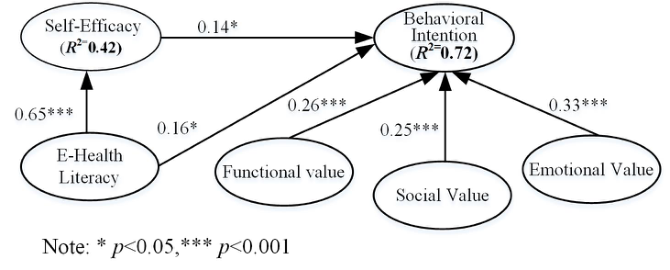
Figure 2 presents the structural model test results. The results indicate that emotional value (β = 0.33, standardized path coefficient, p < 0.001), social
Investigating Health-Care Consumers’ Intention to Use Patient Decision Aids 7
Table 1. Reliability and Validity of the Scale.
Table available in the original PDF paper.
Construct Item loading CR AVE Correlation
EV EH FV SE SV US EV 0.89–0.91 0.96 0.81 0.90 EH 0.77–0.86 0.94 0.68 0.53 0.82 FV 0.94–0.95 0.96 0.90 0.61 0.54 0.95 SE 0.84–0.90 0.93 0.76 0.56 0.64 0.55 0.87 SV 0.89–0.91 0.95 0.82 0.55 0.53 0.51 0.56 0.91 US 0.88–0.91 0.94 0.81 0.50 0.54 0.58 0.55 0.59 0.90
Note: The leading diagonal shows the square root of the AVE of each construct.
value (β = 0.25, p < 0.001), functional value (β = 0.26, p < 0.001), self- efficacy (β = 0.14, p < 0.05), and e-health literacy (β = 0.16, p < 0.05) had a positive effect on behavioral intention and that, when taken together, they explained 72% of its variance. Consequently, hypotheses 1, 2a, 3, 4, and 5 were confirmed. E-health literacy (β = 0.65, p < 0.001) significantly influenced self-efficacy and explained 42% of the total variance. Therefore, hypothesis 2b was supported.
DISCUSSION
This study explores how consumption values and individual characteristics influence patients’ intentions to use the PDA tools in the SDM process. We integrate CVT, self-efficacy, and e-health literacy to determine whether this extended CVT model represents a superior theoretical framework. The results show that emotional, social, and functional value have positive effects on behavioral intention. This is in line with the findings of previous stu- dies on technology adoption (Yang and Lin, 2017; Carlson et al., 2018) and highlights the critical role of consumption value in mobile technology use. First, when individuals need treatment for a disease, they can use PDAs to understand the disease process and the available treatment methods. This will make them feel that their health is well protected, which will enhance their intention to use PDAs. Second, patients’ use of PDA tools can promote the
doctor–patient relationship and solve problems related to treatment choices, which will enhance the intention to use PDAs. Third, patients believe that PDA tools can provide useful and practical empirical medical evidence on disease treatment, which strengthens their behavioral intention to use such tools in medical decision-making. Self-efficacy is an influential factor in the intention to use PDAs. This finding is consistent with the results of Deng and Liu (2017). Thus, patients who perceive higher levels of self-efficacy are more confident in using PDAs for SDM in order to understand information on their disease and treatment options. This enhances their intention to use PDAs. E- health literacy also has a direct positive effect on self-efficacy and behavioral intention, which is consistent with the findings of Kim et al. (2015). This implies that high levels of e-health literacy can improve patients’ ability to make informed health decisions, thereby promoting their usage intention.
CONCLUSION
Our study has two limitations. The primary one is related to sample size. Future studies could use our research model on a larger sample. The secon- dary limitation is that a cross-sectional study cannot analyze behavior over time. Longitudinal studies could provide a clearer picture of how patient beh- aviors and the relationships between the variables change over time. Our study has several implications for academic practice. First, few studies have investigated consumption values and individual characteristics in the con- text of SDM. Our research provides a more complete set of antecedents that better explain the intention to employ a specific health technology, which improves the practical relevance of our study. Second, from the perspective of CVT, we find that emotional, social, and functional value are important in motivating patients to use PDAs for medical decision-making. Third, in terms of people’s individual characteristics, our results show that self-efficacy and e-health literacy are significant factors that promote patients’ willin- gness to use PDAs. Therefore, future studies can incorporate self-efficacy and e-health literacy into their research models to enhance the explanatory power of individual characteristics in understanding shared decision-making by doctors and patients. Some practical suggestions can be drawn from the findings of this study. First, because consumer value (i.e., emotional, functi- onal, and social value) has a significant impact on the intention to use PDAs, health-care providers should emphasize such value to formulate promotional strategies, which can focus on enhancing the functionality and effectiveness of PDAs for medical decision-making; encourage communication between doctors and patients; and reduce patients’ anxiety, which will increase use intention. Second, our results show that e-health literacy and self-efficacy are significant factors affecting patients’ intention to use PDAs, while e-health literacy is also an important factor affecting self-efficacy. Therefore, to encou- rage more patients to use PDAs, system managers should strive to improve the functionality and performance of these tools. Third, managers should employ user-friendly designs and ensure not only that patients can easily learn how to use PDAs, but also that health-care professionals educate patients on the care process, thereby increasing their confidence and ability to use a PDA for
Investigating Health-Care Consumers’ Intention to Use Patient Decision Aids 9
medical decision-making. Finally, we hope that the findings of this study will stimulate interest in future research on the application of health technology in health-care decision-making and motivate scholars to delve deeper into this unexplored but potentially rich field of inquiry.
ACKNOWLEDGMENT
This study was funded and supported by the National Science and Technology Council of Taiwan (grant number: MOST 111-2410-H-041-001).
REFERENCES
Bandura, A. (1977). Self-efficacy: Toward a unifying theory of behavioral change, Psychological Review Volume 84 No. 2, pp. 191–215. Carlson, J., Wyllie, J., Rahman, M. M., Voola, R. (2018). Enhancing brand relati-
onship performance through customer participation and value creation in social media brand communities, Journal of Retailing and Consumer Services Volume 50, pp. 333–341. Coulter, A. (2018). National strategies for implementing shared decision making.
Bertelsmann Stiftung: [Accessed July 21, 2022]. https://www.bertelsmann- stiftung.de/en/publications/publication/did/national-strategies-for-implementing- shared-decision-making-engl. Deng, Z., Liu, S. (2017). Understanding consumer health information-seeking behavior from the perspective of the risk perception attitude framework and social support in mobile social media websites, International Journal of Medical Informatics Volume 105, pp. 98–109. Fathima, A., Khan, A., Alam, A. S. (2022). Relationship of the theory of consum-
ption values and flow with online brand experience: A study of young consumers, Journal of Internet Commerce. doi:10.1080/15332861.2022.2109876. Fornell, C., Larcker, D. (1981). Structural equation models with unobservable variables and measurement error: Algebra and statistics, Journal of Marketing Research Volume 18 No. 3, pp. 382–388. Hair, J., Black, W. C., Babin, B. J., Anderson, R. E., Tatham, R. L. (2006) Multivariate
data analysis, 6th ed., Upper Saddle River, NJ: Prentice-Hall. Hallem, Y., Barth, I. (2011). Customer-perceived value of medical tourism: An exploratory study-the case of cosmetic surgery, Journal of Hospitality and Tourism Management Volume 18 No. 1, pp. 121–129. Hirvonen, N., Ek, S., Niemelä, R., Pyky, R., Ahola, R., Korpelainen, R., Huotari,
M. L. (2016). Everyday health information literacy in relation to health behavior and physical fitness: A population-based study among young men, Library & Information Science Research Volume 38, pp. 308–318. Hsieh, P. J. (2022). Determinants of knowledge-sharing intentions for shared decision-making platforms, Journal of Computer Information Systems Volume 62 No. 5, p. 1980747. Hsu, H. C., Lin, S. C., Lee, Y. H., Wu, H. Y., Wang, P. Y., Li, J. Y., Lin, M. H.
(2021). Development and testing of the shared decision-making attitudes scale among nurses in Taiwan: A cross-sectional scale development study, BMJ Open Volume 14;11 No. 9, e044733. Krones, T., Keller, H., Becker, A., Sönnichsen, A., Baum, E., Donner-Banzhoff, N.
(2010). The theory of planned behaviour in a randomized trial of a decision aid on cardiovascular risk prevention, Patient Education and Counseling Volume 78, pp. 169–176.
Kim, Y. C., Lim, J. Y., Park, K. (2015). Effects of health literacy and social capital on health information behavior, Journal of Health Communication Volume 20, pp. 1084–1094. Malloy-Weir, L. J., Charles, C., Gafni, A., Entwistle, V. A. (2015). Empirical relation-
ships between health literacy and treatment decision making: A scoping review of the literature, Patient Education and Counseling Volume 98 No. 3, pp. 296–309. Melzner, J., Heinze, J., Fritsch, T. (2014). Mobile health applications in workplace health promotion: An integrated conceptual adoption framework, Procedia Technology Volume 16, pp. 1374–1382. Norman, C. D., Skinner, S. A. (2006). eHEALS: The eHealth literacy scale, Journal
of Medical Internet Research Volume 8 No. 4, e27. Oh, H. J., Lauckner, C., Boehmer, J., Fewins-Bliss, R., Li, K. (2013). Facebooking for health: An examination into the solicitation and effects of health-related social support on social networking sites, Computers in Human Behavior Volume 29, pp. 2072–2080. Reychav, I., Najami, I., Raban, D. R., McHaney, R., Azuri, J. (2018). The impact of
media type on shared decision processes in third-age populations. International Journal of Medical Informatics Volume 112, pp. 45–58. Sackett, D. L. (1997). Evidence-based medicine, Seminars in Perinatology Volume 21, pp. 3–5. Sheth, J. N., Newman, B. I., Gross, B. L. (1991). Why we buy what we buy: A
theory of consumption values, Journal of Business Research Volume 22 No. 2, pp. 159–170. Smith, S. K., Dixon, A., Trevena, L., Nutbeam, D., McCaffery, K. J. (2009). Exploring patient involvement in healthcare decision making across different education and functional health literacy groups, Social Science & Medicine Volume 69, pp. 1805–1812. Taiwan Health and Welfare (April 20, 2022). 2021 Taiwan health and welfare report.
Taiwan Health and Welfare: https://www.mohw.gov.tw/lp-137-2.html. Venkatesh, V., Morris, M. G., Davis, G. B., Davis, F. D. (2003). User acceptance of information technology: Toward a unified view, Management Information Systems Volume 27 No. 3, pp. 425–478. Yang, H. L., Lin, R. X. (2017). Determinants of the intention to continue use of
SoLoMo services: Consumption values and the moderating effects of overloads, Computers in Human Behavior Volume 73, pp. 583–595.
LISTED IN THE AHFE DIGITAL BOOKSTORE CATALOGUE
Explore the complete digital volume
Human Factors in Accessibility and Assistive Technology
Read this individual research paper free through the original publisher, or explore the full digital proceedings book.
ISBN 978-1-958651-63-6
Explore this ISBN in the AHFE Bookstore ↗Listed in the July 2026 bookstore catalogue; search by ISBN to confirm current availability · Digital book purchase optional