Pi-jung Hsieh, Hui-min Lai, Yung-ching Yang (2023). Exploring the Influencing Factors of Personal Loyalty to Health Passbooks: Extending the Perspective of Consumption Values. In: Emerging Technologies in Healthcare and Medicine. AHFE Open Access, vol. 116, pp. 362–371. https://doi.org/10.54941/ahfe1004390
As Taiwan’s society ages, chronic disease and long-term care have become more common. The National Health Insurance Administration (NHIA) in Taiwan uses health passbooks as self-health monitoring tools to assist in disease prevention. As a result, the health passbook is widely used, and its user satisfaction and numbers have greatly increased, making it an important self-health management tool. However, a high level of satisfaction does not necessarily translate into continued willingness to use the health passbook. Therefore, this study extends consumption value theory and integrates user satisfaction with subjective well-being to explain which factors affect user loyalty to health passbooks. The subjects of the study are Taiwanese citizens who are over 20 years old and have used health passbooks. The resulting 471 valid questionnaires constituted a response rate of 90.9%. The results showed that functional, emotional, epistemic, and conditional value had positive effects on user satisfaction. Moreover, user satisfaction and subjective well-being had a positive and significant impact on loyalty. The results of this study provide valuable insights into how to enhance the willingness of users to embrace health passbooks, which is helpful for governments and hospitals to increase the likelihood of user loyalty.
Since 1995, Taiwan’s National Health Insurance (NHI) has successfully cov- ered 99.6% of citizens’ medical care. As Taiwan’s society ages, the health needs of chronic diseases and long-term care become more urgent (National Health Insurance Administration, 2023). Thus, the National Health Insur- ance Administration (NHIA) in Taiwan stores each citizen’s medical care information in the NHI Health Database to develop a health passbook that addresses citizens’ self-care needs. The goal of the health passbook is to encourage citizens to take individual responsibility for their health and to be more engaged in the clinical care process. Citizens can use the health passbook to inquire about or download their personal medical informa- tion, including inpatient and outpatient history, medication, surgery, allergies,
Exploring the Influencing Factors of Personal Loyalty to Health Passbooks 363
examination results, medical imagery, pathology tests, adult preventive health exam results, screening results for cancer, and vaccination records. Thus, it allows users to view personal medical records conveniently and improve data queries to strengthen personal health management. Further, to assist with COVID-19 prevention and control, information integrating vaccina- tions, polymerase chain reaction (PCR) tests, and rapid test results were added in 2021.
By the end of 2021, 7.4 million users had downloaded and used the health passbook (Taiwan Health and Welfare, 2023). It has been widely used, and its user satisfaction and numbers have greatly increased, making it an impor- tant pandemic prevention tool. However, a high level of satisfaction does not necessarily translate into continued willingness to use the health pass- book. User retention or loyalty dominates the efficiency and survival of health passbooks. Previous studies have explored the functions of health passbooks (Huang et al., 2017), compared the core characteristics of personal medical accounts (Yeh and Saltman, 2019), and studied the use of health passbook adoption behavior (Hsieh and Lai, 2020). However, there is little literature directly related to users’ loyalty to the passbooks. Continuing use decisions for health passbooks may differ among users compared with other mobile service users in previous studies. Thus, the purpose of this study was to investigate whether consumption values, user satisfaction, and subjective well-being (SWB) significantly influenced patients’ loyalty to health pass- books. Considering consumption values, user satisfaction, SWB, and loyalty enables this study to provide a useful theoretical model to identify key factors influencing users’ behavioral intentions to continue using health technology. Therefore, this research contribution provides medical institutions and health authorities with unique insights into improving users’ loyalty to health pass- books, thereby encouraging them to continue using health passbooks for self-directed health management.
LITERATURE REVIEW
Consumption Value Theory Zeithaml (1988) proposed that value can be regarded as consumers’ overall assessment of the utility of a product or service. Sheth et al. (1991) devel- oped consumption values theory (CVT) and argued that consumer choice is a function of multiple consumption values that have varying degrees of influence in different choice situations and that these values are indepen- dent. The theory identifies five types of consumer value: functional, social, emotional, epistemic, and conditional. These five values are critical to influ- encing consumers’ decision-making choices. Functional value is the perceived utility gained from the functional or physical performance capabilities of alternatives. Social value is the perceived utility gained from an alternative’s association with one or more specific groups. Emotional value is the perceived utility derived from the ability of an alternative to evoke an emotional state. Epistemic value is the perceived utility obtained from stimulating curiosity about alternatives. Conditional value is the perceived utility obtained through alternatives due to the situation faced by the chooser. Chen and Wang (2016)
suggested that consumers’ perceived value has a positive impact on service provider satisfaction. Since using a health passbook brings functional, social, emotional, cognitive, and conditional value to self-health management, we hypothesize that all five types of value are determinants of user satisfaction.
Loyalty, User Satisfaction, and Subjective Well-Being Loyalty is the deep-rooted commitment of a user to using a system repeatedly, and even recommending it to others (Kim and Kim, 2020). Therefore, loyalty can replace continuous use behavior as a key indicator that can drive individ- uals to continue using mobile services (Chiu et al., 2013; Baabdullah et al., 2019). Donio et al. (2006) suggested that loyal consumers can constitute a competitive asset for firms, because compared with non-loyal users, loyal consumers are much less affected by negative information about their favorite services. Therefore, system managers must identify the antecedents of user loyalty and develop strategies to foster consumer loyalty. Among the many antecedents of loyalty, past studies have shown that satisfaction and SWB are key factors (Chiu et al., 2013; Lin et al., 2015; Kim et al., 2021). SWB refers to optimal mental function and experience (Ryan and Deci, 2001). Lee and Park (2006) defined SWB as happiness in everyday life. Diener (1984) sug- gested that when people reach a expectation of life or value standard certain state of life expectations, they achieve SWB. In this study, SWB was defined as an individual’s assessment of their own well-being using a health passbook for self-health management. It is a positive emotion and intrinsic motivation that refers to the performance of an activity for which there is no apparent reward other than the activity itself. Therefore, when users feel happy about using health passbooks for self-health management, they are more likely to actively continue using them.
Satisfaction reflects the overall feeling customers get from perceived value (Woodruff, 1997). Hostler et al. (2017) indicated that the more satisfied consumers are with a product or service, the more likely they are to be loyal. In the context of technology use, when users are satisfied with the information technology, their desire to use the technology is stimulated. Past studies have suggested that SWB is an important antecedent of loyalty (Chiu et al., 2013; Kim and Kim, 2020). Hew (2016) also suggested that when an individual is satisfied with the use of a system, it is more likely to satisfy their well-being in life. Thus, our study identifies SWB and user satisfaction as key factors to explain health passbook loyalty.
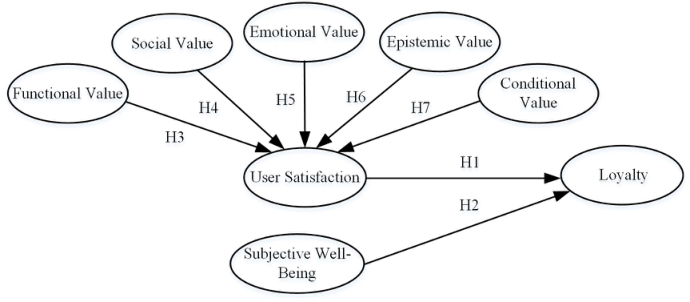
RESEARCH MODEL This study adopts the five CVT constructs—functional, social, emotional, epistemic, and conditional value—and two individual factors—user satisfac- tion and SWB—to identify loyalty to health passbooks. Figure 1 shows the theoretical model of this study.
Lin et al. (2015) suggested that user satisfaction is an important antecedent of loyalty, because when consumers are satisfied with the use of technological products, they tend to repurchase and continue to use it. Therefore, high user satisfaction increases technology product loyalty. Prior studies have also
Exploring the Influencing Factors of Personal Loyalty to Health Passbooks 365
Figure 1: Research framework.
confirmed that user satisfaction positively affects loyalty (Lin et al., 2015; Kim et al., 2021). In this study, when citizens have a good experience using health passbooks, their accumulated satisfaction will enhance their loyalty to health passbooks. Thus, we propose the following hypothesis: H1. User satisfaction has a positive impact on their loyalty to health passbooks.
Chiu et al. (2013) suggested that SWB is a key factor affecting an individ- ual’s loyalty to a product or service. For example, when individuals feel happy and satisfied interacting with others through online social software, it pro- motes their willingness to continue participating in online activities. When individuals can easily carry out self-health management through the health passbook, they feel happy in their healthy lives, thereby promoting their pref- erence to continue using health passbooks. Thus, we propose the following hypothesis: H2. SWB has a positive impact on loyalty to health passbooks. Bhattacherjee (2001) indicated that perceived performance is an impor- tant predictor of user satisfaction. Thus, when the health passbook allows users to quickly view and understand their recent medical records, test results, and preventive care data, it enables them to monitor their health status and perform health self-management, thereby enhancing their satisfaction with health passbooks. Past studies have also confirmed that the perceived value of a system significantly affects user satisfaction (Sørebø et al., 2009; Rezvani et al., 2017). Thus, we propose the following hypothesis:
H3. Functional value has a positive impact on loyalty to health passbooks. Citizens can use a mobile device to log into the health passbook app, allow- ing them to query their personal medical care data, which can also be viewed by physicians during visits. In this way, the health passbook can reduce infor- mation asymmetry between physicians and patients while also enhancing medical safety and clinical care effectiveness. Past research has also confirmed a positive correlation between social value and user satisfaction (Chen and Wang, 2016). Thus, we propose the following hypothesis: H4. Social value has a positive impact on loyalty to health passbooks. The health passbook provides online services for individuals to realize the right to know and help them practice self-care. Therefore, it makes citizens
feel protected and safe in their disease management and enhances their will- ingness to use the health passbook. Carlson et al. (2018) also confirmed that high emotional value can enhance users’ usage intentions. Thus, we propose the following hypothesis: H5. Emotional value has a positive impact on loyalty to health passbooks. The health passbook can predict the probability of developing hepatoma in the next ten years and evaluate the prognosis and risk of kidney disease cases. It provides users with a portable personal health management tool, thereby enhancing their loyalty to health passbooks. Yang and Lin (2017) confirmed that high epistemic value can enhance users’ continuous use behavior. Thus, we propose the following hypothesis:
H6. Epistemic value has a positive impact on the loyalty of health passbooks.
To enhance people’s own health management during the COVID-19 epi- demic, using the health passbook, citizens can view COVID-19 test results and vaccination records and click on the hyperlink to the “Digital COVID- 19 Certificate” website to download vaccination records, test results, and isolation certificates for contacts of confirmed COVID-19 cases and other infections. Gonçalves et al. (2016) confirmed that conditional value affects consumer behavior intentions. Thus, we propose the following hypothesis: H7. Conditional value has a positive impact on loyalty to health pass- books.
RESEARCH METHODOLOGY Questionnaire Development
The survey questionnaire consisted of two parts. The first part included nom- inal scales and five-point Likert scales ranging from strongly agree to strongly disagree. The questionnaire was adopted to collect basic information about the respondents’ characteristics, including age, gender, education, and health passbook usage experience. The items for functional, social, emotional, epis- temic, and conditional value were adopted from Carlson et al. (2018) and Sheth et al. (1991), while those for user satisfaction were adopted from Lin et al. (2015). The items measuring SWB were adapted from Kim and Kim (2020). The items measuring loyalty were taken from Kim et al. (2021).
Data Analysis Our study adopted an online survey for data collection. We used structural equation modeling using partial least squares estimations for the data analy- sis. We examined the reliability and validity of the research model. The model was deemed reliable if the construct reliability (CR) was greater than 0.8. Convergent validity was assessed based on the following criteria: (a) statisti- cally significant item loading greater than 0.7, (b) CR greater than 0.8, and (c) average variance extracted (AVE) greater than 0.5 (Hair et al., 1998). The discriminant validity was examined based on the criterion that the square root of the AVE for each construct should be greater than the corresponding correlations with all the other constructs (Fornell and Larcker, 1981).
Exploring the Influencing Factors of Personal Loyalty to Health Passbooks 367
Sample and Data Collection The subjects of the study are Taiwanese citizens over 20 years old who have used the health passbooks. To improve the generalization of the study results, the participants consisted of different target groups by gender and geography. A total of 518 questionnaires were distributed, and 471 were returned.
RESEARCH RESULTS The resulting 471 valid questionnaires constituted a response rate of 90.9%. Slightly more than half (50.3%) of the respondents were male. The major- ity (72.2%) were aged between 20 and 39. Of the respondents, 53.3% had completed university education and 31.6% had 1–3 years of expe- rience in using health passbooks. All CR values were greater than 0.9. For convergent validity, all item loadings and CR were greater than 0.9, and the AVEs ranged from 0.78 to 0.98. For discriminant validity, the square root of the AVE for each construct was greater than its correspond- ing correlations with the other constructs. Table 1 presents the descrip- tive statistics of the principal constructs and the correlation matrix. These results indicate acceptable reliability, convergent validity, and discriminant validity.
Table 1. Reliability and validity of the scale.
Table available in the original PDF paper.
Construct Item loading CR AVE Correlation
FV SV EV EP CV US SW LO FV 0.95–0.97 0.99 0.98 0.99 SV 0.88–0.92 0.93 0.78 0.55 0.88 EV 0.91–0.95 0.95 0.88 0.50 0.56 0.94 EP 0.96–0.98 0.98 0.94 0.44 0.59 0.54 0.97 CV 0.81–0.91 0.90 0.76 0.58 0.46 0.52 0.51 0.87 US 0.95-0.97 0.97 0.92 0.34 0.49 0.54 0.42 0.53 0.96 SW 0.92-0.94 0.96 0.87 0.55 0.52 0.43 0.52 0.52 0.47 0.93 LO 0.88–0.92 0.97 0.81 0.50 0.47 0.54 0.51 0.53 0.57 0.50 0.90
Note: The leading diagonal shows the square root of the AVE of each construct. FV: functional value; SV: social value; EV: emotional value; EP: epistemic value; CV: conditional value; US: user satisfaction; SW: subjective well-being; LO: loyalty.
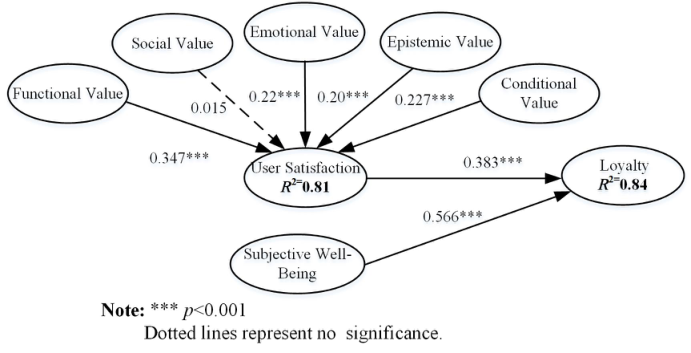
Figure 2 presents the structural model test results. User satisfaction (β = 0.383, standardized path coefficient, p < 0.001) and SWB (β = 0.566, p < 0.001) significantly influenced loyalty and explained 84% of the total variance. Accordingly, hypotheses 1 and 2 were supported. Fur- ther, the results indicate that functional value (β = 0.347, p < 0.001), emotional value (β = 0.22, p < 0.001), epistemic value (β = 0.20, p < 0.001), and conditional value (β = 0.227, p < 0.001) had a pos- itive effect on user satisfaction and, when taken together, explained 81% of its variance. Consequently, hypotheses 3, 5, 6, and 7 were confirmed.
Figure 2: Structural model results.
DISCUSSION
This study explores the loyalty of Taiwanese people to using health passbooks for self-health management. We integrated consumer value, user satisfaction, and SWB as important antecedents of loyalty to identify whether extending the CVT theoretical model contributes to a useful theoretical framework. The findings indicate that functional, emotional, epistemic, and conditional value positively influence user satisfaction. This is consistent with previous find- ings on technology adoption (Carlson et al., 2018) and highlights the critical role of consumption value in mobile technology services. First, this implies that when users have chronic disease management needs, they can effectively understand medical images and test results, and track medication records through the health passbook. Therefore, the health passbook allows them to understand their treatment status and feel that their health status has been well protected, thereby enhancing their satisfaction with the health passbook. Second, the health passbook allows people to quickly view and understand their recent medical records, test results, and preventive care data, enabling them to monitor their health status and perform health self-management. This novel self-directed healthcare will enhance users’ satisfaction with the health passbook.
The results indicate that social value had no significant impact on user satisfaction. This finding is inconsistent with the results of Chen and Wang (2016). A possible explanation for this is that NHIA has provided cloud- based medical records for physicians to check medical records instead of health passbooks, so social value did not enhance user satisfaction. Satisfac- tion and SWB are important factors affecting loyalty to health passbooks. This finding is consistent with the results of Chiu et al. (2013) and Kim et al. (2021). Therefore, a high degree of satisfaction enhances the use of health passbooks for self-health management, thereby enhancing loyalty to health passbooks. In addition, when the experience of using a health pass- book leads to a high level of well-being, it can increase users’ willingness to use it repeatedly for health management.
Exploring the Influencing Factors of Personal Loyalty to Health Passbooks 369
CONCLUSION
Although this study validates useful results, some potential limitations need to be considered. For example, we did not examine factors such as the health literacy levels and habits of the respondents. Future research could focus on accumulating empirical evidence and data to overcome the limitations of this study.
This study has several implications for academic practice. First, few studies have investigated user loyalty in the context of mobile health services. Our study provides a more complete set of antecedents that can better explain loyalty to specific health technology adoption, thereby improving the con- tribution of our study. Second, from the perspective of consumption value, it showed that functional, emotional, epistemic, and conditional value are important factors for promoting user satisfaction. Third, user satisfaction and SWB are important factors in promoting loyalty to health passbooks. Therefore, future research could incorporate consumption value, user sat- isfaction, and well-being into research models to enhance the explanatory power of individuals’ continued use of mobile health services.
The results of this study have several practical applications. First, con- sumption value (such as functional, emotional, epistemic, and conditional) has a significant impact on user satisfaction with health passbooks. System managers should emphasize the value of health passbooks in formulating pro- motional strategies, such as strengthening self-directed health management and disease monitoring functions to increase user satisfaction. Second, the research results showed that user satisfaction and SWB are important factors affecting loyalty to health passbooks. To continuously attract more users to the health passbook, system managers should understand users’ satisfaction and needs to enhance its functions. In summary, we hope that the findings of this study will stimulate interest in future research on the application of mobile health technologies to self-directed health management and motivate researchers to delve deeper into this unexplored but potentially rich area of research.
ACKNOWLEDGMENT
This study was funded and supported by the National Science and Technol- ogy Council of Taiwan (Grant number: NSTC 112-2410-H-041 -001 -MY2).
REFERENCES
Baabdullah, A. M., Alalwan, A. A., Rana, N. P., Kizgin, H., and Patil., P. (2019).
Consumer Use of Mobile Banking (M-Banking) in Saudi Arabia: Towards an Integrated Model, International Journal of Information Management Volume 44, 38–52. Bhattacherjee, A. (2001). Understanding Information Systems Continuance: An Expectation-Confirmation model, MIS Quarterly Volume 25, 351–370. Carlson, J., Wyllie, J., Rahman, M. M., and Voola, R. (2018). Enhancing Brand
Relationship Performance Through Customer Participation and Value Creation in Social Media Brand Communities, Journal of Retailing and Consumer Services Volume 50, 333–341.
Chen, C. H., and Wang, J. P. (2016). Customer Participation, Value Co-creation and Customer Loyalty- A Case of Airline Online Check-in System, Computers in Human Behavior Volume 62, 346–352 Chiu, C. M., Cheng, H. L., Huang, H. Y., and Chen, C. F. (2013). Exploring Idivid-
uals’ Subjective Well-Being and Loyalty towards Social Network Sites from the Perspective of Network Externalities: The Facebook Cas,. International Journal of Information Management Volume 33, 539–552. Diener, E. (1984). Subjective Well-Being, Psychological Bulletin Volume 95, 542–575. Donio, J., Massari, P., and Passiante, G. (2006). Customer Satisfaction and Loyalty in a Digital Environment: An Empirical Test, Journal of Consumer Marketing Volume 23, 445–457. Fornell, C., and Larcker, D. (1981). Structural Equation Models with Unobservable
Variables and Measurement Error: Algebra and Statistics, Journal of Marketing Research Volume 18, No. 3, 382–388. Gonçalves, H. M., Lourenço, T. F., and Silva, G. M. (2016). Green Buying Behavior and the Theory of Consumption Values: A Fuzzy-Set Approach, Journal of Business Research Volume 69, 1484–1491. Hair, J., Black, W. C., Babin, B. J., Anderson, R. E., and Tatham, R. L. (2006)
Multivariate data analysis, 6th ed., Upper Saddle River, NJ: Prentice-Hall. Hew, J. J., Leong, L. Y., Tan, G. W. H., Ooi, K. B., and Lee, V. H., (2019). The Age of Mobile Social Commerce: An Artificial Neural Network Analysis on Its Resistances, Technological Forecasting and Social Change Volume 144, 311–324. Hostler, R. E, Yoon, V. Y., and Guimaraes, T. (2012). Recommendation Agent Impact
on Consumer Online Shopping: The Movie Magic case study, Expert Systems with Applications Volume 39, 2989–2999. Hsieh, P. J., and Lai, H. M. (2020). Exploring People’s Intentions to Use the Health Passbook in Self-Management: An Extension of the Technology Acceptance and Health Behavior Ttheoretical Perspectives in Health Literacy, Technological Forecasting & Social Change Volume 161, 120328. Huang, S. K., Pan, Y. T., and Chen, M. S. (2017). My Health Bank 2.0 Making a
Patron Saint for People’s Health, Journal of the Formosan Medical Association Volume 116, 69–71. Kim, M., and Kim, J. (2020). How Does a Celebrity Make Fans Happy? Interaction between Celebrities and Fans in the Social Media Context, Computers in Human Behavior Volume 111, 106419. Kim, Y., Wang, Q., and Roh, T. (2021). Do Information and Service Quality Affect
Perceived Privacy Protection, Satisfaction, and Loyalty? Evidence from a Chinese O2O-Based Mobile Shopping Application, Telematics and Informatics Volume 56, 101483. Lee, T. M., and Park, C. (2006). Effects of Directionality and Type of Online WOM on Purchase Intention: Comparison of Korean and the US, Journal of Korean Marketing Association Volume 21(1), 29–56. Lin, T. C., Huang, S. L., and Hsu, C. J. (2015). A Dual-Factor Model of Loyalty
to IT Product–The Case of Smartphones, International Journal of Information Management Volume 35, No. 2. 215–228. National Health Insurance Administration. (2023). National Health Insurance 2022–2023 Annual Report. Accessed July 23 2023. https://eng.nhi.gov.tw/en/cp -11-434ff-59-2.html. Rezvani, A., Khosravi, P., and Dong, L. (2017). Motivating Users toward Continued
Usage of Information Systems: Self-Determination Theory Perspective, Computers in Human Behavior Volume 76, 263–275.
Exploring the Influencing Factors of Personal Loyalty to Health Passbooks 371
Ryan, R. M., and Deci, E. L. (2001). On Happiness and Human Potentials: A Review of Research on Hedonic and Eudaimonic Well-Being, Annual Review of Psychology Volume 52, 141–166. Sørebø, O., Halvari, H., Gulli, V. F., and Kristiansen, R. (2009). The Role of Self-
Determination Theory in Explaining Teachers’ Motivation to Continue to Use E-Learning Technology, Computers & Education Volume 53, No. 4. 1177–1187. Sheth, J. N., Newman, B. I., and Gross, B. L. (1991). Why We Buy What We Buy: A Theory of Consumption Values, Journal of Business Research Volume 22, No. 2. 159–170. Taiwan Health and Welfare. (2023). 2022 Taiwan Health and Welfare Report,
Accessed July 8 2022. https://www.mohw.gov.tw/lp-137-2.html. Woodruff, R. B. (1997). Customer Value: The Next Source for Competitive Advantage, Journal of the Academy of Marketing Science Volume 25, No. 2. 139-153. Yang, H. L., and Lin, R. X. (2017). Determinants of the Intention to Continue Use of
SoLoMo Services: Consumption Values and the Moderating Effects of Overloads, Computers in Human Behavior Volume 73, 583–595. Yeh, M. J., and Saltman, R. B., (2019). Creating Online Personal Medical Accounts: Recent Experience in Two Developed Countries, Health Policy and Technology Volume 8, 171–178. Zeithaml, V. A. (1988). Consumer Perceptions of Price, Quality, and Value: A Means-
End Model and Synthesis of Evidence, Journal of Marketing Volume 52, No. 3. 2–22.
LISTED IN THE AHFE DIGITAL BOOKSTORE CATALOGUE
Explore the complete digital volume
Emerging Technologies in Healthcare and Medicine
Read this individual research paper free through the original publisher, or explore the full digital proceedings book.
ISBN 978-1-958651-92-6
Explore this ISBN in the AHFE Bookstore ↗Listed in the July 2026 bookstore catalogue; search by ISBN to confirm current availability · Digital book purchase optional