Xinxin Nie (2025). A kano model-based design for age-friendly shopping carts in large commercial malls. In: Human Factors in Aging and Special Needs. AHFE Open Access, vol. 174, pp. 22–32. https://doi.org/10.54941/ahfe1006291
With the growing aging population, improving the shopping experience and safety of elderly users in malls is increasingly important. This study applies the Kano model to design an age-friendly shopping cart based on the needs of 100 older adults. Their demands were categorized into functional, safety, and experiential aspects. The Better–Worse coefficient analysis prioritized key features to guide product development. The findings offer practical strategies to enhance elderly users’ autonomy and satisfaction in shopping environments.
With the global demographic shift, population aging has become a shared challenge across nations. In China, in particular, the rapid pace of aging has posed increasing demands on public infrastructure and service design. Within today’s retail environments, the shopping experience of elderly consumers is of critical importance, as shopping constitutes a significant part of their daily routines. However, existing shopping cart designs in malls often fail to accommodate the physiological and cognitive needs of elderly users, resulting in various operational difficulties that compromise both efficiency and safety (Lee & Coughlin, 2015).
As an essential public space in daily life, shopping malls should integrate age-friendly principles into their design. Studies have shown that malls are among the most frequently visited locations by mature consumers and serve as important venues for social interaction and leisure among older adults (Hu & Jasper, 2007). Elderly shoppers often spend extended periods in these environments and are particularly drawn to high-traffic areas. Therefore, optimizing their shopping cart experience in large commercial settings is crucial to improving their quality of life and personal autonomy.
This study aims to identify the main difficulties faced by elderly users when operating shopping carts in large-scale malls and to propose feasible design improvements. To systematically analyse and categorize user needs, the research adopts the Kano model as a framework for age-friendly design. The Kano model effectively distinguishes between different levels of
A Kano Model-Based Design for Age-Friendly Shopping Carts in Large Commercial Malls 23
user requirements and identifies key functional attributes that significantly impact user satisfaction. This model provides a scientific basis for product development and design prioritization. By applying the Kano model, designers can gain deeper insight into the fundamental needs and latent expectations of elderly users, thereby creating more targeted and effective design solutions.
The study involves identifying existing usability issues for elderly shoppers, collecting user requirements through structured questionnaires, and classifying those needs using the Kano model to determine functional priorities. The ultimate goal is to propose design strategies for shopping carts that meet elderly users’ operational habits, safety concerns, and emotional expectations. These findings are intended to offer both theoretical and practical guidance for manufacturers, contributing to the development of user-centered, age-friendly products. The research is expected to enhance shopping independence and social participation among the elderly, improve their overall shopping experience, and promote the broader application of age-friendly design in commercial facilities, thereby advancing social inclusion and elderly well-being.
Aging Population and Design Needs The global demographic shift towards an aging population presents significant challenges and opportunities for the design field. According to the World Health Organization, the proportion of the global population aged 60 years and older is expected to nearly double from 12% in 2015 to 22% by 2050 (Organization, 2002). This trend necessitates enhanced adaptability and inclusivity in public facilities, product designs, and service systems to meet the evolving needs of older adults.
Age-friendly design emphasizes accessibility and user-centered functionality, aiming to improve safety, convenience, and comfort for elderly users (Organization, 2007). Iwarsson and Ståhl (2003) propose that such design should adhere to key principles including usability, flexibility, simplicity, and intuitiveness. These principles ensure that products and environments can accommodate the physical and cognitive changes associated with aging.
In urban planning and architectural design, creating age-friendly communities has become a global focus. Research indicates that dense and accessible neighbourhood designs can enhance older people’s mobility and social participation, thereby promoting their physical and mental health (Lo & Mitra, 2025). For instance, providing flat walking paths, ample rest areas, and clear wayfinding systems can alleviate discomfort and feelings of isolation among older adults in public spaces.
Technological advancements also offer new solutions to address the challenges of an aging society. The development of smart homes, wearable devices, and assistive technologies enables older adults to enjoy safer and more convenient living environments. However, the design and implementation of such technologies must fully consider the acceptance and usability for older users to ensure they truly benefit from these innovations (Czaja & Lee, 2007).
24 Nie
In summary, facing the global trend of population aging, the design field must adopt comprehensive strategies encompassing universal design, ergonomics, urban planning, and technological innovation. By holistically considering the physiological, psychological, and social needs of older adults, designers can develop solutions that enhance their quality of life and social participation.
Ergonomic Considerations in Age-Friendly Shopping Cart Design In contemporary retail environments, the integration of age-friendly design principles has garnered increasing attention, particularly concerning the usability of shopping carts by older adults. Kim, Lee, and Chang (2015) emphasize the importance of incorporating easily identifiable and operable components into shopping cart design, such as magnified display windows and large-font labels on control buttons. Such features can significantly boost the confidence and satisfaction of elderly users by simplifying interactions and reducing cognitive load.
Ergonomic considerations are paramount in the development of smart cart systems. Similarly, Kim, Lee, and Chang (2015) highlights that optimizing the placement of touchscreens—specifically positioning them 250 mm from the cart handle—and adjusting handle angles to 45
or maintaining them horizontally can substantially improve user comfort and efficiency. These adjustments aim to minimize physical strain on the eyes, arms, and wrists during cart operation. Furthermore, their study indicates that implementing pick-to-light systems enhances performance by reducing human errors and improving task execution speed.
Fisk et al. (2020) discuss the necessity of adapting product designs to accommodate age-related changes in sensory, cognitive, and motor functions. They advocate for design modifications such as larger fonts, clearer icons, and simplified operational procedures to enhance usability and safety for older adults.
Reid et al. (2003) provide empirical evidence supporting ergonomic redesigns of shopping carts. Their study recommends transitioning from single-handed pulling to two-handed pushing methods, thereby shifting from asymmetric to symmetric load distribution. This change potentially reduces the risk of musculoskeletal injuries among users. Such ergonomic improvements not only benefit elderly shoppers but also have positive implications for retail staff and other stakeholders within the shopping environment.
Application of the Kano Model in Product and Service Design The Kano model, introduced by Noriaki Kano in 1984, offers a structured approach to understanding customer satisfaction by categorizing product (Kano, 1984). Incorporating the Kano model into product development processes allows teams to identify which features are essential, which enhance satisfaction proportionally, and which can delight users unexpectedly. For instance, integrating the Kano model with Quality Function Deployment (QFD) has been shown to streamline the translation of customer needs
A Kano Model-Based Design for Age-Friendly Shopping Carts in Large Commercial Malls 25
into design specifications, thereby improving product quality and customer satisfaction (Matzler & Hinterhuber, 1998).
The model’s applicability extends to the design of products tailored for the aging population. By analysing the specific needs and preferences of older adults, designers can classify features that are fundamental for usability, those that improve performance, and those that provide additional delight (Bohan, 2022). This approach ensures that products are not only functional but also resonate with the target demographic’s expectations and limitations (Ho & Tzeng, 2021).
METHODS
Observational Method This study employed observational methods to identify the primary pain points experienced by elderly individuals when using shopping carts in large- scale retail environments. A total of five participants aged 60 and above, all capable of independent living, were observed. To ensure broad applicability of the findings, participants were selected across different genders and health conditions.
We systematically recorded participants’ behaviour patterns and shopping cart usage across various store sections. Key areas of focus included whether participants shopped alone or with assistance, their cart usage in core zones such as produce, seafood, fresh meat, grains and oils, and home goods, as well as specific physical actions including pushing, pulling, lifting, walking, bending, sitting, and standing. The observations revealed multiple challenges faced by elderly users when operating shopping carts. These included difficulty manoeuvring the cart, especially in crowded or narrow spaces; insufficient ergonomic support from the cart design, leading to instability in gait; and the need for frequent bending or stretching, which increased the risk of falls. In larger retail environments such as Costco, additional challenges were identified. For instance, the main shopping areas (e.g., produce and seafood sections) are typically located farther from store entrances, requiring seniors to traverse long distances and increasing physical fatigue. Furthermore, due to extended periods of walking and standing, participants expressed a need for more frequent rest opportunities, yet in- store seating was found to be limited, negatively affecting the shopping experience.
Age-related vision decline also posed a barrier, as elderly users struggled to read small-font labels on products—such as expiration dates and prices— often relying on assistance from store staff. In terms of technological adaptation, participants showed low acceptance of self-checkout systems, which made autonomous payment processing difficult. Additionally, extended queues at sampling stations and checkout counters placed further physical strain on elderly shoppers, and some chose to forgo purchases or seek help to avoid causing inconvenience to others.
Finally, cart operability and manoeuvrability were found to be especially critical in crowded shopping environments. These findings will inform
26 Nie
the development of a Kano model-based questionnaire to better address age-specific design needs in future product development.
Table 1: Pain points (created by the authors).
Table available in the original PDF paper.
Category Pain Point Description Resting Needs Elderly users require more resting areas to pause and regain energy during shopping. Visual and Information
Poor eyesight makes it difficult for elderly users to read
Access
product labels, especially small-print information such as expiration dates; self-checkout machines and smart systems are also difficult to use. Shopping Convenience Long wait times for food sampling and checkout cause discomfort, especially during crowded holidays. Impact of Shopping Mode Designs often do not match elderly users’ physical and
cognitive abilities when shopping independently; when accompanied, more space and easier operation are required. Physical Actions During
Difficulties in pushing and pulling, especially when the
Shopping
cart is unstable or wheels do not rotate smoothly; unstable walking due to insufficient support; inconvenience in bending and reaching, increasing the risk of falls; hard to handle when the cart is overloaded. Peak Hour Operation
During busy hours, especially in narrow aisles, the
Issues
manoeuvrability and flexibility of shopping carts become critical. Emergency Safety Needs Elderly users may need to call for help in emergencies, so shopping carts should include an emergency alert button to ensure safety. Resting Needs Elderly users require more resting areas to pause and
regain energy during shopping.
Kano Model Questionnaire Design To gain deeper insights into the needs of elderly users when using shopping carts and to assess how various design features influence user satisfaction, this study developed a questionnaire based on the pain points identified through observational analysis. The questionnaire is structured into three key dimensions: Functional Relevance, Safety and Convenience Priority, and User Experience Enhancement.
The Functional Relevance dimension focuses on the core physical and operational features of the shopping cart, such as adjustable handrail height, optimized wheel design, and the inclusion of a brake system. The goal is to evaluate how these basic design elements impact the cart’s usability for elderly users. The Safety and Convenience Priority dimension addresses design attributes that directly affect the safety and ease of use for elderly individuals. This includes features like a portable seat, an integrated magnifying glass, and an emergency call function—each aiming to enhance the security and accessibility of the cart during use in large-scale shopping environments.
A Kano Model-Based Design for Age-Friendly Shopping Carts in Large Commercial Malls 27
The User Experience Enhancement dimension examines features that contribute to a more comfortable and satisfying shopping experience. Examples include dedicated cane storage compartments, tools to assist in reading small product labels, and integrated resting features. These elements are intended to support elderly users during extended shopping sessions by improving comfort and overall satisfaction.
Each dimension is assessed using the Kano model’s dual-question approach, incorporating both positive and negative phrasing for each feature. This enables a comprehensive evaluation of how each function contributes to user satisfaction and helps prioritize design improvements accordingly (Table 2).
Table 2: Kano model questionnaire design (created by the authors).
Table available in the original PDF paper.
Demand Category Demand Description Code Functional Relevance Adjustable Handrail N1 Functional Relevance Optimized Wheels N2 Functional Relevance Brake Function N3 Functional Relevance Portable Seat N4 Safety and Convenience Elderly Identifier on Cart Front N5 Safety and Convenience Emergency Call Function N6 Safety and Convenience Notebook or Sticky Notes N7 User Experience Cane Storage Function N8 User Experience Magnifying Glass Feature N9
Data Collection This study employed a questionnaire-based survey method to investigate the actual experiences and needs of elderly users when using shopping carts, as well as to evaluate the impact of various functional features on their satisfaction. The questionnaire began by collecting participants’ demographic information, including age, gender, and shopping habits, to facilitate analysis of inter-group differences among older adults. The core section of the questionnaire was developed using the Kano model framework. For each identified pain point—such as the need for rest, difficulty in accessing information, and shopping convenience—two corresponding questions were designed: one addressing the satisfaction when the feature is present, and another assessing dissatisfaction when the feature is absent. Each item was evaluated using a five-point Likert scale ranging from 1 (very dissatisfied) to 5 (very satisfied) (Table 3). Considering the participants’ potential limitations in technology use, the survey was administered in both online and offline formats.
A total of 100 elderly participants were surveyed. Among the participants, 52.36% were male and 47.64% were female. This near-balanced gender distribution ensures that the findings are representative of elderly individuals of different genders. In terms of age distribution, the largest proportion of participants (60.38%) were aged between 60 and 64, followed by those aged 65 to 70 (30.66%), and participants over 70 years old accounted for 8.96%. Regarding shopping habits, 81.61% of the respondents reported
28 Nie
visiting shopping malls at least once a week, and 40.09% of them indicated frequent use of shopping carts. The majority of participants were healthy, self-sufficient elderly individuals, most of whom reside in urban areas. They were recruited through community centers, senior citizen associations, and online social platforms. All respondents were aged 60 or older and represented diverse health statuses and living conditions to ensure broad representativeness and applicability of the results. For the online portion of the survey, a simplified digital format was used, and many elderly respondents completed the questionnaire with the assistance of family members or facilitators. Recognizing that some participants may face cognitive or technological challenges, face-to-face interviews were also conducted. In these cases, researchers administered the survey using a “guided response” approach, in which the researcher read questions aloud and recorded participants’ responses directly. This approach not only ensured the accuracy of responses but also allowed real-time clarification of any questions from participants.
All collected data were treated as strictly confidential and used solely for academic research purposes. Data entry and preliminary analysis were conducted by the research team, with full compliance to privacy protection protocols. Out of the 100 questionnaires distributed, 4 were excluded due to incomplete or invalid responses, resulting in a valid response rate of 96%.
Table 3: Examples of positive and negative questions (created by the authors).
Table available in the original PDF paper.
I Dislike
Question I Like It It Should Be That Way
I Am Indifferent
I Can Tolerate It It
How do you feel if the shopping cart is equipped with an emergency call function? How do you feel if the shopping
cart is NOT equipped with an emergency call function?
RESULT
The analysis began with data cleaning and preprocessing, followed by classification of the impact of each functional feature using the Kano model. Satisfaction and dissatisfaction coefficients were calculated for each feature to categorize them into specific attribute types and identify which functions play a critical role in increasing or decreasing user satisfaction.
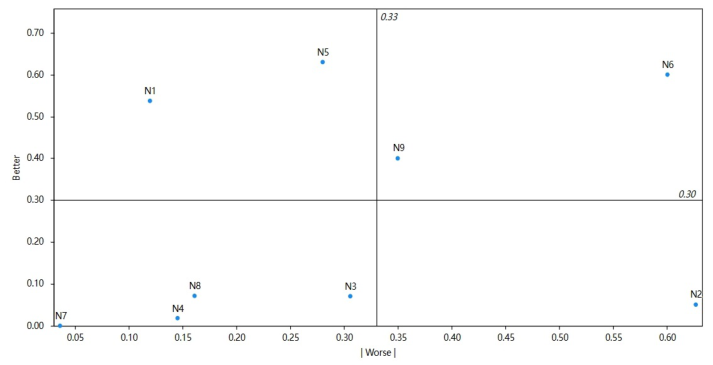
The results revealed that the adjustable handrail function (N1) and the elderly identifier on the cart front (N5) were classified as Attractive Attributes. These features significantly enhance user satisfaction when present, but their absence does not cause dissatisfaction. This suggests that such value-added features are essential for improving the overall user experience. The emergency call function (N6) was identified as a One- Dimensional (Performance) Attribute, indicating that its presence greatly enhances user satisfaction, while its absence leads to dissatisfaction. Users have clear expectations for this type of safety-related feature. The optimized wheels (N2) were categorized as a Must-Be Attribute, representing a
A Kano Model-Based Design for Age-Friendly Shopping Carts in Large Commercial Malls 29
basic requirement from users. Proper optimization meets their fundamental expectations for ease of use, while the absence of this function leads to substantial dissatisfaction.
Table 4: Kano model analysis results summary (created by the authors).
Table available in the original PDF paper.
F A O M I R Q C B W N1 32% 4% 4% 27% 29% 4% A 53.73% –11.94% N2 4% 1% 61% 33% 1% 0% M 5.05% –62.63% N3 5% 1% 25% 54% 15% 0% I 7.06% –30.59% N4 1% 0% 8% 46% 45% 0% I 1.82% –14.55% N5 51% 12% 16% 21% 0% 0% A 63.00% –28.00% N6 23% 37% 23% 17% 0% 0% O 60.00% –60.00% N7 0% 0% 2% 53% 45% 0% I 0.00% -3.64% N8 4% 0% 9% 43% 44% 0% R 7.14% –16.07% N9 35 % 5% 30% 30% 0% 0% A 40.00% -35.00%
The study utilized a Better–Worse coefficient diagram to visually analyse the needs of elderly users. This visualization plots each function or service based on its Better value on the vertical axis and the absolute value of its Worse coefficient on the horizontal axis, providing an intuitive classification of user demands.
In the diagram, the first quadrant represents One-Dimensional (Performance) Attributes, indicating that both the presence and absence of these features significantly influence user satisfaction. These features should be prioritized in design. The second quadrant includes Attractive Attributes, which have little impact when absent but can substantially enhance satisfaction when present. Despite their optional nature, they are still considered high-priority design elements due to their strong potential to delight users. The third quadrant contains Indifferent Attributes, which show low influence on both satisfaction and dissatisfaction. These features are generally not the focus of design optimization. The fourth quadrant represents Must-Be Attributes, whose presence may not noticeably increase satisfaction but whose absence leads to significant dissatisfaction. Ensuring the existence of these features is essential.
Feature prioritization is thus guided by the hierarchy: Must-Be Attributes, One-Dimensional Attributes, Attractive Attributes, and finally Indifferent Attributes. This approach helps ensure that design resources are efficiently allocated to meet core user needs and enhance the overall shopping experience (Figure 1).
Table 5 categorizes and ranks shopping cart features based on the Kano model analysis. The table evaluates each feature’s positive impact (Better) and negative impact (Worse) on user satisfaction, clearly indicating which needs should be prioritized in design. The analysis shows that Must-Be Attribute N2 should be given top priority, as its absence significantly decreases user satisfaction. Following closely is One-Dimensional Attribute N6, which has a substantial influence on both satisfaction and dissatisfaction. Next in priority are the Attractive Attributes N1, N5, and N9. Although their absence
30 Nie
causes minimal dissatisfaction, their presence can significantly increase user satisfaction, thereby enhancing the product’s overall appeal.
Figure 1: Better and worse axes (created by the authors).Table 5: Priority attribute sorting table.
This study applied the Kano model to systematically analyse elderly users’ satisfaction with various shopping cart design features and to examine how different functional attributes influence their overall experience. The results identified features such as adjustable handrails, elderly-specific signage on the cart front, and emergency call functions as key factors in enhancing user satisfaction. Notably, the signage and emergency call features significantly contributed to a more personalized user experience. The methodological approach of this study provides an empirical foundation for shopping cart manufacturers, enabling them to make data-driven decisions during product development and to design solutions that better meet the needs of elderly users. Future research could explore additional dimensions of elderly user needs, such as technological integration and interactive design, and investigate the applicability of these features across different cultural and
A Kano Model-Based Design for Age-Friendly Shopping Carts in Large Commercial Malls 31
economic contexts. This study not only deepens the understanding of aging user groups but also advances innovation in user-specific product design. It contributes to improving the quality of life for elderly individuals and offers valuable insights for both academic research and practical applications in the field of inclusive design.
ACKNOWLEDGMENT
The authors would like to express their sincere gratitude to the elderly participants who generously shared their time and insights during the observational study and survey. Their contributions were invaluable to understanding user needs and validating the Kano model in the context of age-friendly product design. We also extend our appreciation to the community centers and family members who assisted in facilitating data collection. Special thanks go to our academic advisor and the research committee at the City University of Macau for their guidance and constructive feedback throughout the research process.
REFERENCES
Bohan, L. (2022). Research on Design of Aging Products Based on Kano Model.
Paper presented at the 2022 International Conference on Creative Industry and Knowledge Economy (CIKE 2022). Czaja, S. J., & Lee, C. C. (2007). The impact of aging on access to technology.
Universal access in the information society, 5, 341–349. Fisk, A. D., Czaja, S. J., Rogers, W. A., Charness, N., & Sharit, J. (2020). Designing for older adults: Principles and creative human factors approaches: CRC press. Ho, H.-H., & Tzeng, S.-Y. (2021). Using the Kano model to analyze the user interface
needs of middle-aged and older adults in mobile reading. Computers in Human Behavior Reports, 3, 100074. Hu, H., & Jasper, C. R. (2007). A qualitative study of mall shopping behaviors of mature consumers. Journal of Shopping Center Research, 14(1), 17–38. Iwarsson, S., & Ståhl, A. (2003). Accessibility, usability and universal design—positioning and definition of concepts describing person-environment relationships. Disability and rehabilitation, 25(2), 57–66. Kano, N. (1984). Attractive quality and must-be quality. Journal of the Japanese
society for quality control, 31(4), 147–156. Kim, M. K., Lee, E. Y., & Chang, Y. S. (2015). A study on the human factors for a smart cart system. Procedia Manufacturing, 3, 566–573. Lee, C., & Coughlin, J. F. (2015). PERSPECTIVE: Older adults’ adoption of
technology: An integrated approach to identifying determinants and barriers. Journal of Product Innovation Management, 32(5), 747–759. Lo, A. W.-T., & Mitra, S. K. (2025). A tale of two aging nations: How do urban designs impact older adults’ mobility in automobile versus transit societies? Travel Behaviour and Society, 39, 100961. Matzler, K., & Hinterhuber, H. H. (1998). How to make product development
projects more successful by integrating Kano’s model of customer satisfaction into quality function deployment. Technovation, 18(1), 25–38. Organization, W. H. (2002). Active ageing: A policy framework: World Health Organization. Noncommunicable Disease Prevention and Health Promotion Department. In.
32 Nie
Organization, W. H. (2007). Global age-friendly cities: A guide: World Health Organization. Reid, M. J., Enns, J., Frazer, M., & Wells, R. (2003). A case study on the impact of
an ergonomic change to the mall delivery trailer and redesign of a mall cart used for delivery in the transportation sector. Paper presented at the Proceedings of the 35th Annual Conference of the Association of Canadian Ergonomists.
LISTED IN THE AHFE DIGITAL BOOKSTORE CATALOGUE
Explore the complete digital volume
Human Factors in Aging and Special Needs
Read this individual research paper free through the original publisher, or explore the full digital proceedings book.
ISBN 978-1-964867-50-2
Explore this ISBN in the AHFE Bookstore ↗Listed in the July 2026 bookstore catalogue; search by ISBN to confirm current availability · Digital book purchase optional