Jia Xiang Huang (2025). User Experience Design for New Energy Vehicles from the Perspective of the KANO Model. In: Usability and User Experience. AHFE Open Access, vol. 194, pp. 244–253. https://doi.org/10.54941/ahfe1006687
This study focuses on drivers' demand for personalized operation in new energy vehicles, analyzing user attitudes and willingness to accept the industry from four dimensions: voice operation, gesture operation, auxiliary operation, and physical operation. With the rapid adoption of new energy technology, user demand has become the core driving force behind industry development. Through literature analysis and a questionnaire survey, basic driver needs regarding convenience, interaction efficiency, and comfort were identified, providing a data foundation for further analysis. Using field interviews, user feedback, and the KANO model, the study categorizes user needs into essential, desired, and charismatic needs. Essential needs relate to driving safety and operational stability; desired needs focus on enhancing user experience, such as voice control accuracy; and charismatic needs go beyond expectations, including innovative designs like gesture control and panoramic interaction. The study prioritizes needs based on the hierarchy of needs theory and satisfaction coefficients, offering a scientific basis for functional design direction. The results show that the KANO model effectively reveals the hierarchy of user needs and their impact on user experience, providing valuable insights for the new energy vehicle industry in function optimization and marketing. Future research can explore dynamic changes in demand and cultural differences in user needs to support broader technological innovation and market adaptation, driving the industry's development.
INTRODUCTION TO THE NEW ENERGY VEHICLES In recent years, China has entered the golden age of new energy vehicle (NEV) adoption, driven by regulations such as the “Guiding Opinions on Further Constructing a High-Quality Charging Infrastructure System” and new tax reduction measures for NEV purchases. As the number of NEVs grows, the driver’s experience has become increasingly important. While much of the literature focuses on “ride comfort,” the crucial aspect of “operational needs” is often overlooked. Operational needs refer to the situation where drivers cannot afford to be distracted while driving. This paper focuses on operational demands in NEV driving, emphasizing the importance of minimizing distractions to reduce accidents. With technological advancements and AI, the diversity of operational methods
User Experience Design for New Energy Vehicles From the Perspective of the KANO Model 245
during driving has increased. Research on the operating environment of drivers across age groups can provide valuable insights for designing better automobile interactions and products.
Theoretical Studies and Literature Review With the rapid development of the new energy vehicle (NEV) industry, the performance of its components, especially intelligent driving, has gained increasing attention. Intelligent driving, as a key development direction, presents both opportunities and challenges (Luo Congbo, 2023). In various driving scenarios, driver-vehicle interactions differ, especially in terms of driving safety. Distractions while driving pose potential accident risks, and factors like vehicle stability and protective devices also come into play. As NEVs continue to evolve, electric vehicles have become the ideal platform for intelligent driving. In the future, smart electric vehicles, rather than just pure electric ones, will dominate the market (Xu Nuo, Xie Pin, Yuan Hongyang, 2023). Several cities in China have already implemented intelligent driving technology, and in the coming years, this will be a key growth path for the NEV industry.
The KANO model, proposed by Prof. Noriaki Kano in the 1970s, is based on Herzberg’s two-factor theory and categorizes user demands into five attributes: charisma, expectation, basic, irrelevant, and inverse attributes (Lee et al., 2023). To assess the impact of various demand types on user satisfaction, the model calculates coefficients like the better/SI coefficient, which indicates positive satisfaction when a feature is improved. The higher this value, the greater the impact on satisfaction. Conversely, the worse/Dsl coefficient represents dissatisfaction when a feature is removed, with more negative values indicating stronger dissatisfaction. This helps identify how different features influence overall user experience.
EMPIRICAL RESEARCH AND RESEARCH METHODOLOGY Clarifying Objectives
Kano modeling is a common qualitative analysis method often used to determine user acceptance of a new service, rather than being used directly to assess user satisfaction. Identifying and examining the unique needs of different groups is an excellent core function of the Kano model, in addition to its usefulness for user research and needs analysis. The model is able to thoroughly classify the attributes of numerous factors through standardized questionnaires, which is useful for investigating the operational needs of new energy drivers. It can solve the localization problems related to the demand attributes while improving the user satisfaction with the product performance. Since the personal safety of drivers is very important matter and the development of new energy vehicles in China is not considered perfect, in order to deal with the needs of this group of people when dealing with the operation of various vehicles, a qualitative study is conducted using the Kano model, and then this information will be used in the design of the vehicle operation. The main purpose of this study is to collect the needs
246 Huang
of drivers of different ages for vehicle operation during driving.Kano model needs survey is conducted using data collected from literature sources and then it is organized and analyzed to explore the operation needs of drivers of new energy vehicles at this stage and to provide help to the drivers in operating the vehicles.
Questionnaire Research Obtaining Driver Needs and Screening Through checking relevant literature to understand the actual situation of new energy drivers of different age groups, we initially listed the basic operational needs of new energy vehicle drivers; then, according to age and gender, we selected 10 new energy vehicle drivers with typical sample characteristics, and conducted a small-scale information interview and driving observation, during which we asked drivers about the operational problems they encountered in the process of driving under the circumstance of guaranteeing driving safety. During the interviews, we asked the drivers about the operational problems they encountered during the driving process, while ensuring driving safety, in order to capture the user’s most realistic operational experience as close as possible. The collected information was first used to categorize, code, and randomize the 15 initial needs of the driver during the entire driving process, as shown in Table 1.
Driving requirements are included as comprehensively as possible from each functional dimension of operation, and the problem orientation is clearly defined to facilitate the questionnaire design to summarize the functional attributes corresponding to the requirements, and to improve the user participation and concentration. According to the general situation in the “Notes on Safe Operation of New Energy Pure Electric Vehicles”, four dimensions of voice operation, gesture operation, auxiliary operation, and physical operation were selected to be categorized and recoded, and a total of 15 items of operation requirements for drivers of new energy vehicles were finally identified, as shown in Table 2.
Table 1: New energy vehicle drivers’ operational raw requirements.
Table available in the original PDF paper.
Coding Description of
Coding Description of
Coding Description of
Requirements
Requirements
Requirements
01 Voice Input 12 Mechanical hand/foot
05 Wake-up call feature
brake
02 Manual Adjustment 13 Self-adjustment cruise 06 Physical Keys 03 Mechanical Gear 14 Lane keeping 07 Automatic Parking 04 Gesture Control 15 Blind Spot Detection 08 Motion of hand 09 ADAS (Automated
11 Voice indication 10 One-touch activation
Driving)
Table 2: Demand for driver operational screening in new energy vehicles.
Designing the Kano Questionnaire and Conducting the Survey In Kano analysis research, the information obtained from the questionnaire survey is very important, therefore, the questionnaire should be designed to ensure that the questions are comprehensible and intuitive, so that the users can understand correctly and provide true answers. The questionnaire is divided into two parts: operation requirement information and basic information. It is intended to be used for the driving operational needs of new energy vehicles.
The questions set in the first part include basic information about the driver, such as age, gender, information about driving new energy vehicles and other related questions. The main focus is to understand the basic information of the driver.
The Kano questionnaire is tailored to each unique need and the second part of theoperational need data is categorized according to the four operational characteristics of the selected need items in Table 2. Where different qualitative features are categorized as positive and negative and are used to measure the driver’s response to their presence or absence. Take for example the demand item “01 wake-up function” in the voice operation dimension. The user is provided with five levels of preference: “like it very much”, “agree”, “don’t care”, “accept it reluctantly” and “Dislike Very Much”. Then, two opposite options are set: “Have this feature” and “Don’t have this feature”. The form is shown in Table 3.
Table 3: Model questionnaire sample.
Table available in the original PDF paper.
Voice Operation Requirements (01 Wake-Up Function) There is such a function I like it. It’s only right. I don’t care. Accept I don’t like it. No such function I like it. It’s only right. I don’t care. Accept I don’t like it.
In this survey, 18–40+ new energy vehicle owners were selected as the research objects, and a combination of online and offline methods was used. Online, the survey was conducted through the design of a questionnaire to be sent to new energy vehicle owners’ groups, and offline, the author conducted on-site interviews when riding on online new energy vehicles in his spare time. Due to the distinctive characteristics of the surveyed objects, the online survey needed to set up a basic information filtering sample on the network to ensure the validity of the questionnaires. A total of 100 online questionnaires were distributed and 91 were returned.
248 Huang
Organize Data Analyze the Survey Data and Determine the Kano Categories According to the Kano model, there are five categories: basic needs, desired needs, non-differentiated needs, and reverse needs. Berger et al. introduced the Better-Worse coefficient, which is the percentage of attribute classification, so that the Kano model crosses over from qualitative analysis to quantitative analysis, and the attributes are further categorized according to the magnitude of the value and the importance of the needs are scientifically ranked. The Better coefficient represents the coefficient of user satisfaction when increasing the functionality of a requirement. The coefficient of satisfaction = (A+O)/(A+O+M+I), which is a range of values, with the larger value representing the higher level of user satisfaction. Referring to the five types of requirements defined by Kano’s model in Fig. 1, where type A is charismatic requirement; type O is expected requirement; type M is mandatory requirement; type I is irrelevant requirement; and type R is reverse requirement. This means that customer happiness will not decrease if this criterion is not met, but it will increase significantly if this criterion is not met; if these prerequisites are met, category O indicates an increase in customer satisfaction, and vice versa. category M indicates that there will be no significant increase in customer satisfaction after this condition is met, but there will be a decrease; category R indicates that meeting this need will result in a decrease in satisfaction; category I indicates that whether it is necessary or not, there is no significant difference in customer satisfaction.
In the Kano Model Needs Categorization Assessment Table, the A, O, M, I, and R intervals correspond to each of the five categories of needs, and the respondents were statistically categorized for each entry as a means of defining the different needs.
The definition of Kano’s model states that in order to increase the competitiveness of goods, attractive needs must be satisfied first. Anticipated needs are able to satisfy user expectations and are appropriately prioritized or reinforced; the basic needs that must be satisfied are referred to as prerequisites. The statistics of each user need in the survey questionnaire are shown in Table 5.
Table 4: Categorization of new energy vehicle operational demand items.
Table available in the original PDF paper.
Requirements A Requirements O Requirements M 02Voice-activated vehicles
12 Mechanical Physical Keys
13 Physical Brake Feedback
05 Recognizing the meaning of gestures
01 Intelligent Voice Awakening
14 Physical Shift
10 Intelligent Lane Keeping 08 Vehicle Automation 04 Gesture Control Vehicle
09 Cruise control 06 Self-parking 03 Voice Recognition Input
User Experience Design for New Energy Vehicles From the Perspective of the KANO Model 249
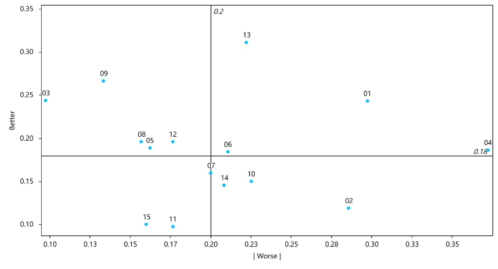
Measuring the Satisfaction and Dissatisfaction Coefficients According to the process of calculating the Better-Worse coefficient, a scatter plot can be constructed with satisfaction and dissatisfaction as the Y and X coordinates respectively. The mean value of Better/SI and Worse/DSI coefficients is used as the threshold to divide into four quadrants, and then the absolute value of the coefficients is taken as the coordinates to create a scatter plot, see Fig. 3. In the quadrant plot, the needs in the first quadrant are the desired needs, the second quadrant is the charismatic needs, the third quadrant is the irrelevant needs, and the fourth quadrant is the essential needs.
According to the distribution of the quadrants, it can be concluded that the demand points are generally distributed in the range of 0.10–0.35 for Better coefficient and 0.1–0.4 for Worse coefficient; The distribution of voice operation requirements is relatively decentralized in the first, second and fourth quadrants, where 01, 03 are expected and charismatic requirements, and 02 is a required requirement; the distribution of gesture operation requirements is also relatively large in the first and second quadrants, where 04 is expected and 05 is charismatic; the distribution of auxiliary operation requirements is larger in the first and second quadrants, and less in the third and fourth quadrants, where The distribution of auxiliary operation requirements is more in quadrant 1 and 2, less in quadrant 3 and 4, where 06 is expectation requirement, 08, 09 is charisma requirement, 07, 10 is essential requirement, and 11 is irrelevant requirement; the distribution of physical operation requirements is more average, and it is found in all the four quadrants, where 13 is expectation requirement, 12 is charisma requirement, 15 is irrelevant requirement, and 14 is essential requirement.
Figure 1: Better-worse coefficient quadrant distribution chart.
DATA ANALYSIS Analysis of Operational Needs
With the statistical results based on the operational demand information in the second part of the questionnaire and the distribution of the demand
250 Huang
scatter points in the good - bad quadrant, we can determine that the demand points are ranked as charismatic, essential, desired and irrelevant in terms of the number of distributions. Quadrants one, two and four contain the majority of demand points and quadrant three contains the least number of demand points. The reasons for this are analyzed because the survey itself is limited and cannot represent tens of thousands of drivers across the country; secondly, new energy vehicles have not yet been fully developed, and most drivers have not yet fully experienced all the functions brought by the latest technology.
Based on the hierarchy of the operational needs of new energy vehicle drivers, the prioritization of needs should follow the principle of “essential over desirable over attractive over irrelevant”. According to the Better-Worse Coefficient, which reflects the degree of user satisfaction with the change of demand, from the distribution of various types of operation demand points: (1) The demand for new energy vehicle operation should be developed into intelligent auxiliary functions. (2) While developing intelligence, some parts of traditional vehicles should be retained, such as the function buttons that can give feedback. (3) It is better to use intelligent systems to control parts of the car while driving, such as the rearview mirror, sun visor, and so on.
NEW ENERGY VEHICLE OPERATION REQUIREMENT ANALYSIS Voice Operation Requirement Analysis
In the voice operation system of new energy vehicles, the mandatory (required) requirements are basic functions that users expect as standard, and their absence leads to dissatisfaction. These include high responsiveness and accuracy, with the system expected to recognize commands quickly and accurately in both static and dynamic environments. Essential functions like dialing, navigation, and media control must be performed smoothly and error-free to meet user expectations. Failure to meet these basic requirements significantly impacts overall user satisfaction and the vehicle experience.
Desired requirements, on the other hand, are advanced features that users may appreciate but do not expect. While their absence doesn’t cause strong dissatisfaction, they enhance user experience and satisfaction. In the case of a voice operation system, these include higher-level capabilities like natural language processing and contextual understanding. Users expect the system to understand complex commands such as weather queries, setting reminders, or detailed navigation requests. Additionally, the system should personalize responses based on the user’s habits, like remembering frequently visited places or music preferences to improve future interactions.
Gesture Operation Requirement Analysis Gesture operation in new energy vehicles is an innovative technology, with its essential requirement being the accurate and reliable execution of basic functions. The gesture recognition system must be highly responsive and precise, ensuring real-time recognition and proper execution of user gestures. It should be able to distinguish different gestures and link them to
User Experience Design for New Energy Vehicles From the Perspective of the KANO Model 251
corresponding functions, such as turning lights on or adjusting the volume. Additionally, system stability and reliability are crucial for proper operation in various environments and conditions.
Expected requirements for gesture operation reflect users’ desire for more advanced features, such as a broader range of gesture recognition and richer functionality. Users expect the system to recognize more gesture types and associate them with additional vehicle functions, like opening the sunroof or adjusting the seat position. They also expect the system to allow for combining multiple gestures to control more complex functions, such as navigation or media switching. Furthermore, users would like to personalize gesture-function mappings according to their preferences, providing a more tailored and intuitive operating experience.
Assistive Operation Requirement Analysis The auxiliary operation system in new energy vehicles is vital for enhancing driving safety and convenience. Necessary requirements include features that ensure vehicle safety and basic functionality, such as automatic emergency braking, lane-keeping assist, and adaptive cruise control. These systems help reduce the driver’s workload and intervene in critical moments, such as automatically braking to prevent collisions or warning the driver when straying from the lane.
Desired requirements go beyond basic functionality to improve the user experience, incorporating features like Advanced Driver Assistance Systems (ADAS) such as Traffic Jam Assist, automatic parking, and intelligent speed limit systems. These features reduce driving stress and provide a smoother, more comfortable experience. For example, Traffic Jam Assist automatically adjusts speed in heavy traffic, alleviating driver fatigue. Users also expect these systems to integrate with the infotainment system for a more intuitive, convenient interface.
Attractive demands are innovative features that surprise users and add extra value, even though they may not be explicitly expected. Examples include fully automated driving, which, despite being technically immature, illustrates the future potential of automobiles and boosts brand loyalty. Context-aware systems that adjust assistance levels based on the driving environment or driver state, such as enhancing lane-keeping or light assistance at night, can also greatly enhance safety and comfort, fostering trust and security among users.
Physical Operations Requirements Analysis Physical operation is essential in new energy vehicles, with necessary requirements ensuring that users can conveniently and intuitively operate various vehicle functions. This includes easy-to-use physical controls like steering wheel buttons, center console knobs, and switches, which must be well laid out, easily accessible, and provide good tactile feedback for quick and accurate operation. Ergonomic design is also crucial to prevent driver fatigue during long periods of driving.
252 Huang
Desired physical operation requirements reflect users’ expectations for more advanced, intelligent control experiences. These include the use of touch-sensitive technology for simpler, more comfortable console operations. Additionally, users may expect personalized settings, allowing drivers to customize button and control configurations based on their preferences, providing a more tailored driving experience.
CONCLUSION
Through the requirement analysis, it is mainly found that the needs of new energy vehicle users for operation are mainly categorized into essential, desired and charismatic. The essential needs are concerned with basic operation and safety, the desired needs are to enhance user experience, and the attractive needs are innovative functions. The implication for the new energy vehicle industry is that the basic needs of users must be satisfied first, and then the user experience and innovative technologies should be introduced to enhance market competitiveness. Future research could explore in-depth user acceptance of new technologies and how to better integrate user feedback and market dynamics to guide product innovation and development. At the same time, we can explore how to further enhance the user experience and convenience of new energy vehicles through intelligent technologies and human-machine interaction design.
ACKNOWLEDGMENT
First and foremost, I would like to sincerely thank my supervisor for the thoughtful guidance and support throughout the research process. Your academic expertise and rigorous approach to scholarship have been invaluable to me. From the topic selection to the writing of this thesis, every step has benefited from your patient instruction and invaluable advice.
A special thank you to “AHFE 2025” for the inclusion and publication of this thesis. I am grateful to the editorial team for their professionalism and patience, which provided me with tremendous support during the publication process. It is through your recognition and assistance that this research is now available for sharing and exchange with fellow scholars in the academic community.
REFERENCES
Berger C, Blauth R, Boger D, et al. Kano’s methods for understanding customerdefined quality [J]. Computer Science, 1993, 2(4): 2–36. Li Jiaxin, Zhang Jian. Impact of standardization based on distributional lag model
on the diffusion of technological innovation in strategic emerging industries--The case of new energy automobile industry [J]. Journal of Economic Research, 2024, (01): 38–41. Li Zhirong, Li Hongjia, Chen Siyu & Lau Hongyu. (2023). Study on Smart Home Health Needs of Widowed Elderly Based on Kano Model. Packaging Engineering (16), 145–153.
User Experience Design for New Energy Vehicles From the Perspective of the KANO Model 253
Liang Yaling, Chen Yingwei, Liu Sijia. A Study on Domestic New Energy Vehicle Sales Forecast Based on SSA-SVR Model [J]. Modern Industrial Economics and Informatization, 2023, 13 (09): 290–293. Liu Ling, Xue Yanan, Hu Yu. Fast charging strategy for new energy vehicles based
on battery electrochemical model [J]. Automotive Test Report, 2023, (19): 38–40. Liu, Chengjie. Simulation study of model-based SOC estimation method for new energy vehicle power battery [J]. Automotive Technology, 2023, (06): 16–20. Lu Wenhui, Qu Zexia. Analysis of factors affecting the export competitiveness of
China’s new energy vehicles based on a panel data model [J]. Modern Industrial Economy and Informatization, 2023, 13 (11): 194–198. Luo Congbo. (2023). Development Trend Analysis of Intelligent Driving in New Energy Vehicles. Automotive Test Report (03), 4–6. Qian Yong, Meng Liqing. Analysis of New Energy Vehicle Industry in Yunnan Based
on PEST Model [J]. Research on Automobile Industry, 2023, (04): 11–14. Xu, Liao, Xie, Pin & Yuan, Hongyang. 2011 A study of the new energy vehicle sales in China [J]. (2023). Analysis of New Energy Vehicle Industry Development–The Case of SAIC-GM-Wuling. Times Auto (02), 116–118.
LISTED IN THE AHFE DIGITAL BOOKSTORE CATALOGUE
Explore the complete digital volume
Usability and User Experience
Read this individual research paper free through the original publisher, or explore the full digital proceedings book.
ISBN 978-1-964867-70-0
Explore this ISBN in the AHFE Bookstore ↗Listed in the July 2026 bookstore catalogue; search by ISBN to confirm current availability · Digital book purchase optional