Wen Zhong, Jiaxuan Gong, Yawei Hao (2025). Creating Human-Centered Museums: User Experience in Digital Exhibitions from a Multimodal Perspective. In: Usability and User Experience. AHFE Open Access, vol. 194, pp. 182–193. https://doi.org/10.54941/ahfe1006680
In the third media age, experience economy prevails, technological change brings new opportunities for the digital development of cultural industry, museums rely more and more on cutting-edge digital technology to attract tourists, and multimodal interaction has gradually become a key strategy to enhance the audience's sense of participation and depth of experience. Based on the characteristics of multimodal interaction, this study combines the Hassenzahl's Model of User Experience and the Unified Theory of Acceptance and Use of Technology (UTAUT), and then extends and innovates the Technology Acceptance Model (TAM) proposed by Davis, in order to analyze the influence mechanism of the multimodal characteristics of museum digital exhibitions on the acceptance and behavioral intention of users. In this study, questionnaires were used to refine and clarify the motivational variables and external stimuli—Interactivity (IN), Immersion (IMM), and System Quality (SQ), and to formulate hypotheses, which were verified by means of confirmatory factors analysis (CFA) and structural equation modeling (SEM). The results show that perceived usefulness (PU), perceived ease of use (PEU), and perceived fun (PF) are important motivational variables that affect users' attitudes and thus their final intention to use the product; exogenous variables such as IN, IMM, and SQ jointly and significantly affect PF, forming a fun-dominated relational system; in this study, the effects of IMM on PEU and PEU on PU are not significant. Ultimately, the correspondence between each dimension and each motivational variable is used as a theoretical guide to propose strategies to enhance user engagement and provide theoretical support for the digital and intelligent transformation of museums.
Digital exhibitions provide a more informative, entertaining, and enjoyable experience to the visitors through realism and user engagement in the virtual space (Bajaj et al., 2024). Multimodality focuses on various modes of expression (such as gestures, gaze, actions, postures, etc.) and explores how the resources and processes of meaning construction interact with individuals, institutions, and society. Its strength lies in providing concepts, methods, and theoretical frameworks for collecting
Creating Human-Centered Museums: User Experience in Digital Exhibitions 183
and analyzing diverse aspects, including visual, auditory, bodily, material, and spatial elements, as well as their interrelations in interactions and environments (Diamantopoulou et al., 2024). Human-computer natural interaction based on multimodal technologies (such as virtual reality, augmented reality, and interactive touch screens) is a key factor in more broadly and richly accessing museum resources. Its primary purpose is to establish positive and lasting relationships with visitors, promoting meaningful and sustainable user experiences. This enhances the cultural and educational information exchanged between users and exhibits through both virtual and physical forms (Raptis et al., 2021), transforming users from passive receivers of information into active participants and even creators, thus providing new possibilities for the educational functions and cultural dissemination of museums. However, despite the increasing popularity of the application of digital exhibitions in museums, there is still a relative lack of systematic research on user experience and their behavioral characteristics in multimodal environments. Existing researches either focus on the refinement of physical technology based on visual, auditory and other sensory levels, such as the improvement of equipment material structure and system algorithms, or analyse and reshape the relationship between human and objects and spatial context around the exhibition itself, while there are fewer researches on the physiological behaviors and psychological and emotional elements affecting the users’ experience, and there is a lack of factors affecting the perceived usefulness and ease of use from the users’ willingness to use the exhibition by analyzing the factors in a reverse direction.
This study explores user receptiveness to multimodal digital technologies in museum exhibits, identifies key factors influencing acceptance, and proposes strategies to enhance user experience. Through a literature review, it defines concepts and builds a theoretical model integrating user- and system-related factors with the TAM model. Hypotheses are tested via structural equation modeling based on survey data. The findings address the core questions, offering theoretical insights and practical guidance for improving digital exhibitions and advancing museum user experience assessment systems.
RELATED WORK
Museums, as places for the exploration of ideas and creative display of artifacts and information resources, are key to the evolution of the HCI discipline, and thus a focus on user behaviour and experience is instructive in the digital technological challenges they face (Hornecker and Ciolfi, 2022). UX is a consequence of a user’s internal state (predispositions, expectations, needs, motivation, mood, etc.), the characteristics of the designed system (e.g. complexity, purpose, usability, functionality, etc.) and the context (or the environment) within which the interaction occurs (e.g. organizational/social setting, meaningfulness of the activity, voluntariness of use, etc.) (Hassenzahl and Tractinsky, 2006). The TAM model is widely used in user experience related research, Nizar et al. (2018), Al-Shamaileh and Sutcliffe (2023) explored the factors affecting users’ willingness and
satisfaction to use a mobile application in a specific environment based on the TAM model, and Ngubelanga and Duffett (2021), Mailizar et al. (2021) extended the TAM model to establish a new evaluation system to validate the influence of relevant variables on user experience, behaviour, and perception. In recent years, a growing number of studies have delved into exploring the behavioral characteristics of users in multimodal interaction environments based on the TAM model, which not only focus on users’ perceived usefulness and ease of use of technology, but also extend the understanding of immersion, emotional interaction, and social engagement in user experience. Rukhiran et al. (2023) combined TRA theory and explored students’ willingness to apply multimodal face recognition technology based on the extended TAM model, and Hu et al. (2023) combined TPB and PR theories and explored the factors affecting disabled people’s use of accessible products based on the TAM model. These studies demonstrate the popularity of multimodal interaction technology in various application scenarios and the combination of innovation with other theories. Although multimodal interaction technology is widely used in the museum field, there are still fewer studies that explore and systematically analyse the specific factors affecting user experience in digital exhibitions.
THEORETICAL FRAMEWORK AND HYPOTHESES Multimodal and TAM Models
During the process of navigating a digital exhibition, the use of multiple senses in both passive and active ways to explore the surrounding environment, confirm expectations about the external world, and perceive new information can be referred to as multimodality (Turk, 2014). This approach transcends the limitations of traditional unimodal experiences, integrating sensory, cognitive, and emotional experiences, thereby allowing users to immerse themselves in the content, narrative, and meanings of the exhibition as active participants.
The TAM model is a theoretical model proposed by Davis in 1986 based on the Theory of Rational Behaviour and the Theory of Planned Behaviour, which aims to explain and predict user behaviour in accepting and using new technologies and products (Davis et al., 1989). The classic TAM model consists of three main components: external variables, internal beliefs and behavioral intentions (Davis, 1989). This study explores how exogenous variables, such as technology features and user differences, affect perceived ease of use and perceived usefulness, and ultimately how they affect users’ attitudes and actual experiences.
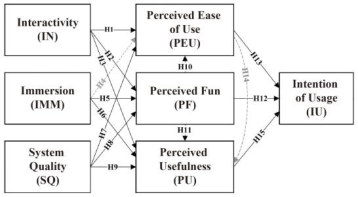
New Theoretical Model and Hypothesis Formulation Many studies have added external variables to accommodate different research contexts, which are usually associated with specific tasks, technology types and user groups. Based on the relevant theoretical literature, this study proposes three external variables: interactivity, immersion and system performance to better explain user experience and acceptance in
Creating Human-Centered Museums: User Experience in Digital Exhibitions 185
multimodal digital exhibitions. The extended model based on the original TAM model is detailed in Fig. 1.
Figure 1: Extended TAM model.
Interactivity is the ability of a user to dynamically interact with the system during the experience of a digital exhibit. Li and Lv (2024) found that interactivity positively influences users’ internal beliefs, such as perceived ease of use and perceived usefulness, ultimately shaping their behavioral intentions in a museum’s VR exhibition through both qualitative and quantitative analyses. Moon and Kim (2001) identified perceived playfulness as a key factor affecting behavioral intentions, demonstrating that highly interactive designs enhance users’ perceived enjoyment, which in turn boosts engagement and motivation. Additionally, Roca and Gagné (2008) found that perceived playfulness positively impacts learners’ continued use of e-learning systems, with interactive designs enhancing playfulness and motivating participation. Building on these theories and findings, this study considers interactivity as a critical external variable in examining the acceptance of multimodal digital technologies in museum exhibits. Based on this, the following hypotheses are proposed: H1: Interactivity has a positive effect on perceived ease of use. H2: Interactivity has a positive effect on perceived fun. H3: Interactivity has a positive effect on perceived usefulness. Immersion can be understood as a state in which users lose awareness of time and the real world during their exhibition experience, resulting from high levels of engagement and emotional investment. Xie et al. (2022) have identified immersion as a positive emotional dimension related to the use of interactive media, through which participants can experience a altered sense of time and reduced self-awareness. Cheng et al. (2024) found that immersion contributes to perceived usefulness and ease of use in their study. Cho et al. (2024) explored the factors influencing users’ intention to use AR games based on an extended TAM model and discovered that perceived enjoyment is a key variable affecting immersion. Building on these theories and findings, this study considers immersion as a key external variable in examining the acceptance of multimodal digital technologies in museum exhibitions. The following hypotheses are proposed:
H4: Immersion has a positive impact on perceived ease of use. H5: Immersion has a positive impact on perceived fun. H6: Immersion has a positive impact on perceived usefulness.
System quality refers to the overall performance and stability of a system at the technical level, including factors such as system responsiveness, ease of use of interface design, smoothness of operation, system stability, and effective feedback on user input. Almaiah et al. (2016) based on the extended TAM model found that system quality features such as user interface design, ease of use, and responsiveness have a positive impact on students’ perceived usefulness and perceived ease of use. Wang and Lin (2012) found that system quality is an important prerequisite for mobile phone users’ perceived ease of use and perceived usefulness. and perceived ease of use. In this study, system quality is used as an important external variable to study the acceptance of multimodal digital technologies in museum exhibitions, and the following hypotheses are proposed: H7: System quality has a positive effect on perceived ease of use. H8: System quality has a positive effect on perceived fun. H9: System quality has a positive effect on perceived usefulness. Rachmawati et al. (2020) found that perceived fun not only increases users’ interest and attitudes towards using social media and purchasing online, but also indirectly influences users’ perceptions of the platform’s usefulness and ease of use by enhancing the user experience. Hussain et al. (2016) demonstrated through a series of studies that perceived fun significantly influences users’ intention to use. Based on this, the following hypotheses are proposed in this study:
H10: Perceived fun has a positive effect on perceived ease of use. H11: Perceived fun has a positive effect on perceived usefulness. H12: Perceived fun has a positive effect on perceived intention to use. Chu et al. (2021) explored the effect of perceived ease of use on the intention to use virtual goods in online games based on the TAM model, and showed that perceived ease of use was positively correlated with perceived usefulness and intention to use. Based on this, this study proposes the following hypothesis: H13: Perceived ease of use has a positive effect on intention to use. H14: Perceived ease of use has a positive effect on perceived usefulness. H15: Perceived usefulness has a positive effect on intention to use.
METHODOLOGY
Questionnaire Design Firstly, this study designed the questionnaire based on the above model. The questionnaire consists of two parts: ‘Personal Information’ and ‘Formal Scale’. The ‘Personal Information’ section includes the respondents’ gender, age, educational background, and experience of digital museum exhibitions. The items in the ‘Formal Scale’ section are all from published academic literature and modified according to the context of this study, with a total of 24 questions, as shown in Table 1.
Creating Human-Centered Museums: User Experience in Digital Exhibitions 187
Table 1: Questionnaire content.
Table available in the original PDF paper.
Construct Illumination Conditions Source Interactivity IN1. The system can quickly respond to my Leung et al.
(IN)
actions.
(2022) IN2. I believe I have a high level of operability with the system. IN3. The system can understand and respond
to my behaviors. IN4. My interaction with the system is diverse and controllable. Immersion IMM1. Using the system makes me forget Huang et al.
(IMM)
about my surroundings and time.
(2023) IMM2. Using the system keeps me focused on what I’m doing. IMM3. I am completely immersed in the
content and interactions provided by the system. IMM4. The content and interactions provided by the system fully capture my attention. System Quality SQ1. The system effectively supports me in Zhang (2023)
(SQ)
completing tasks.
SQ2. The system operates smoothly, and information is responded to in a timely manner. SQ3. The system interface navigation is clear
and easy to understand. SQ4. I did not encounter any significant technical issues while using the system. Perceived Ease PEU1. I can master how to use the system in a
Manis and Choi
of Use (PEU)
short time.
(2019) PEU2. I find the multimodal interaction process of the system intuitive and simple. PEU3. I believe using the system does not
require too much effort or thought. Perceived Fun
PF1. The interaction methods of the system
Zhang (2023)
(PF)
are interesting to me.
PF2. The interactive elements of the system enhance my exploratory interest. PF3. I enjoy the process of interacting with the
system. Perceived
PU1. The multimodal interaction of the system
Venkatesh and Davis (2000)
Usefulness (PU)
increases my efficiency in obtaining exhibition information.
PU2. The multimodal interaction of the system deepens my understanding of the exhibition content. PU3. I find the multimodal interaction of the
system very useful.
Continued
Table 1: Continued Construct Illumination Conditions Source
Table available in the original PDF paper.
Intention to Use
IU1. I would recommend the multimodal (IU) technology in the exhibition to people around me. IU2. I would prioritize choosing exhibitions
that provide multimodal interaction. IU3. I plan to experience more exhibitions that offer multimodal interaction in the future.
Data Collection and Sample Description The questionnaire was distributed both online (via WeChat, Weibo, etc.) and offline (in the digital exhibition halls of the National Museum and Nanjing Museum). It was available from October 20 to 22, 2024, with a completion time of 2–5 minutes. Each question was rated on a 7-point scale (1=lowest, 7=highest). A total of 258 responses were collected (218 online, 40 offline), with 27 excluded due to issues like short completion times or logical inconsistencies, resulting in a 90% recovery rate.
The final sample included 231 responses, with 124 females and 107 males (gender ratio: 1.16:1). The largest age group was 18–25 years (44.16%), followed by 26–30 years (23.81%) and under 18 years (8.66%). Educational backgrounds varied, with the majority holding a bachelor’s degree or higher (82.68%). Most participants had visited digital museum exhibitions 1–3 times (62.30%), followed by 4–6 visits (25.11%).
Reliability Testing The Cronbach’s α values of the variables in this study ranged from 0.7 to 0.8, with an overall value of 0.852, indicating good reliability. The KMO values of the variables exceeded 0.6, and the overall KMO value was 0.834. The significance of the Bartlett’s test of sphericity was 0.000, which was less than 0.05, indicating a strong correlation between the variables and supporting the subsequent structural analyses. The combined validity (CR) and average variance extracted (AVE) of the variables were further analyzed using AMOS 26.0, and the results showed that the CR was greater than 0.8 and the AVE was greater than 0.5, indicating that the scales had good internal consistency, as shown in Table 2.
Table 2: Convergence validity results.
Table available in the original PDF paper.
Construct Cronbach’s α Composite
Average Variance Reliability Extracted Interactivity 0.853 0.855 0.598 Immersion 0.824 0.829 0.552 System quality 0.804 0.804 0.508 Perceived ease of use 0.824 0.830 0.621 Perceived fun 0.787 0.788 0.554 Perceived usefulness 0.881 0.882 0.714
Continued
Creating Human-Centered Museums: User Experience in Digital Exhibitions 189
Table 2: Continued Construct Cronbach’s α Composite
Table available in the original PDF paper.
Average Variance Reliability Extracted Intention to use 0.836 0.838 0.634 Total 0.852 0.926 0.593
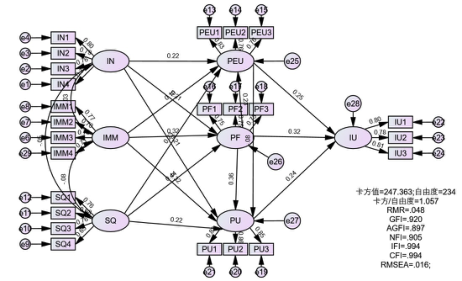
Model Fit Test After the reliability and validity analyses, the data were analyzed using structural equation modelling with AMOS 26.0. The model fit was analyzed using the generic 7 fit indices, and the model fit indices were obtained as shown in Table 3, which were all within the acceptable range, and the overall model fit was ideal.
Table 3: Fitting indicators and recommended values.
Table available in the original PDF paper.
Common Indices Judgment Criteria Value x2/df <3 0.234 GFI >0.9 0.920 RMR <0.05 0.048 CFI >0.9 0.994 NFI >0.9 0.905 TLI >0.9 0.993 IFI >0.9 0.994
RESULTS
The path test of the structural equation model in AMOS 26.0 yielded the path coefficients and the influence relationships between variables as shown in Table 4. Judging by the significance criteria of |C.R.|>1.96 and P Label<0.05, hypotheses H4 and H14 proposed in the previous section are not supported, and the rest of the hypotheses are supported. The new relationships between the variables in the model are redrawn, as detailed in Fig. 2.
Immersion has been identified as a psychological state characterized by the perception of being surrounded by, contained within, and engaged in interaction with an environment that provides continuous stimulation and experience (Witmer and Singer, 1998). In this study, the failure of H4 suggests that immersion failed to significantly improve users’ perceptions of system ease of use. In addition to the influence of perceived fun (H10, H11, H12), users’ high level of participation and engagement may also be oriented towards ‘deciphering.’ Unlike ‘Flow,’ which is both challenging and competently balanced, this process tends to become polarized into ‘puzzling,’ where the user receives multidimensional stimuli that generate interest but fails to receive an adequate guide to make connections. This misalignment leads to a biased self-efficacy assessment, which in turn creates confusion, frustration, and other negative emotions. The simplicity and clarity of the interface, the timeliness and adequacy of feedback, the smoothness and accuracy of the operation process, and the appropriateness of the interaction methods are all important factors that influence the user’s perception of ease of use.
The failure of H14 reveals that for the object of this study, perceived ease of use did not directly enhance users’ perceptions of the usefulness of the system, Davis (1989) found through a series of studies that the reliability coefficients for perceived ease of use and perceived usefulness were lower in hedonic than in utilitarian environments. By combining H10 and H11, it is evident that perceived fun in digital exhibitions plays a more decisive role in determining user behavioral intentions than ease of use and perceived usefulness in the conventional TAM model. Additionally, the three
Creating Human-Centered Museums: User Experience in Digital Exhibitions 191
core exogenous variables—interactivity (H1, H2, H3), immersion (H4, H5, H6), and system quality (H7, H8, H9)—together shape perceived fun. This can be understood as the user first receiving stimuli through multimodal means and synthesizing sensory impressions from their own perspective, which leads to the initial formation of physical immersion. The transition from physical to psychological immersion is a critical intervention point in determining deep user behavior. Therefore, this aligns with the failure of H14, as overly complex platform or system operations in digital exhibitions (e.g., cumbersome steps, unclear navigation, untimely feedback, lagging responses) make it difficult for users to assess through hands-on experience, leading to withdrawal. Without the accumulation of a sense of achievement and the empowerment of a mission, users are likely to lose their intrinsic motivation.
CONCLUSION
This study explores the application of multimodal digital technologies in museum exhibitions, emphasizing the key role of user experience in the transformation of the digital culture industry. By systematically analyzing the attributes of museum digital exhibitions using an extended technology acceptance model (TAM), we reveal the multiple factors that influence user acceptance. The findings indicate that interactivity, immersion and system quality are important variables that enhance user experience. Interactivity significantly enhanced users’ perceived ease of use, interest, and usefulness, which in turn increased their acceptance of the exhibition. While immersion failed to directly improve perceived ease of use, the positive impact on perceptions of fun and usefulness still suggests that immersive experiences are effective in stimulating users’ emotional connection and promoting deeper levels of engagement. Improvements in system quality likewise had a positive effect on user experience, further demonstrating the importance of high-quality design in digital exhibitions. In addition, perceived fun and ease of use were identified as important motivational variables influencing users’ intention to use. The perceived fun that users experience in museum digital exhibitions directly influences their intention to use, while perceived usefulness also proves its key role in the user decision-making process. These findings provide theoretical guidance for museum design in digital exhibitions, emphasizing the need to enhance user engagement.
Whether the findings of this study are applicable to different types and themes of digital exhibitions still needs to be further verified by subsequent researchers through diverse cases. In addition, studies targeting audience groups with different backgrounds and needs are particularly important. As mentioned earlier, there are significant differences in how audiences experience digital exhibitions. Future research should consider a wider sample of audiences, including educational backgrounds, age levels, cultural backgrounds, and visitors with different physical and mental abilities. Especially when dealing with digital exhibitions with multimodal interactions, the experience and acceptance of these audience types need to be explored in greater depth in order to provide more targeted design strategies for enhancing audience engagement and satisfaction.
REFERENCES
Al-Shamaileh, O. & Sutcliffe, A., 2023. Why people choose apps: An evaluation of the ecology and user experience of mobile applications. International Journal of Human-Computer Studies, 170, p. 102965. Almaiah, M. A., Abdul Jalil, M. & Man, M., 2016. Extending the TAM to examine
the effects of quality features on mobile learning acceptance. Journal of Computers in Education, 3, pp. 453–485. Bajaj, A., Jain, A. & Bhattacharjee, A., 2024. Design and development of digital humans in virtual exhibition space. Multimedia Tools and Applications, 83(12), pp. 36157–36174. Cheng, A., Ma, D., Pan, Y. & Qian, H., 2024. Enhancing museum visiting experience:
Investigating the relationships between augmented reality quality, immersion, and TAM using PLS-SEM. International Journal of Human–Computer Interaction, 40(17), pp. 4521–4532. Cho, N., Wang, Y., Lim, J. H. & Yu, G., 2022. Factors influencing continuous usage intention in augmented reality games: A comparative analysis of Korean and Chinese users. Asia Pacific Journal of Information Systems, 32(2), pp. 249–274. Chu, X., et al., 2021. Does perceived ease of use affect the willingness to use virtual
goods in online games? Role of perceived usefulness and player neuroticism. Psychological Science, 1, 134. Davis, F. D., 1989. Perceived usefulness, perceived ease of use, and user acceptance of information technology. MIS Quarterly, 13(3), pp. 319–340. Davis, F. D., Bagozzi, R. P. & Warshaw, P. R., 1989. User acceptance of computer
technology: A comparison of two theoretical models. Management Science, 35(8), pp. 982–1003. Diamantopoulou, S., Christidou, D. & Blunden, J., 2024. Multimodality and museums: Innovative research methods and interpretive frameworks. Multimodality & Society, 4(3), pp. 249–258. Hassenzahl, M. & Tractinsky, N., 2006. User experience—a research agenda.
Behaviour & Information Technology, 25(2), pp. 91–97. Hornecker, E. & Ciolfi, L., 2022. Human-computer interactions in museums.
Springer Nature. Hu, S., Jiang, W., Rong, L., Hu, S., Zhong, X. & Wei, Y., 2023. Building a human-computer interaction framework based on TAM/TPB/PR: A study of user satisfaction for accessible products. Journal of Intelligent & Fuzzy Systems, 45(2), pp. 3053–3075. Huang, Y. C., Li, L. N., Lee, H. Y., Browning, M. H. & Yu, C. P., 2023. Surfing
in virtual reality: An application of extended technology acceptance model with flow theory. Computers in Human Behavior Reports, 9, p. 100252. Leung, W. K., Cheung, M. L., Chang, M. K., Shi, S., Tse, S. Y. & Yusrini, L., 2022.
The role of virtual reality interactivity in building tourists’ memorable experiences and post-adoption intentions in the COVID-19 era. Journal of Hospitality and Tourism Technology, 13(3), pp. 481–499. Li, J. & Lv, C., 2024. Exploring user acceptance of online virtual reality exhibition technologies: A case study of Liangzhu Museum. PLoS ONE, 19(8), e0308267. Mailizar, M., Burg, D. & Maulina, S., 2021. Examining university students’
behavioral intention to use e-learning during the COVID-19 pandemic: An extended TAM model. Education and Information Technologies, 26(6), pp. 7057–7077.
Creating Human-Centered Museums: User Experience in Digital Exhibitions 193
Manis, K. T. & Choi, D., 2019. The virtual reality hardware acceptance model (VR- HAM): Extending and individuating the technology acceptance model (TAM) for virtual reality hardware. Journal of Business Research, 100, pp. 503–513. Moon, J. W. & Kim, Y. G., 2001. Extending the TAM for a World-Wide-Web context.
Information & Management, 38(4), pp. 217–230. Ngubelanga, A. & Duffett, R., 2021. Modeling mobile commerce applications’ antecedents of customer satisfaction among millennials: An extended TAM perspective. Sustainability, 13(11), p. 5973. Nizar, N. N. M., Rahmat, M. K., Nabihah, N. & Nizar, M., 2018. Examining
the museum visitors’ use of mobile technology through technology acceptance model (TAM). Journal of Tourism, Hospitality, and Event Management, 3(11), pp. 14–24. Raptis, G. E., Kavvetsos, G. & Katsini, C., 2021. MuMIA: Multimodal interactions to better understand art contexts. Applied Sciences, 11(6), p. 2695. Roca, J. C. & Gagné, M., 2008. Understanding e-learning continuance intention
in the workplace: A self-determination theory perspective. Computers in Human Behavior, 24(4), pp. 1585–1604. Rukhiran, M., Wong-In, S. & Netinant, P., 2023. User acceptance factors related to biometric recognition technologies of examination attendance in higher education: TAM model. Sustainability, 15(4), p. 3092. Turk, M., 2014. Multimodal interaction: A review. Pattern Recognition Letters, 36,
pp. 189–195. Venkatesh, V. & Davis, F. D., 2000. A theoretical extension of the technology acceptance model: Four longitudinal field studies. Management Science, 46(2), pp. 186–204. Wang, K. & Lin, C. L., 2012. The adoption of mobile value-added services:
Investigating the influence of IS quality and perceived playfulness. Managing Service Quality: An International Journal, 22(2), pp. 184–208. Witmer, B. G. & Singer, M. J., 1998. Measuring presence in virtual environments: A presence questionnaire. Presence, 7(3), pp. 225–240. Xie, T., Zheng, L., Liu, G. & Liu, L., 2022. Exploring structural relations among
computer self-efficacy, perceived immersion, and intention to use virtual reality training systems. Virtual Reality, 26(4), pp. 1725–1744. Zhang, Q. W., 2023. Research on the design of augmented reality guided tour products in museums based on the TAM model and proximity theory. M. S. thesis, Jiangnan University, Wuxi, China.
LISTED IN THE AHFE DIGITAL BOOKSTORE CATALOGUE
Explore the complete digital volume
Usability and User Experience
Read this individual research paper free through the original publisher, or explore the full digital proceedings book.
ISBN 978-1-964867-70-0
Explore this ISBN in the AHFE Bookstore ↗Listed in the July 2026 bookstore catalogue; search by ISBN to confirm current availability · Digital book purchase optional