Yassaman Khodadadeh, Shahrzad Jafari (2025). Exploring User Preferences for Health-Focused Digital Nudges: Insights from a Preliminary Study. In: Usability and User Experience. AHFE Open Access, vol. 194, pp. 141–152. https://doi.org/10.54941/ahfe1006676
This study explores the effectiveness of digital nudges in driving health-related behavioral change through mobile applications. Grounded in Nudge Theory and the Fogg Behavior Model (FBM), three interactive prototypes were developed to target hydration, posture, and mindfulness behaviors. A total of 88 participants (aged 25–35) tested these prototypes. The results indicate that Signal and Spark Triggers were significantly more effective than Facilitator Triggers in fostering user engagement and promoting behavior change. The study found that 65.91% of participants actively use applications for habit formation, while 93.94% confirmed the clarity and comprehensibility of the tested messages. Design elements such as message tone, graphic components, and color schemes were identified as key factors in capturing user attention, with a strong preference for personalized, visually supported messages framed with factual information. Findings suggest that for simple health-related tasks where ability and motivation are moderate, gentle reminders and positive reinforcement are the most effective nudging strategies. These insights reinforce the integration of FBM principles with Nudge Theory from behavioral economics. The study provides valuable strategies for designing more effective digital health interventions while preserving user autonomy and engagement. These findings offer actionable guidance for designers and policymakers in creating user-centered health applications that promote sustainable behavior change.
Nowadays all of our daily lives are intertwined with digital services and applications, and whether we are aware of it or not, we are continuously nudged towards their use by various external stimuli. Integrating digital technologies into health interventions offers a powerful opportunity to improve public health by promoting healthier behaviors. At the core of this approach is Nudge Theory, which subtly guides users toward better choices while preserving their autonomy (Meske & Amojo, 2020; Adkisson, 2008). Digital nudges, embedded in user interfaces, utilize principles like defaults, reminders, and framing to influence user behavior. However, designing effective digital nudges remains challenging. This research is part of a broader
initiative aimed at developing a comprehensive framework for evidence- based digital nudges that facilitate lasting behavioral change. This study examines health-focused digital nudges through the lens of the Fogg Behavior Model, analyzing user preferences and responses to various strategies. It explores how different triggers, framed with varying themes, influence user behavior and contribute to effective design principles.
Mobile health (mHealth) apps are key to achieving global health goals, with the WHO recognizing them as vital for meeting 2030 health targets (WHO, 2021). These apps promote healthier lifestyles and improved outcomes, prioritizing well-being over financial motives. While a 2021 meta-analysis demonstrated that mHealth apps increased physical activity levels by an average of 26%, sustaining long-term user engagement remains a challenge (Zangger et al., 2023). Research shows that only 20% of users consistently engage with health apps post-download (Lim, 2020). To enhance retention, integrating ethical behavioral design and digital nudging can align app features with user needs, fostering meaningful behavioral change.
Nudge Theory Nudge theory, a behavioral economics concept, subtly influences choices without restricting freedom or altering economic incentives. This “choice architecture” steers individuals toward better decisions through indirect suggestions (Ashraf Butt, 2023). Nudges adapt to user behavior, maintaining relevance over time. Popularized by book named Nudge: Improving Decisions About Health, Wealth, and Happiness (2008) by Adkisson, the theory distinguishes between irrational Humans and rational Econs, with nudges primarily affecting Human behavior (Jesse & Jannach, 2021). While effective when aligned with user interests, nudges can be misused as “dark nudges” or “sludge,” manipulating users for commercial gain. With clear guidelines, nudges can encourage positive behavioral change without compromising free will or manipulating user decisions (Li et al., 2024).
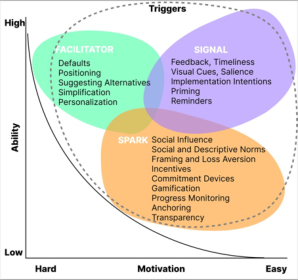
Fogg Behavior Model (FBM) The Fogg Behavior Model (FBM) is a key framework in persuasive and behavioral design, explaining how interfaces and products influence user actions through three elements: Motivation (driven by pleasure/pain, hope/fear, and social acceptance/rejection), Ability (ease of action based on time, effort, and skill), and Triggers (cues that prompt action) (Fogg, 2009). Figure 1 maps nudging mechanisms to the FBM, by classifying triggers into Signals (reminders for ready individuals), Sparks (motivational cues for disengaged users), and Facilitators (assistants when motivation exists but barriers remain).
Exploring User Preferences for Health-Focused Digital Nudges 143
Figure 1: The 23 nudging mechanisms mapped into three types of triggers suggested by Fogg’s Behavior Model (adopted form Caraban et al., 2019).
Digital Nudge Theory Soon after the concept of nudging gained popularity, the term “digital nudging”emerged to describe its application in online environments (Jesse & Jannach, 2021). Digital nudging uses user interface (UI) elements in software to subtly influence choices without limiting freedom. It involves the design of digital environments that guide behavior by leveraging principles from behavioral economics and cognitive science (Aktas et al., 2023; Karlsen & Andersen, 2019). Digital nudging necessitates intentional design and ethical considerations, where UI elements such as default settings, reminders, and feedback are used to influence user behavior in a way that aligns with the designer’s objectives (Purohit et al., 2023). For example, nudges can reduce screen time on Instagram or increase paying tips in mobile payments. Designed ethically, digital nudges can improve health behaviors, such as medication adherence by up to 35%, and boost user engagement by 40% (Ashraf Butt, 2023). The next section outlines key digital nudge methods, categorized by trigger (one element from Fogg behavior model) types in design.
Spark Triggers:
Social and Descriptive Norms: Highlighting peers’ activities to encourage alignment with group actions or feel team challenge.
Framing and Loss Aversion: Presenting choices to emphasize benefits or avoid potential losses.
Incentives: Offering rewards to motivate user engagement.
Facilitator Triggers:
Defaults: Pre-selected options that guide users toward desired behaviors.
Positioning: Placing options prominently to influence choices.
Suggesting Alternatives: Recommending another option.
Signal Triggers:
Feedback and Timeliness: Providing real-time feedback and responses to reinforce engagement.
144 Khodadadeh and Jafari
Visual Cues and Salience: Using graphical elements to highlight specific actions and getting more attention in specific button.
Implementation Intentions: Encouraging user to set specific plans for task.
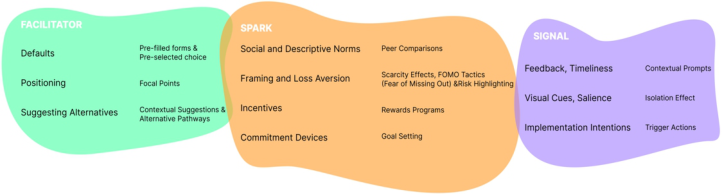
When integrated with design methodologies, digital nudges become more effective. For instance, the “Defaults” method guides decisions by pre- selecting options, and “Social and Descriptive Norms” can be applied via friends Comparison, showing users what others do to encourage similar behavior. The “Feedback and Timeliness”nudge delivers contextual prompts, like recommending travel insurance during flight bookings. These strategies, shown in Figure 2, are categorized into sub-methods with design features that can be applied to app development to foster healthy behavior change.
Figure 2: Digital nudge methods and design solutions by trigger type (by authors).
MATERIAL & METHODS This study aimed to investigate user preferences for digital nudges and their effectiveness in promoting healthy behaviors. To achieve this, three interactive prototypes were developed, each targeting a distinct health-related domain with easy actions:
Healthy Eating: Encouraging adequate water consumption to support hydration.
Physical Activity: Promoting proper posture to enhance musculoskeletal health.
Mindfulness: Facilitating deep breathing exercises to improve mental well-being.
Each prototype incorporated digital nudges categorized into three trigger types: Spark, Facilitator, and Signal, to assess their impact on user behavior. The prototypes, designed using Figma, featured three interactive pages, with each page presenting one trigger type for the user to select.
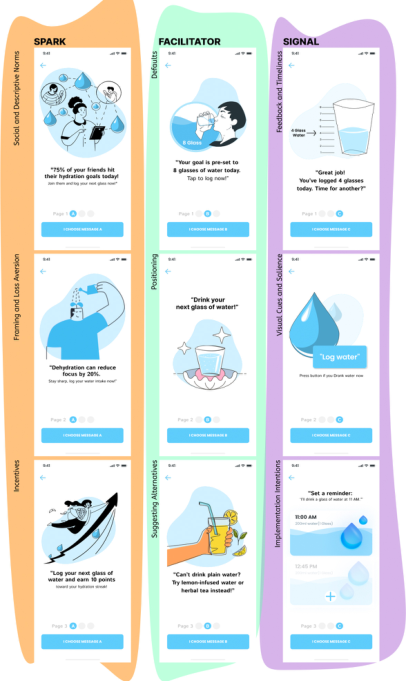
The digital nudges embedded within each prototype were structured as follows: Page 1:
Spark: Social and Descriptive Norms (e.g., “75% of users met their hydration goals today! Join them and drink your next glass of water.”)
Exploring User Preferences for Health-Focused Digital Nudges 145
Facilitator: Defaults (e.g., “Your goal is pre-set to 8 glasses of water today. Tap to log now!”)
Signal: Feedback and Timeliness (e.g., “Great job! You’ve logged 4 glasses today. Time for another?”)
Page 2:
Spark: Framing and Loss Aversion (e.g., “Dehydration can reduce focus by 20%.”)
Facilitator: Positioning (e.g., “Drink your next glass of water!” with a prominently placed button)
Signal: Visual Cues and Salience (e.g., “Stay sharp. log your water intake now with a button!”)
Page 3:
Spark: Incentives (e.g., “Log your next glass of water and earn 10 points toward your hydration streak!”)
Facilitator: Suggesting Alternatives (e.g., “Can’t drink plain water? Try lemon-infused water or herbal tea instead!”)
Signal: Implementation Intentions (e.g., “Set a reminder: ‘I’ll drink a glass of water at 3 PM.”’)
Figure 3: Drinking water prototype, each of three pages has one kind of trigger combined with digital nudge methods.
146 Khodadadeh and Jafari
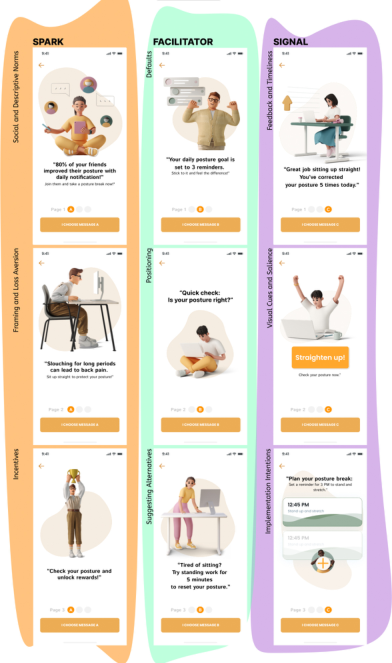
This structured approach facilitated the assessment of nine distinct digital nudge methods across the three trigger categories. While the examples provided pertain to the water consumption prototype, similar nudge implementations were applied to the posture correction and deep breathing prototypes.
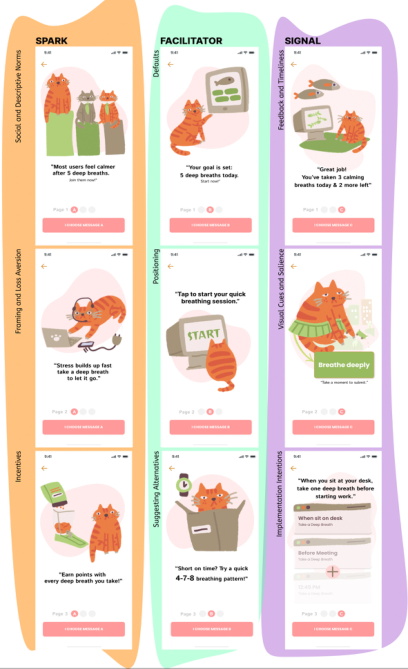
Figures 3, 4, and 5 illustrate the integration of these triggers within each respective prototype.
Figure 4: Posture correction prototype, each of three pages has one kind of trigger combined with digital nudge methods.
A total of 88 participants, aged 25–35, were recruited for this study. This age group was chosen for their high familiarity with digital tools, as well as their openness to adopting healthier habits and making lifestyle changes. Participants were randomly selected and invited via a digital link, where they were instructed to engage with the prototypes and assess the effectiveness of various nudging techniques.
Each participant reviewed all three pages of given prototype, experiencing each trigger type in sequence and choose one in each page. They were then asked to identify the design elements they found most appealing and effective.
Exploring User Preferences for Health-Focused Digital Nudges 147
Follow-up questions were included to provide further insights into their preferences and behavioral responses.
A mixed-methods approach was employed, integrating quantitative analysis of user interactions with qualitative feedback to gain a comprehensive understanding of user behavior.
Figure 5: Deep breathing prototype, each of three pages has one kind of trigger combined with digital nudge methods.
Quantitative Analysis: Click-through rates and interaction data were collected via Maze platform to assess the effectiveness of different nudge strategies in prompting user engagement.
Qualitative Analysis: User preferences and motivations were explored through open-ended responses and multiple-choice surveys assessing message clarity, motivational appeal, and overall design effectiveness and future suggestions.
Participants rated the effectiveness of the prototype messages using a five-point Likert scale, providing insights into their immediate reactions and willingness to adopt the suggested behaviors. Data analysis focused
148 Khodadadeh and Jafari
on identifying recurring themes, including the impact of message tone, visual design, and perceived personalization on engagement and habit formation. Additionally, participants provided insights into common habits they attempted to develop through digital applications, such as exercise, sleep improvement, and language learning, offering broader context for the findings.
The study’s findings were interpreted within the framework of the Fogg Behavior Model (FBM), examining the interplay between Motivation, Ability, and Triggers in shaping user actions. The effectiveness of different nudging techniques was assessed in terms of their ability to capture user attention, reduce cognitive load, and drive behavioral change.
RESULT
The study demonstrated that 65.91% of participants reported using applications to help build and maintain new habits. These applications served a diverse range of purposes, reflecting the various lifestyle goals of participants. Key areas included exercise and running, language learning, sleep regulation, healthy eating and drinking habits, meditation, social detoxification, self-care and makeup, smoking cessation, and financial management. Popular applications cited by participants included Opal, Consistency, Duolingo, home gym apps, sleep-regulating apps, and Strava, among others.
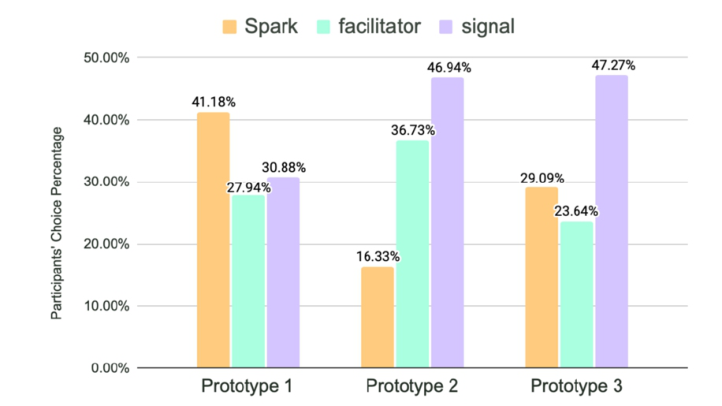
A total of 88 participants interacted with the prototypes developed for this study, which were designed to explore nudging methods preference for behavioral change. The participants were divided as follows: 37 participants tested the Deep Breathing prototype, 25 participants interacted with the Posture Correction prototype, and 26 participants used the Drinking Water prototype. Analyzing the participants’ responses revealed that the majority preferred signal and spark nudge methods over facilitation-based approaches (Figure 6).
In the follow-up questions, participants were asked about the clarity and ease of understanding of the messages presented in the prototypes. An overwhelming 93.94% of participants confirmed that the messages were clear and easy to comprehend.
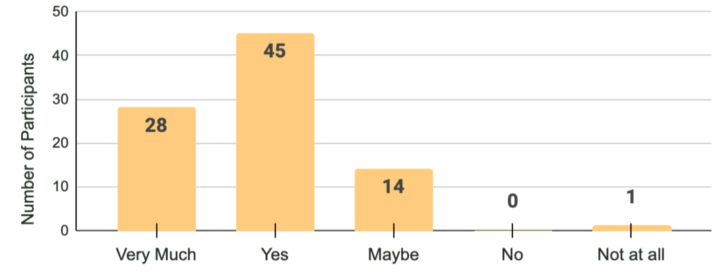
The motivational impact of the prototype messages was evaluated using a five-point Likert scale across all three prototypes. The results showed that 28 participants found the messages highly motivating (“very much”), 45 participants reported a positive motivational effect (“yes”), 14 participants expressed moderate motivation (“maybe”), and only 1 participant indicated no motivation (“not at all”). These findings highlight the effectiveness of the messages in prompting immediate action for most participants. Figure 7 presents the distribution of responses.
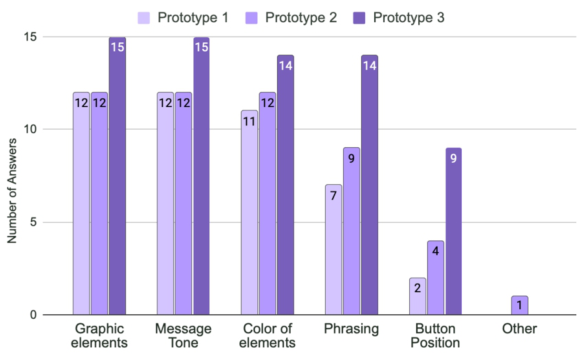
To further assess the appeal and attractiveness of the prototypes, participants were asked to identify their preferred design elements. These elements included various aspects such as graphic design, message tone, color scheme, phrasing, and button positioning, each contributing to the overall user experience. By analyzing these preferences, the study aimed to gain
Exploring User Preferences for Health-Focused Digital Nudges 149
deeper insights into the design features that most effectively engage users. The distribution of these preferences is presented in Figure 8, offering a visual representation of the participants’ design choices and highlighting key factors that influence user engagement and satisfaction.
Figure 6: Participants’ preferences for nudge methods.Figure 7: Five-point Likert scale distribution of participant responses on the motivational impact of prototype messages.
This feedback highlights the critical role of visual and textual elements in enhancing user engagement and satisfaction. Participants were also asked whether they found the nudging messages effective for habit formation or if they were likely to ignore them. Of the total participants, 84.13% found the messages effective, 9.52% stated they would ignore them, and 6.35% were undecided.
This positive response further reinforces the potential of well-designed nudging messages to support behavioral change. Additionally, participants
150 Khodadadeh and Jafari
provided suggestions for improving the effectiveness of the nudging messages. These suggestions reflect a nuanced understanding of user preferences and offer actionable insights for designing more impactful habit-forming tools:
Figure 8: Appeal of different elements in messages across each prototype.
Personalized or customized messages: Participants emphasized the importance of tailoring messages to individual needs and preferences, which can enhance relevance and engagement.
Messages with visual elements or figures: Including graphics or icons to support text-based messages was suggested to make the prompts more engaging and visually appealing.
Short and friendly messages: Participants preferred concise messages with an approachable and friendly tone, avoiding overly formal or directive language.
Graphs or accomplishment goals: Suggestions included incorporating visual representations of progress, such as graphs, to motivate users by illustrating their achievements.
Feedback and progress tracking: Providing feedback on progress and enabling users to track their habits over time were identified as key features for improving user satisfaction and motivation.
Alternative suggestions: Participants suggested offering alternative actions or solutions to accommodate different situations and maintain flexibility in the app’s recommendations.
Fact-based framing without inducing guilt: Participants preferred nudges framed in a positive, fact-based manner, avoiding messages that could evoke guilt or negative emotions.
Avoidance of social comparison: Participants expressed a preference for messages that focused on individual progress rather than comparisons with others, which could lead to discouragement.
Exploring User Preferences for Health-Focused Digital Nudges 151
DISCUSSION & CONCLUSION The study underscores the growing familiarity of participants with digital technologies and their widespread use of applications for habit formation, with a particular focus on health and well-being. Health concerns were identified as the primary motivation for engaging with these applications, highlighting the relevance and potential of this research area. The voluntary nature of participation further emphasizes the participants’ intrinsic interest in improving their well-being, thus validating the importance of this field. Additionally, the clarity of the study’s methodology was affirmed by the participants, most of whom found the test easy to understand. This supports the reliability of the data collected and strengthens the validity of the insights into user preferences.
The results of the study revealed a distinct preference for Signal and Spark Triggers, such as feedback, visual cues, framing, and incentives, over Facilitator Triggers like defaults and suggestions. This finding suggests that users are more responsive to interactive features that encourage engagement and foster a sense of reciprocity and personal care. These interactions serve to motivate users and enhance their overall experience, leading to greater behavioral change. The observed preference for Signals and Sparks aligns with the Fogg Behavior Model, which posits that when tasks are relatively easy, as is often the case in health-related activities like drinking water or posture correction, triggers like Signals and Sparks are crucial for initiating action. In contrast, more complex tasks may require further investigation into the effectiveness of these triggers.
From a cognitive perspective, theories such as Reinforcement Learning and Decision-Making further support the effectiveness of Signal and Spark Triggers. These triggers simplify the decision-making process and reduce cognitive load, particularly in tasks that require consistent engagement over time. For instance, simple tasks such as maintaining hydration or correcting posture can benefit from nudges that prompt users to act without overwhelming them with mental effort. The study found that 80.3% of participants agreed that digital nudges play a significant role in habit formation, with many feelings immediately motivated to act after interacting with the prototypes. This suggests that the nudges successfully bridge the gap between intention and action, particularly for health-related behaviors, where timely action is key.
Participants favored message tone, graphics, and color as key design features, stressing the importance of clarity in visual and linguistic communication. While button positioning and layout were secondary, they still contributed to usability. The study’s findings suggest that effective nudges incorporate personalization, visual appeal, positive framing, and actionable feedback to foster long-term engagement.
Finally, the study demonstrates that participants responded positively to nudges, perceiving them as effective tools for influencing behavior. This reinforces the critical role of well-crafted nudges in promoting user engagement and guiding healthy behaviors. By integrating the right combination of triggers and design features, digital health applications can
152 Khodadadeh and Jafari
create an environment conducive to sustained behavioral change, ultimately improving user well-being and supporting long-term habit formation.
Future research should explore:
Exploring long-term engagement strategies, particularly for maintaining user interest and reducing nudge fatigue.
Investigating the role of progress tracking and goal-setting as Commitment Devices to reinforce behavior change.
Developing a comprehensive framework that integrates these findings into established behavior models, such as the Fogg Behavior Model, to guide designers in creating impactful, ethical nudges.
REFERENCES
Adkisson, R. V. (2008). Nudge: Improving Decisions About Health, Wealth and Happiness. The Social Science Journal, 45(4), 700–701. https://doi.org/10.1016/ j.soscij.2008.09.003 Aktas, M., Cambon, L., & Aromatario, O. (2023). User engagement in digital health
applications: A scoping review. Research Square. https://doi.org/10.21203/rs.3.rs- 3333695/v1 Ashraf Butt, A.(2023). The role of digital nudges in engineering students’ engagement with an educational mobile application [Doctoral dissertation, Purdue University]. Caraban, A., Karapanos, E., Gonçalves, D., & Campos, P. (2019). 23 ways to
nudge: A review of technology-mediated nudging in human-computer interaction. Proceedings of the 2019 CHI Conference on Human Factors in Computing Systems, 1–15. https://doi.org/10.1145/3290605.3300733 Fogg, B. J. (2009). Behavior model for persuasive design. Stanford University. Jesse, M., & Jannach, D. (2021). Digital nudging with recommender systems: Survey and future directions. Computers in Human Behavior Reports, 3, 100052. https:// doi.org/10.1016/j.chbr.2020.100052 Karlsen, R., & Andersen, A. (2019). Recommendations with a nudge. Technologies,
7(2), 45. https://doi.org/10.3390/technologies7020045 Li, Y., Zhang, J., Lu, Y., & Jiang, Y. (2024). Exploring the effect of nudge approach on driver’s willingness to use driver tracking. Transportation Research Part F: Traffic Psychology and Behaviour, 101, 15–32. https://doi.org/10.1016/ j.trf.2023.12.016 Lim, I. (2020). Nudging in supermarkets to reduce plastic bag consumption among
customers: A framework for change. Journal of Sustainable Development, 13(4), 142. https://doi.org/10.5539/jsd.v13n4p142 Meske, C., & Amojo, I. (2020). Ethical guidelines for the construction of digital nudges (Version 1). arXiv. https://doi.org/10.48550/ARXIV.2003.05249 Purohit, A. K., Schöbel, S., Bill, O., & Holzer, A. (2023). Nudging to change,
the role of digital health. In H. Rivas & T. Boillat (Eds.), Digital health (pp. 137–154). Springer International Publishing. https://doi.org/10.1007/978-3- 031-17666-1_10 WHO. (2021). Global strategy on digital health 2020–2025. World Health Organization. Licence: CC BY-NC-SA 3.0 IGO. Zangger, C., et al. (2023). The impact of mobile health apps on physical activity: A meta-analysis. Journal of Mobile Health Research, 45(3), 123–140.
LISTED IN THE AHFE DIGITAL BOOKSTORE CATALOGUE
Explore the complete digital volume
Usability and User Experience
Read this individual research paper free through the original publisher, or explore the full digital proceedings book.
ISBN 978-1-964867-70-0
Explore this ISBN in the AHFE Bookstore ↗Listed in the July 2026 bookstore catalogue; search by ISBN to confirm current availability · Digital book purchase optional