Hui Ran Xie, Xiaodong Gong (2025). Waiting information design based on outpatients' waiting information needs and time cognition. In: Usability and User Experience. AHFE Open Access, vol. 194, pp. 173–181. https://doi.org/10.54941/ahfe1006679
Waiting in the outpatient department is a common phenomenon in the patient's medical treatment process. The uncertainty of waiting information can significantly affect the medical experience. Establishing a waiting time information system that meets the needs of patients can effectively guide patients to form reasonable expectations, thereby improving patient satisfaction. This study, through the theoretical framework of time cognition and grounded theory analysis, identified four core information needs. Considering the dynamic characteristics of the medical waiting scenario, on the basis of the traditional three dimensions of duration, time point and sequence, the time-varying information dimension was innovatively introduced to construct the outpatient waiting expected time information model (T-EWIM). Taking the outpatient service in China as an example, the intervention effect of introducing time-varying information elements in the patient's medical treatment time prediction task was studied through simulation experiments, verifying the effectiveness of time-varying information elements in time prediction and their impact on user satisfaction. It provides a systematic theoretical model and design framework for information support in the medical waiting scenario.
In the contemporary medical model, the “waiting” stage is a key part of the patient journey. Long and uncertain waiting times before consultations are a major source of dissatisfaction with medical services. Improving the waiting experience is essential for enhancing service quality and patient satisfaction. Research shows that patients lacking clear waiting information tend to overestimate wait times, intensifying negative emotions (Maister, 1984). Optimizing the waiting experience requires not only reducing actual wait times but also managing expectations and providing accurate, timely, and clear information. Ineffective or unclear information can increase confusion and dissatisfaction. Thus, designing a scientific, effective, and user-friendly waiting information system is vital for improving outpatient care.
Clear Waiting Time In service management research, many studies have explored the impact of information intervention on deterministic waiting. Providing expected queuing time information enhances users’ perceived time accuracy and prevents overestimation (Katz et al., 1991). Effective communication of queuing information reduces regret rates (Munichor et al., 2007), while continuous updates during waiting maintain users’ sense of control and reduce anxiety (Hui and Tse, 1996). In hospital settings, scholars emphasize that informing patients about their visit stage, status, and queuing management can improve satisfaction by altering negative perceptions of waiting (Yusoff et al., 2015).
Currently, many medical institutions face issues such as vague, outdated, or impersonal waiting time information. This insufficient guidance leads to unclear waiting time judgments and lowers overall service evaluations. To address this, this study integrates patients’ time cognition, information needs, and the unique aspects of medical services to construct a scientific expected waiting time information model. The goal is to provide patients with clear waiting expectations, optimizing their experience and enhancing satisfaction.
Theory of Time Cognition In psychology, time cognition is used to explore human time perception. Research on individual time perception has a long history, during which several classic models emerged, including the storage capacity model, processing-time model, change/segmentation model, and range-synthetic model.
Early studies defined time perception as an individual’s awareness of the duration and sequence of objective phenomena, encompassing temporal sequence perception and temporal duration perception (Fontes et al., 2016). Specifically, temporal sequence perception refers to recognizing the order of successive events, while temporal duration perception involves estimating the interval between two events or the length of a specific event. Time points differ from durations by focusing more on event positioning along the time axis rather than emphasizing “time quantity.”
The medical outpatient waiting scenario serves as a natural setting for time cognition: patients must judge the sequence of medical procedures (e.g., examination orders), estimate time intervals (e.g., ultrasound durations), and anchor key time points (e.g., appointment times).
A Grounded Theory Analysis of Patients’ Anticipated Information Needs During Waiting Periods Grounded theory is a systematic qualitative research method developed in the 1960s. Its core feature is deriving theories from actual data rather than relying on preconceived assumptions. This method systematically builds a theoretical framework through data collection and analysis. A typical process includes three key steps: open coding (initial conceptualization of raw data), axial coding (connecting and classifying concepts), and selective coding (integrating core concepts into a coherent theory). Through these
Waiting Information Design Based on Outpatients’ Waiting Information Needs 175
steps, researchers progressively refine their analysis to construct a complete theory.
In this study, the author conducted semi-structured interviews with 18 respondents familiar with the daily medical treatment process (10 women and 8 men). To explore patients’ information needs regarding expected waiting times during outpatient visits, the interviews focused on the following key questions, informed by the research purpose, existing literature, and pilot interviews: (1) Information needs for forming expected waiting time judgments. (2) Reasons for inaccurate waiting time estimations. (3) Methods used to judge expected waiting times.
During the interviews, researchers clarified unclear viewpoints to ensure accurate and in-depth data collection. All interviews were recorded, and the raw data was organized into 18 texts. Fifteen texts were coded using Nvivo12 software, while the remaining three were reserved for saturation testing.
Open Coding Open coding is the first level of the three-level coding, and it is a process of analyzing and identifying concepts along with their attributes and dimensions (Mohajan, 2022). The author analyzed and labeled the 15 interview texts word by word to ensure the openness and objectivity of the information. Through repeated comparison and organization, the effective information was transformed into conceptualized and categorized core words. To ensure the rigor and scientific nature of the coding, the author replaced the respondents’ oral expressions with professional terms. After the labeling process, 45 pieces of effective information were extracted. Similar concepts with similar meanings were merged and duplicate content was removed. Eventually, 12 concepts were summarized and classified into 8 initial categories, as shown in Table 1.
Table 1: Open coding analysis.
Table available in the original PDF paper.
Category Concept Summarizing Raw Statements Queue distance Remaining progress of Patients’ understanding of the
the queue The demand for
remaining progress of queue information during medical treatment waiting and the transformation of digital time in the queue process.
digitalization of queue time Temporal Inference Cross-linkage estimation The patient’s judgment of the expected waiting time or queuing situation based on their past personal medical experience, as well as their overall judgment of the time for future multiple examination plans and tasks. Time accumulation
calculation Queue positioning Locating requirements in
The positional relationship of
the queue
patients in the medical treatment waiting queue Continued
176 Xie and Gong
Table 1: Continued Category Concept Summarizing Raw Statements
Table available in the original PDF paper.
Individual sequence The order of an
The patient’s own sequence in the
individual in a queue waiting queue Queue dynamics Cognition of Process
Patients’ cognition of the sequence
Sequence
of tasks in the medical treatment process Process sequence Queue speed The observable speed changes of the queue process by the patient Real-time performance High-frequency update The patient continuously receives
dependency
queue information while waiting. Stability Information mutation Patients’ confusion over unexplained
Explanation of Delay Attribution Dynamic adjustment
prompt
mutation queue information, unexplained delays in queue progress, and temporary adjustments to queue changes can affect their estimation of waiting times.
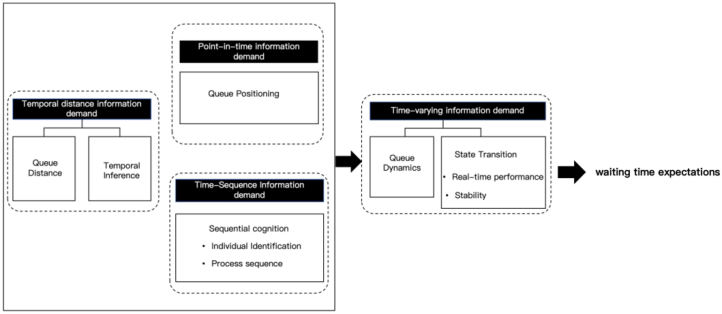
Axial Coding Axial coding further analyzes the correlations among concepts and initial categories identified in open coding, summarizing higher-level categories. By analyzing the 8 initial categories from open coding, the author identified intrinsic connections and grouped them into 4 abstract high-level categories: Temporal distance information demand, Point-in-time information demand, Time-Sequence Information demand, and Time-varying information demand, as shown in Table 2.
Table 2: Axial coding analysis.
Table available in the original PDF paper.
Main Category Category Temporal distance information demand Queue distance Temporal Inference Point-in-time information demand Queue positioning Time-Sequence Information demand Sequential cognition Time-varying information demand Queue Dynamics State Transition
Selective Coding Selective coding is the key step in grounded theory, identifying core categories from those extracted through axial coding and exploring their intrinsic relationships. Qualitative analysis revealed four core categories
Among these, Temporal distance information demand is central to forming time expectations during waiting, enabling patients to make intuitive judgments through reasoning about time intervals. Time point and time sequence information demands supplement individual positions in the queue, enhancing comprehensive judgment of waiting status. Time-varying information demand addresses real-time changes in the queue and their
Waiting Information Design Based on Outpatients’ Waiting Information Needs 177
stability. Together, these categories form a model of patients’ expected information needs during outpatient waiting, as shown in Figure 1.
Figure 1: Waiting expected time information model (T-EWIM).
Theoretical Saturation Test After completing the grounded theory framework, the author conducted a rigorous saturation test by thoroughly analyzing reserved samples to confirm that no new key concepts or categories emerged. The results indicate that the model achieved theoretical saturation.
Based on grounded theory findings, domestic patients’ time information demands during medical waiting can be summarized into four core dimensions: sequence, duration, point-in-time, and time-varying information. While the first three dimensions (temporal sequence, temporal distance, and point-in-time) are well-defined in time cognition, the fourth dimension—time-varying information—is critical for real-world time prediction tasks. Interview analysis revealed that time-varying information significantly impacts time estimation judgments.
From the perspective of time cognition theory, outpatient waiting involves four key elements:
1. Time-Sequence Information: reflects patient order identification, providing relative process positioning. 2. Temporal distance information: indicates the time span from the current moment to the end of the visit. 3. Point-in-time information: represents the patient’s absolute position on the time axis, aiding queue positioning cognition. 4. Time-varying information: captures real-time changes in medical services, addressing uncertainties such as fluctuating consultation speeds and emergency priority treatments.
Traditional time dimensions struggle to fully reflect these uncertainties due to the non-uniformity of medical processes. Thus, this study introduces time-varying information as a dynamic dimension, using real-time updates to
178 Xie and Gong
compensate for static time estimation limitations. These four elements and their typical expressions are summarized in Table 3 for future research.
Table 3: The expression of the four elements of time information in medical treatment scenarios.
Table available in the original PDF paper.
Type of Information Examples of Behaviors in a Medical Waiting Room Scenario Temporal distance information The number of people waiting ahead
(e.g. There are 4 people waiting ahead.) Time-Sequence Information Registration number (e.g. No. 9) Point-in-time information Position in the queue (e.g., the 9th out of 10 waiting numbers in the morning) Time-varying information Queue flow rate (e.g., the average
consultation time for current patients is 10 minutes)
An Experiment on the Validity of Time-Varying Information Elements To further test the role of time-varying information elements in patients’ anticipation of waiting times, this study employed a scenario simulation experiment method, simulating the hospital medical treatment waiting scenario, to investigate the impact of the combination of waiting information including time-varying information elements and the combination of waiting information excluding time-varying information elements on users’ establishment of a clear expected waiting time. The specific content of the combined information is as follows:
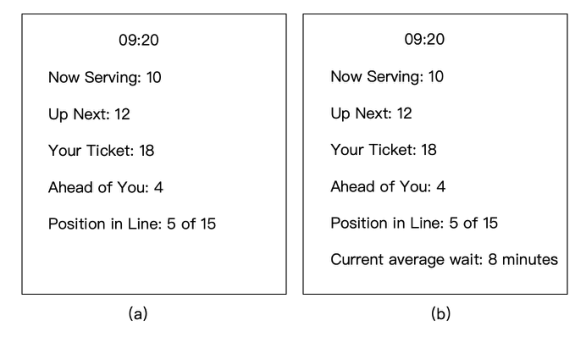
1) Combination a: sequence + duration + time point information. 2) Combination b: sequence + duration + time point + time-varying Information.
The experiment simulated the waiting scenario in a hospital outpatient department. The queue call order was publicly displayed on a monitor and announced through voice. Participants received two different types of dynamic information about their medical appointments via their mobile phones, as shown in Figure 2. To avoid visual representation of the information from interfering with the participants, the information was presented only in text form. During the experiment, participants were required to judge the estimated waiting time based on the information combination they received at the same time. The waiting was considered over when they were called by the system. They then left the experimental area and filled out a questionnaire to rate the information combination sample they held, assessing its effectiveness in supporting their judgment of the expected waiting time and their satisfaction. The questionnaire used a 5-point Likert scale, with 1 to 5 corresponding to strongly disagree, disagree, neutral, agree, and strongly agree, respectively. A total of 10 participants aged 20 to 55 were invited to the experiment, divided into 5 groups of 2 people each, all familiar with the outpatient visit process.
Waiting Information Design Based on Outpatients’ Waiting Information Needs 179
Figure 2: Information combination example.
Data Analysis and Discussion The experimental results show that there are significant differences in the effectiveness and satisfaction scores among the different information combinations provided to the participants. According to the calculation method of the Likert five-point scale, 1 to 2.4 is the negative range; 2.5 to 3.4 is the neutral range; and above 3.5 is the positive range (Tosun, 2022). As shown in Table 4, the scores of combination b in these two dimensions (effectiveness: 4.6; satisfaction: 4.6) are significantly higher than those of combination a (effectiveness: 2.6; satisfaction: 2.8), indicating that the perceived effectiveness and user satisfaction have increased by 76.9% and 64.3% respectively. This difference indicates that in the simulated outpatient waiting scenario, the configuration of dynamic queue information in combination b, which includes time-varying information, better supports the participants’ time estimation tasks and meets their information needs.
Table 4: Data on the effectiveness and satisfaction of time-varying information applications.
Table available in the original PDF paper.
Sample Average Score of Validity Average Satisfaction Score Combination a 2.6 2.8 Combination b 4.6 4.6
In the above-mentioned simulation experiment, to ensure the participants’ sense of involvement, no less than three time prediction tasks were set. To verify the impact of time-varying information on time judgment errors, the sample size of the participants was increased. Eighteen participants were involved in the time prediction task and were divided into two groups: one with time-varying information and the other without (9 participants with time-varying information and 9 without). The real waiting time was set uniformly for the task. During the waiting process, the participants conducted the time prediction task twice to estimate the expected waiting time.
180 Xie and Gong
Table 5: A comparison of task differentiation in forecasting with time-varying information or not.
By comparing and analyzing the data of the two groups of participants, it was found that the average absolute error of the group with time-varying information was significantly lower than that of the group without time- varying information, and the standard deviation of the error was also smaller. This indicates that time-varying information not only effectively reduces the deviation in time prediction but also enhances the stability of the prediction. Specifically, in the two time prediction tasks, the mean error of the group with time-varying information (Task 1: 4.4 ± 3.8; Task 2: 2.6 ± 2.1) was significantly lower than that of the group without time-varying information (Task 1: 9.4 ± 7.2; Task 2: 6.7 ± 5.3). This result validates the positive role of time-varying information in improving the accuracy of time judgment and provides empirical support for its application in related fields.
CONCLUSION
Hospital waiting times are complex and unpredictable. To address the uncertainty of patient time expectations, this study developed a time prediction information model based on time cognition theory and grounded theory. Through simulation experiments, it verified the role of time-varying information in improving prediction accuracy. The results show that providing dynamic updates (e.g., real-time waiting progress) significantly enhances prediction accuracy, reduces estimation errors, and improves user satisfaction compared to static waiting notifications. This confirms the importance of time-varying information in time prediction and provides empirical support for applying time cognition theory in practice. Additionally, the study validates the model’s effectiveness, offering theoretical and practical guidance for hospitals to optimize waiting information strategies and enhance patient experience. Future research could explore the broader applicability and long-term effects of time-varying information in diverse scenarios.
ACKNOWLEDGMENT
The author thanks the support of the Beijing Industrial Design Promotion Special Project for Outstanding Design Talents (2023).
REFERENCES
Fontes, R., Ribeiro, J., Gupta, D. S., Machado, D., Lopes-Júnior, F., Magalhães, F., Bastos, V. H., Rocha, K., Marinho, V., Lima, G., Velasques, B., Ribeiro, P., Orsini, M., Pessoa, B., Leite, M. A., & Teixeira, S. (2016). Time Perception Mechanisms at Central Nervous System. Neurology international, 8(1), 5939.
Waiting Information Design Based on Outpatients’ Waiting Information Needs 181
Hui, M. K., & Tse, D. K. (1996). What to Tell Consumers in Waits of Different Lengths: An Integrative Model of Service Evaluation. Journal of Marketing, 60(2), 81–90. Katz, K. L., Larson, B. M., & Larson, R. C. (1991). Prescription for the Waiting-in-
Line Blues: Entertain, Enlighten, and Engage. MIT Sloan Management Review, 32, 44–53. Maister, D. H. (1984). The psychology of waiting lines. Boston: Harvard Business School, (pp. 71–78). Mantel, S. P., & Kellaris, J. J. (2003). Cognitive determinants of consumers’ time
perceptions: The impact of resources required and available. Journal of Consumer Research, 29(4), 531–538. Munichor, N., & Rafaeli, A. (2007). Numbers or apologies? Customer reactions to telephone waiting time fillers. Journal of Applied Psychology, 92(2), 511. Mohajan, Devajit and Mohajan, Haradhan (2022): Exploration of Coding in
Qualitative Data Analysis: Grounded Theory Perspective. Published in: Research and Advances in Education, Vol. 1, No. 6 (6 December 2022): pp. 50–60. Pruyn, A., & Smidts, A. (1998). Effects of waiting on the satisfaction with the service: Beyond objective time measures. International journal of research in marketing, 15(4), 321–334. Tosun, C. (2002). Host perceptions of impacts: A comparative tourism study. Annals
of tourism research, 29(1), 231–253. Yusoff, F. H., Azhar, M. A., & Ismail, M. (2015, August). A review of user aware infographic display system in waiting room area. In 2015 IEEE Conference on Open Systems (ICOS) (pp. 124–129). IEEE.
LISTED IN THE AHFE DIGITAL BOOKSTORE CATALOGUE
Explore the complete digital volume
Usability and User Experience
Read this individual research paper free through the original publisher, or explore the full digital proceedings book.
ISBN 978-1-964867-70-0
Explore this ISBN in the AHFE Bookstore ↗Listed in the July 2026 bookstore catalogue; search by ISBN to confirm current availability · Digital book purchase optional