Xiaodong Gong, Chen Wei, Yushun Liu, Qian Gong (2023). Design of a home-based food assistance service for the elderly. In: Human Factors in Aging and Special Needs. AHFE Open Access, vol. 88, pp. 30–39. https://doi.org/10.54941/ahfe1003659
The urgent needs of food assistance for senior citizens increase rapidly. Elderly people are physically weak, especially those who are living alone, longliving, disabled and semi-disabled, and it is difficult for them to prepare nutritious meals on their own. Besides, since most of them suffer from chronic diseases and have special dietary requirements, the food provided to the general public is not suitable for them. It is becoming increasingly important to provide healthy eating assistance services for the elderly people at home. In this paper, users’ needs were inspected from the perspective of service design and an elderly-friendly meal service system was built for them. Firstly, we analyzed the existing elderly meal service model through desktop research. Secondly, we explored the problems of elderly users in the process of dining through semi-structured interviews in households and gain insight into their real needs. Then, we constructed an elderly-friendly meal service system. It solves various problems related to diets brought by aging (such as chronic disease management, lack of nutritional knowledge, etc.) by interactive designs, so that the elderly can receive meal assistance services based on their own health status, dietary preferences and other personalized needs.
China entered an aging society in 2000, and the dependency coefficient of the elderly has been increasing year by year. The latest census of the National Bureau of Statistics shows that the population aged 60 and above is 264.02 million, accounting for 18.70%. Among them, the population aged 65 and above totaled 190.64 million people, accounting for 13.50% (Du, P. and Wang, Y., 2016).
By 2025, the population of people aged 60 and above will reach 300 million, and China will become a super-aged country. The rapid growth in the number of vulnerable elderly people leads to the fact that community and home-based elderly care has become the mainstay and institutionalized elderly care cannot satisfy the demands of senior citizens anymore (Zhou, J. and Walker, A., 2016).
Nowadays, senior care services are closely combined with “Internet+”. User demands will become more diversified and personalized. As people get older, the daily meals of them can be very different from those of the young,
Design of a Home-Based Food Assistance Service for the Elderly 31
due to the living environment, social interaction, economic incomes and dis- eases. How to meet the nutritional supply of meals for the elderly, maintain health and improve the quality of life has become an important issue (Liu, R. and Grunert, K.G., 2020).
Existing studies on meal assistance for the elderly are mostly focusing on national policies, economics, sociology, statistics, etc. There are few cases of design-driven social innovation to refer to. Therefore, in this paper, we explo- red the innovation of meal service system under community aging-in-place model with the help of designing research method.
CHALLENGES TO HEALTHY EATING FOR OLDER ADULTS Families have traditionally been the major source of financial and caregiving support for older adults in China, and most older adults have children living with them or nearby who can provide caregiving assistance (Krings et al. 2022). However, the proportion of elderly people living alone is increasing, and it is no longer realistic to rely entirely on families to provide meals.
Older adults generally have lower calorie needs, but similar or even increased nutrient needs compared to younger adults.Nutrient needs in this population are also affected by chronic health conditions, use of multiple medicines, and changes in body composition (Moro et al. 2015).
Aging is accompanied by physiologic changes that can negatively impact nutritional status. Sensory impairment, such as decreased sense of taste and smell, that occurs with aging may result in reduced appetite (Elsner, R. J., 2002). Poor oral health and dental problems can lead to difficulty chewing, inflammation, and a monotonous diet that is poor in quality, all of which increase the risk of malnutrition (Payette, H. and Shatenstein, B., 2005). 5 Progressive loss of vision and hearing, as well as osteoarthritis, may limit mobility and affect the elderly people’s ability to shop for food and prepare meals.
Along with physiologic changes, the elderly may also experience pro- found psychosocial and environmental changes, such as isolation, loneliness, depression and inadequate finances. These affect dietary intake ultimately impacting nutritional status (Towers et al. 1994).
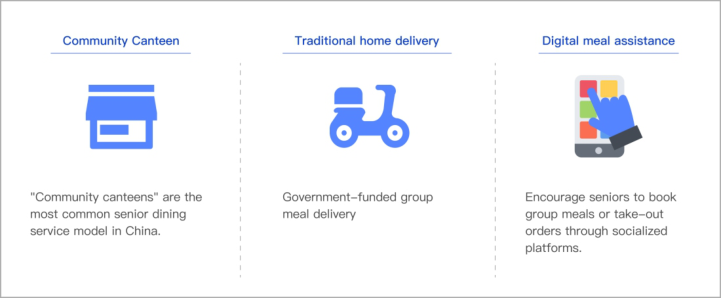
CURRENT SITUATION AND PROBLEMS OF MEALS-ON-WHEELS SERVICES FOR THE ELDERLY IN CHINA For caterers, the increasingly large elderly consumer group cannot be ignored. The silver hair catering market has a wide space, and the senior catering market is gradually moving towards segmentation (Zhukovska, A., 2020). Relevant surveys show that among various consumption expenditures, the elderly rank first in food category, accounting for 28%, and senior dining gets more attention from the market. At present, there are three models of mainstream elderly meal services in China (see Figure 1).
Community senior canteens are the most common senior dining service model in China, focusing on meeting the dining needs of the disabled, demen- ted and elderly(Wang, X. et al. 2020). As for the traditional meal delivery
Figure 1: Mainstream meal service models for the elderly in China.
service model, it refers to the government-sponsored group meal delivery, in which the homebound elderly register in advance with the community canteen service, and then the canteen service feeds the meal demand to the catering company, which cooks meals and delivers them one by one according to the established route.
However, the traditional meal service model can no longer meet the diversified and personalized needs of senior citizens. The use of digital tech- nology to empower the health and elderly industry has been a major trend (Haikio et al. 2010). Digitally-enhanced meal services encourage seniors to order take-out meals through socialized platforms. This model is also the popular one around the world (Kong, W. and Du, S., 2022).
There are many pains and difficulties in the existing elderly service model, and the situation of different groups of elderly people also provides the oppor- tunity for service design to intervene. Service design is a user-centered process that starts from certain needs and determines the content with the help of service design tools and methods. Through the design and integration of the whole process, the contact points at each level are clarified so as to improve the service quality and user experience (Zomerdijk et al. 2010). With the intervention of service design, the meal preparation and delivery process is standardized to integrate social resources and improve efficiency.
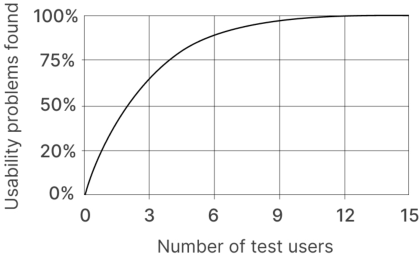
INSIGHT INTO THE DEMAND FOR MEAL ASSISTANCE FOR THE ELDERLY User research experts Nielsen, Landauer, et al. suggest that most or 80% of usability problems can be detected by testing the first five participants, and the probability of finding more problems after the fifth participant is much smaller (Nielsen, J., 1994). The relationship between the number of participants and the percentage of usability problems found is shown below (see Figure 2).
Due to the variability of aging users’ living habits, cultural backgrounds, physical conditions, and economic incomes, it is necessary to develop a tar- get user sample and use household semi-structured interviews to observe and
Design of a Home-Based Food Assistance Service for the Elderly 33
Figure 2: Number of interviewed participants in relation to the percentage of problems identified.
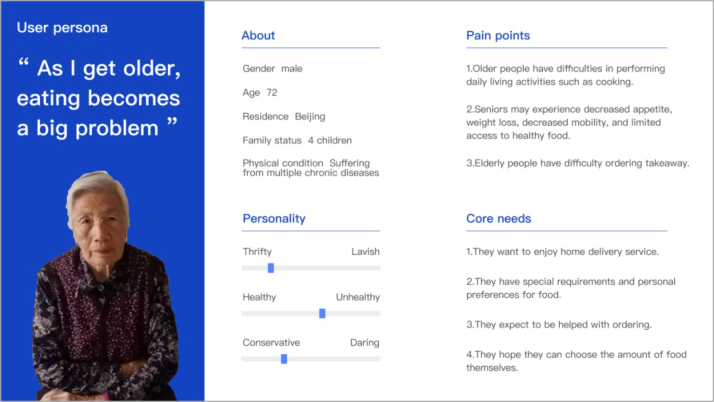
analyze the target users. In this study, a total of five aging users in a com- munity in Beijing were selected as the target user sample. Their age ranged from 65 to 85, and the common characteristics among them were that they adopt community aging in place, and all of them suffered from different types of chronic diseases. Based on the collected information, a user persona was constructed (see Figure 3).
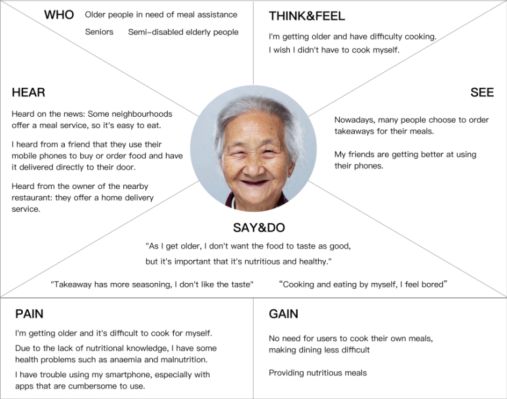
In addition, an empathy map (see Figure 4) was drawn to discover users’ deep motivation and real needs (Ferreira, B. et al. 2015). The key informa- tion was summarized as follows: the target users of this service are the elderly who have difficulties in cooking by themselves. Because of lacking nutritional knowledge, their diets do not meet the health standards, resulting in malnu- trition and various diseases. Besides, they have perceived the prosperity of the take-out industry and are eager to enjoy the home delivery service, elimi- nating the hard work of buying food, cooking and washing dishes. However,
Figure 3: User profile.Figure 4: Empathy map.
there are various take-out services in the market nowadays, and not all of them are suitable for older people.
CONSTRUCTION OF MEAL ASSISTANCE SERVICE SYSTEM Based on the user research, the design of elderly meal service should not only be planned on the basis of understanding users’ pain points, but also consi- der how to balance between uniform meal distribution and users’ individual needs. Therefore, from the perspective of service design of the whole chain, the community meal service will be organized and innovated in the timeli- ness of home delivery and personalization of nutritious meals, in order to create the excellent user experience from three aspects: overall community meal service, personalization of health records and intelligent meal ordering system (CAI, Y., 2015).
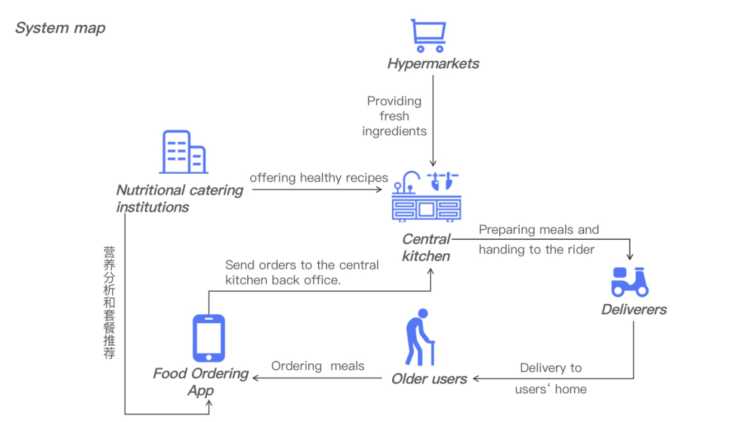
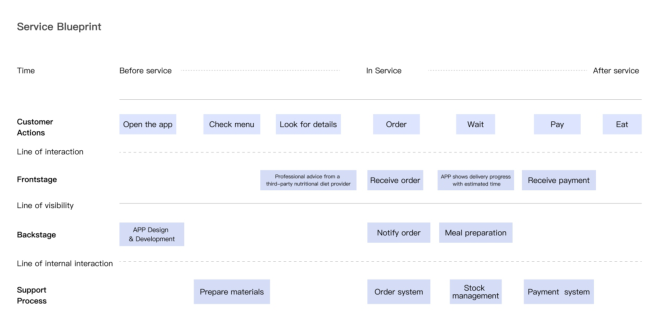
(1) Elderly meal service system construction The service system was built among users (empty nesters, senior citizens, disabled and semi-disabled elderly), operators (community properties, nei- ghborhood committee staff and volunteers), and supervisors (government, health supervision departments, and third-party nutrition assessment age- ncies). Service design tools were used to sort out stakeholders, contact points, services and processes (Yang, Z., 2021). And a system map (see Figure 5) was drawn as well as a service blueprint (see Figure 6) of the whole chain of service integration (Bitner et al. 2008).
In the process of meal service, firstly, users place orders on the ordering app, and the third-party nutritional dietary institution makes personalized meal recommendations based on users’ health status and personal informa- tion. Then, after purchasing fresh ingredients from large supermarkets, the central kitchen configures semi-finished products or cooks nutritious meals, which are then delivered to users’ homes by riders. The shopless operation
Design of a Home-Based Food Assistance Service for the Elderly 35
Figure 5: System map.Figure 6: Service blueprint.
mode directly connects users and products and delivers products from the central kitchen to consumers by building a take-out logistics system, thus realizing a closed-loop transaction (Vestbro, D. U., 1992).
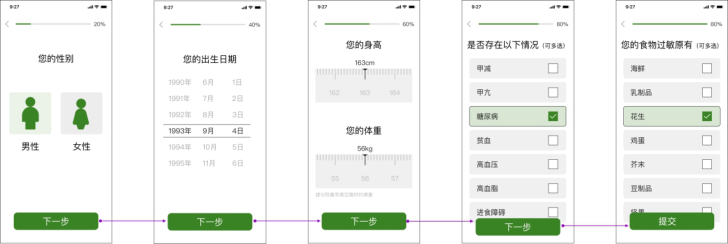
(2) Overview of the elderly meal service process After the service system is built, users can enjoy quality services through the APP. First of all, users enter basic body data, daily exercise consumption and medical checkups during registration and login, and the intelligent AI pre- cision algorithm carries out comprehensive professional analysis to form a quantitative meal plan (Cong, N. et al. 2021). The interface (see Figure 7) is shown below.
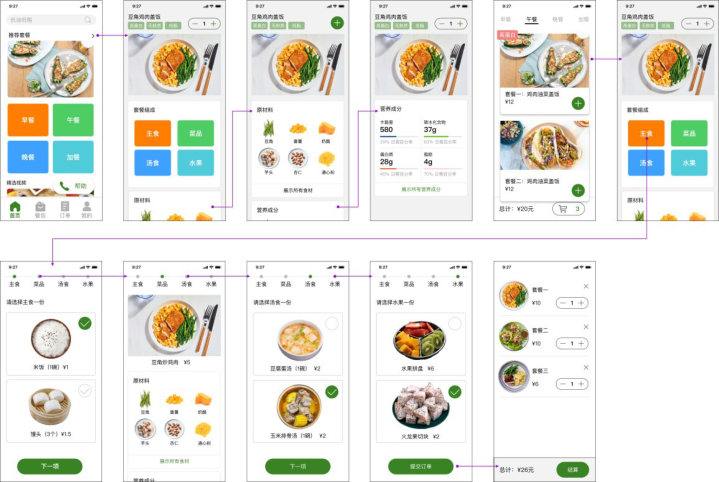
Based on the personal information, the system makes daily set recommen- dations for users, including staple foods, dishes, soups and fruits. Elderly
Figure 7: User information registration interface.
people can choose and match their own food packages and clearly see the health and nutrition data, easily enjoying customized nutritional meals (see Figure 8).
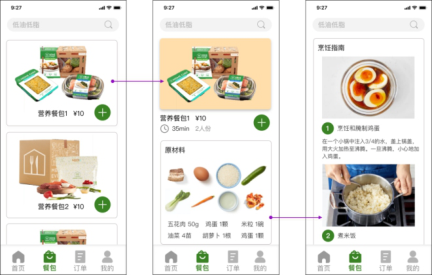
According to the research results, some people hope to buy semi-finished products to cook by themselves, so the product provides the service of deli- vering meal kits to their doors. By clicking on the picture, users can view the included raw materials and cooking guide. The interface design is shown below (see Figure 9).
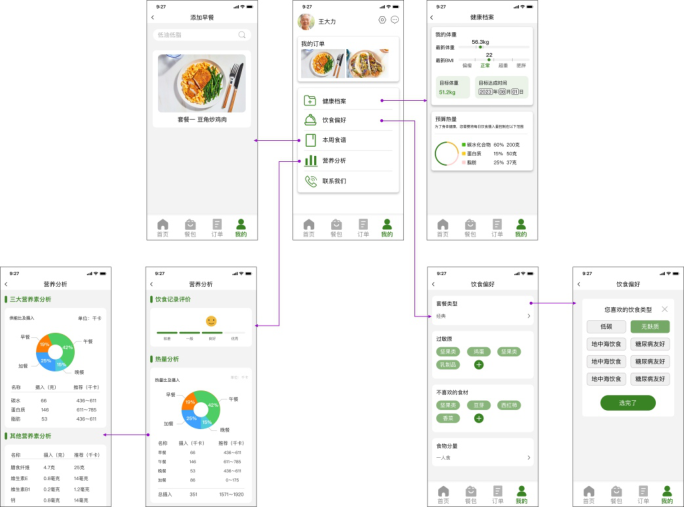
In the “Mypage” (see Figure 10), users can view their health profile, set dietary preferences, record recipes for the week, and get access to nutritional analysis of food intake.
Figure 8: User ordering interface.
Design of a Home-Based Food Assistance Service for the Elderly 37
Figure 9: User booking interface for meal packages.Figure 10: The interface of my page.
CONCLUSION
This paper takes the elderly people who rely on community aging in place as the research object, understands the current situation and problems of the elderly meal service in China through desktop research and in-home inte- rview, inspects the user needs, draws the user portrait and empathy map according to the interview results. Then, service design thinking is used to realize the cross-border combination of different systems, and the service blueprint and system map is built. Based on the results of user research, the interaction design of aging-appropriate meal ordering APP is carried out to help the elderly order meals easily and enjoy nutritious meals. The service system solves the problem of inefficiency in the traditional meal assistance
mode to a certain extent, differentiated from the existing take-away services in the market, conforms to the eating habits of the elderly and provides them with personalized meal choices. Undeniably, there are stills some problems with the system. Personalized service leads to increased costs, and whether elderly users are willing to pay for it remains to be verified. Another worry is that what if users refuse to provide personal information. Both of them are issues that need to be seriously considered in the follow-up study.
ACKNOWLEDGMENT
The authors are grateful for the support of the Study on Evaluation Index of Urban Environment Construction for Livable City for Old People in Beijing (Grant/Award number: 18YTA001).
REFERENCES
Bitner, M. J., Ostrom, A. L. and Morgan, F. N., 2008. Service blueprinting: a practical technique for service innovation. California management review, 50(3), pp. 66–94. CAI, Y., 2015. Senior dining system service redesign for Shanghai starcastle retire-
ment community. Cong, N., Zhao, A. and Gong, P., 2021. Food Delivery Platform: A Potential Tool for Monitoring the Food Environment and Mitigating Overweight/Obesity in China. Frontiers in Nutrition, 8, p. 703090. Du, P. and Wang, Y., 2016. Population ageing and the development of social care
service systems for older persons in China. International Journal on Ageing in Developing Countries, 1(1), pp. 40–52. Elsner, R. J., 2002. Changes in eating behavior during the aging process. Eating behaviors, 3(1), pp. 15–43. Ferreira, B., Silva, W., Oliveira, E. and Conte, T., 2015, July. Designing Personas with
Empathy Map. In SEKE (Vol. 152). Haikio, J., Wallin, A. and Isomursu, M., 2010. Digitally-enhanced services for the elderly. International Journal of Services Sciences, 3(2-3), pp. 232–249. Kong, W. and Du, S., 2022, November. Research on the Dilemma of Supplying Smart
Senior Care Meal Assistance Service and Countermeasures–Taking Daoli District of Harbin City as an Example. In 2022 International Conference on Sport Science, Education and Social Development (SSESD 2022) (pp. 33–43). Atlantis Press. Krings, M. F., van Wijngaarden, J. D., Yuan, S. and Huijsman, R., 2022. China’s Elder Care Policies 1994–2020: A Narrative Document Analysis. International Journal of Environmental Research and Public Health, 19(10), p. 6141. Liu, R. and Grunert, K. G., 2020. Satisfaction with food-related life and beliefs about
food health, safety, freshness and taste among the elderly in China: A segmentation analysis. Food Quality and Preference, 79, p. 103775. Moro, D., da Silva, J., Barbosa, R., de Sousa, F., da Silva, R., Zeni, R., Zannete, L. and Henrique, M., 2015. Dietary habits of older adults: a comparison between two distinct regions of Brazil (Southern and Northeastern). Clinical Nutrition and Hospital Dietetics, 35(2), pp. 26–34. Nielsen, J., 1994. Estimating the number of subjects needed for a thinking aloud test.
International journal of human-computer studies, 41(3), pp. 385–397.
Design of a Home-Based Food Assistance Service for the Elderly 39
Payette, H. and Shatenstein, B., 2005. Determinants of healthy eating in communitydwelling elderly people. Canadian Journal of Public Health/Revue Canadienne de Sante’e Publique, pp. S27-S31. Towers, A. L., Burgio, K. L., Locher, J. L., Merkel, I. S., Safaeian, M. and
Wald, A., 1994. Constipation in the elderly: influence of dietary, psychologi- cal, and physiological factors. Journal of the American Geriatrics Society, 42(7), pp. 701–706. Vestbro, D. U., 1992. From central kitchen to community cooperation: development of collective housing in Sweden. Open House International, 17(2), pp. 30–38. Wang, X., Liu, M., Li, Y., Guo, C. and Yeh, C. H., 2020. Community canteen services
for the rural elderly: determining impacts on general mental health, nutritional status, satisfaction with life, and social capital. BMC public health, 20, pp. 1–9. Yang, Z., 2021. E-Meal: A Food Delivery Platform for Seniors (Doctoral dissertation, Northeastern University). Zhou, J. and Walker, A., 2016. The need for community care among older people in
China. Ageing & Society, 36(6), pp. 1312–1332. Zhukovska, A., 2020. “Silver economy” as a resorce of inclusive development of the national economy. Herald of Economics, (3 (97)), pp. 37–53. Zomerdijk, L. G. and Voss, C. A., 2010. Service design for experience-centric services.
Journal of service research, 13(1), pp. 67–82.
LISTED IN THE AHFE DIGITAL BOOKSTORE CATALOGUE
Explore the complete digital volume
Human Factors in Aging and Special Needs
Read this individual research paper free through the original publisher, or explore the full digital proceedings book.
ISBN 978-1-958651-64-3
Explore this ISBN in the AHFE Bookstore ↗Listed in the July 2026 bookstore catalogue; search by ISBN to confirm current availability · Digital book purchase optional