Xiaodong Gong, Yang Yingxue, Yushun Liu, Qian Gong (2023). Interaction Design of Closed Dark Cabin Driving Interface based on Situation Awareness. In: Human Factors in Transportation. AHFE Open Access, vol. 95, pp. 60–70. https://doi.org/10.54941/ahfe1003792
Purpose: In a closed dark cabin driving environment, the lack of external environmental information leads to a low level of driver situation awareness. At the same time, the design quality of the vehicle terminal interface will directly affect the driver's situation awareness level during driving. Therefore, this study explores the design of the vehicle terminal interface in a closed dark cabin driving environment as an example, to improve the driver's perception of the environmental information outside the cabin and the ease of use of the interface. Methods: Through analyzing the constraints and special features of the dark cabin driving environment and the driver's information perception needs during driving, we explore the key factors affecting the driver's situation awareness and the pain points of interface design in the dark cabin driving environment, and on this basis, we develop a design method for the dark cabin environment driving interface to improve the driver's situation awareness by combining relevant design principles. The design method is based on user performance measurement, SART scale and other methods to extract indicators such as completion time, difference from standard time and situation awareness level of drivers to explore the effectiveness of the design method. Conclusion: Through the experimental findings, it can be proved that the design method will effectively enhance the driver's situation awareness, give full play to the vehicle performance, reduce the driver's workload during driving, and improve the system performance.
The closed dark cabin driving scenario is a driving scenario based on obse- rvation interaction interface that must be driven in the closed dark cabin environment due to various factors. After special vehicles enter the battlefi- eld environment, in order to prevent reconnaissance and protect the personal safety of passengers, it is necessary to drive in a closed dark cabin.
With the application of breakthrough observation technology and the development of integration of driving interface, the way of obtaining envi- ronmental information has shifted from periscope to system interface, and information interface is the main way for users to obtain environmental infor- mation (Wang Huichuan, 2012). However, in the closed dark cabin driving situation, due to the restriction and interaction of objective environmental
Interaction Design of Closed Dark Cabin Driving Interface Based on Situation Awareness 61
conditions, the direct driver will be physically, mentally and consciously active, resulting in a significant decline in the user’s cognitive efficiency (Liu Wei, 2004). Situational awareness is an important mechanism that affe- cts cognitive efficiency. Situational awareness in this environment is quite different from ordinary window-opening driving, which will lead to the lack of situational awareness (Wang Heping, 2010).
This design will first analyze the constraints and particularity of the envi- ronment, and then build an interface based on the needs of drivers, visualize the information as needed, propose a scheme for special vehicles to improve situational awareness, and guide the summary of the interface design methods under such environment.
Overview of Situational Awareness Situational cognition was first proposed by the United States Air Force in the 1980s. It refers to people’s perception of a dynamic environment or their perception and understanding of “what is happening”, and then predicts the changes that will occur in the future. Its most representative research was proposed by Endsley (Endsley M. R., 1999).
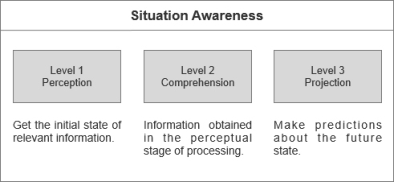
In 1988, Endsley pointed out that situational cognition is a complete pro- cess in which people perceive different elements in a dynamic environment within a certain time and space, understand their internal meaning, and pre- dict the situation that will happen (Endsley M. R., 2001). In the subsequent research, Endsley proposed a classic three-layer model, as shown in Figure 1.
Endsley established a three-level model: perception stage, understanding stage and prediction stage. Detailed analysis of the three-level model of SA. The goal of the perception layer is to let users purposefully understand and extract key information, mainly the driver’s reading and perception of the information of the interactive interface. The second is the understanding level. The goal is to let users process information. The influencing factors include memory, experience and mental model. The last is the prediction layer, which is to expect the driver to predict the future dynamic environment and behavior.
Application of Situational Awareness in Interaction Design Through the co-occurrence analysis of the existing literature keywords rela- ted to the closed cockpit interface, it is found that its research in the direction
Figure 1: Endsley’s three-level model of situational awareness.
of human-computer interaction is mainly focused on the research of the factors affecting the cockpit human-computer interface, such as the impact mechanism of the interface on the driver’s psychology and physiology, the research of the interface interaction mode, such as the design and applica- tion of multimodal interaction in the cockpit environment, and the research of evaluation indicators. It involves fusion perception, open architecture, virtual/augmented reality, digital graphics and other key technologies.
However, few studies have explored how the cockpit human-computer interface design affects the driver’s situational awareness level in the closed dark cabin environment from the perspective of situational awareness the- ory, so as to guide the interface design optimization. Therefore, the article will combine the SA three-level model to disassemble the environmental pain points and the needs of drivers, so as to improve the design of situational awareness.
ANALYSIS OF SITUATIONAL AWARENESS OF CLOSED DARK CABIN DRIVING Constraints on the Driving Interface of Special Vehicles
In the closed dark cabin situation, the pilot mainly observes the screen inter- face and interaction, which will be affected by the objective environmental conditions and interaction forms.From the perception level, the driver needs to perceive a lot of information such as speed, distance, and external environ- ment information. At this time, if the interface design can not provide a good way to present information, it will need to occupy a lot of brain resources. At the understanding level, it is necessary to focus on the driver’s immersion and understanding of information. At the prediction level, drivers are expected to predict such as road type, road condition, distance and driving plan.
In general, there are several main constraints in the closed dark cabin environment:
1) Weak external perception and observation, weak situational awareness: unlike passenger cars, it cannot directly observe the external environ- ment, lacks reference to real things, and has weak external perception. 2) Darkroom environment: the lack of light for closing windows and the need for long-term operation and other problems lead to driver fati- gue, lack of situational awareness, low cognitive efficiency and other problems. 3) The information content is complex and changeable: the system inter- face information types are more and more complex than passenger cars. Situational awareness is very important and closely related to the visual presentation and mechanism of the system.
Driving Scenario and Design Objectives The driver’s processing of information mainly includes four independent pro- cessing stages: identifying the front vehicle, understanding the front vehicle status, judging/predicting the subsequent status of the front vehicle and the
Interaction Design of Closed Dark Cabin Driving Interface Based on Situation Awareness 63
Figure 2: Cognitive structure model of car-following driver.
Figure available in the original PDF paper.
rear vehicle decision (Jia Hongfei, 2005), as shown in Figure 2. The core ele- ments that drivers pay attention to in the whole driving task are environment (including road conditions), speed and distance. So when these three elements are not fully perceived, understanding the driving situation will naturally be missing. Focus on the driver’s most important viewing needs for informa- tion when driving, which is usually related to driving safety and task. When driving, you need to read relevant contents such as speed, distance from the vehicle in front, route, environment, driving safety, etc., and when dri- ving, you need to understand the driving task, completion degree and other information.
This research is designed and verified based on improving the distance situ- ational awareness of the pilots in closed dark cabin. Aiming at the display and control information product of a special vehicle driving in closed dark cabin, explore the solution to the problem of driving in closed dark cabin, and strengthen the situational awareness of the system operator. The target user is the driver who uses the closed dark cabin driving interface. With spe- cial vehicle display and control screen as the main part, the user’s goal is to strengthen situational awareness.
DESIGN OPTIMIZATION OF CLOSED DARK CABIN DRIVING Situational Awareness: Distance Perception
Driving situational awareness is the core concern that affects the driving of drivers in closed dark cabin. Their driving situational awareness can be divi- ded into distance perception, speed perception and environment perception. This research mainly focuses on how to strengthen the distance perception of pilots in the closed dark cabin.
Distance perception means that the judgment of passenger cars on distance is mainly based on the glass of the left and right driving positions, and the distance is judged by the visual perception of other vehicles/objects, while the closed dark cabin vehicles have no visual window observation, so at this time, it is necessary to increase the interface distance value display and provide more driving perspective image return to strengthen the perception.
Strategies to Strengthen Distance Situational Awareness: Visual Processing Generally speaking, in the first stage of perception of layout and interface, we should focus on strengthening the driver’s situational awareness in the design, and strengthen the driver’s immersion in every design detail. The reinforcement of immersion in the layout is to abandon the parallel layout
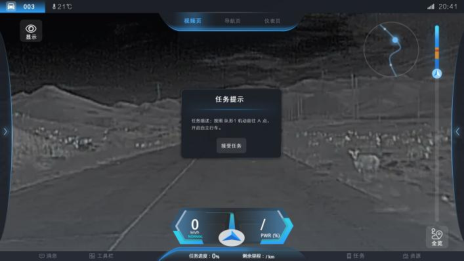
and adopt the through-type layout; On the system, we should strengthen immersion, focus and reduce visual pressure, which is reflected in color, font size, information level, etc. HUD and auxiliary dynamic effect forms are used in dynamic effect enhancement reference enhancement perception; In terms of elements, it helps the driver to quickly understand the situation, and the icon replaces the text and distinguishes similar elements. The system design example is shown in Figure 3.
Distance judgment is one of the key factors of the situational awareness of the pilot in the closed dark cabin. This design focuses on how to streng- then the situational awareness of the pilot’s distance perception on the basis of ensuring that other factors are consistent with the enhanced situational awareness. In terms of strategy, various visualization forms, such as data visualization and color visual grading, are used to visualize key information.
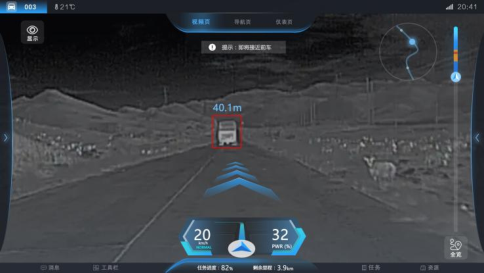
(1) Early warning When the relevant vehicle or object is approaching the safe distance (less than 50m), the text prompt will be displayed in the center of the interface in advance to give the driver psychological expectation in advance, as shown in Figure 4.
(2) Visualization of critical distance When the external object approaches or is about to approach the safe distance, the interface will give different colors of visual marking prompt;
Figure 3: Closed cockpit pilot interface - task acceptance.Figure 4: Distance early warning.
Interaction Design of Closed Dark Cabin Driving Interface Based on Situation Awareness 65
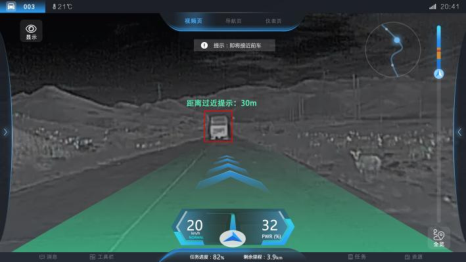
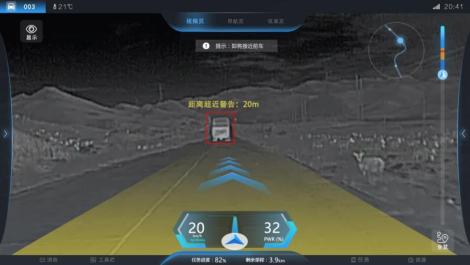
Helping the driver to intuitively perceive the distance between vehicles and quickly judge the distance warning situation. The specific design strategy is as follows: When the distance between the surrounding vehicles/obstacles is less than 30 m from the vehicle, the screen will display a green light beam and a value mark, indicating “too close prompt+distance value”, as shown in Figure 5;
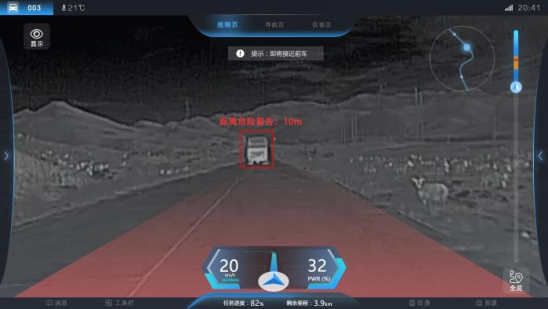
When the distance between the surrounding vehicles/obstacles is less than 20 m from the vehicle, the screen will display a yellow light beam and a value mark, indicating “distance value+distance over-close warning”, as shown in Figure 6; When the distance between the surrounding vehicles/obstacles is less than 10m from the vehicle, the screen will display a red beam and a value mark, indicating “distance value+distance hazard warning”, as shown in Figure 7;
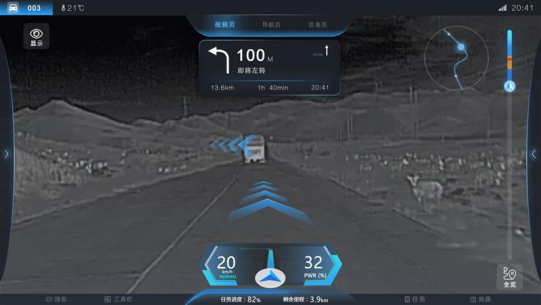
(3) Marking of key decisions (direction, etc.) When the driver is driving the car, there are some key decision-making stages, early warning and marking help to judge.
When the vehicle is less than 100m away from the left/right turn interse- ction, the screen will display a left/right turn prompt, indicating “about to turn left/right”; When deviates from the queue/yaw, the screen will display the yaw/depar- ture prompt, indicating “You have yaw” and giving the correct route.
Figure 5: Prompt for too close.Figure 6: Near warning.Figure 7: Distance hazard warning.Figure 8: Distance hazard warning.
EXPERIMENTAL DESIGN AND DESIGN EVALUATION Preparation Before Experiment
The experimental design scheme and equipment are as follows.
Table 1. Preparation of experimental equipment.
Table available in the original PDF paper.
Experimental apparatus Test Laptop Display pixels 1920 px * 1080 px, 15.6 inches Data acquisition software Axure file Testing environment The indoor lighting condition is dark, and the illumination is 150 lx Attitude of the subject The posture operation interface of sitting posture, the subject is 50cm away from the display
Interaction Design of Closed Dark Cabin Driving Interface Based on Situation Awareness 67
Experimental Design Scheme Test Object Among the test users, 37 drivers with driving experience and 3 system desi- gners were selected. The subjects had no color blindness, no color weakness, and no less than 5.0 corrected vision, and had not been exposed to experi- mental materials before. A total of 40 people were divided into experimental group 1 (without a design treatment scheme) and experimental group 2 (with a design treatment scheme), with 20 people in each group.
Evaluation Indicators Subjective evaluation data. The SART scale is used to collect two groups of samples from the subjects for comparison, which is one of the indicators to measure the efficiency of the subjects’ situational awareness.
Performance evaluation data. Based on the experimental task flow, the difference between the task execution completion time and the operation time and the standard time is taken as one of the indicators to measure the user’s situational awareness.
Experimental Process Comparative sample 1 of this experiment: the original driving interface (with- out visual processing); comparative sample 2: the optimized driving interface (with visual processing). The experimental design mainly includes three parts.
Part 1: Pre-experiment process description. Part 2:The main test process is as follows: (1) Accept the driving task, prompt autonomous driving and play the driving video. (2) Judge whether the distance between the car in front and the car is equal to 30m. When confirming, press the K key, which represents the deceleration operation and is recorded as T1. (3) Judge whether the distance between the car in front and the car in front is equal to 20m. When confirming, press the J key, which represents the deceleration operation again and is recorded as T2. (4) Judge whether the distance between the car in front and the car is equal to 10m. When confirming, press the L key, which represents the brake operation and is recorded as T3. Inform the subjects that the test task is over.
Part 3: Fill in the SART scale. Objectively evaluate your feelings during operation.
Experimental Data and Results After each subject completed the task, the operation process was objectively evaluated. For this Overall SART score, the mean value of the subdimensions associated with the three main categories (Demand, Supply, and Understan- ding) were first calculated, and then the SA(calc) algorithm was applied to these means to obtain the single numerical Overall SART score.The calculation formula is:
Experimental group 1 11.71s 2.04s 2.75s 0.38s 0s 0.10s 6 Experimental group 2
Exact time 11.33s 2.04s 2.65s / / / /
It can be seen from Table 2 that the difference between the operation time and the standard time: experimental group 2 adopts the scheme with visual design, and the completion time of three tasks T1, T2 and T3 is 11.71s, 2.04s and 2.75s respectively. The group 1 adopted the initial design scheme. The completion time of the three tasks was 7.35s, 3.68s and 3.32s respectively. The actual standard time nodes were 11.33s, 2.04s and 2.65s respectively.
The error of the three data from the standard time in group 1 is signifi- cantly greater than that in group 2. The operation accuracy of group 2 is significantly better than that of group 1, and the distance perception brought to the driver is significantly more accurate. It can be seen that the optimi- zed design scheme effectively strengthens distance perception in situational awareness.
Comparison of situational awareness level: Through the SART scale test, the average situational awareness of group 2 was significantly higher than that of group 1.
To sum up, the optimized design scheme effectively enhanced the subject’s situational awareness.
CONCLUSION
This design focuses on strengthening the situational awareness of drivers in closed dark cabin, analyzing the key factors affecting situational awareness, and combining the driving environment and hardware constraints of special vehicles to make interactive interface design optimization. In the interactive design of the closed dark cabin interface, we should focus on strengthening the driver’s situational awareness, strengthening the driver’s sense of immer- sion from each design detail, and strengthening his perception of distance judgment.
In general, the existing research on situation information elements is mostly focused on the situation information elements themselves and is rarely combined with interaction design and actual operational require- ments. Secondly, the current situation of situational awareness research is still dominated by technology, models and other links, and the research on streng- thening driver’s situational awareness also needs to be improved urgently.
ACKNOWLEDGMENT
The authors are grateful for the support of the Study on Evaluation Index of Urban Environment Construction for Livable City for Old People in Beijing (Grant/Award number: 18YTA001).
Interaction Design of Closed Dark Cabin Driving Interface Based on Situation Awareness 69
REFERENCES
Antrobus V, Burnett G, Krehl C. Driver-passenger collaboration as a basis for humanmachine interface design for vehicle navigation systems[J]. Ergonomics, 2017, 60(3): 321–332. Endsley M, JonesW. A model of inter and intrateam situation awareness: Implications
for design, training and measurement[J]. New Trends in Cooperative Activities, 2001. Endsley M. R., Praphrcul G. Supporting situation awareness in aviation systems[J].
british journal of occupational therapy, 1999, 5(62): 131–135. Gong Xiaodong, Gong Qian, Liu Yushun, etc Research on interactive design strategy of radar information view based on cognitive load theory [J] Packaging Engineering. Jia Hongfei, Jun Zhicai, Cao Peng Establishment of driver cognitive structure model
in the process of car-following [J] Highway Transportation Technology, 2005, 22 (11): 130–132. DOI: 10.3969/j.issn.1002–0268.2005.11.033. Li Lanping, Guo Xiuyuan Research on the design of human-computer interaction interface outside autonomous vehicle [J] Packaging Engineering, 2020, 41 (2): 57–64. Liu Wei, Yuan Xiugan, Liu Zhongqi, et al. Comprehensive evaluation index and
method of human-computer display/control interface adaptability [J] Chinese Journal of Safety Science, 2004, 14 (4): 32–35. Livingston, M. A. ; Ai, Z.; Karsch, K.; Gibson, G. O. User interface design for military AR applications[J].arXiv, pp. 10–20. April 2019. Mao Hui Analysis of control system in special vehicles [J] Volkswagen, 2015 (4):
98–98. DOI: 10.3969/j.issn.1006–9836.2015.04.068. Merenda C, Hyungil K, Tanous K, et al. Augmented reality interface design approaches for goal-directed and stimulus-driven driving tasks[J]. IEEE Transactions on Visualization and Computer Graphics, 2018, 24(11): 2875–2885. Park, D.; Yoon, W. C.; Lee, U. Cognitive States Matter: Design Guidelines for Driving
Situation Awareness in Smart Vehicles[J]. Sensors 2020, 20, 2978. Pedersen T, Johansen C, Josang A. Behavioural Computer Science: an agenda for combining modelling of human and system behaviours[J]. Human-centric Computing and Information Sciences, 2018, 8(1). Qiang Yong, Gou Heng, Wang Yonggang. Progress in target recognition technology
of battlefield perception system [J]. Fire Control Radar Technology, 2008, 37 (1): 1–9. DOI: 10.3969/j.issn.1008–8652.2008.01.001. Sato T. Human Interface Design in Transition from Automated Driving to Manual Driving[J]. SID Symposium Digest of Technical Papers, 2018, 49(1): 819–822. Shen Liangqiang, Liu Jian, Ren Yu, et al. Research on key technologies of complex
position situation visualization [J]. Fire and Command and Control, 2019, 44 (7): 147–150. DOI: 10.3969/j.issn.1002–0640.2019.07.028. Sun M, Yu H. Automobile intelligent dashboard design based on human computer interaction[J]. International Journal of Performability Engineering, 2019, 15(2): 571–578. Tao Da, Cai Jian, Zhang Xu, etc Impact of information element design on visual
search in shaking environment [J] Journal of Shenzhen University (Science and Engineering Edition), 2019, 36 (04): 440–446. Tavakoli A, Kumar S, Guo X, et al. HARMONY: A Human-Centered Multimodal Driving Study in the Wild[J]. IEEE Access, 2021, 9: 23956–23978. Wang Heping, Xue Hai, Li Rongli, etc Assessment of the impact of the interior envi-
ronment of armored vehicles on the combat effectiveness of passengers [J] Fire and Command and Control, 2010, 35 (6): 39–42.
Wang Huichuan, Zhao Xiaozhe. Overview of human-machine interface development of naval gun weapon system [J]. Command, Control and Simulation, 2012, 34 (2): 1–4. Xiao Shenglong, Shi Zhangsong, Wu Zhonghong. Concept and technology of
battlefield situation awareness under modern information conditions * [J]. Ship Electronics Engineering, 2014, (11): 13–15138 DOI: 10.3969/j.issn1672- 9730.2014.11.004. Yang H, Wang Y, Jia R. Dimensional Evolution of Intelligent Cars Human-Machine Interface considering Take-Over Performance and Drivers’ Perception on Urban Roads[J]. Complexity, 2020, 2020. Yang Song, Yang Qiang, Yang Chaohui, et al. Context-based battlefield situational
awareness interface model [J]. Command, Control and Simulation, 2017, 39 (2): 81–84 DOI: 10.3969/j.issn.1673–3819.2017.02.016. Yourui T, Bochen J. An Augmented-reality-based Warning Interface for Pedestrians: User Interface Design and Evaluation[J]. Proceedings of the Human Factors and Ergonomics Society Annual Meeting, 2019, 63(1): 1834–1838.
LISTED IN THE AHFE DIGITAL BOOKSTORE CATALOGUE
Explore the complete digital volume
Human Factors in Transportation
Read this individual research paper free through the original publisher, or explore the full digital proceedings book.
ISBN 978-1-958651-71-1
Explore this ISBN in the AHFE Bookstore ↗Listed in the July 2026 bookstore catalogue; search by ISBN to confirm current availability · Digital book purchase optional