Marina Weck, Sonja Kedonperä, Markus Sihvonen (2023). Customer-Oriented Service Innovation Grounded in Data-Driven Decision-Making: A Readiness Assessment Framework. In: Human Factors, Business Management and Society. AHFE Open Access, vol. 97, pp. 200–209. https://doi.org/10.54941/ahfe1003896
In the current increasingly competitive and technologically advanced market, significant opportunities to develop service innovations can be realized by utilizing data-driven decision-making (DDDM), which has been widely recognized as an effective means of making decisions that are more informed and based on evidence. Service innovation (SI) grounded in DDDM, or data-driven service innovation (DDSI), refers to integrating data-driven thinking or simply the use of data into the SI development process. However, the large variety of data available for organizational use creates pressure to achieve the capabilities necessary to obtain high-quality and time-sensitive data from internal and external sources, while also organizing and analyzing it properly. These capabilities present a particularly significant challenge for many firms seeking growth by triggering customer-oriented SI. Hence, firms must systematically evaluate the maturity level of their capabilities, enabling effective customer-oriented SI grounded in DDDM. This study sought to establish an approach to assess a firm’s readiness to implement customer-oriented DDSI and to explore the capabilities imperative for its implementation. Based on a theoretical analysis, a readiness assessment framework for customer-oriented DDSI was conceptualized by adopting a process view and utilizing the Business Process Maturity Model (BPMM) for the maturity assessment of the key capabilities identified, including DDDM. With a well-established framework, this study proposes a practical guide for firms looking to implement a customer-oriented SI grounded in DDDM.
The current competitive and technologically advanced market is characte- rized by demanding customers and a rapidly growing need for customer- oriented and innovative services. Service innovation (SI) is therefore widely acknowledged as an important activity for both service and traditional manufacturing firms (Kindström et al., 2012). Innovative services can only be developed if firms have the set of capabilities required for innovation (Laforet, 2011), as they provide the basis for sustained competitiveness by differentiating firms from competitors and by adding value to their customers (den Hertog et al., 2010).
Customer-Oriented Service Innovation Grounded in Data-Driven Decision-Making 201
When firms seek growth in triggering customer-oriented SI, significant opportunities for that matter can be realized by utilizing data-driven decision- making (DDDM), defined as an effective method of making decisions that are more informed and based on evidence, instead of relying on intuition and experience (e.g., Thiess et al., 2018; Brynjolfsson et al., 2011). Therefore, it is imperative for firms to assess and improve their readiness continuously to ensure they can support and nurture SIs that offer customers new value pro- positions with advances in DDDM. However, DDDM, which enables the use of digital data and analytics within the decision-making process, presents a particularly significant challenge for many firms and is considered an area in need of significant changes and advancements (see Jia et al., 2015). Though new technologies can collect more data than ever before, small and medium- sized enterprises (SMEs) in particular lack an understanding of the data, of data analytics, and of the expertise and tools required to analyze data (e.g., Iqbal et al., 2018; Parra et al., 2019). Thus, decision- making based on the experience and intuition of managers rather than on knowledge extracted from data is still a common practice (e.g., Järvenpää et al., 2023).
Despite increasing recognition of the importance of SIs and the capabili- ties enabling them, there is a lack of management frameworks that offer a practical guide for firms (e.g., Gryszkiewicz et al., 2013). In addition, the related literature is largely fragmented, or it proposes different approaches and definitions, leading to significant confusion and knowledge gaps (Walsh et al., 2009; den Hertog et al., 2010). Rather limited research has dealt expli- citly with the assessment of firms’ readiness to implement customer-oriented SI grounded in DDDM and has provided limited guidance for its implemen- tation. In this paper, SI grounded in DDDM, or DDSI, refers to the ability to integrate data-driven thinking or simply the use of digital data and analytics into the SI development process.
The study sought to explore the following two topics: (a) a firm’s readiness to implement customer-oriented DDSI and (b) the key capabilities enabling its implementation. The overall aim was to conceptualize a framework that can provide guidance for firms in the assessment of their readiness to implement customer-oriented DDSI.
Based on a theoretical analysis, we conceptualized a customer-oriented DDSI readiness assessment framework by exploring the process of developing customer-oriented SI and its phases, while simultaneously reviewing the capa- bilities that enable the process, including DDDM. Next, we proceeded with adapting the BPMM for a maturity measurement of customer-oriented DDSI capabilities, focusing specifically on DDDM. The result was well-established elements of a customer-oriented DDSI readiness assessment framework and the achievement of explicit alignment among them.
DEVELOPING A CUSTOMER-ORIENTED DDSI READINESS FRAMEWORK The rising customer demand for individualized experiences and interactions is causing a shift in focus from product innovation to SI (e.g., Barrett et al., 2015). The following definition explicates the SI concept well:
A service innovation is a new service experience or service solution that consists of one or several of the following dimensions: new service concept, new customer interaction, new value system/business partners, new reve- nue model, new organizational or technological service delivery process (den Hertog et al., 2010, p. 494).
Distinct phases must be followed when designing, planning, and develo- ping SI in individual firms (e.g., Gustafsson & Johnson, 2003; Ojasalo et al., 2015), and in all phases of the SI process, customer engagement is of increa- sing importance (e.g., von Hippel, 1986; Griffin & Hauser, 1993; Magnusson et al., 2003; Sandén et al., 2006), as any “service depends on people, human behavior, human cognition, human emotions, and human needs” (Maglio, 2015, p. ii). DDSI has received significant attention in recent research (e.g., Blöcher et al., 2020; Engel & Ebel, 2019; Rizk et al., 2017; Schymanietz et al., 2022), particularly explorative DDSI, which uses data and analytics to identify opportunities, such as customer needs, trends, or ideas for new advanced services throughout the entire SI process (Lusch and Nambisan, 2015; Urbinati et al., 2018). In this paper, customer-oriented DDSI refers to a development process by which a firm utilizes its resources and capabilities, including DDDM, to create a new or advance an existing service through strong interaction and collaboration with customers.
Data-Driven Decision-Making Capability Firms engage in decision-making every day, and it is often based on both data and experience (Provost et al., 2013). However, DDDM has become increasingly popular in recent years due to the growth of digital data availa- bility and advancements in technology that make it easier for data analysis and management. According to Ackoff (1989), data, information, and know- ledge form a sequence in which data are transformed into information and, in the end, into knowledge that can be used in decision-making. In this regard, using data and analytics allows firms to make informed decisions based on evidence and facts, rather than based on intuition, experiences, or feelings. In contrast to traditional decision-making, which mainly uses previous expe- riences, DDDM uses data science, data processing, and data engineering to make a decision (Thiess et al., 2018; Provost et al., 2013). This capability can lead to decisions that are more accurate and based on evidence, and it can support firms in making better use of their data assets.
In this paper, capability generally refers to the ability or capacity of a firm to perform a specific task or function; thus, the following definition of DDDM capability, proposed by Jia et al. (2015, p. 6), is adopted: “the abi- lities of an organization to utilize data, information, and insight assets in a series of coordinated decision-making processes in order to support, inform, or make decisions.” Firms are gradually realizing the importance of DDDM capability, enabling them to make a good use of data, analytics, and con- temporary technologies in all their functions and processes, as well as when seeking growth by triggering customer-oriented SI. However, regardless of the acknowledged importance of DDDM capability, it should not replace human
Customer-Oriented Service Innovation Grounded in Data-Driven Decision-Making 203
judgement, experience, and other capabilities entirely, but rather complement them and provide additional insights.
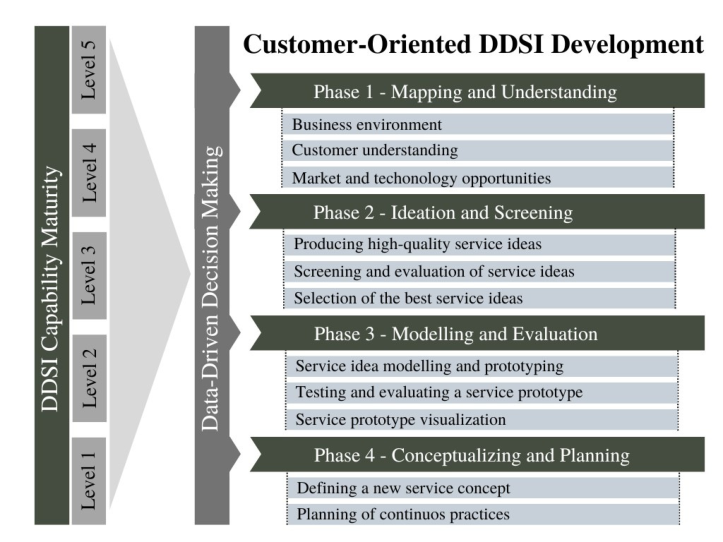
Development Phases and Capabilities The process view, which implies a structured approach to the understanding of customer-oriented DDSI development and its phases, was adopted for the purpose of this study. The following four phases were defined based on the insights obtained from the literature review on customer-oriented SI (e.g., Gustafsson & Johnson, 2003; Leiponen, 2005; Ojasalo et al., 2015): phase 1 – mapping and understanding, phase 2 – ideation and screening, phase 3 – modelling and evaluation, and phase 4 – conceptualizing and planning. The key capabilities identified to enable customer-oriented DDSI are briefly discussed in relation to each development phase.
Phase 1 – Mapping and Understanding Mapping future changes in the business environment and understanding customer needs and desires are key to building sensing capability for SI (Oja- salo et al., 2015), and it involves the proactive identification and analysis of the symptoms of these coming changes, as well as potential trends and disru- ptions that may impact a company. Environmental monitoring and scanning are essential for detecting social, economic, and technological changes; predi- cting their future development (e.g., Bell, 2009); and responding proactively to external impacts.
Having a good understanding of customer needs and desires is particu- larly critical for SI (e.g., Alam & Perry, 2002), and this involves gathering information about customer preferences, behavior, and feedback to identify opportunities for service improvements. This can be done through a variety of methods, such as surveys, focus groups, interviews, and customer analy- tics. A significant amount of knowledge is also embedded in firms internally, including knowledge about their products and services, production proces- ses, customer relationships, and internal operations, and management should facilitate the sharing and reuse of this knowledge among firms (e.g., Alavi & Leidner, 2001; Žitkien˙e et al., 2015). An understanding of what knowledge must be collected and compiled is essential to success in the later phases of the process and should be evaluated in terms of what knowledge is relevant, reliable, and valuable (Nielsen, 2006).
Phase 2 – Ideation and Screening The main goal of this phase is to generate and screen a diverse set of innova- tive ideas to determine the most promising ones. Ideation typically involves brainstorming, research, and idea generation techniques to produce many potential ideas, and for this purpose, collaboration with various stakeholders, including customers, partners, suppliers, competitors, and research organiza- tions is of utmost importance. The contribution of customers is particularly important at this phase of the SI process, and they should be treated like partners (Alam & Perry, 2002). Firms that maintain close collaboration with different partners are more likely to develop innovation capabilities (Faria
et al., 2010; Mention, 2011), which implies a specific capability of maste- ring and exploiting collaborative innovation networks, requiring constant interaction, openness, and dynamism. High-quality service ideas are produ- ced diversely from different perspectives, which requires cross-functionality (Alam & Perry, 2002) and heterogeneity (Ojasalo et al., 2015) among firms’ innovation teams. The quality of a service idea should be considered accor- ding to its feasibility, viability, and desirability, which, respectively, signify whether it is possible to implement the idea in the near future, whether it is a sustainable business, and whether it makes sense in mind and use (Brown, 2009).
Phase 3 – Modelling and Evaluation Modelling new service solutions early helps in evaluating their true value for the customer and for the firm before large amounts of resources are used for actual implementation. Through experimentation and prototyping, firms may build knowledge, as well as extend their existing and build new capabilities (Choo, 2001). This phase involves prototyping and testing with customers to gather feedback and to identify any issues needing address. The methods in use are visualization, simulation, and experimentation, by which new ideas will be concretized and tested. Narrative means are also required because of the intangible nature of the service (Ojasalo et al., 2015). Prototy- pes help to ground the change, move from analytical to experiential, and test the service experience rapidly (Polaine et al., 2013), and these include physi- cal objects, models, or simulations for concept and context exploration and stakeholder communication (Meroni & Sangiorgi, 2011). Further, documen- ting and learning from failed and successful SI efforts are both essential to determine where improvements are needed (den Hertog et al., 2010).
Phase 4 – Conceptualizing and Planning The conceptualization and planning phase comprises the final definition of the service concept and the plan for the continuous evaluation, monitoring, and development of the new service. A shared understanding of the new service is important to succeed; therefore, as a concept, it should be preci- sely defined (Ojasalo et al., 2015), for example, by utilizing business model elements, such as value proposition, target customers, distribution channels, relationship management, value configuration, core capabilities, partnersh- ips, cost structures, and revenue streams (Osterwalder, 2004). Feedback received from users is also critical for the final assessment of the concept, based on which the decision to implement or reject the service is made. In addition, the concept definition of a new service may also include a compre- hensive plan for integrating the service into the firm’s operations, strategy, and assumed focus group of the service (den Hertog et al., 2010). It is impor- tant for a development team—set up for this specific purpose—to plan the implementation, monitoring, and further development of the new service with redefined key performance indicators (KPIs).
Customer-Oriented Service Innovation Grounded in Data-Driven Decision-Making 205
Capability Maturity Model for DDSI The initial Capability Maturity Model (CMM) was developed to address the problems in software development processes and to evaluate the capability of software organizations (Paulk et al., 1995), providing the basis for other maturity models. These include the Capability Maturity Model Integration (CMMI) supporting organizations to assess and improve systematically their process capabilities across every industry (CMMI Product Team, 2002), and the Business Process Maturity Model (BPMM), which concerns the capabi- lities of business processes and is applicable to a broad range of domains, including the BPMM for Service Operations (Object Management Group [OMG], 2008).
In this study, the five capability levels of BPMM were adopted in the development of a maturity model for assessing customer-oriented DDSI capa- bilities, with a specific focus on DDDM, which implies the use of data and analytics in decision-making across all phases of the customer-oriented DDSI development process. The developed maturity model for the key capabilities of customer-oriented DDSI is introduced in Table 1.
Readiness Assessment Framework for Customer-Oriented DDSI The proposed customer-oriented DDSI readiness assessment framework is based on the process view and BPMM, which are utilized in the assessment of key capabilities, with a specific focus on DDDM in each phase of DDSI development. The conceptual framework provides the basis for a practical tool that can help firms assess their readiness to implement customer-oriented DDSI by identifying key capabilities and determining areas for improve- ments to become more customer- focused and innovative. Figure 1 depicts the proposed framework.
Table 1. Maturity model for capabilities required for DDSI (adapted from OMG, 2008).
Table available in the original PDF paper.
Maturity levels Descriptions Level 5 – Innovating Continuously improving tasks: continuous self-learning from KPI measures to improve effectiveness proactively, with predictive analytics for DDDM Level 4 – Predictable Quantitatively managed practices: quantitative measures (KPIs) are used to monitor and control practices against the plan and to adjust when it is needed based on fully adopted DDDM Level 3 – Established Defined practices: practices performed and maintained in a standardized way by defining and controlling each with systematic DDDM support Level 2 – Performed Performed practices: practices performed (i.e., planned, monitored and adjusted) mostly in an intuitive manner, lacking optimal methods for DDDM Level 1 – Initial Ad-hoc tasks: most tasks are performed ad hoc (i.e., in an unpredictable, poorly controlled, and reactive way) without any initiative to engage in DDDM
Figure 1: Readiness assessment framework for customer-oriented DDSI.
CONCLUSION
In compliance with the overall aim of the study, this paper presents a conce- ptual framework that provides guidance to firms in the assessment of their readiness to implement customer-oriented DDSI. The main constructs of the customer-oriented DDSI readiness framework were derived from a thorough review of the customer- oriented SI literature, with an emphasis on SI and DDDM capabilities. The framework was established by adopting the pro- cess view of DDSI development and utilizing the BPMM for the maturity assessment of the identified key customer-oriented DDSI capabilities.
The study makes three primary contributions to theory and practice. First, the proposed conceptual framework provides the basis for a straightforw- ard, practical tool that can be utilized to assess firms’ readiness to implement customer- oriented DDSI. Second, the framework offers firms a compre- hensive roadmap for becoming more customer-focused and innovative by determining the maturity level of their existing DDSI capabilities and areas for improvement in a structured and consistent way. Third, it is scalable and feasible for use in the provision of a complete end-to-end evaluation of customer-oriented DDSI in firms of different sizes and business areas.
The proposed customer-oriented DDSI readiness framework is a starting point on the path to a deeper understanding of the complex DDSI capabili- ties that underpin the capacity of firms to produce SIs. Possible avenues of future research include an examination of the potential value in and limitati- ons of operationalizing the framework. Next research steps already identified
Customer-Oriented Service Innovation Grounded in Data-Driven Decision-Making 207
include improving and finalizing the proposed customer-oriented DDSI rea- diness framework through semi-structured in-depth interviews with experts and tests in firms representing different service sectors. The tests are to be completed regarding the framework’s feasibility (ease of following along), usability (ease of use), and utility (usefulness).
ACKNOWLEDGMENT
This paper presents the initial results of a larger project, titled “NUOTTA - Customer-oriented service innovation in digitally transforming operational environment,” which aims to support SMEs located in Finland in creating conditions for customer-oriented service innovations. The project is financed by the European Regional Development Fund (ERDF).
REFERENCES
Ackoff, R. L. (1989). From Data to Wisdom, Journal of Applied Systems Analysis Volume 16, pp. 3–9. Alam, I. and Perry, C. (2002). A Customer-Oriented New Service Development
Process, Journal of Services Marketing Volume 16 No. 6, pp. 515–534. DOI: 10.1108/08876040210443391. Alavi, M. and Leidner, D. E. (2001). Review: Knowledge Management and Knowledge Management Systems: Conceptual Foundations and Research Issues, MIS Quarterly Volume 25 No. 1, pp. 107–136. DOI: 10.2307/3250961. Barrett, M., Davidson, E., Prabhu, J. and Vargo, S. L. (2015). Service Innovation in
the Digital Age: Key Contributions and Future Directions, MIS Quarterly Volume 39 No. 1, pp. 135–154. DOI: 10.25300/MISQ/2015/39:1.03. Bell, W. (2009). Foundations of futures studies, 5th edn. London: Transactions Publishers. Blöcher, K., Wittwer, M., Alt, R. (2020) “Customer Data Mapping: A Method for Data- Driven Service Innovation”, proceedings of the Fifteenth International Conference on Wirtschaftsinformatik, Potsdam, Germany. DOI: 10.30844/wi_2020_j4-bloecher Brown, T. (2009). Change by design: How design thinking transforms organizations and inspires innovation. New York, NY: HarperCollins. Brynjolfsson, E., Hitt, L. M., Kim, H. H. (2011) Strength in Numbers: How Does
Data- Driven Decision-Making Affect Firm Performance? SSRN Working Paper. http://ssrn.com/abstract=1819486. Choo, C. W. (2001). The Knowing Organization as Learning Organi- zation, Journal of Education and Training Volume 43, pp. 197–205. DOI: 10.1108/EUM0000000005482. CMMI Product Team. (2002) CMMI for Software Engineering, Version 1.1, Staged Representation (CMMI-SW, V1.1, Staged). Software Engineering Institute, Technical Report No. CMU/SEI-2002-TR-029. DOI: 10.1184/R1/6572408.v1. De Faria, P., Lima, F. and Santos, R. (2010). Cooperation In Innovation Activities:
The Importance of Partners, Research Policy Volume 39, pp. 1082–1092. DOI: 10.1016/j.respol.2010.05.003. Den Hertog, P., van der Aa, W. and de Jong, M. W. (2010). Capabilities for Managing Service Innovation: Towards a Conceptual Framework, Journal of Service Management Volume 21, pp. 490–514. DOI: 10.1108/09564231011066123. Engel, Christian, Ebel, Philipp, (2019) “Data-Driven Service Innovation: A Systema-
tic Literature Review and Development of a Research Agenda”, proceedings of the
Twenty-Seventh European Conference on Information Systems (ECIS), Stockholm and Uppsala, Sweden. https://aisel.aisnet.org/ecis2019_rp/161 Grant, R. M. (1996). Toward a Knowledge-Based Theory of the Firm, Strategic Management Journal Volume 17 Special Issue: Knowledge and the Firm (Winter, 1996), pp. 109–122. DOI: 10.1002/smj.4250171110. Griffin, A. and Hauser, J. R. (1993). The Voice of the Customer, Marketing Science
Volume 12 No. 1, pp. 1–27. DOI: 10.1287/mksc.12.1.1. Gryszkiewicz, L., Giannopoulou, E. and Barlatier, P. J. (2013). Service Innovation Capabilities: What Are They?, International Journal of Services, Eco- nomics and Management Volume 5 No. 1-2, pp. 125–153. DOI: 10.1504/IJ- SEM.2013.051857. Gustafsson, A., Johnson, M. D. (2003). Competing in a service economy: How to
create a competitive advantage through service development and innovation. New York, NY: John Wiley & Sons. Iqbal, M., Kazmi, S. H. A., Manzoor, A., Soomrani, A. R., Butt, S. H., Shaikh, K. A. (2018) “A Study of Big Data for Business Growth in SMEs: Opportunities & Challenges”, proceedings of International Conference on Computing, Math- ematics and Engineering Technologies (ICoMET) , Sukkur. DOI: 10.1109/ICO- MET.2018.8346368. Järvenpää, A.-M., Jussila, J., Kunttu, I. (2023) “Barriers and practical challen-
ges for data- driven decision-making in circular economy SMEs”, in: Big data and decision- making: applications and uses in the public and private sector, Visvizi, A., Troisi, O., Grimaldi, M. (Eds.). Bingley: Emerald Publishing Limited, pp. 163–179. DOI: 10.1108/978-1-80382-551-920231011. Jia, L., Hall, D., Song, J. (2015) “The Conceptualization of Data- Driven Decision Making Capability”, proceedings of the Twenty- First Americas Conference on Information Systems, Puerto Rico. https://www.researchgate.net/publication/280051851 Kindström, D., Kowalkowski, C. and Sandberg, E. (2012). Enabling Service Innovation: A Dynamic Capabilities Approach, Journal of Business Research Volume 66 No. 8, pp. 1063–1073. DOI: 10.1016/j.jbusres.2012.03.003. Laforet, S. (2011). A Framework of Organisational Innovation and Outcomes in
SMEs, International Journal of Entrepreneurial Behavior & Research Volume 17, pp. 380–408. DOI: 10.1108/13552551111139638. Leiponen, A. (2005). Organization of Knowledge and Innovation: The Case of Finnish Business Services, Industry and Innovation Volume 12, pp. 185–203. DOI: 10.1080/13662710500087925. Lusch, R. F. and Nambisan, S. (2015). Service Innovation: A Service-Dominant Logic
Perspective, MIS Quarterly Volume 39 No. 1, pp. 155–175. DOI: 10.25300/MI- SQ/2015/39.1.07 Maglio, P. P. (2015). Editorial—Smart Service Systems, Human-Centered Service Systems, and the Mission of Service Science, Service Science Volume 7 No. 2, ii–iii. DOI: 10.1287/serv.2015.0100 Magnusson, P., Matthing, J. and Kristensson, P. (2003). Managing User Involvement
in Service Innovation: Experiments with Innovating End Users, Journal of Service Research Volume 6 No. 2, pp. 111–124. DOI: 10.1177/1094670503257028. Mention, A.-L. (2011). Co-operation and Co-Opetition as Open Innovation Practices in the Service Sector: Which Influence on Innovation Novelty?, Technovation Volume 31 No. 1, pp. 44–53. DOI: 10.1016/j.technovation.2010.08.002. Meroni, A. and Sangiorgi, D. (2011) Design for services. Design for social responsi-
bility. Farnham: Gower.
Customer-Oriented Service Innovation Grounded in Data-Driven Decision-Making 209
Nielsen, A. P. (2006). Understanding Dynamic Capabilities through Knowledge Management, Journal of Knowledge Management Volume 10 No. 4, pp. 59–71. DOI: 10.1108/13673270610679363. Object Management Group (OMG). (2008) Business Process Maturity Model
(BPMM) - Version 1.0. http://www.omg.org/spec/BPMM/1.0/PDF Ojasalo, K., Koskelo, M., Nousiainen A. K. (2015) “Foresight and service design boosting dynamic capabilities in service innovation”, in: The handbook of service innovation, Agarwal, R. et al. (Eds.). London: Springer-Verlag, pp. 193–212. DOI: 10.1007/978- 1-4471-6590-3_10. Osterwalder, A. (2004) The Business Model Ontology: A Proposition in a Design
Science Approach. Dissertation, University of Lausanne. Parra, X., Tort-Martorell, X., Ruiz-Viñals, C.and Álvarez-Gómez, F.(2019). A Maturity Model for the Information-Driven SME, Journal of Industrial Engineering and Management Volume 12 No. 1, pp. 154–175. DOI: 10.3926/jiem.2780. Paulk, M. C., Weber, C. V., Curtis, B., Chrissis, M. (1995). The capability maturity
model: Guidelines for improving the software process. Reading: Addison-Wesley. Polaine, A., Lovlie, L., Reason, B. (2013). Service design—From insight to implementation. Brooklyn, NY: Rosenfeld Media. Provost, F. and Fawcett, T. (2013). Data Science and its Relationship to Big Data
and Data- Driven Decision Making, Big Data Volume 1 No. 1, pp. 51–59. DOI: 10.1089/big.2013.1508. Rizk, A., Bergvall-Kåreborn, B., Elragal, A. (2017) “Digital Service Innovation Enabled by Big Data Analytics - A Review and the Way Forward”, proceedings of 50th Hawaii International Conference on System Sciences, pp. 1247–1256. Sandén, B., Gustafsson, A., Wittel, L. (2006) “The role of the customer in the develo-
pment process”, in: Involving customers in new service development, Edvardsson, B., Gustafsson, A., Kristensson, P., Magnusson, P. and Matthing, J. (Eds.). London: Imperial College Press. Schymanietz, M., Jonas, J. M. and Möslein, K. M. (2022). Exploring Data-Driven Service Innovation—Aligning Perspectives in Research and Practice, Journal of Business Economics Volume 92, pp. 1167–1205. DOI: 10.1007/s11573-022- 01095-8. Thiess, T., Müller, O. (2018) “Towards Design Principles for Data-Driven Decision
Making: An Action Design Research Project in the Maritime Industry”, proce- edings of ECIS 2018. AIS Electronic Library (AISeL). https://aisel.aisnet.org/eci s2018_rp/144/ Urbinati, A., Bogers, M., Chiesa, V. and Frattini, F. (2018). Creating and Capturing Value from Big Data: A Multiple-Case Study Analy- sis of Provider Companies, Technovation Volume 84–85, pp. 21–36. DOI: 10.1016/j.technovation.2018.07.004. von Hippel, E. (1988). Lead Users: A Source of Novel Product Concepts, Management Science Volume 32 No. 7, pp. 791–785. DOI: 10.1287/mnsc.32.7.791. Walsh, M., Lynch, P. and Harrington, D. (2009) “A Proposed Model of Firm-
Level Innovativeness: The Small Tourism Firm”, proceedings of The Tourism and Hospitality Research in Ireland Conference, DIT. Žitkien˙e, R., Kazlauskien˙e E. and Deksnys M. (2015) “Dynamic Capabilities for Service Innovation”, proceedings of the Management International Conference, Portoroz, Slovenia.
LISTED IN THE AHFE DIGITAL BOOKSTORE CATALOGUE
Explore the complete digital volume
Human Factors, Business Management and Society
Read this individual research paper free through the original publisher, or explore the full digital proceedings book.
ISBN 978-1-958651-73-5
Explore this ISBN in the AHFE Bookstore ↗Listed in the July 2026 bookstore catalogue; search by ISBN to confirm current availability · Digital book purchase optional