Michihiko Fukunaga, Ryoga Fujioka, Yuta Kawasaki (2023). How do the antagonistic muscles contract during modulating the output force?. In: Physical Ergonomics and Human Factors. AHFE Open Access, vol. 103, pp. 109–114. https://doi.org/10.54941/ahfe1003041
Muscle forces or joint loads during daily living are important data for designing assistive devices or interfaces. Since it is difficult to measure them, they are usually calculated by static or dynamic simulations. However, such simulation requires some assumptions to solve the statically indeterminate problem, which is, the number of muscles is larger than the number of the static or dynamic conditions. One reason for the indetermination is the simultaneous contraction of the antagonist muscle. Antagonist muscles are considered to be exerted to increase the stiffness of the joint, however, it is not used as the condition to solve the indeterminate problem yet, because there is no quantitative evidence. We have assumed that the antagonist would contract during modulating the output force sensitively. Although we already confirmed the assumption by simulation, the experimental support to show the validation had been lacking. Therefore, we performed the experiment to confirm the assumption using the upper limb. Test subjects were asked to grasp a handle with a force sensor and push/pull it; by maximum force, about half of the maximum force, and the half force by monitoring the output of the force sensor with inputting some unpredictable external force. EMGs of the biceps and triceps brachii were measured. As a result, the antagonist was exerted only in the condition of monitoring the force to modulate the output. Our future plan is to confirm the relation between the magnitude of the antagonist exertion and the sensitivity to modulate the output force.
Muscle forces and joint loads during daily living, sports, or working are important data for designing assistive devices, interfaces, or artificial joints (Fukunaga, 2015). Since it is difficult to measure them, they are usually calcu- lated by static or dynamic simulations. However, such simulation requires some assumptions to solve the statically indeterminate problem, which is, the number of muscles is larger than the number of the static or dynamic conditi- ons. Some assumptions are necessary to solve the problem. The assumptions are usually considered to be mechanically reasonable, for example, minimi- zing the muscle energy, the sum of the muscle forces, the joint loads or so. Whereas, actual human muscles would not always exert according to such a reasonable manner (Fukunaga, 2012).
One reason for the indetermination is the simultaneous contraction of the antagonistic muscle. Since antagonists disturb generating the required joint torques, they would not exert under the mechanically reasonable assum- ptions. Actually, the antagonists sometimes contract simultaneously. We
considered that such unreasonable muscular control might not be observed under ideal conditions, and the antagonist muscles would contract under some dynamic unstable situations.
We had already performed a simulation in our previous study (Fukunaga, 2020). We assumed that the antagonist muscles might contract when adju- sting the output force sensitively. We created a dynamic musculoskeletal model of a lower limb to drive the pedal of a bicycle. As a result, the antago- nists contracted stronger when external forces acted randomly. However, we could not validate the results experimentally, because it was difficult to con- trol the dynamic conditions or parameters of the actual muscles. Therefore, in this study, we performed a simulation under the condition without body motions and tried to validate the results through experiments.
MATERIALS AND METHODS
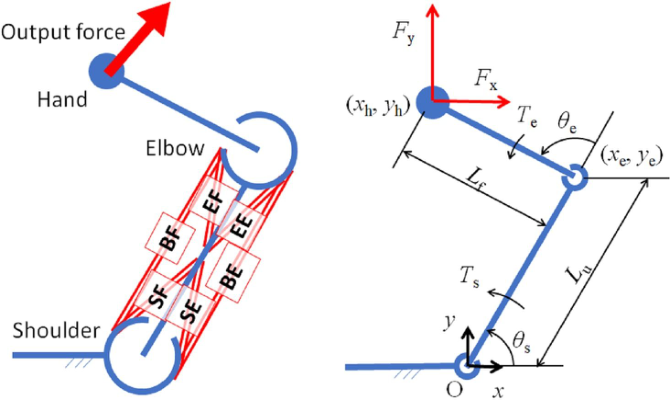
In this study, we targeted an upper limb, and the task was to apply force on a griped handle without body motions. This was formulated referring to the earlier research (Fujikawa, 1997). We performed both simulation and experiment. The simulation was performed by a two-dimensional musculo- skeletal model shown in Fig. 1. It included shoulder and elbow joints with six muscles around them. First, the position of the elbow and hand from the shoulder, (xe, ye) and (xh, yh), were calculated using lengths of the upper and forearms, lu and lf, and angles of the shoulder and elbow joints, θs and θe, as shown in Eq.(1) and (2). These angles and lengths were set to match the experiments described below. Next, the shoulder and elbow torques, Ts and Te, were calculated from the muscle forces, as shown in Eq.(3) and (4). Here, FSF, FSE, FEF, FEE, FBF, and FBE stand for the muscle forces of shoulder flexor, shoulder extensor, elbow flexor, elbow extensor, biarticular flexor, and biar- ticular extensor respectively. Similarly, the moment arm lengths are stood for l with each muscle index. Next, the output force on the hand was calculated by the moment equilibrium conditions around the two joints including the input six muscle forces, as shown in Eq.(5). Here, Fx and Fy stand for the medial and anterior components of the output force.
cos θs
(1)
= Lu
xe ye
sin θs
cos (θs + θe) = + L
(2)
xe ye
sin (θs + θe)
xh yh
f
Equation reproduced from the original PDF.
[Equation or mathematical symbol available in the original paper PDF]
[Equation or mathematical symbol available in the original paper PDF]
−Ts(xh−xe) + Texh yh(xh−xe)−xh(yh−ye) = [Equation or mathematical symbol available in the original paper PDF]
[Equation or mathematical symbol available in the original paper PDF] (5)
Fx Fy
−Ts(yh−ye) + Teyh xh(yh−ye)−yh(xh−xe)
How Do the Antagonistic Muscles Contract During Modulating the Output Force? 111
Figure 1: The musculoskeletal model.
The muscle forces were determined by an artificial neural network, accor- ding to our previous study (Fukunaga, 2020). It outputs six muscle forces by inputting a position of the fand and a target output force. The teacher data were created with random hand positions and muscle exertions.
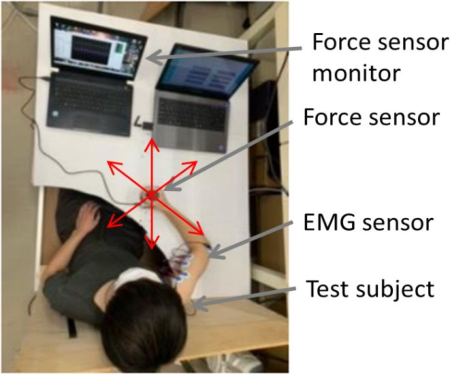
The experiments to validate the simulation were performed as shown in Fig. 2. Three healthy males are used as test subjects. They were asked to grip the handle with laying the arm horizontally and apply a force, and the force was measured by the force sensor attached to the handle. The measured force was shown to the test subjects. The EMGs of the biceps and triceps brachii were measured during the experiments, which are the biarticular flexor and extensor.
Figure 2: The system of the experiments.
We tried three conditions for both simulations and experiments; (a) maxi- mum force, (b) reduced force, and (c) reduced force with external disturbance. The target output force was 500N, larger than the maximum output force of all the test subjects, on condition (a). On conditions (b) and (c), the target output force was 200N. The simulation of condition (c) was performed by applying random error on the output force of the teacher data. In the expe- riments, the errors were applied to the display of the force sensor shown to the test subjects. We estimated that, on conditions (a) and (b), the anta- gonist muscle would not work, and the exertion of the agonistic muscle would be reduced on condition (b). The antagonist would work on con- dition (c) to modulate the output force dynamically. The output force was applied to all directions. The direction was at intervals of 60 degrees in the experiments since the six directions are important for muscular functions (Kumamoto, 1994). Test subjects were asked to apply the force for 3 seconds and the average of the rectified EMG during the middle 1 second was used as the measured value. The intervals between the measurement were at least 60 seconds.
RESULTS
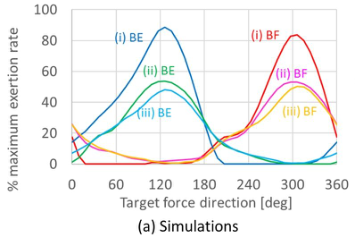
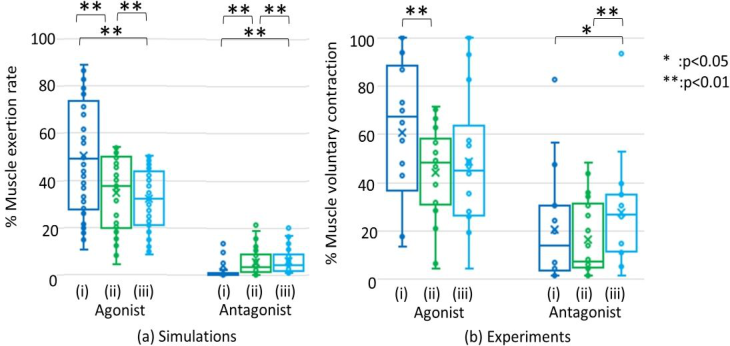
The results of the simulations and experiments are shown in Fig. 3. Experimental results were normalized by the maximum contraction during the experiments and shown as the average among the test subjects. The biar- ticular flexor is the agonist and the extensor is the antagonist during the angle of the output force is under 180 degrees, and the extensor is the ago- nist and the flexor is the antagonist during the angle is over 180 degrees. The summary of the muscle exertion of the agonists and antagonists are shown in Fig. 4. Significant differences were shown in experiments, between condition (a) and (b) on the agonists and between condition (b) and (c) on theantagonists.
DISCUSSIONS We assumed that the antagonists would contract simultaneously with the agonists during modifying the output force under some dynamically unsta- ble disturbance, which was almost supported by the experimental results.
Figure 3: The calculated muscle exertions and measured MVC.
How Do the Antagonistic Muscles Contract During Modulating the Output Force? 113
Figure 4: Summary of the MVC on the simulations and the experiments.
Comparing the experimental results of condition (i), maximum force, and (ii), reduced force, a significant difference was shown in the agonists and not in the antagonists in the results of the experiments. It indicated that the output force would be controlled by only agonists under an ideal and static condition. In contrast, there was a significant difference in the antagonists between condition (ii), reduced force, and (iii), reduced force with external disturbance. It indicated that the antagonists would work to control the out- put force dynamically. Therefore, the results of the experiments supported our assumption.
On the other hand, significant differences were shown between all the con- ditions in the results of the simulations. Focusing on the antagonists, the difference between conditions (i) and (ii) was larger than (ii) and (iii). It indi- cated that the antagonists worked to reduce the output force under static conditions without external disturbance. It was not in good agreement with the results of the experiments. Such a problem also occurred in our previous study (Fukunaga, 2021), and was relieved by adding the target to make the sum of muscle exertions small. The results indicated that still some conditions or targets are lacking or inadequate.
Besides, the experimental result of condition (i), maximum force, did not correspond with the earlier research (Fujikawa, 1997). Fujikawa et al. sho- wed more mechanically reasonable results, which is, the muscle voluntary contraction of agonists is almost 100% and of antagonists 0%. We consi- der the mismatch is because the objective task was not usual for our daily lives as pedaling a bicycle. The mismatch of the output force direction of the peak muscle exertion might also be caused by such a problem. The task itself would an unstable for the test subjects and required sensitive control of muscles. The task should be improved to avoid the problem. On the other hand, our results of the simulation were also mismatched with the results of Fujikawa et al. The simulation result was better without the target of the neural network to make the sum of muscle exertions small, however, it was
necessary to adjust the output force (Fukunaga, 2021). The validity of the simulation model to decide muscle exertions should be reconsidered.
In summary, the results of the experiments supported our assumption, and that of the simulation was not in good agreement with the experiments. Our next task is to confirm our assumption quantitatively to apply it for estimating the muscle forces or joint loads by simulation.
CONCLUSION
We performed the simulations and the experiments to observe how the anta- gonist muscle contract simultaneously with the agonist using the pair of biarticular muscles around an upper limb. Therefore, the results of the expe- riments indicated that the antagonist muscle would work during controlling the output force under an unstable condition with dynamic disturbance. However, the result of the simulation was not in good agreement with the experiments. Our future task is to arrange the condition to apply it for solving the inverse dynamics problem of the musculoskeletal system to calculate the muscle forces or joint loads.
ACKNOWLEDGMENT
This work was supported by JSPS KAKENHI Grant Number 19K11324.
REFERENCES
Fujikawa, T., Oshima, T., Kumamoto, M. and Yokoi N. (1997) “Functional Coordination Control of Pairs of Antagonistic Muscles”, Transactions of the Japan Society of Mechanical Engineering Series C, Vol. 63, No. 607, pp. 769–776. [in Japanese]. Fukunaga, M. (2021) “E How the Artificial Neural Network Solves the Muscle
Redundancy Problem During Pedaling Motion?”, Advances in Intelligent Systems and Computing, AHFE 2020 Proceedings, Vol. 20, pp. 315–320. Fukunaga, M., Hirokawa, S. (2012) “Effect of the Tensile Force Ratio of Gluteus Maximus and Hamstrings on the Knee Joint Force”, Transactions of the Japan Society of Mechanical Engineering Series C, Vol. 78, No. 788, pp. 1192–1201. [in Japanese]. Fukunaga, M., Morimoto, K. (2015) “Calculation of the knee joint force at deep squ-
atting and kneeling”, Journal of Biomechanical Science and Engineering, Vol. 10, No. 4, pp. 15–00452. Kumamoto, M., Oshima, T. and Yamamoto, T. (1994) “Control properties induced by the existence of antagonistic pairs of bi-articular muscles - mechani- cal engineering model analyses”, Human Movement Science, Vol. 13, No. 5, pp. 611–634.
LISTED IN THE AHFE DIGITAL BOOKSTORE CATALOGUE
Explore the complete digital volume
Physical Ergonomics and Human Factors
Read this individual research paper free through the original publisher, or explore the full digital proceedings book.
ISBN 978-1-958651-79-7
Explore this ISBN in the AHFE Bookstore ↗Listed in the July 2026 bookstore catalogue; search by ISBN to confirm current availability · Digital book purchase optional