Electromagnetic pulse massage mimics the current signal of human nerve fibers by conducting a weak current to the deeper layers of the skin, which makes the muscle fibers contract and imitates massage techniques such as pounding and kneading, thus achieving a relaxing effect on the cervical spine. Wearing stability of such products largely affects the effectiveness and comfort of massage. This paper aims to investigate the wearing stability and influencing factors of electromagnetic pulse neck massagers. Three representative neck massagers were used for testing, and subjective ratings of fit were collected from 58 participants (29 males, 29females), along with measurements of wearing slipping distance and neck dimensions. The results showed that females wore the neck massager significantly more loosely than males and had a longer slipping distance of 10.256mm. Moreover, the correlation analysis indicated that the wearing fit was strongly correlated with Middle Neck Width (MNW), moderately correlated with Middle Neck Girth (MNG), weakly correlated with Root Neck Girth (RNG) and Front Neck Length (FNL), which was a guideline for the design of size and grading for neck massages.
Neck pain is a currently prevalent health problem that continues to affect people’s standard of living and quality of work (Lee et al., 2022). As a result of changes in work practices, more workers are suffering from neck pain due to sedentary work. In addition, with the popularity of smartphones and computers, neck pain and related disorders are becoming more prevalent at a younger age (Ge et al., 2014; Tapanya et al., 2021; Wta et al., 2021). EMP massage mimics current signals of human nerve fibers by conducting a weak current to the deeper layers of the skin, making muscle fiber contraction, imitating whack, pinch and other massage techniques to achieve relaxation of the cervical spine.
As a wearable massage product, the wearing stability of the EMP neck massager significantly affects the massage effect and user experience. Unsta- ble wearing can easily lead to neck massager misalignment or slippage, and massage electrodes can not stimulate the correct parts, resulting in a reduced
Stability Assessment of Electromagnetic Pulse Neck Massagers 9
massage effect. Different users of the same neck massager stability will also have different evaluation results due to the gender, age differences between individuals (Molnar and Pearson, 1998) and dynamic changes in their physi- ological state (Luximon, 2001; Ruff, 2002). In addition, the spread of mass production also poses a great challenge to product design. Products that lack ergonomic studies are more likely to be unstable and uncomfortable to wear in mass production (Luximon et al., 2012).
Based on the above background, this paper aims to investigate the wearing stability of the EMP neck massager and to analyze its influencing factors using anthropometric measurements. Three commercially available EMP neck massagers were used for testing to enhance the generalizability and accuracy of the experiment while minimizing the effects of extraneous vari- ables (test time, test sequence). The study initially establishes a link between the wearing stability of the EMP neck massager and the neck dimensions, complementing the ergonomic research theory of this type of product.
MEASUREMENTS Participants
Fifty-eight participants (29 males, 29 females) with a mean age of 23.7 years (SD = 2.3) were recruited in the EMP neck massager-wearing experiment, 17 of whom had experience with EMP neck massagers. Participants were free of physical discomfort and medical problems that would affect the experi- mental measurements. The experimental procedure was fully explained to the participants, who voluntarily participated and signed informed consent. Participants were asked to wear a crew neck top while participating in the experiment and were given cash compensation at the end of the experi- ment. The experimental procedures were approved by the institutional ethics committee of the South China University of Technology.
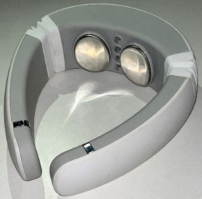
Apparatus After sufficient research, three representative and good sales of EMP neck massagers were used in the experiment. To avoid the influence of the brand effect on the experimental results, the brand logo of the product was obscured during the experiment. The overall structure of the EMP neck massager can be divided into an open circular structure for fixing and an elliptical piece structure for massaging, with the massager symmetrical to the left and right. The design details of the three neck massagers are slightly different, with M1’s ring hinged at both ends and connected with a certain degree of tension. Neck massager M2 has airbags at both ends of the ring, while neck massager M3 has non-slip particles at both ends, as shown in Figure 1. M1, M2, and M3 weigh 224.3g, 149.6g and 141.9g, respectively.
Experiment Procedure A three-stage experiment was used to investigate the wearing stability of the neck massager with dimensional measurements, subjective evaluation of fit,
(M1) (M2) (M3)
Figure 1: Three electromagnetic pulse neck massagers.
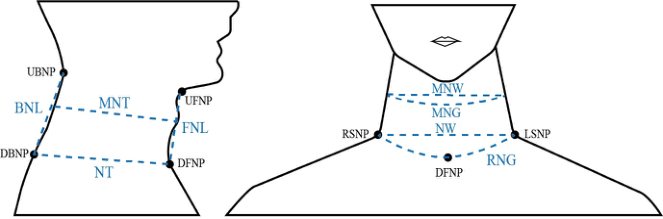
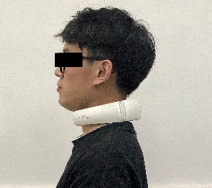
and slipping distance measurements. According to the neck dimension defini- tion (Zhongzeyu and Guanluo, 2000), participants’ Down Front Neck Point (DFNP), Up Front Neck Point (UFNP), Down Back Neck Point (DBNP), Upper Back Neck Point (UBNP), and Down Side Neck Point (RSNP, LSNP). Then, Front Neck Length (FNL), Back Neck Length (BNL), Neck Width (NW), Middle Neck Width (MNW), Neck Thickness (NT), Middle Neck Thickness (MNT), Root Neck Girth (RNG), and Middle Neck Girth (MNG) were measured manually, as shown in Figure 2. And the marker points were removed at the end of the measurement. Afterwards, participants wore the massager correctly (Figure 3 a) and marker points were applied to the back of the participant’s neck (Figure 3 b). The participants were asked to turn their heads three times in the left-right (±80
) and up-down (±20
) directi- ons and then fill out the wearing fit evaluation form (Table 1), after which the position was re-recorded by applying the marker points on the back of the participant’s neck again. Finally, the participants removed the massager, and the slipping distance between the two marker points was measured (Figure 2 c). Each participant was required to evaluate three massagers, with a five- minute interval in each group, and the test sequences of M1, M2, and M3 were randomized. The massagers were always turned off during the test to avoid the influence of the massage function.
Statistical Analysis Data were analyzed by SPSS 26.0 with a significance level of 0.05. A T-test was used to investigate the gender differences in neck dimensions. Two-way
Figure 2: Measurement marker points and measurement items.
Stability Assessment of Electromagnetic Pulse Neck Massagers 11
(a) Wearing (b) Marking points (c) Measuring the distance
repeated measures ANOVA (2 Genders × 3 Types) was applied to analyze subjective scores of tightness and slippage distance, and post hoc comparisons were made using the LSD post hoc test. Spearman correlation coefficients were used to analyze the relationship between subjective scores of tightness and neck dimensions.
RESULTS
Stability
Table 2 summarizes the results of the repeated measures ANOVA for the fit score and slipping distance. For the fit score, a main effect of gender showed that males felt significantly tighter than females wearing the neck massager, with a mean score of 1.74 for males and -1.43 for females. Correspondingly, in terms of slipping distance, a main effect of gender was also significant, with a mean slipping distance of 10.28 mm for females and only 5.61 mm for males. More importantly, the females’ fit score was less than 0, indicating that the three neck massages produced different degrees of looseness. The means and standard deviations of the tightness score and slipping distance are shown in Table 3.
Neck Dimensions The neck dimensions and T-test results for genders are summarized in Table 4, which showed that RNG, NG, NW, NT, MNW, and MNT were significantly higher in males than in females, except for FNL and BNL.
Person correlation analysis was applied to explore the relationship between fit score and neck dimensions, and the results are shown in Table 5. The fit score had a strong correlation with MNW (r>0.7), moderate correlation with MNG, NW, NT, and MNT (0.4<r<0.7), weak correlation with RNG and FNL (0.2<r<0.4), and no correlation with BNL (r<0.2).
Table 2. Repeated-measures ANOVA of fit score and slipping distance.
Table 5. Correlation analysis of fit score and neck dimensions.
Table available in the original PDF paper.
RNG MNG FNL BNL NW NT MNW MNT Fit score .393** .657** .214** .026 .669** .631** .709** .638**
**: p < 0.01
DISCUSSION
Neck massagers were significantly more unstable when worn on females than males. The results of the fit evaluation for the three neck massagers showed that females had significantly lower fit scores in each type than males. More importantly, the mean score for females was less than 0, indicating that fema- les felt the neck massagers produced looseness, while the mean score for males was greater than 0, with male users not feeling unstable in wearing them. The
Stability Assessment of Electromagnetic Pulse Neck Massagers 13
slipping distance measurements that females’ slipping distance was higher than males, about 4-6cm, also confirmed this conclusion.
The difference in neck dimension is an essential factor affecting the wearing stability of the massager. T-test results indicated that the six neck dimensions of females were significantly smaller than those of males, which explained the worse performance of the massager in the subjective fit evaluation and objective slipping distance measurements of females. To the best of our kno- wledge, the EMP neck massager shape design has a greater convergence, with a more open ring structure to fit the neck curve. To enhance wearing stabi- lity, designers have chosen to add particles or use articulated structures at the ends of the rings. Still, basically, no dimensional division has been made, resulting in generally low stability in females. Consistent with the previous research, it isn’t easy to fit all users with only one product size (Luximon et al., 2012). Further, there was a significant correlation between fit scores and MNG, NW, NT, MNT, and MNW. Product sizing and grading meth- ods have been studied(Yan et al., 2012; Zheng et al., 2007), so based on the neck measurements in the study, guidance can be provided for the sizing and grading design of the neck massager, which in turn will improve wear stability.
The main effect of type and the interaction effect of including type are not discussed in this paper. Conclusions about the more excellent value and broader significance of EMP neck massagers were presented, which were not limited to the three massagers in the experiment. The results of this study can be used in the styling and structural design of the EMP neck massager.
CONCLUSION
Wearing stability is an essential consideration in ergonomics. In this paper, the wearing stability of the EMP neck massager and its influencing factors were investigated through a three-stage test using a combination of subje- ctive evaluation and objective measurements. The results of the study showed that ignoring the differences in neck dimensions between genders was the main reason for the generally lower stability of females. To improve the wea- ring stability of the EMP neck massager, cluster analysis of neck dimensions should be conducted to guide the size grading of the neck massager. Among them, MNG, NW, NT, MNT, and MNW should be given priority. Meanwh- ile, the evaluation strategy of wearing stability of massager proposed in this paper can be applied in the iterative design process of the product.
ACKNOWLEDGMENT
The research is supported by the National Key Research and Development Program of China [No. 2022YFF0607000] and the Natural Science Founda- tion of Guangdong Province [No. 2021A1515010934].
Mechanistic experimental pain assessment in computer users with and without chronic musculoskeletal pain. BMC Musculoskeletal Disorders 15.
Lee, R., James, C., Edwards, S., Snodgrass, S. J., 2022. Differences in upper body posture between individuals with and without chronic idiopathic neck pain during computerised device use: A 3D motion analysis study11This research did not receive any specific grant from funding agencies in the public, commercial, or not-for-profit sectors. Gait & Posture. Luximon, A., 2001. Foot shape evaluation for footwear fitting. Luximon, A., Zhang, Y., Luximon, Y., Xiao, M., 2012. Sizing and grading for
wearable products. Computer-Aided Design 44, 77–84. Molnar, S., Pearson, 1998. Human variation : races, types, and ethnic groups. Human variation : races, types, and ethnic groups. Ruff, C., 2002. Variation in human body size and shape. Annual Review of
Anthropology 31, 211–232. Saavedra-Hernández, M., Castro-Sánchez, A., Fernández-De-Las-Pe˜nas, C., Cleland, J. A., Ortega-Santiago, R., Arroyo-Morales, M., 2011. Predictors for identifying patients with mechanical neck pain who are likely to achieve short-term success with manipulative interventions directed at the cervical and thoracic spine. Journal of Manipulative & Physiological Therapeutics 34, 144–152. Tapanya, W., Puntumetakul, R., Neubert, M. S., Hunsawong, T., Boucaut, R., 2021.
Ergonomic arm support prototype device for smartphone users reduces neck and shoulder musculoskeletal loading and fatigue. Applied Ergonomics 95, 103458. Wta, B., Rpa, B., Msna, C., Tha, B., Rb, D., 2021. Ergonomic arm support prototype device for smartphone users reduces neck and shoulder musculoskeletal loading and fatigue. Applied Ergonomics. Yan, L., Ball, R., Justice, L., 2012. The 3D Chinese head and face modeling.
Computer-Aided Design 44, 40–47. Zheng, R., Yu, W., Fan, J., 2007. Development of a new chinese bra sizing system based on breast anthropometric measurements. International Journal of Industrial Ergonomics 37, 697–705. Zhongzeyu, Guanluo, Y., 2000. Human Body and Clothing: Anatomy of Clothes.
Human Body and Clothing: Anatomy of Clothes.
LISTED IN THE AHFE DIGITAL BOOKSTORE CATALOGUE
Explore the complete digital volume
Physical Ergonomics and Human Factors
Read this individual research paper free through the original publisher, or explore the full digital proceedings book.
ISBN 978-1-958651-79-7
Explore this ISBN in the AHFE Bookstore ↗Listed in the July 2026 bookstore catalogue; search by ISBN to confirm current availability · Digital book purchase optional