Aijaz Siddiqui, Dibakar Sen (2022). Contact Pressure as an Indicator of Postural Stability in Digital Human Models. In: Digital Human Modeling and Applied Optimization. AHFE Open Access, vol. 46, pp. 70–78. https://doi.org/10.54941/ahfe1001901
This paper presents a natural stability model of Digital Human Models. In the traditional convex-hull-based stability approach, a posture is stable if the Center of Pressure lies within the Base of Support. The posture has no qualitative degree (less/more stable). Additionally, some existing methods use Functional Stability Regions and make the Centre of Pressure lie inside it. Though, this is based solely on experimental observation and lacks reasoning. Hu-mans sense contact/reaction forces. Very low contact pressure may provoke toppling, and high contact pressure induces discomfort. So, humans do not allow forces to rise beyond or recede below certain limits. In this paper, a Sensing-based method that involves estimating pressure at support points is presented to decide whether a posture is stable & comfortable along with its degree. The method provides a rationale for using the Functional Stability Region & applies to any set of support points.
Contact Pressure as Indicator of Postural Stability in Digital Human Models 71
of Support (FBoS) (Tomita et al., 2021). Although the trajectory and sway of the COP are considered in those studies, the overall observation focu- ses on the measure of apparent reduction in the utilization of the physically available BoS.
Research Gap The postural system works actively to make the human body stable through the interaction of sensory, cognitive, and muscle actuation system (Scataglini, 2019). The stability models of existing DHMs ignore these aspects of the postural system and rely solely on geometry and physics. Also, humans can- not control postures based on their COP and BOS as they are unaware of both. Additionally, these models check if a posture is stable or not; postures are not qualified using any measure of stability. On the other hand, there is no physics or biomechanics-based model that explains the empirical fact that FBoS is significantly smaller BOS and there is subjective variation. Also, the support points inside the BOS are generally ignored, although they contribute to load-bearing. Therefore, there is a need to develop a criterion to qualify postures considering both stability and comfort.
Motivation and Purpose Unlike inanimate objects, human-beings actively adjust posture to maintain balance or stability, as referred to in this work; the sensory, cognition and action systems work in a closed-loop. It utilizes one’s awareness about the deviation of the current state from the desirable stable state; hence, it must be in terms of parameters that can be sensed and qualitatively measured dire- ctly. Location of COP is not directly observable; but the support reaction forces (SRF) can be sensed directly. SRFs depend upon COP and support compliance. As postural changes alter the COP, SRF would change for given support locations. The COP location can be indirectly controlled by adjusting the posture through maintenance of directly sensed SRF, ensuring a stable and comfortable posture.
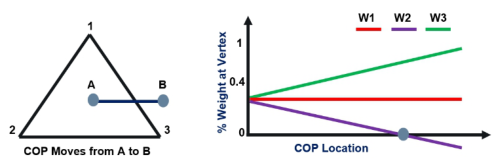
For the situation with only three support points as in Figure 1. The concept of Barycentric coordinates is intrinsically related to SRFs. Thereby, the com- puted SRFs (W1, W2, W3) change linearly as COP moves horizontally from A to B. In analysis of static stability, only location of COP is relevant. The- refore, the dynamic effect of the sway trajectory of COP is not considered here. As COP moved out of the triangle, W2<0 indicates an unstable posture. Knowledge of SRFs enables a reason-based scheme for determining the state and quality of stability and comfort for a posture of a DHM. So, the aim is to develop a biomechanically significant model using sensing of support reaction forces.
METHOD: SUPPORT REACTION and STABILITY Barycentric Scheme for Support Reaction
If there are only 3 support points, we get 3 equations in terms of the 3 unknown SRFs and we get a unique solution. For more support points, SRFs
72 Siddiqui and Sen
Figure 1: Percentage of body weight at support points vs COP location.
cannot be determined from statics alone as the system becomes statically inde- terminate. Since we need only a reasonable estimate of the SRFs to assess postural quality and model the genesis of the FSR (or FBoS), we consider only the three requirements for estimating the meaningful yet unique SRFs. They are: (a) Positivity: to eliminate physically inadmissible negative (tensile) forces at the supports, (b) Partition of Unity: to ensure that the sum of the forces at the supports equals the body weight, (c) Inclusivity: to ensure that contribution of all support points is accounted for, irrespective of whether they lie on a convex polygon or not.
There are various types of barycentric coordinates reported in literature with distinct set of properties (Floater, 2015), (Warren, 1996). They can be grouped in two categories: (A) Methods for convex polygons, viz. Barycen- tric Coordinates and Waschpress/Generalized Barycentric Coordinates (WC) (B) Methods not demanding convexity of polygons, viz. Mean-value (MV) coordinates and Generalized Mean value coordinates (GMV). It was found during our study that WC satisfies all the three required properties, but it is applicable only for convex polygon. GMV was chosen in our work as it sati- sfies all the requirements, including the ability to be utilized with non-convex polygons.
However, it is noticed that all the methods are usable only for polygons, i.e. the results depend upon the order of the points in the computation. But in practice, we have contact points (as representation of supporting regions), which are not inherently ordered. So, to use the existing method of GMV coordinates, we need to construct a unique non-self-intersecting polygon for estimating unique SRFs.
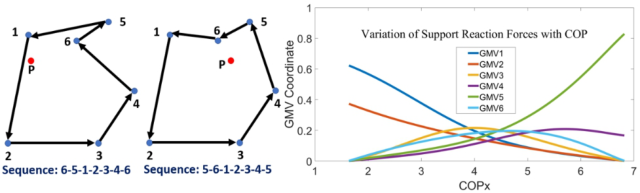
Trend and Effect of Support Reaction Forces For a given COP and an arbitrary set of support points, a unique polygon can be obtained by angular sorting of support points with respect to COP. This forms a so-called star polygon as there is at least one point in it, e.g. COP, from which the whole polygon is visible without any obstruction. Then, GMV is used for estimation of SRFs at the vertices. For different location of COP, the polygon changes; consequently, the SRFs also change. In Figure 2, the support locations are same in both the cases, but location of COP (P) is chosen at different locations on a horizontal straight line. Although the star polygons changes dramatically, the change in weightages at the support- points is smooth and continuous. Also, note that at the extremities, all but two SRFs go to zero simultaneously; the two non-zero support-reactions,
Contact Pressure as Indicator of Postural Stability in Digital Human Models 73
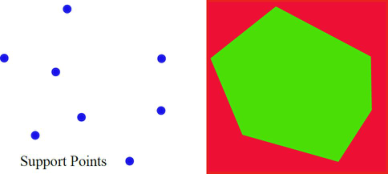
Figure 2: Effect of moving COP on star polygon and support reaction.Figure 3: COP location vs computed GMV: green for valid, red for invalid.
define the tilting edge. The body will be on the verge of losing stability with lifting of support points with low SRFs and topple about the edge connecting two support points with high SRFs. Also, the relatively large SRF is likely to cause discomfort at the two loaded locations.
Equivalence of Sensing and CH-Based Stability Assessment SRF at arbitrary support locations can estimated from the GMV for COP located at any point on the plane, by constructing an appropriate star poly- gon. But GMV scheme is not applicable if the COP lies outside the kernel of the star polygon. Such situations are considered invalid. In Figure 3 valid and invalid situations are plotted with GREEN and RED respectively. It can be observed that the GREEN locations for COP falls within the convex hull of the support points. Postures corresponding to these points, as per CH based schemes, are stable. Also, in such cases, the SRFs satisfy required properties. It therefore shows that if COP is inside the convex hull, we always get a valid star polygon to calculate SRFs at all support points. So, even though a convex hull is not constructed, the proposed method conforms to the physics behind the CH-based stability approach.
Equivalence of Physiological Response and Physical Phenomenon It is empirically established in literature that the COP doesn’t go up to the boundary of BOS. We argue that if the pressure value at support point(s) is very low, the subject would lose confidence as less reaction force at support point(s) means that the contact is about to lose, leading to instability. Also, when the pressure at the support point is higher than some threshold, it indu- ces discomfort. There are regions near BOS where the reaction forces are very low at support points, and discomfort is very high (see left and right extre- mities in Figure 2). Consequently, subjects do not allow reaction forces to
74 Siddiqui and Sen
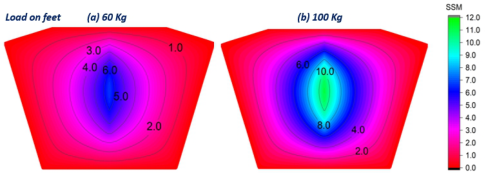
Figure 4: Iso-contours of stability with variation in total load.
recede below or rise beyond certain limits. This we believe is the reason why COP does not reach up to the BOS boundary. The sensing-based scheme also explains the physical fact about where the body will topple when its stability is lost without the need for the awareness about the BOS or the containment of COP in that.
Most Preferred Point in BOS Empirical studies proposed FSR to be determined from BOS, which requires COP of quiet standing and FSL. However, the subjects are unaware of both. All postures for which COP lies inside FSR are considered equivalent. Unlike CH-based approaches, the SRF approach allows us to define postures with varying psychophysical measures of stability and comfort. Thus, based on the nature of work at hand, it is possible to find postures with the highest stabi- lity index or the lowest discomfort index, or the optimum trade-off between both. The COP corresponding to such a posture is termed the Most Preferred Point (MPP) in BOS as the resulting SRFs lead to posture with either highest stability or highest comfort or optimal combination of both.
RESULT: PREDICTION OF USER EXPERIENCE Iso-Contours of Stability
If the pressure at support point(s) is very less, the body will be on the verge of toppling. So, checking the value of the minimum reaction force at the support points is sufficient to decide whether a posture is stable. Thus, Subjective Stability Measure (SSM), which is a measure of stability of a posture for a given COP is defined as the minimum of the weightages at the points of support. It is a measure of perceived stability. Given any set of support points, contour plots are obtained based on the SSM value as shown in Figure 4.
Figure 4 shows the gradation of stability zones for two loading scenarios. It can be observed that the perceived stability is higher for COP lying on the inner contours. If it is assumed that when the weight at any support point is less than 2Kg, the person would perceive a tendency to topple over, then the region inside contour label-2.0 would represent the FSR. As the load increases, a given stability index has larger area, indicating that perceived stability increases with load. This interpretation needs empirical validation; the authors are working on it.
COP location may change as the posture changes. In a standing forward- reach task, if the perceived postural stability is high, and postural change
Contact Pressure as Indicator of Postural Stability in Digital Human Models 75
Figure 5: Iso-contours of discomfort with variation in load at support points.
results in COP moving towards the direction of reach, the subject is likely to take a greater risk to lean further in that direction. As the COP moves, the perceived stability reduces until the subject is unwilling to take additional risks to lean further. It is also observed that as the load increases, the SSM for each point also increases. For body weight loading and the stance width of 30 cm the calculated FSR is 46.8%. (Tomita et al., 2021) reported average FSR to be 47.2% of BOS for feet at shoulder width. Shape of the outer contours are pointed anteriorly whereas inner contours are pointed at both ends. Studies show that FSR/FBoS has the similar shape, with a pointed top and a flat bottom (Holbein-Jenny et al., 2007), (Tomita et al., 2021); the computed FSR (Figure 4) is qualitatively similar.
Iso-Contours of Discomfort Discomfort is deemed to occurs when the pressure at a support point exceeds subjective pressure-threshold. Thus, discomfort at a support is expressed as a ratio of SRF to the threshold; Subjective Discomfort Measure (SDM) is defined as
SRFi SDM = maximum tLimiti
tLimiti is the threshold value of weight at which discomfort starts at support point i and SRFi is the support reaction force at support point i.
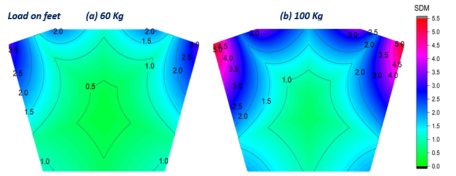
Figure 5, shows the gradation of discomfort zones for two load conditi- ons. It is observed that as the load increases, the area of given discomfort zone grows. When the load is 60 kg, discomfort zone area (outside SDM =1) is 42% of the BOS; it increases to 80% for 100 kg load. It is also observed that as the load increases, perceived discomfort at all points increases. Suppose the perceived discomfort is high for a given posture, and the posture change for the task results in COP moving towards a direction. The subject will not venture to lean further in that direction. As the COP moves, the perceived discomfort increases until the subject is willing to tolerate additional discom- fort to lean further. The shape of the iso-counters is such that discomfort at the heels are lesser than the toes.
76 Siddiqui and Sen
Figure 6: Combined perception of stability, discomfort and load.
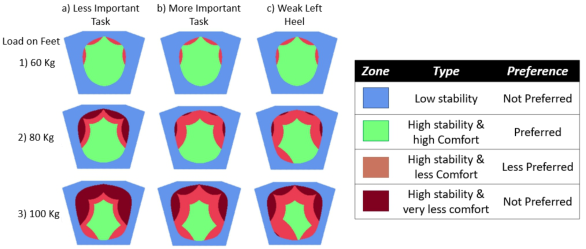
DISCUSSION: COMBINED PERCEPTION OF STABILITY, DISCOMFORT and LOAD As per the discussion above, as the load increases, the perceived stability increases encouraging one to reach further; but the perceived discomfort also increases with load which discourages one to reach further. However, the stability and discomfort are experienced by one simultaneously. This neces- sitates the assessment of combined effect of stability, discomfort and load on a posture. The level of discomfort an individual tolerates is determined by the importance of the task, the presence of hazard in the task’s direction, the individual’s tolerance capacity for pressure or injury at specific support points. Refer Figure 6, at the low load conditions (case 1), FSR is slightly more than the comfortable region. So, the FSR governs the posture, and plau- sible posture will mostly be highly stable and comfortable. At high load (cases 2 and 3), FSR is more, but the area of the discomfort zones is very high. The postures in such cases are controlled more by discomfort rather than stability, although the stability condition is necessary. In such cases, a significant area of BOS belongs to the postures that are either less or not preferred. As the load increases, the area of the preferred zone decreases, whereas the less pre- ferred and not preferred zone area increases. Comparing cases, a and b when the task importance is more, a person puts extra effort to bear discomfort to accomplish the task, resulting in smaller not preferred zone. In case c, left heel is weak, so at higher loads, area of preferred zone decreases whereas area of less and not preferred zones increases. Thus, the posture can be classified into four kinds (refer Figure 6): low stability (not preferred), high stability and high comfort (preferred), high stability and less comfort (less preferred), and high stability and very less comfort (not preferred).
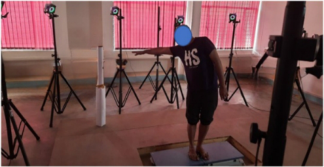
VALIDATION A multi-directional reach test (Figure 7) was performed on two surfaces, nor- mal and acupressure mat (less comfortable) with three subjects carrying loads (0-20 kg) on the back. A more comprehensive study is in progress.
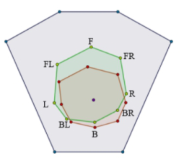
The empirical SDM values were found to closely match the theoretical SDM values. Figure 8 shows FSR on normal surface (green) and acupres- sure mat (red). Both FSRs lie inside BOS. This is in accordance with existing
Contact Pressure as Indicator of Postural Stability in Digital Human Models 77
Figure 7: Set-up for functional reach task.Figure 8: FSRs on normal surface and acupressure mat.
studies. Also, area of FSR on acupressure mat is significantly smaller. Thus, contact pressure or discomfort, which is neglected in literature, significantly influences the FSR.
CONCLUSION
Presented method provides qualitative measures for static stability and com- fort from estimated support reaction forces at all support points. Constru- ction of a convex Base of Support is obviated. The method explains why Centre of Pressure does not go up to the boundary of the Base of Support in practice. The work also demonstrated modeling of pathologies and pre- ferences. Thus, the work enables responsive posturing in Digital Human Models.
REFERENCES
Abdel-Malek, K. et al. (2019) ‘Santos: An integrated human modeling and simulation platform’, in DHM and Posturography. Academic Press, pp. 351–364. ISBN: 978- 0-12-816713-7. Badler, N. I., Phillips, C. B. and Webber, B. L. (1993) ‘Simulating humans: computer
graphics animation and control’. Oxford University Press. Boulic, R. et al. (2004) ‘Virtual worker reachable space evaluation with prioritized inverse kinematics’, in Proceedings of the 35th international symposium on robotics, Paris. Floater, M. S. (2015) ‘Generalized barycentric coordinates and applications’, Acta
Numerica, 24, pp. 161–214. Hanson, L. (2020) ‘Experimental evaluation of postural stability using stepping strategies during industrial tasks’, in DHM2020: Proceedings of the 6th International Digital Human Modeling Symposium, p. 156. Holbein-Jenny, M. A. et al. (2007) ‘Validity of functional stability limits as a measure
of balance in adults aged 23–73 years’, Ergonomics, 50(5), pp. 631–646.
78 Siddiqui and Sen
Marler, T., Knake, L. and Johnson, R. (2011) ‘Optimization-based posture prediction for analysis of box lifting tasks’, in International Conference on Digital Human Modeling. Springer, pp. 151–160. Reed, M. P. et al. (2006) ‘The HUMOSIM Ergonomics Framework: A new approach
to digital human simulation for ergonomic analysis’, SAE Technical Paper 2006- 01-2365, 2006, https://doi.org/10.4271/2006-01-2365. Scataglini, S. and G. Paul (2019), ‘Posturography’, in DHM and Posturography.
Academic Press, pp. 351–364. ISBN: 978-0-12-816713-7 Selvan, K. E. and Sen, D. (2020) ‘Estimating functional reach envelopes for standing postures using digital human model’, Theoretical Issues in Ergonomics Science, 21(2), pp.153–182. Tomita, H. et al. (2021) ‘Limits of stability and functional base of support while
standing in community-dwelling older adults’, Journal of Motor Behavior, 53(1), pp.83–91. Warren, J. (1996) ‘Barycentric coordinates for convex polytopes’, Advances in Computational Mathematics, 6(1), pp. 97–108.
LISTED IN THE AHFE DIGITAL BOOKSTORE CATALOGUE
Explore the complete digital volume
Digital Human Modeling and Applied Optimization
Read this individual research paper free through the original publisher, or explore the full digital proceedings book.
ISBN 978-1-958651-22-3
Explore this ISBN in the AHFE Bookstore ↗Listed in the July 2026 bookstore catalogue; search by ISBN to confirm current availability · Digital book purchase optional