Jesus Fernando Padilla Magaña, Esteban Peña-Pitarch, Neus Tico Falguera, Anas Al Omar, Iñaki Alcelaylarrión (2022). ARAT Test with Multisensory Information. In: Digital Human Modeling and Applied Optimization. AHFE Open Access, vol. 46, pp. 99–106. https://doi.org/10.54941/ahfe1001905
The Action Research Arm Test (ARAT) is a widely tool used by physical therapists to evaluate the performance of the upper extremities in people who have suffered a stroke, brain injury or multiple sclerosis. The ARAT consists of 19 items grouped into four subtests: grasp, grip, pinch, and gross movement. Nevertheless, it’s a subjective test because the score its only based on the interpretation of the therapist who performs it. Therefore, in this work the integration of a Multi-sensory System to the ARAT test is presented. The System developed consists in: an application developed in the software Unity® and in two sensors (an instrumental Glove with bend sensors (CyberGlove II®) and five force sensing resistors (FSR)). The application records the Human Hand Motion data at the moment of realizing the ARAT in real-time (joint angles and fingertip forces) and the data its stored in a database. The application also includes a hand simulation for monitoring purposes. An experimental study was carried out with ten healthy volunteers. Inclusion criteria: over eighteen years old, right-handed, without any injury in their hands, collaborative patients. With the aim of testing and evaluating the performance of the proposed system. The results presented in this paper corresponds at the subtest Grasp and analyze the correlation between fingertip force and the flexion angle of each joint. The proposed system allows therapists and health care professionals a more objective and accurate evaluation. It also serves as the basis for future projects and applications of augmented reality (AR) and virtual reality (VR) about hand rehabilitation due to the compatibility of the Unity ®.
is of great importance for the recovery of hand movements, rehabilitation is traditionally carried out by a physical therapist specialized in in the tre- atment of disabilities related to motor and sensory impairments(Whitehead & Baalbergen, 2019). Physical therapist help restore physical functioning by assessing and treating problems regarding movement, balance, and coordina- tion. In order to evaluate the effectiveness of a stroke rehabilitation program it is crucial to perform a correct evaluation through the use of valid, standar- dized and reliable assessment tools. The Action Research Arm Test (ARAT) is a standardized and validated test that evaluates the performance of the upper extremities and is commonly used by physical therapists and ano- ther health professionals for the evaluation of stroke patients (Hsieh, C. L., Hsueh, I. P., Chiang, F. M., & Lin, 1998) (Koh et al., 2006) (Chen, Lin, Wu, & Chen, 2012). ARAT was first described by (Lyle, 1981) the test eva- luates 19 tests of arm motor function, divided into 4 subtests (grasp, grip, pinch, and gross arm movement). Each test is given an ordinal score of 0, 1, 2, or 3, with higher values indicating better arm motor status. The total ARAT score is the sum of the 19 tests, and thus the maximum score is 57 (Yozbatiran, Der-Yeghiaian, & Cramer, 2008). The evaluation is based in an examiner‘s observations as well as other motor assessments that determine the corresponding score. The human factor can cause variability in the score process because it is an observational measure. The use of multiple sensors for the analysis of human hand motion allows to know: hand position, fin- ger joint angles, angular velocity and finger force detection in real time. In recent years, research using multisensory information has been developed to analyze hand motion. A Data-Glove and force sensitive resistors (FSRs) were used during eating activities (Hussain, Zainul Azlan, & Yusof, 2018). (Ju & Liu, 2014) Developed an integrated framework with Three different types of sensors: CyberGlove® for angle trajectories, FingerTPS® for contact forces, and electromyography (EMG) sensor for forearm signals. A data-glove-based system embedded with 9-axis inertial sensors and FSRs were designed for evaluation of hand function (Hsiao, Yang, Lin, Lee, & Chou, 2015). An arm rehabilitation monitoring device was developed using an Arduino-based microcontroller, a flex sensor to detect arm bending movement, two FSRs to detect muscle force, and an Inertial Measurement Unit (IMU) (Ambar, Ahmad, Mohd Ali, & Abdul Jamil, 2011). Data from a Microsoft Kinect sensor (kinematic upper limb) and an FSRs glove to predict muscle forces in stroke patients were used by (Hoda, Hoda, Hafidh, & El Saddik, 2018).
Therefore, this paper presents a multisensory system for human hand motion analysis. The aim of this study is to measure the flexion/extension angles of hand finger joints and the fingertip force during the performance of Grasp subtest (ARAT) with the multisensory system. The multisensory information allows physical therapists to make more objective assessments.
MATERIAL AND METHODS Multisensory System
The multisensory system designed is composed by a data glove CyberGlove II®, Force Sensing Module and a graphical user interface (GUI) developed
Participants This study included 10 healthy subjects (six females and four males, mean age: 33 ± 11.9 years, HL: 183.2 ± 10.74, HB: 78.8 ± 8.59). The subjects were selected under the criteria of being right-handed, over 18 years old, and not having suffered any hand disorders or lesions. All participants provided written informed consent and all experiments were performed in accordance with the declaration of Helsinki.
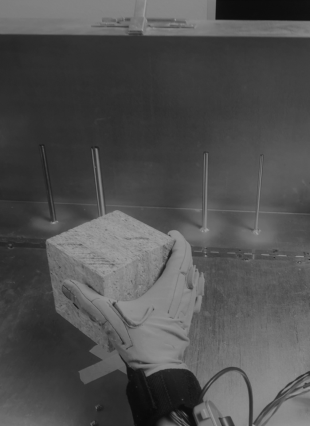
Experimental Setup The study was performed at the Manresa School of Engineering (EPSEM- UPC). Before the experiment, subjects were instructed about the Standard positioning of the ARAT (Yozbatiran et al., 2008) and encouraged to perform the task in the most natural way possible. Five FSRs were attached to the finger tip of the fingers (thumb, index, middle, ring, little). A silk glove was placed taking care that the sensor’s wires passed through the dorsal part of the hand, then the CyberGlove II® was put on in the hand (see Figure 1). Finally, the connection to the GUI was tested. Equipped with the multisensory system in the right hand, the subjects executed the subtest Grasp of the ARAT. The Subject is asked to grasp the objects for each activity which were placed on the table in front of them, one at a time: lift vertically, place, and then release each onto the top of the shelf. The experiment was repeated three times in order to decrease random errors. In the present study, only Grasp subtest activities
Figure 1: A participant wearing the multisensory system.
were performed, the subtest consists in six items: block 10cm, block 2.5 cm, block 5 cm, block 7.5cm, cricket ball and sharpening stone.
RESULTS
Statistical analysis was conducted by using Software R 4.1.0, an Analysis of variance (ANOVA) a well-known statistical test was used to check if the means of two or more groups were significantly different from each other. The DIP angle joint of fingers was not considered in the analysis because there is a linear relationship with the proximal joint PIP, distal joint was assumed as DIP = 2/3 * PIP. However, the information of this joint is in the database.
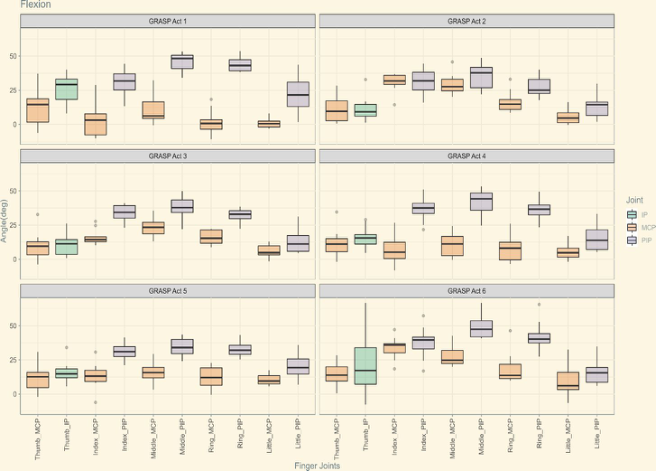
The flexion angle for all finger Joints (IP, MCP, PIP) captured by the Mul- tisensory system during the six activities of the Grasp Subtest are shown in Figure 2. In activity 1, few differences were observed in the MCP joint angle of the index, middle, ring and little fingers. The mean flexion angle of the Thumb IP was 26.08°, Index PIP 30.71°, Middle PIP 45.87°, Ring PIP 43.94° and Little PIP 22.22°. In contrast, the mean flexion angle of the thumb MCP was 12.98°. In Activity 2, the maximum mean flexion angles were found at the MCP 30.76° and PIP 31.64° joints of the index, the MCP 29.36° and PIP 35.18° joints of the middle, and MCP 16.48° and PIP 27.60° joints of the ring. In Activity 3, maximum mean flexion angles were found in the MCP 16.10° and PIP 33.66° joints of the index, the MCP 29.25° and PIP 37.79° joints of the middle, and the MCP 15.92° and PIP 32.03° joints of the ring. In Activity 4 the maximum mean flexion angles were found in the index PIP 36.75°, middle PIP 41.94° and ring PIP 36.71°. In Activity 5, the maximum mean flexion angles were found in the index PIP 31.5°, middle PIP 34.28° and ring PIP 33.21°. In Activity 6, the maximum angles were found
ARAT Test with Multisensory Information 103
Figure 2: Boxplots of the flexion values of all the joints measured with the CyberGlove II® sensor.
in the MCP 34.05° and PIP 37.97° joints of the index, MCP 28.06° and PIP 49.34° joints of the middle, and the MCP 18.57° and PIP 42.41° joints of the ring.
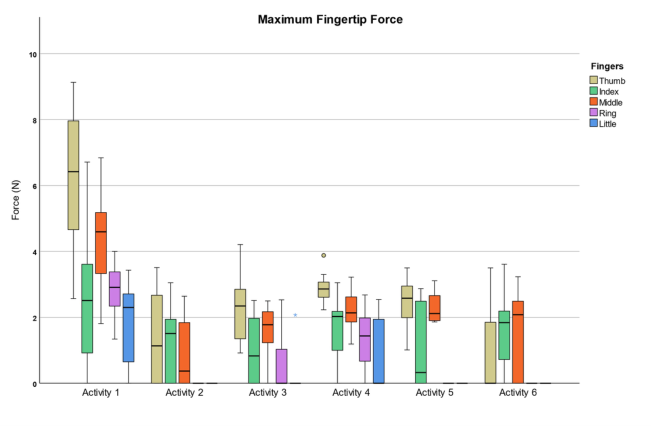
On the other hand, the maximum forces of the fingertips (Thumb, Index, Middle, Ring, Little) captured during each ARAT activity are shown in Figure 3. In Activity 1, mean maximum forces were found in the thumb fin- gertip 6.18 N and middle fingertip 4.43 N. In the case of Activity 2, maximum forces were found in the fingertip of the thumb 1.33 N and 1.40 N in the index fingertip. In Activity 3, maximum forces were found in the thumb fin- gertip 2.29 N and middle fingertip 1.40 N. In Activity 4, maximum forces were found in thumb fingertip 2.90 N, index fingertip 1.63 N and middle fingertip 2.24 N. In Activity 5, maximum forces were found in the thumb fingertip 2.43 N and middle fingertip 2.27 N. Finally, maximum forces were found in the index 1.56 N and middle fingertip 1.70 N in the Activity 6. The total fingertip force in the Activity 1 is 17.6 N, in Activity 2 3.54 N, Acti- vity 3 is 5.65 N, Activity 4 is 8.98 N, Activity 5 is 5.75 N, and Activity 6 is 4.28 N.
In this work, an ANOVA One-way was performed to determine if there is a statistically significant difference in the mean flexion angle of the finger joints (IP, MCP, PIP) based on the different activities of the Grasp Subtest. Table 1. showed a significant difference (p < .05) in the flexion angles of the index MCP, middle MCP, middle PIP, ring MCP and ring PIP between at least two Grasp activities. In contrast, no significant differences were found in the mean flexion angle of the other finger joints; therefore, these finger joints were not affected by the type of activity.
Figure 3: Boxplots of the maximal force values of all the fingers measured with the FSRs sensors.Table 1. Anova one-way summary table.
Table available in the original PDF paper.
Finger Joints Sum of Squares df Mean Square F Sig.
The results obtained in the Anova showed that there is a strong relationship when an object is grasped between the size of the object and the flexion angle of the finger joints, similar results were found (Lee & Rim, 1991) (Peña- Pitarch et al., 2020) . The MCP and PIP finger joints increased during the performance of the Activity 2 and Activity 6 due to the size of the obje- cts used in each activity. Activity 2 = 2.5 cm block and Activity 6 = stone (10×2.5×1 cm). Activity 4 and Activity 5 have similar size objects but with different shape, a block 7.5cm and a cricket ball φ = 6.5 cm respectively. At the moment that the cricket ball was grasped, we found an increment of the mean flexion angle in the index MCP 7.13°, middle MCP 4.96°, ring MCP 4.6° and little MCP 5.3° but also a decrease in the angles of index PIP 5.25° middle PIP 7.66° and ring PIP 3.5°. This is due to the fact that when a pre- cision grasp is used the fingertip position tends to form a circle independent from the object’s shape, therefore the cricket ball fits better the hand shape. The maximum forces of the fingertips allow to know the number of fingers used at the moment of grasping an object. We found a correlation between the size of the object and the fingers used. Similar observations were found
ARAT Test with Multisensory Information 105
in (Peña-Pitarch et al., 2020) where the number of fingers used to grasping an object depends on the objects radius (ρ) e.g. for 5 ≤ρ ≤12.5 mm were used 2 fingers, 12.5 ≤ρ ≤20 mm were used 3 fingers, 20 ≤ρ ≤35 mm were used 4 fingers and 35 ≤ρ ≤70 mm were used 5 fingers. The results obtai- ned showed that for the item (10 cm) corresponding to Activity 1 five fingers were used, in Activity 2 item (2.5 cm) results showed that subjects used two fingers and other three fingers. Activity 3 item (5 cm) results showed that subjects used in general three fingers and only a few four fingers. In Activity 4 item (7.5 cm) four and five fingers were used. Activity 5 item (φ = 4.5 cm) and Activity 6 (2.5 cm) three fingers were used.
CONCLUSION
In this paper we present a novel multisensory system to asses hand motion. The system allows to know the range of motion (ROM) of the finger joints and the fingertip forces during the execution of the ARAT test. The informa- tion obtained by the system will allow health care professionals and physical therapists to make a more objective assessment with the ARAT in stroke pati- ents. Although measurements with post stroke patients must be performed, these first results are promising.
ACKNOWLEDGMENT
This work was partially supported for Spanish government by the project PID2020-114819GB-I00.
REFERENCES
Ambar, R., Ahmad, M., Mohd Ali, A., & Abdul Jamil, M. (2011). Arduino based arm rehabilitation assistive device. Journal of Engineering Technology, 1(October 2017), 5–13. Chen, H. F., Lin, K. C., Wu, C. Y., & Chen, C. L. (2012). Rasch validation and
Lindsay, P. (2022). World Stroke Organization (WSO): Global Stroke Fact Sheet 2022. International Journal of Stroke, 17(1), 18–29. https://doi.org/10.1177/ 17474930211065917 Flórez, J. A., & Velásquez, A. (2010). Calibration of force sensing resistors (fsr) for static and dynamic applications. 2010 IEEE ANDESCON Conference Pro- ceedings, ANDESCON 2010, 2–7. https://doi.org/10.1109/ANDESCON.2010. 5633120 Hoda, M., Hoda, Y., Hafidh, B., & El Saddik, A. (2018). Predicting muscle
forces measurements from kinematics data using kinect in stroke rehabilitation. Multimedia Tools and Applications, 77(2), 1885–1903. https://doi.org/10.1007/ s11042-016-4274-5
Hsiao, P. C., Yang, S. Y., Lin, B. S., Lee, I. J., & Chou, W. (2015). Data glove embedded with 9-axis IMU and force sensing sensors for evaluation of hand function. Proceedings of the Annual International Conference of the IEEE Engi- neering in Medicine and Biology Society, EMBS, 2015-Novem, 4631–4634. https: //doi.org/10.1109/EMBC.2015.7319426 Hsieh, C. L., Hsueh, I. P., Chiang, F. M., & Lin, P. H. (1998). Inter-rater reliability
and validity of the Action Research arm test in stroke patients. Age and Ageing, 27(2), 107–113. https://doi.org/10.1093/ageing/27.2.107 Hsu, W. C., Sugiarto, T., Chen, J. W., & Lin, Y. J. (2018). The design and application of simplified insole-based prototypes with plantar pressure measurement for fast screening of flat-foot. Sensors (Switzerland), 18(11). https://doi.org/10.3390/ s18113617 Hussain, Z., Zainul Azlan, N., & Yusof, A. Z. Bin. (2018). Human Hand Motion
Analysis during Different Eating Activities. Applied Bionics and Biomechanics, 2018. https://doi.org/10.1155/2018/8567648 Ju, Z., & Liu, H. (2014). Human hand motion analysis with multisensory information. IEEE/ASME Transactions on Mechatronics, 19(2), 456–466. https://doi.or g/10.1109/TMECH.2013.2240312 Koh, C.-L., Hsueh, I.-P., Wang, W.-C., Sheu, C.-F., Yu, T.-Y., Wang, C.-H., & Hsieh,
C.-L. (2006). Validation of the action research arm test using item response theory in patients after stroke. Journal of Rehabilitation Medicine, 38(6), 375–380. https: //doi.org/10.1080/16501970600803252 Lee, J. W., & Rim, K. (1991). Measurement of finger joint angles and maximum finger forces during cylinder grip activity. Journal of Biomedical Engineering, 13(2), 152–162. https://doi.org/10.1016/0141-5425(91)90062-C Lyle, R. C. (1981). A performance test for assessment of upper limb function in physi-
cal rehabilitation treatment and research. International Journal of Rehabilitation Research, 4(4), 483–492. https://doi.org/10.1097/00004356-198112000-00001 Maw, J., Wong, K. Y., & Gillespie, P. (2016). Hand anatomy. British Journal of Hospital Medicine, 77(3), C34–C40. https://doi.org/10.12968/hmed.2016.77.3. C34 Peña-Pitarch, E., Costa, J. V., Martinez, J. L., Al Omar, A., Larrión, I. A., &
Tico-Falguera, N. (2018). Introductory Analysis of Human Upper Extremity After Stroke. International Journal of Privacy and Health Information Management, 7(1), 45–60. https://doi.org/10.4018/ijphim.2019010103 Peña-Pitarch, E., Magaña, J. F. P., Ticó-Falguera, N., Omar, A. Al, Larrión, I. A., & Costa, J. V. (2020). Virtual human hand: Grasps and fingertip deformation. Advances in Intelligent Systems and Computing, Vol. 975, pp. 484–492. https: //doi.org/10.1007/978-3-030-20216-3_45 Whitehead, S., & Baalbergen, E. (2019). Post-stroke rehabilitation. South Afri-
can Medical Journal, 109(2), 81–83. https://doi.org/10.7196/SAMJ.2019.v109i 2.00011 Ye, Q., Seyedi, M., Cai, Z., & Lai, D. T. H. (2015). Force-sensing glove system for measurement of hand forces during motorbike riding. International Journal of Distributed Sensor Networks, 2015. https://doi.org/10.1155/2015/545643 Yozbatiran, N., Der-Yeghiaian, L., & Cramer, S. C. (2008). A standardized appro-
ach to performing the action research arm test. Neurorehabilitation and Neural Repair, 22(1), 78–90. https://doi.org/10.1177/1545968307305353
LISTED IN THE AHFE DIGITAL BOOKSTORE CATALOGUE
Explore the complete digital volume
Digital Human Modeling and Applied Optimization
Read this individual research paper free through the original publisher, or explore the full digital proceedings book.
ISBN 978-1-958651-22-3
Explore this ISBN in the AHFE Bookstore ↗Listed in the July 2026 bookstore catalogue; search by ISBN to confirm current availability · Digital book purchase optional