Zhelin Li, Yiteng Sun, Yuguang Shao, Lijun Jiang, Jingjing Wang, Xianghong Deng (2022). 3D digital head-shaped platform construction for head acupoint massage product design. In: Ergonomics In Design. AHFE Open Access, vol. 47, pp. 523–530. https://doi.org/10.54941/ahfe1001979
Head acupoint massage products imitate human massage techniques, and act on acupuncture points on the head by means of inflating, squeezing, vibrating, and heating to promote blood circulation in the head, relieve fatigue and prevent diseases. The fit of such products to the head greatly affects the effectiveness and comfort of the massage. In order to design head acupoint massage products suitable for Chinese head shape and improve the adaptation performance of product massage structure and head acupoints, this paper studies a 3D digital head-shaped platform with complete head acupoint distribution and conducts dynamic analysis of fitting fit. Firstly, the 5th, 50th and 95th percentile 3D digital head shapes of 5 types of Chinese standard head shapes were reconstructed. Secondly, 3D distribution models of 7 meridians and 78 acupoints were established on the head shape according to the theory of traditional Chinese medicine. Finally, a head-mounted massage product module was analyzed the adaptability of acupoint matching. The problems of a head acupoint massage product were analyzed by virtual wearing in the 3D digital head-shaped platform, and the head massage product was optimized. The results showed that the inner surface of the optimized product could fit well with the head, and the acupoint massage position was accurate.
Acupressure on the head refers to pressing specific acupoints on the head with tools or massage techniques, so as to achieve the purpose of eliminating fatigue, strengthening physical health and preventing diseases (Li., 2017). By stimulating specific acupuncture points on the head, the function of the viscera can be adjusted, and diseases can be prevented and treated. The head acupoint massager imitates human massage techniques, and acts on the head acupuncture points by means of inflating, squeezing, vibrating, and heating to achieve the effect of traditional Chinese medicine physical massage. The fit of this type of product to the head greatly affects the comfort of the massage, and the accuracy of the acupoint positioning affects the effectiveness of the
massage. Long-term wearing of products that do not match the shape of the head will not only fail to achieve the effect of massage and relaxation, but even lead to chronic physical damage.
In order to achieve a good match between headwear products and head shapes, some scholars have been engaged in the measurement and statistical analysis of head data, as well as the establishment of standardized head three- dimensional models to assist product design. Such as the development of 3D head model fitting and evaluation tools based on Chinese human cephalome- tric data (Wang, Chen, et al., 2018); the development of a web-based Chinese 3D head and face data and measurement database (Wang, Yu, Chen, Yang, & Ball, 2018), creating individual heads through 3D scanning The model carries out the custom design of glasses (Zhang et al., 2016). Some scholars also used the North American anthropometric database CAESAR Database to obtain 2299 head shapes for the study of the specification classification of headwear products (Lee et al., 2018).
However, at present, when designing head-mounted products, only two- dimensional dimensions of relevant standards or three-dimensional head shapes with few samples are referred to, resulting in poor adaptability of head-mounted products. Especially when designing a head massager, the head model data lacks acupoint information, which cannot guide the design of the head acupoint massager.
With the increasing demand for head acupressure products in China, it is important to obtain 3D head data of Chinese people containing acupoint data. Therefore, this paper studies the 3D digital head shape for head acu- pressure product design and develops an analysis module to assist the design of head acupressure machine.
RECONSTRUCT HEAD MODEL WITH CUPOINT Head Model Reconstruction
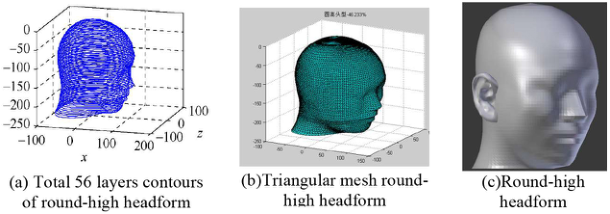
According to the parametric equation of the head contour of Chinese adult males proposed in the literature (Standardization Administration of China, 2009), a 56-layer contour of the head shape was established, as shown in Figure 1(a); then the adjacent contours were triangulated to reconstruct the circle. The 50th percentile model of five types of standard headforms (round-high, round-normal, middle-normal, middle-high, round-extra-high) were constructed. The round-high head triangular mesh model is shown in Figure 1(b). Based on the 62 The double adult male high-quality ear model was calculated to obtain the average ear model, and the ear model was atta- ched to the head model according to the ear position parameters, as shown in Fig. 1(c). The 5th and 95th percentile head models are established by scaling according to the scaling factors of the 5 types of 50th percentile head models.
Acupuncture and Meridian Distribution On the basis of reconstructing the Chinese standard head shape, using the acupoint location method of traditional Chinese medicine theory - the method of Bone Scale Method to extract features and conversion distances
3D Digital Head-Shaped Platform Construction 525
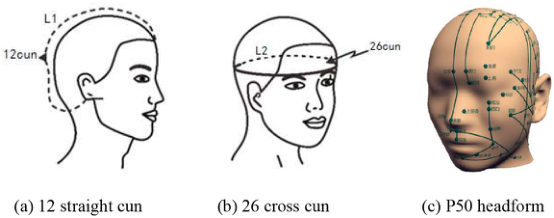
Figure 1: Three-dimensional head model.Figure 2: Meridians and acupoints on round-high headform.
(Yang., 1984), the distribution model of the meridians and acupoints of the head was established. Taking the 50th percentile round-high standard head shape as an example, the Bone Scale Method indicates that the folded measu- rement from the front hairline to the back hairline is 12 straight cun, and the head circumference is 26 cross cun (Yang., 1984), as shown in Figure 2(a) and 2(b). In the software, the front hairline to rear hairline size L1=330.5 mm and the head circumference size L2=558.6 mm of the P50 round-high stan- dard head shape were measured by the method of drawing line fitting, and the conversion results were 1 straight cun = 27.5 mm and 1 cross cun = 21.5 mm. According to this method, 78 acupuncture points on the 5th, 50th and 95th percentile head shapes of 5 types of head shapes were determined, and the acupoints were connected into 7 meridians according to the distribution of the meridians. Mark the acupoint name and export the model to a json format file, which can be loaded and displayed by the Three.js function in the browser. As shown in Figure 2(c), the 50th percentile of the round-high headform was established.
AUXILIARY DESIGN MODULE Based on WebGL, this paper develops a head-shaped platform for assisting the design of head acupoint massage products. Using Three.js as the 3D engine, the Chinese standard head model with acupoint information is loa- ded into the web page. By importing the digital model of the product, the gap between the product and the head and the matching of acupoints can be analyzed.
Gap Analysis The gap analysis function of this module is used to verify whether the product fits the head. By operating the cutting slider, the user can continuously cut the headwear product and head model on multiple datum planes. In turn, it helps users to discover the structural design problems of the inner part of the product in contact with the head. At the same time, the outline of the head shape and the product can be drawn through the distance button, and the distance between the outline of the head shape and the product outline can be calculated.
Acupoint Space Analysis The 3D digital head shape platform can analyze the positional relationship between the product and the acupuncture points on the head. By checking the distribution positions of five head-shaped acupoints and meridians, it can accurately reflect the distribution of acupoints of different head types. At the same time, the acupoints will change with the size of the head shape. When the head shape changes at the 5th to 95th percentile, the distribution position of the acupuncture points related to the head massager will be calculated and dynamically displayed in real time. Visual assessment of acupoint suitability.
DESIGN EXAMPLE In this paper, a head massager with a large market sales volume is used as an example to verify the effectiveness of the module. The reverse engineering method is used to reconstruct the 3D model of the product. After importing the analysis platform, the standard Chinese 3D digital head shape try it on, analyze the adaptability of the product and optimize the design.
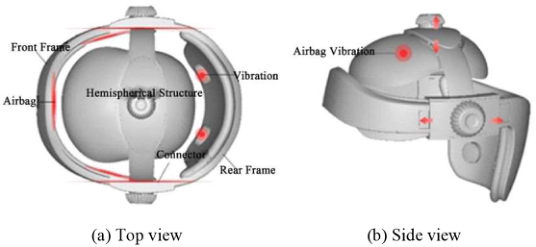
Case Analysis The head massager selected in this paper is shown in Figure 3. It is mainly composed of front and rear frames and the top hemisphere structure. The front and rear, upper and lower dimensions of the massager can be adjusted, and the width is a fixed distance. The front end, left and right sides of the product are airbag devices, the top is an airbag and a vibration device, and the back half is a two-vibration device, which is used to squeeze and massage the acupuncture points on the head.
The three-dimensional models of the minimum, medium and maximum size states of the head massager were obtained through modeling, and then the three-dimensional head massager models were compared with the 5th, 50th, and 95th head massager models of different head types in the auxili- ary design module. This article takes the round-high head type (population coverage rate of 46.23%) as an example to analyze the adaptability of the massager.
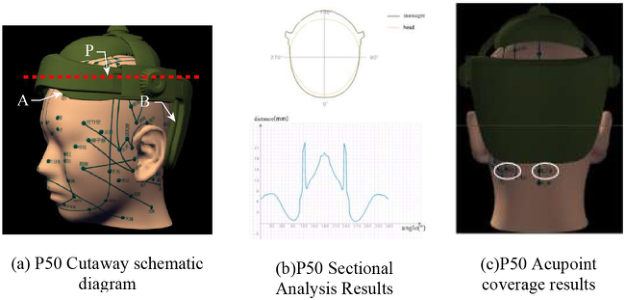
Use the gap analysis function provided by the auxiliary platform to analyze the fitness of the massager and the head model. In this analysis, the horizon- tal plane where the main contact point between the massager and the head is located is selected as the cutting plane, as shown by the dotted line in
3D Digital Head-Shaped Platform Construction 527
Figure 3: Head massager 3 model.Figure 4: Adaptability analysis of head massager.
Figure 4(a). At the position shown, the P plane cuts the 3 percentile head shapes to obtain 3 sectional results. The cross-sectional results show that in the left and right direction, the width of the product is a fixed distance, as shown in Figure 4(b).From the 5th percentile to the 95th percentile, the distance between the product and the left and right sides of the head beco- mes smaller and smaller, or even interference; the massager is in the front and rear direction (A and B in the Figure 4(a)), when the distance between the front and rear of the massager is gradually increased, the fit between the product and the deformed surface of the head is getting worse and worse, resulting in stress on the support part Concentrated, uncomfortable to wear.
The head acupoints related to the head massager are 7 acupoints 7 acu- points Sishencong (EX-HN1), Baihui (DU 20), Sizhudong (SJ 23), Yangbai (GB 14), Temple (EX-HN5), Fengchi (GB 20) and Fengfu (DU 16) (Huang, 2009). Firstly, the acupoint model provided by the auxiliary platform was used to analyze the coverage of the acupoints by the massager when the size was adjusted, as shown in Figure 4(c). The results show that this massa- ger lacks pressure on the Temple (EX-HN5) and Sizhudong (SJ 23) on both sides of the forehead. As the head shape gradually increases from the 5th to 95th percentile, the massager gradually cannot press the Fengchi (GB 20) and Fengfu (DU 16) points near the back of the head. At the same time,
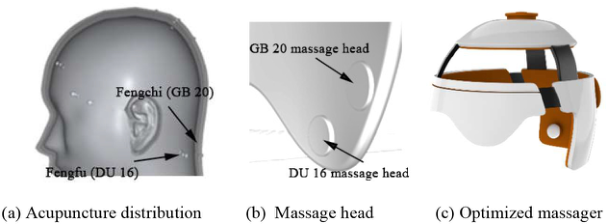
Figure 5: Redesign of acupoint adaptation of massager.
this massager uses the wrapped airbag to squeeze a large area, which cannot achieve precise pressing on specific acupoints.
Product Redesign With the aid of the analysis of the auxiliary design module, it is found that there are two main problems with this head massager: (1) with the change of the head size, the pressure points of the massager are inaccurate; (2) the mas- sager has a low degree of fit with the head, it is prone to stress concentration or unreliable matching, resulting in uncomfortable wearing.
To this end, this paper first uses a cylinder to envelop the same acupoint on different percentile head shapes, the diameter of the cylinder covers the variation range of the acupoint, and then the outline of the cylinder is proje- cted on the inner surface of the air cushion liner, The distribution area of the massage heads on the inner surface of the model can be obtained. As long as the size of the massage contact covers this area, it can be ensured that even if the position of the acupoint is shifted after the head shape is changed, the massage head can be accurately pressed, as shown in Figure 5(a) and 5(b).
Based on the sectional analysis diagram, adjust the inner plane shape of the massager to make it fit as closely as possible with the head surface while adjusting the size of the massager. Through continuous iteration, avoid inter- ference between the massager and the head or the gap is too large. The optimized head acupuncture massager is shown in Figure 5(c).
Import the optimized massager model into the auxiliary design module for adaptation analysis. The results show that the optimized massager fits the shape of the head better, and when the massager adjusts the size, it can always keep a good fit with the head in the left and right directions, and there is no interference between the massager and the head. At the same time, the coverage of the massage contacts of the massager was analyzed. Adjust the optimized massager to three sizes of large, medium and small, and then try it on with different percentile head shapes of the round-high headform. Use the material function on the platform to reduce the transparency of the massager model, so that we can see the coverage of the acupoints by the contacts inside the massager. The results show that the massage contacts designed according to the envelope of the acupoint change trajectory can achieve precise pres- sing on the acupoints, and can still cover the changes well when the size and
3D Digital Head-Shaped Platform Construction 529
structure of the massager are changed to adapt to different head types. The position of the specific acupuncture point can always be pressed to the point that needs to be pressed. Therefore, the optimized design of the head massa- ger based on the auxiliary design module of the headwear product improves the structure and function of the existing massager to a certain extent, and solves some problems of fit and adaptation of the existing massager.
CONCLUSION
The adaptability of headwear products affects the comfort and safety of wea- ring, and how to improve the adaptability of products has become the focus of research. Based on the national standard data, this paper reconstructs the 3D digital model of the five head shapes of the Chinese, and uses Three.js to develop a WebGL-aided design platform, which integrates the digital head shape and the distribution of head acupoints and meridians, which enables designers to easily the three-dimensional head dimensions of the Chinese were obtained for design analysis. Taking a head massager product as an example, the adaptability analysis was carried out, and it was found that there were problems in the fit between the product and the head. The effectiveness of the auxiliary design module is verified through optimized design and before and after comparative analysis. It can be seen that the auxiliary design module can provide a reference for the adaptability design of headwear products, and has certain practicability. In the follow-up research, more adaptability analysis functions will be added, quantitative evaluation indicators of fitting gap and interference will be established, and digital simulation of the pressure distribution of the product on the head will be carried out, and a compreh- ensive evaluation and analysis of the comfort of headwear products will be carried out.
ACKNOWLEDGMENT
The research is supported by the Natural Science Foundation of Guangdong Province (grant 2021A1515010934).
REFERENCES
Huang, Longxiang. (2009). World Health Organization Standard Acupuncture Meridian Positioning: People’s Health Publishing House. Lee, W., Lee, B., Yang, X., Jung, H., Bok, I., Kim, C., . . . You, H. (2018). A 3D Anth-
ropometric Sizing Analysis System Based on North American CAESAR 3D Scan Data for Design of Head Wearable Products. Computers & Industrial Engineering, 117(MAR.), 121–130. Li, Ge. (2017). Illustrated Head Massage Therapy. Chemical Industry Press Standardization Administration of China,3D size of adult male head, GB/T 23461- 2009 C.F.R. (2009) Wang, H., Chen, W., Li, Y., Yu, Y., Yang, W., & Ball, R. (2018). A 3D Head Model
Fitting Method Using Chinese Head Anthropometric Data. Paper presented at the International Conference on Cross-Cultural Design.
Wang, H., Yu, Y., Chen, W., Yang, W., & Ball, R. (2018). Responsive web design for Chinese head and facial database. Paper presented at the International Conference on Cross-Cultural Design. Yang, Jiasan. (1984). Acupuncture. Shanghai Science and Technology Press. Zhang, Jiaxin., Guan, Shaoping., Li, Zhelin., Zhang, Xiaomin., Jiang, Lijun., Yu,
Guangzheng. (2016). Research on head morphological parameters based on the action area of glasses. Chinese Journal of Graphics, 37(3), 7.
LISTED IN THE AHFE DIGITAL BOOKSTORE CATALOGUE
Explore the complete digital volume
Ergonomics In Design
Read this individual research paper free through the original publisher, or explore the full digital proceedings book.
ISBN 978-1-958651-23-0
Explore this ISBN in the AHFE Bookstore ↗Listed in the July 2026 bookstore catalogue; search by ISBN to confirm current availability · Digital book purchase optional