Neha Mehra, Sandhya Rani, Promila Sharma, Pratibha Joshi (2019). Ergonomic Assessment of Activities of Front Office Worker in Selected Hospitality Units and Record Related Health. In: Advances in Safety Management and Human Factors. AHFE Open Access, vol. 5. https://doi.org/10.54941/ahfe100150
Often when we imagine the kind of workers who get workplace injuries, we think of those who need to exert a lot of physical energy on the job. It is true that employees in these work environments may be at greater risk for injury, but office workers are also at risk. Front Office work is rapidly changing, as new developments in computer technology come along which can make our jobs easier, but which also can present new problems for both management and employees. There is enough information contained here to allow a single employee to set up their own workstation to suit the way they work. This paper provides with the information and tools necessary to analyze office jobs related health problems. A descriptive research enumerates the existing conditions in which the researcher has no control over the variables and can report only actual conditions. The interview schedule was found to be an appropriate tool, which would adequately gather information pertaining to research work. Considering the objective of the study, research was carried out at Pancham Hotel of Bareilly. A sample size is a definite plan for obtaining a sample from a given population. Total sample sizes of 30 were selected. Many office injuries are caused by the repetitive tasks that put strain on our muscles and joints. There are several health related problems faced by office workers which affect their daily working schedule such as chronic back pain, gastric bronchial, asthma, diabetes, depression, arthritis, anaemia and headache. Sixty percent respondents quite seldom suffered from digestion difficulties whereas 12 percent respondents quite often and only 16 percent respondent almost always suffered from digestion difficulties. Several research studies reveals that gastrointestinal complaints of gastric upset, gas, constipation, poor eating etc. are strongly correlated with front office work.
Often when we imagine the kind of workers who get workplace injuries, we think of those who need to exert a lot of physical energy on the job. It is true that employees in these work environments may be at greater risk for injury, but office workers are also at risk.
In the hotel industry, the front office welcomes guests to the accommodation section: meeting and greeting them, taking and organizing reservations, allocating check in and out of rooms, organizing porter service, issuing keys and other security arrangements, passing on messages to customers and settling the accounts. In Indian professional sports, the term refers to upper management of a club, especially player personnel decision-makers.
Objectives
1) Demographic profile of the workers.
2) Health related problems of the workers.
METHODOLOGY
Methodology is a crucial step of research as it directly influences the whole research and its findings. Appropriate research methodology and skilful management of the same are imperative in the successful execution of the research project. It forms an important part of any research venture and is the way to systematically solve the research problems. Descriptive research design is concerned with analysis of the relationship among variables and generalization. A descriptive research enumerates the existing conditions in which the researcher has no control over the variables and can report only actual conditions. The interview schedule was found to be an appropriate tool, which would adequately gather information pertaining to research work. Considering the objective of the study, research was carried out at Pancham Hotel of Bareilly. A sample size is a definite plan for obtaining a sample from a given population. Total sample sizes of 30 were selected.
Results and Discussion
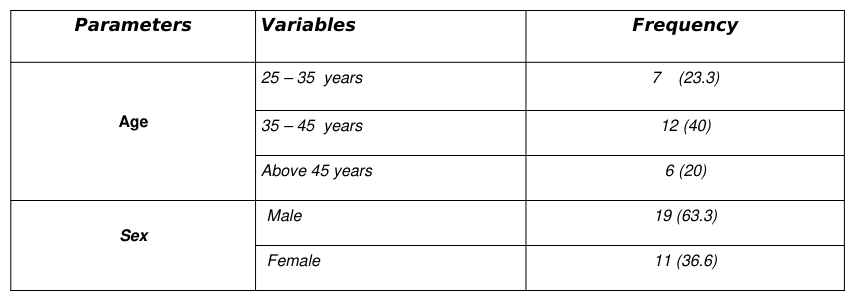
Age determines the maturity of an individual and has a bearing on the thinking, experience and exposure of a person that is achieved at different stages of life. The age of the workers were categorized into four categories viz. 25-35 years, 35-45 years and above 45 years. Table 1. Clearly envisages that a total of 23.3 percent of the workers were found to be in the age group of 25-35 years followed by 40 percent in the age group of 35-45 years, 20 percent of the workers were found in the age group of above 45 years.
Table 1: Demographic profile of the workers (N=30) Parameters Variables Frequency
Quite a big number of respondents were found to be having an educational qualification up to Graduate (70 percent) and only a small number of respondents were educated up to Postgraduate (30 percent). A good number of respondents (50 percent) were found to have an experience of working for 10 – 15 working years.
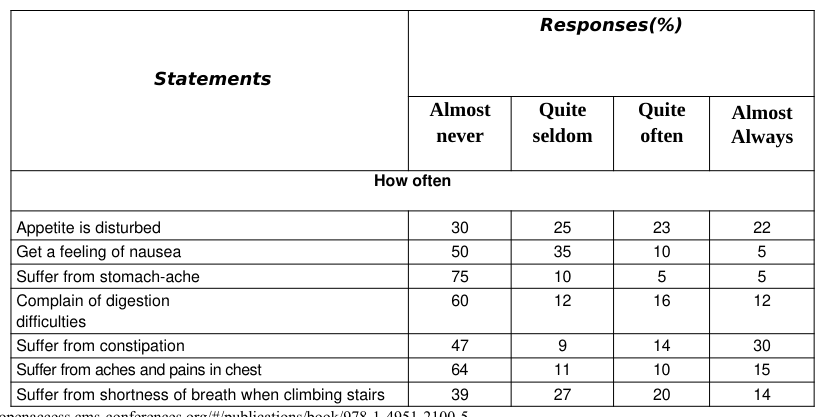
Table 2: Medical profile of the front office workers Responses(%)
Health related problems of the front office workers revealed that, 30 percent respondent reported that their appetite almost never disturbed during the working period. One fourth of the total respondent said that their appetite was quite seldom disturbed and few reported that their appetite was quite often/almost always disturbed during work period. Approximately half of the total respondents, reported that they almost never felt nausea between their shifts systems and only 35 percent respondent felt quite seldom nausea during their shifts systems if there was too much suffocation or more pressure at work. Maximum respondent (75 percent) responded that they almost never suffered from stomach problem and 10 percent respondents quite seldom had any such problems whereas 5 percent respondent quite often suffered from their stomach-ache. Sixty percent respondents quite seldom suffered from digestion difficulties whereas 12 percent respondents quite often and only 16 percent respondent almost always suffered from digestion difficulties. Several results of Andlauer et al 1979; Reinberg 1986; Oginska et al 1993, reveals that gastrointestinal complaints of gastric upset, gas, constipation, poor eating etc. are strongly correlated with front office work.
Data pertaining to constipation problems amongst sample population reveals that 47 percent respondents quite often suffer from this problem followed by 9 percent respondents almost always suffer from constipation. Less than one fourth respondents of the total quite seldom suffer from this problem. Sixty four percent respondents were of opinion that they almost never suffered from aches and pains in their chest. Only 11 percent responded that they felt quite seldom ache in their chest. Thirty nine percent respondents gave positive response to suffering from shortness of breath when climbing the stairs normally and 17 percent respondent quite seldom suffered from shortness of breath whereas 20 percent respondents quite often suffered from shortness of breath when climbing the stairs normally.
High blood pressure as an indicator of health related problem was reported by twenty seven percent of the total respondents. Whereas 16 percent respondents had almost never suffered from high blood pressure. An irregular eating habit is one of the major reasons responsible for gain in weight amongst rotational workers (Carter, J. B. and Banister, E. W. 2007). More than 31 percent of the total respondents have put on weight since beginning of front office work. Forty-five felt that they have not gained weight since beginning of job. Similar results have been reported by Yuichi et al. 2001.
All the responses of the respondents, 34 percent responded that they almost never suffered from chronic back pain, 21 percent respondents quite seldom and 10 percent quite often suffered from chronic back pain. Most of the respondents in both the categories were of same opinion that gastric problem aggravated with front office work. Of all the selected respondents 25 percent respondents responded that they almost never suffered from bronchial asthma. Thirty one percent respondents responded that they almost never suffered from depression and only 26 percent quite seldom suffered from depression. Responses related to anaemia reveal that 48 percent responded that they almost never suffered from anaemia and 29 percent respondents quite seldom and 19 per cent quite often and 4 percent almost always suffered from anaemia. Approximately 26 percent responded that they quite seldom suffered from headache and 16 percent quite often and 14 percent almost always suffered from headache.
Tabulating the responses of the symptoms of anxiety, 48 percent respondents reported that they almost never felt their heart beat increased during anxiety and 20 percent respondents quite seldom and only 16 per cent quite often felt that their heart beat increased during anxiety. Forty one percent respondents responded that they almost never felt diarrhoea and jittery in body.
Data pertaining to use of medicines for prolonged period revealed that cent percent respondents almost never used any sleeping tablets, anti-depressants and heart medicines. Forty one percent responded that they almost never used drugs to control high blood pressure and 20 percent quite seldom used blood pressure medicines. Few were quite often or almost always taking drugs to control high blood pressure. Thirty one percent respondents almost never used vitamins or tonics, and 21 percent quite seldom and 10 percent quite often.
Twenty nine percent of the total respondent reported that almost never used pain killer and 31 per cent quite seldom used and 12 percent quite often used pain killer for relieving pain. Thirty nine percent respondents stated that they almost never used hormonal tablets and 26 percent quite seldom and 21 percent used quite often respondents almost always used hormones tablets.
CONCLUSIONS
Front office refers to a company's departments that come in contact with clients, including the marketing, sales, and service departments. Many office injuries are caused by the repetitive tasks that put strain on our muscles and joints. There are several health related problems faced by office workers which affect their daily working schedule such as chronic back pain, gastric bronchial, asthma, diabetes, depression, arthritis, anaemia and headache.
REFERENCES
Booher, H.R., Minninger, J. (2003), “Human systems integration in army systems acquisition”, in: Handbook of human systems integration, Booher, Harold (Ed.). pp. 663-698 Carol Boyd (2009), “Shift work and cardiovascular disease”. Scandinavian Journal of Work and Environmental Health, 10:409–
414. Carter, J.B., Banister, E.W. (2007). “Interactions between the brain and the immune system” .Annual Review of Pharmacol Toxicol, 30: 561-602. Cooper, C.L., Cartwright, S. (2010), “Ergonomics and Development”. Journal of Physiology, 75: 507–512. Geldart, S. (2001),“Individual difference correlates of night work and shift-work rotation”. Personality and Individual
Differences, 26(5), 941-959. Korhonan, T. et al. (2002). “Psychoneuroimmunology: interactions between the nervous system and the immune system”. The Lancet, 345: 99-102.
LISTED IN THE AHFE DIGITAL BOOKSTORE CATALOGUE
Explore the complete digital volume
Advances in Safety Management and Human Factors
Read this individual research paper free through the original publisher, or explore the full digital proceedings book.
ISBN 978-1-4951-2100-5
Explore this ISBN in the AHFE Bookstore ↗Listed in the July 2026 bookstore catalogue; search by ISBN to confirm current availability · Digital book purchase optional