Janki Joshi, Promila Sharma (2020). Risk Among Hill Families of Mountain Region of Uttarakahnd, India. In: Advances in Social and Organizational Factors. AHFE Open Access, vol. 9. https://doi.org/10.54941/ahfe100342
The present study was conducted in mountain region of Uttarakhand, a hilly state of India. The objective of the study was to find the injury and accidents data due to poor lighting. It was assumed that injuries and accidents among hill people occur due to poor lighting. For this purpose descriptive research design was used. In Uttarakhand state, districts i.e Almora and Nainital were selected purposively from which purposive selection of 4 villages was done. From each village, 30 families were selected by simple random sampling technique without replacement to make a total sample of 120 families. The data was collected through interview schedule and observation. Descriptive and statistical analysis of data was done with the help of frequency, per cent and chi-square test respectively. The records focused that main accidents and injuries in last 10 years due to poor lighting were fall and slip outside the house, catching of fire during cooking and burning of finger while lighting kerosene lamp and cutting finger during vegetable cutting, animal/snake bite, attack of wild animate, catching fire to the cattle and burning of cattle with the use of kerosene lamp. The results were found to be significant at p<0.05, indicating that accidents like fall/slip during fetching fodder, fuel and water, accidents in kitchen, cases of wild animals/snake bite and other accidents dependent on availability of light. It was concluded that injuries and accidents among hill people occur due to poor lighting.
Uttarakhand is a hilly state of India comprised of 13 districts. Out of these 13 districts, nine districts comprise the hill region of the state. Here villages are so remote those basic services such as lighting which is available either in minimum quantity or not at all. In such harsh situation people are really sufferer and prone to many accidents and injuries like fall and slip on the way in the absence of sufficient light.
Generally families use kerosene lamp and poke some firewood into a fuming chulha to cook dinner. Both the lamp and the chulha fill up the house with hazardous smoke, putting at risk the health of the woman and also her children whom she tries to attend to while cooking. Burning chilka, or pinewood, is the traditional source of light in remote villages, yet the health effects of indoor smoke pollution are alleviated with clean energy, smoke affected children’s eyes, nose and mouth. These types of light are expensive, dangerous, and harmful to the environment. They also have a negative impact upon people's health, education, and security. Kerosene is costly, a fire hazard, and the fumes from the lanterns are highly toxic, especially for women and children who spend more time in enclosed spaces where the fumes are concentrated. In addition these sources do not provide enough light for a child to study. Children spend a majority of their day at school. By the time they return home, in the night, they are unable to study without light and can never do their homework at home because of the absence of a light source. This makes it very difficult for these children to have proper education. This lack of education is what can have the largest long term effect on a country.
Some people also light dry sticks as a torch for checking on the animals at night. The flammable hay can easily catch on fire. Studies have shown that there are links between biomass combustion and respiratory illness in women and children. There are also numbers of accidents and injuries and problem associated with poor lighting system but limited data are available with respect to injuries and accidents and health problem occurred due to poor lighting in hill region especially in Uttarakhand. Present study filled this research gap. Considering the above facts in the mind, the investigation entitled “Effect of poor light on the hill families of Uttakahand” was proposed with the objective to find out the injuries, accidents and related problems due to poor lighting system.
MATERIALS AND METHODS
To achieve the above objective descriptive research design was selected to see the effect of poor light on the hill families. The multi-stage, Purposive cum random sampling techniques was used to select the study area i.e. state, districts, blocks, villages, families. The Uttarakhand state was selected purposively. Districts like Almora and Nainital were selected purposively from the state Hawalbag and Bhimtal block from district Amora and Nanital respectively were selected purposively. The unit of enquiry was family and the key informant was head of the family. Total sample size comprised of 120 families selected randomly from the four villages which were selected purposively from the above blocks. Pre-coded interview schedule which include three point rating scale to assess the level of injury, accident and related problems due to poor lighting in terms of rarely, occasionally and frequently was used as an instrument for collecting data. Collected data was coded into the coding sheets and was then transferred into tabular form and analyzed using descriptive statistics.
RECULTS AND DISCUSSION Injuries and accidents due to poor lighting
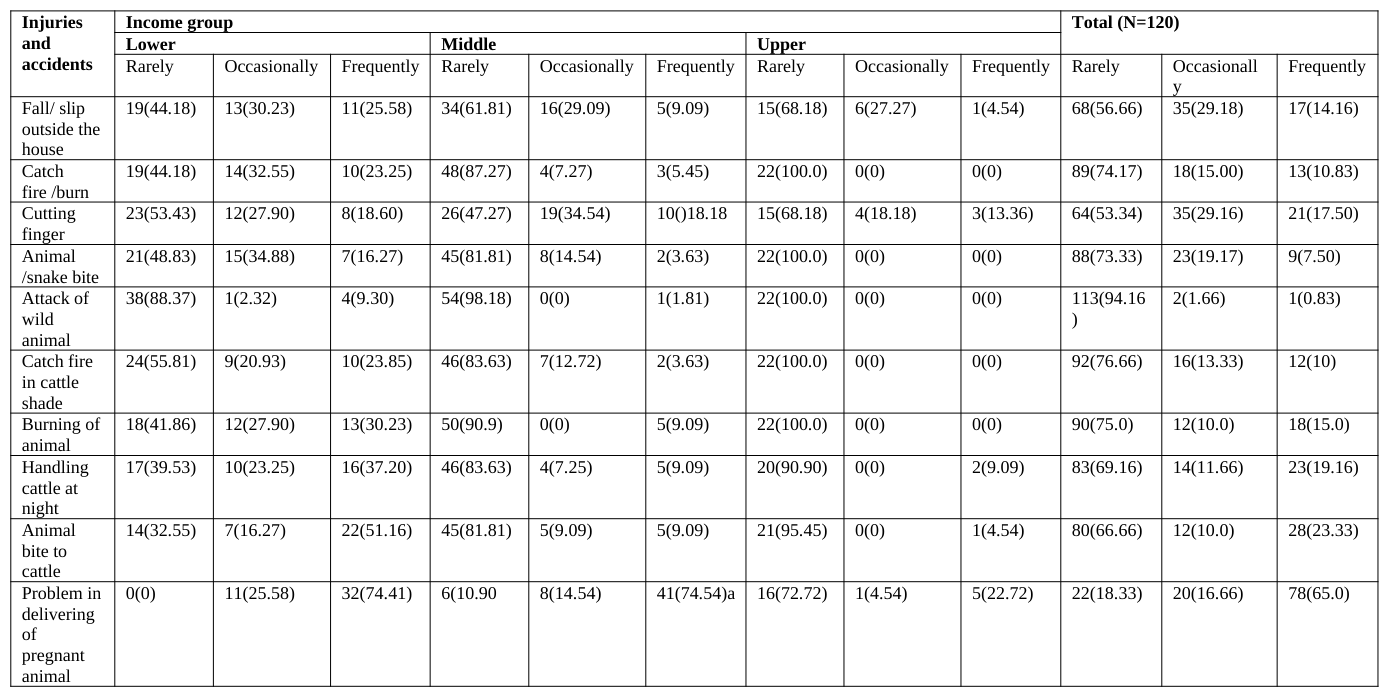
Fall and slip out side About 14 per cent families reported that the occurrence of fall and slip was frequent due to poor lighting. While comparing different income group it was found that among 25.85 per cent families from the lower income group fall and slip occurred frequently. The fall and slip might occur due to poor lighting as well as combination with countless terraces outside.
Catch fire/ burn It was found that 10.38 per cent respondents reported that catching of fire during cooking and burning of finger while lighting kerosene lamp in the absence of lighting was frequent in their family. It was found that in lower income group and middle income group this occurred frequently among 23.25 per cent and 5.45 per cent families respectively. Whereas in upper income group all the families said that it occurred rarely.
Cutting finger It was found that in the absence of lighting cutting finger during vegetable cutting was frequent among about 18 per cent families While comparing among different income group it was observed that in lower income group and middle income group cutting figure during vegetable cutting was frequent in approximately 19 per cent families while in upper income group among all the families this accident occurred rarely.
Animal/snake bite It was evident from the Table that in the absence of lighting, the case of animal/snake bite was frequent among about 10 per cent families. When comparison was made it was observed that such cases were frequent in 16.27 percent families from lower income group and 3.63 per cent families from middle income group. While in upper income group it was rare in all the families.
It was found that in mountain region during night wild animal used to attack on the human. From the table it was observed that attack of wild animal was frequent among 0.83 per cent families. While comparing among different income group it was found that this phenomenon was frequent only among 9.3 per cent families in lower income group, 1.81 per cent families in middle income group while in upper income group it was rare.
Psychological fear Darkness leads to fear among everywhere. This fear is related to slip, fall, wild animal and robber. It is nothing but weaken the person. The data presented in table interpreted that among all about 48.33per cent families frequently had fear of dark. When comparing among different income groups it was seen about 60.46 per cent families among lower income group and 43.63per cent families in middle income group and 27.27 per cent families of upper income group had frequently fear of dark.
Catching fire in cattle shade Generally it is possible that in the absence of proper lighting, using chillka and kerosene lamp leads to chance of catching fire. Data in the table revealed that in the absence of proper lighting catching fire in cattle shade was frequent among 10 per cent families. It was found that this problem was frequent only among 23.85 per cent families and 3.63 per cent families from lower income group and middle income group respectively while among upper income group it was observed rare among all the families.
Burning of animal Data pertaining to the catching fire to the cattle and burning of cattle due to use of kerosene lamp revealed that it was frequent among 10.0 per cent families. It was clear from the table shows that it was frequent among 30.23 per cent families of low income group and only 9.09 per cent families of middle income group. But it was found to be rare among all the families of upper income group.
Handling cattle at night It was observed that problem in handling cattle at night was frequent among 19.16 per cent families. While comparing among different income group it was found that difficulty in handling cattle at night was frequent in 37.20 per cent families in lower income group whereas 9.09 per cent families of middle income group and upper income group.
Animal bite to cattle It was evident from the table that in the absence of lighting the case of animal/snake bite to their cattle was frequent in 11.58 per cent families. When comparison was made it was observed that such cases were frequent in 60.71 percent families from lower income groups and 7.69 per cent families from middle income group. While in upper income group it occurred frequently among only 4.54 per cent families.
Problem in delivering of pregnant animal Over all analysis showed that 65 percent respondents reported that they frequently faced problem while handling the cattle during delivery due to poor lighting. It was found that about 75 per cent respondents from lower and middle income group frequently faced this problem. While among upper income group only 22.72 per cent families frequently faced this problem.
On the whole it was found that problem in studying was the main frequently occurred problem due to poor lighting system. It might be due to insufficient illumination of kerosene lamp and candle which were used for studying as it was discussed in the study earlier.
Testing of Hypotheses In order to test the hypotheses statistically the null hypotheses were formulated for each hypothesis. Chi-square test and paired t- test were applied for statistical analysis.
Injuries and accidents among hill people occur due to Poor lighting. Chi-square test was applied to see the association between occurrence of injuries, accidents and related problems in kitchen, cattle shed, outside and in home and availability and sufficiency of light. The results are presented in the Table 2.
Proceedings of the 5th International Conference on Applied Human Factors and Ergonomics AHFE 2014, Kraków, Poland 19-23 July 2014 Edited by T. Ahram, W. Karwowski and T. Marek
Table 1: Occurrence of accidents/injuries and related problems due to poor lighting
https://openaccess.cms-conferences.org/#/publications/book/978-1-4951-2102-9 Social and Organizational Factors (2020)
Proceedings of the 5th International Conference on Applied Human Factors and Ergonomics AHFE 2014, Kraków, Poland 19-23 July 2014 Edited by T. Ahram, W. Karwowski and T. Marek
Occurrence of accidents/ injuries due to poor lighting among family
100
Rarely Occasionally Frequently
90
80
70
60
50
Family (%)
40
30
20
10
0
Fall/ slip Catch fire Cutting finger Animal /snake
Attack of w ild Catch fire in Burning of
Handling cattle Animal bite to Problem in
outside the /burn
bite animal cattle shade
animal at night cattle
delivering of
house
pregnant animal
Accidents/ Injuries
Figure: 1 Occurrence of accidents/ injuries and problem due to poor lighting among family
Table: 2 Injuries and accidents among hill people occur due to Poor lighting
Null hypothesis was formulated to see the association between the availability of light and occurrence of accidents in kitchen, occurrence of cases of wild animals/snake bite, occurrence of problem while handling cattle, Occurrence of problem while handling cattle during delivery at night and Occurrence of fall/slip during fetching of fuel, fodder and water. The results were found to be significant at p<0.05 indicated that there was significant association between occurrence of accidents in kitchen, occurrence of cases of wild animals/snake bite, occurrence of problem while handling cattle, Occurrence of problem while handling cattle during delivery at night and Occurrence of fall/slip during fetching of fuel, fodder and water and availability /sufficiency of light.
On the whole it was found that problems were faced by families in every areas of the house including kitchen while cooking, handling cattle in cattle shade and outside the house while fetching fodder, fuel and during late evening and night time in the absence of proper lighting.
It was reported by Barr (2010) that kerosene had adverse effects and it was a barrier to education. Light from Kerosene lamps is poor and inefficient (only 2 to 4 lumens compared to a 60-watt bulb-900 lumens). Poor lighting
Proceedings of the 5th International Conference on Applied Human Factors and Ergonomics AHFE 2014, Kraków, Poland 19-23 July 2014 Edited by T. Ahram, W. Karwowski and T. Marek
According to Mock et al (2008) fire-related burns are responsible for 300,000 deaths every year, 95 percent of which happen in low- and middle-income countries. It was found that that cooking sources as well as lighting sources, including kerosene lamps, were largely responsible for these tragedies. It was common for children to study in bed with a kerosene candle on the edge of their headboards.
REFERENCES
Barr, N. (2010) The Adverse Effect of Kerosene. Illumination Solar. 1p. Chikar, S. (2007) Inclusive Growth in Hilly Regions: Priorities for the Uttarakhand Economy. Working Paper Series E/281/2007. Ghosh , A., Chikar, S. and Sharma, S. (2007) Inequalities of Income Opportunity in a Hilly State: A Study of Uttarakhand. IEG
Working Paper Series E/287/2007. Joseph, A. (2006) The Impact of Light on Outcomes in Healthcare Settings. The Center for Health Design. Aug;(2):1. Mock , C., Peck, M., Peden, M. and Krug, E. (2008) A WHO plan for burn prevention and care. Geneva, World Health Organization.
LISTED IN THE AHFE DIGITAL BOOKSTORE CATALOGUE
Explore the complete digital volume
Advances in Social and Organizational Factors
Read this individual research paper free through the original publisher, or explore the full digital proceedings book.
ISBN 978-1-4951-2102-9
Explore this ISBN in the AHFE Bookstore ↗Listed in the July 2026 bookstore catalogue; search by ISBN to confirm current availability · Digital book purchase optional