Kavita Narwal, Promila Sharma, Pratibha Joshi (2020). Risk Assessment of Forging Workers in Unorganized Sector of Uttrakhand, India. In: Advances in Social and Organizational Factors. AHFE Open Access, vol. 9. https://doi.org/10.54941/ahfe100347
A blacksmith is a person who forges, or shapes, metal by first heating it until it is red-hot, then uses tools like chisels and hammers to force the metal into the shape he desires. Blacksmiths usually work standing up and have to bend over to work on pieces of metal. The work can involve heavy lifting, use of power tools such as power hammers, drills, air chisels and hydraulic presses. However, use of such power tools and poor body posture lead to MSDs. Musculoskeletal disorders (MSDs) are common health problem throughout the world and a major cause of disability in the workplace. MSDs are found due to Inappropriate and poor working postures, lack of task variation, poor ergonomic design of work places, and poor design of plant layout, long working hours, low salaries and awkward schedules are all areas where relatively simple intervention can significantly reduce the rate of exposure to MSDs. They also deal with extremely hot objects and face a constant worry about fire and heat. The blacksmiths perform repetitive hammering jobs that give shape to the instruments. This type of job not only requires skill but is also time consuming. Hammering jobs are responsible for most of the incidents. In Iron & Steel and other manufacturing industries, foundries and forges produce a lots of pollutants in the environment – both working and ambient environment. In these processes, metals are extracted and produced from ores by various metallurgical processes and processes for moulding, melting and castings etc. are accompanied by evolution of heat, noise, dust fines, fly-ash, oxides of Nitrogen, Sulphur and metals. Particulate matters are generated in large quantities when preparing mould core sands and moulds melting metals, pouring metal, knocking out poured moulds and loading and unloading raw materials. Here metals are given a specific shape by metal castings for various engineering purposes. Gaseous matters like gases, vapours, fumes and smoke are produced during melting and pouring operations. The major pollutants are emitted from various work areas in Foundry i.e. Pattern shop, Sand preparation, moulding and core making, mould drying and ladle heating, cupola, electric arc furnace, pouring and mould cooling, knockout, fettling, heat treatment etc. In addition, various air pollutants and noise pollutants (Davis, 2002) are produced from forge shops and other manufacturing industrial units. So keeping all these factors in mind, a study was conducted to assess the risks involved among forging workers of Uttrakhand state of India. For this purpose 120 workers were taken through snowball technique. The data revealed that the most common problem faced by the workers was improper working posture and inappropriate working environment. Due to poorly designed work place, working environment, and working tools, workers physiological and psychological cost of work was high they reported to have health problems like back ache, shoulder ache and difficulty in movement of hands while in operation. Workers were also observed to be found irritated and restless.
A blacksmith is a person who forges, or shapes, metal by first heating it until it is red-hot, then uses tools like chisels and hammers to force the metal into the shape he desires. Blacksmiths usually work standing up and have to bend over to work on pieces of metal. The work can involve heavy lifting, use of power tools such as power hammers, drills, air chisels and hydraulic presses. However, use of such power tools and poor body posture lead to MSDs. Musculoskeletal disorders (MSDs) are common health problem throughout the world and a major cause of disability in the workplace. WMSDs are one of the biggest occupational health problems in industrialized countries (Hagberg et al., 1995). MSDs are found due to Inappropriate and poor working postures, lack of task variation, poor ergonomic design of work places, and poor design of plant layout, long working hours, low salaries and awkward schedules are all areas where relatively simple intervention can significantly reduce the rate of exposure to MSDs.
The casting and forging sectors of the country constitute a considerable proportion of employment (Singh. et.al, 2010.However, health protection is still ignored. Here metals are given a specific shape by metal castings for various engineering purposes. Gaseous matters like gases, vapors, fumes and smoke are produced during melting and pouring operations. The major pollutants are emitted from various work areas in Foundry i.e. Pattern shop, Sand preparation, molding and core making, mould drying and ladle heating, cupola, electric arc furnace, pouring and mould cooling, knockout, fettling, heat treatment etc. In addition, various air pollutants and noise pollutants (Davis, 2002) are produced from forge shops and other manufacturing industrial units.
So keeping all these factors in mind, a study was conducted to assess the risks involved among forging workers of Uttrakhand state of India. For this purpose 120 workers were taken through snowball technique from Uttrakhand state. Descriptive data was done to access the risk faced by forging workers. Most of the workers were illiterate and were working as a forger for more than 5 years. The preceded interview schedule was used to gather information from the respondents pertaining to research work.
RESULT AND DISCUSSION
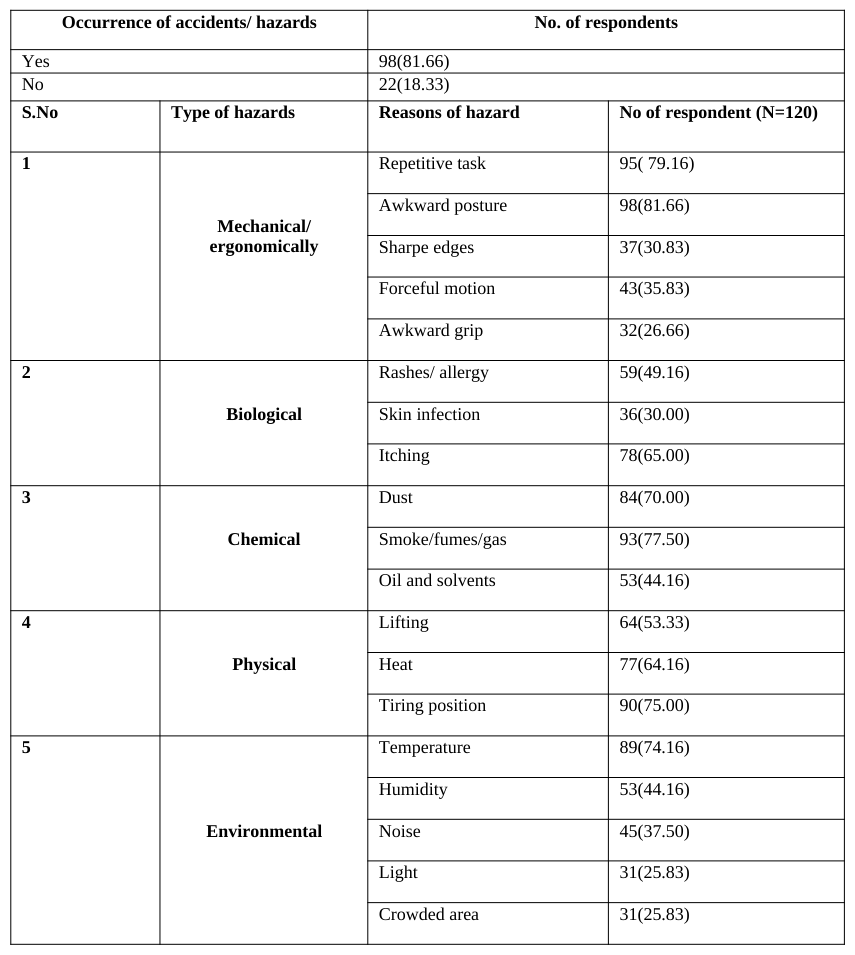
Occupational hazards, accidents, risks or injury at work place Hazards, accidents, risks or injuries are common incidence at forging work. The data revealed (Table 1) that more than 80 percent of workers were experiencing hazards or accident in their work places. The reasons for these hazards or accidents include awkward posture, allergies, rashes, itching, poor environmental condition etc.
Table 1: Occupational hazards, accidents, risks or injury at work place Occurrence of accidents/ hazards No. of respondents
Mechanical hazards The results regarding mechanical hazards as experienced by workers revealed that majority of the workers were encountering with the problem of awkward posture and repetitive motion during work schedule followed by 35.83 percent and 30.83 percent workers who reported hazard with forceful motion and injuries with Sharpe edges respectively. A small proportion i.e 26.66 percent of nurses reported hazards with awkward grip.
Biological hazards Hazards may occur through contact with still water during cooling of iron product and ashes etc which may be infectious to the workers who continuously work in such condition. In the summative responses, biological hazards like itching were reported by majority of workers (65 percent) followed by approximate 50 percent of workers who reported rashes/ allergy. A small no of workers ie 30 percent were suffering from skin infection.
Chemical hazards Chemical hazards may happen while using oil and solvents, exhaustion of waste aesthetic gases, dust, fumes etc. It can be envisaged from table that more than 75 percent of the workers got injured with smoke/fumes/ gases followed by 70 percent who were having infection with dust. Only a small proportion of workers were having infection with oil/ solvents.
Physical hazards Physical hazards are a combination of hazards from lifting, tiring position, heat. It is evident from the table that majority of workers ie 70 percent were suffering from physical hazards due to tiring position for longer period of time followed by nearly 65 percent who were suffering from heat. More than 50 percent of the workers had reported physical hazards due to lifting of heavy instruments while working.
Environmental hazards There are many reasons for environmental hazards which includes noise, temperature (cold as well as hot), light, humidity and crowded area. Majority of the workers had reported that temperature is the most hazardous environmental hazards. As they had to perform their work near heat which might be beneficial in winters but during summer season it is very difficult to work in that situation. Nearly 45 percent of worker had reported humidity as hazardous factor followed by 37 percent of workers who were having problem with noise. Some of the workers nearly 30 percent had reported poor light and crowed working environment as an environmental hazards.
Table 1: Environmental parameter at work place Activity area Temperature (o C) Humidity Noise
As weather has a profound effect on human health and some of such factors include temperature, humidity, illumination, noise etc. The magnitude of activity is greatly influenced by such environmental factors. Table depicts the environmental condition during the experimental phase. Environmental parameters were recorded in work area where all work are performed. The maximum and minimum temperature was 48.7oC and 35.9oC respectively. The humidity in working area ranged from 62 to 44 percent. However noise level in working area was 86 dB. It was further found that illumination was 596 lux. The noise is known to distract, confuse and make mental concentration more difficult. Depending on the individual, the noise intensity and the length of exposure, may affect hearing in long run. It is recommended as per ISI 2207(1999) that maximum ambient noise at operator’s ear level should not exceed 90 dB for 8 hour duration. But it was further conceded that 40 hour of exposure per week of noise of 90 dB or greater will result in hearing loss. It can be concluded that all the measured environmental variables were more in working area as hot temperature, humidity, increased noise level (nearly upper limit of exposure) and adequate illumination.
CONCLUSIONS
The data revealed that the most common problem faced by the workers was improper working posture and inappropriate working environment. Due to poorly designed work place, working environment, and working tools, workers physiological and psychological cost of work was high they reported to have health problems like back ache, shoulder ache and difficulty in movement of hands while in operation. Workers were also observed to be found irritated and restless due to poor working environment.
REFERENCES
Davies, B. (2002), “The handbook of black country forging and foundry project”, 2002, 1-2. Hagberg, M. Silverstein, B. Wells, R. Smith, M. J. Hendric, H. W. Carayon, P., Perusse, M. (1995), “Work- related musculoskeletal disorders: A reference book for prevention”. Taylor & Francis, London.
LISTED IN THE AHFE DIGITAL BOOKSTORE CATALOGUE
Explore the complete digital volume
Advances in Social and Organizational Factors
Read this individual research paper free through the original publisher, or explore the full digital proceedings book.
ISBN 978-1-4951-2102-9
Explore this ISBN in the AHFE Bookstore ↗Listed in the July 2026 bookstore catalogue; search by ISBN to confirm current availability · Digital book purchase optional