Mark Boocock, Liz Ashby, Richard Parker (2023). Musculoskeletal and work practice survey of chainsaw users in the New Zealand forest industry. In: Physical Ergonomics and Human Factors. AHFE Open Access, vol. 103, pp. 70–77. https://doi.org/10.54941/ahfe1003036
Forestry is one of the most dangerous occupations globally, and manual work involving the use of chainsaws present a significant health risk to its workers. Over the last 10 years, there have been 810 chainsaw-related incidents reported in the New Zealand (NZ) forest industry. The aim of this study was to undertake a survey of chainsaw operators in NZ to obtain information on the risks associated chainsaw use, the prevalence of self-reported musculoskeletal complaints, and opinions on the safe use and design of chainsaws and corresponding safety equipment. An anonymised, electronic questionnaire survey was distributed to forest companies by forest sector organisations. The questionnaire was divided into three main components: 1) demographics; 2) self-reported musculoskeletal disorders (a modified version of the Nordic musculoskeletal questionnaire); and 3) chainsaw-related accidents, injuries, and work practices. Descriptive statistics and parametric and non-parametric statistical tests were used to compare differences between frequent (used a chainsaw at least 2 or 3 times per week during the last 2 years) and infrequent chainsaw users. Fifty-seven workers responded to the questionnaire, which was considered a low response rate based on the size of the forest industry in NZ. Approximately 47% of respondents had a BMI of >30, classified as ‘obese’ based on the World Health Organisations BMI classification. Low back pain (51%) was the most frequently reported complaint over the last 12 months, followed by shoulders (36.8%), hands/wrists (33.3%) and knees (31.6%). Approximately 65% of all respondents considered their musculoskeletal symptoms were due to work and 60% felt the injury had restricted their normal work activities to some extent. Frequent chainsaw users did report slightly higher prevalence rates of musculoskeletal complaints across most body parts during the last 12 months. The risk factors considered to add to the physical workload and risk of MSD in chainsaw operators were: “bending over all day”; the repetitive nature of the work; the weight of equipment carried in addition to the chainsaw (e.g. first aid kit, safety chaps, fuel cans, oil, wedges); slips, trips and falls when walking between trees; and limited training opportunities for improving techniques and working postures. The high prevalence of work-related musculoskeletal conditions and the multifaceted nature of risk factors presents unique challenges to improving the health status of NZ forest workers. Interventions should consider a range of individual, physical, psychosocial, and work organisational approaches. Beyond modification to work practices, further consideration should be given to educating and promoting a healthy lifestyle among these workers. Frequent chainsaw users do appear to be at increased risk of musculoskeletal complaints. Some caution is needed when interpreting findings from the survey as the estimated overall response rate was considered low.
Working in the forest industry is recognised as one of the most dangerous occupations globally, and manual work involving the use of chainsaws pre- sents a significant risk to the health of its workers. Over a 10-year period (2011-2020), 810 chainsaw-related incidents were reported in the New Zea- land (NZ) forestry sectors’ voluntary report scheme: Incident Recording Information System (IRIS) (Ashby et al., 2022). A review of these incident reports identified a loss of control of the chainsaw (22%), slip/trip/fall (19%), and being hit by an object (13%) to be the most frequent cause of injury (Ashby et al., 2022). Cuts and lacerations accounted for most injury-related events (73%), with the hands/wrist (33%) and upper extremities (21%) being the most involved body part. Workers with 1 to 5 years’ experience reported the greatest number of incidents (45%), followed by those with less than 1
Musculoskeletal and Work Practice Survey of Chainsaw Users 71
years’ experience (22%). On average, each incident was estimated to result in 93.5 hours lost time, at direct cost of approximately NZ$2,338.
One of the drawbacks of a voluntary reporting system (e.g. IRIS) is the apparent under-reporting of musculoskeletal conditions (sprains, strains and/or gradual onset disorders). Therefore, to supplement accident reports obtained from the IRIS, a survey of NZ forest workers was conducted. The aim of this study was to determine the prevalence of self-reported musculoskeletal complaints associated with chainsaw use. A secondary aim was to gather information on the risks associated with chainsaw use, and user’s perceptions of the use and design of chainsaws and safety equipment.
METHODS
An anonymised, electronic questionnaire survey was constructed using the Qualtrics online software programme (QualtricsXM, USA) and distributed to forest companies by forest sector organisations. The questionnaire comprised three main components: 1) demographics; 2) self-reported musculoskeletal disorders; and 3) chainsaw-related incidents, injuries, and work practices. The demographics section of the questionnaire recorded information on the height, weight, sex, and ethnicity of the respondent, along with information about forest industry work experience, and primary work tasks performed during the last 12 months.
A modified version of the Nordic musculoskeletal questionnaire (Kuorinka et al., 1987) was used to record information about any self-reported musculo- skeletal conditions, work or non-work related. A musculoskeletal condition was defined as “sprain or strain injury, or trouble like ache, pain, discom- fort or numbness that had resulted from an acute injury or developed over time”. Respondents were required to provided information on sym- ptoms by body region (9 body regions) for the past 12 months and 7 days, the severity and duration of symptoms (scale ranging between 0 to 10, with 0 being no discomfort and 10 being the worst pain experienced) and any disability associated with symptoms (e.g. restrictions to normal work tasks).
Questions relating to chainsaw-related incidents, injuries and work practi- ces elicited information about respondents’ experiences, if any, of a chainsaw accident/injury and its potential causes. The questionnaire also requested opinions about important features of chainsaw design, work practices, and protective equipment intended to reduce the risks of injury from chainsaw use.
To ensure suitability and appropriateness of the questions, an initial pilo- ting of the survey was conducted with experienced workers and chainsaw users prior to the main survey. A survey link and QR code for the questi- onnaire was circulated via email and/or through the sector organisation’s standard communication channels, enabling the questionnaire to be comple- ted using a range of different electronic devices. The survey was approved by Auckland University of Technology Ethics Committee (AUTEC 21/307) and was distributed between November 2021 and February 2022.
Descriptive statistics were conducted to determine the frequency, mean, median, standard deviation (SD) of questionnaire response variables. Non- parametric statistical tests (e.g. Chi-square) were used, where appropriate, to compare differences between frequent users (defined as a user who used a chainsaw two or three times a week or more over the last 2 years) and infrequent chainsaw users. A qualitative analysis of responses to open-ended questions was undertaken by grouping feedback under key themes.
RESULTS
Demographics Of the 57 participants who completed the questionnaire, the majority were of NZ European decent (81%) and 16% identified as M¯aori. Most respondents were male (95%), with a mean age of 50 years that ranged between 28 and 78 years. Respondents’ stature was normal distributed (mean = 180 cm) and approximately 47% had a Body Mass Index (BMI) >30, considered ‘obese’ based on the World Health Organisation (2022) BMI classification.
Most respondents (75%) were experienced workers with more than 20 years’ experience in the industry. The work activities performed most fre- quently during the last 12 months were ‘Thin to waste’ (19%), ‘Machine operation, logging’ (14%), ‘Manual work, logging - manual falling’ (13%) and ‘Pruning’(11%). On average, workers reported a mean and median working week (excluding travel) of 43 hours and 45 hours, respectively.
When asked about their experience of using chainsaws, 35% identified that their forestry experience had, at some point, involved the use of chain- saws. Few respondents (4%) reported having no experience using a chainsaw. When asked how often they had used a chainsaw at work during the last 2 years, 47% (n = 23) regarded themselves as a frequent user, i.e. two or three times a week or more (hereafter, referred to as ‘frequent chainsaw users’).
Musculoskeletal Complaints Of those who responded to the survey, 67% reported experiencing at least one musculoskeletal complaint during the previous 12 months. Discom- fort/pain/injury in the low back (51%) was the most frequently reported complaint, followed by shoulders (36.8%), hands/wrists (33.3%) and knees (31.6%). Approximately 65% of those who had experienced a complaint in the last 12 months felt their symptoms were work-related and 60% conside- red the symptoms had restricted their normal work activities to some extent. Of those reporting a musculoskeletal complaint, approximately 29% expe- rienced symptoms for more than 30 days in total during the last 12 months, while 47% indicated experiencing symptoms every day. Approximately 60% of the workers surveyed identified that the injury had restricted their normal work activities to some extent, and frequent chainsaw users reported that the symptoms had had a greater impact on their work activities when com- pared to infrequent chainsaw users (70% versus 30%). Symptoms relating to the knees (44%) and shoulders (37%) restricted normal work activities the most. The severity of most self-reported complaints ranged from mild to
Musculoskeletal and Work Practice Survey of Chainsaw Users 73
moderate, an exception being knee complaints, with workers tending to rate these symptoms as severe.
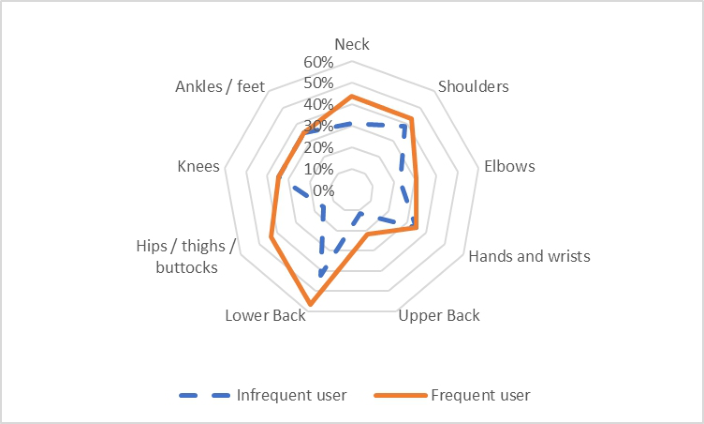
Musculoskeletal complaints (12-month period prevalence) showed a trend towards higher reporting among frequent chainsaw users for most body regions when compared to infrequent users, although differences were non- significant (Figure 1). The factors considered to add to the physical workload and risk of musculoskeletal complaints in chainsaw operators were: “bending over all day”; the repetitive nature of the work; the weight of equipment carried in addition to the chainsaw (e.g. 1st aid kit, safety chaps, fuel cans, oil, wedges); slips, trips and falls when walking between trees; and limited training opportunities for improving techniques and working postures.
Chainsaw-Related Accidents, Injuries and Work Practices Thirty-six percent of those workers who responded to the questionnaire reported having experienced a chainsaw injury, approximately a half of whom (48%) were classified as frequent users and the rest as infrequent users. The most frequently reported injury was a cut or laceration, which was reported by 82% of all injured respondents and 70% of frequent chainsaw users.
Of those who reported a chainsaw incident, the risk factors considered most influential to the cause of the incident were grouped under three main headings: chainsaw kickback; task-related (e.g. “cut foot while trimming bra- nches”); and environmental (e.g. “while walking to the next tree, fell down large hole”). When asked to rate the importance of potential risk factors, chainsaw kickback (74%), lack of experience (70%) and slips, trips, and falls (52%) were the most important factors identified by frequent chainsaws
Figure 1: 12-month period prevalence of self-report musculoskeletal complaints in the last 12 months by body region for frequent (n = 23) and infrequent (n = 26) chainsaw users.
users. When asked about gloves, approximately 26% of frequent chainsaw users indicated that they always wore gloves, while over a half (53%) repor- ted never using gloves. Reasons for not wearing gloves included problems associated with gripping the chainsaw, gloves were often uncomfortable to wear, particularly during warm, summer periods, and could present difficul- ties when used in conjunction with other equipment on the chainsaw, like the safety mitt1.
DISCUSSION
A high prevalence of self-reported musculoskeletal complaints was found in NZ forest workers, with approximately two-thirds of those who completed the questionnaire reporting on at least one musculoskeletal condition during the past 12 months. For those classified as frequent chainsaw users, the preva- lence rate was slightly higher when compared to those classified as infrequent user: 70% vs 65%. Whilst high in comparison to other industries and service sectors, the prevalence of self-reported musculoskeletal conditions in this study appears comparable to data from other international studies on chain- saw workers in the forest industry (Greece, Poland, UK and USA) (Dimou et al., 2020b, Dimou et al., 2020a, Gallis, 2006, Grzywi´nski et al., 2016, Hulse and Gunstone, 1998, Lagerstrom et al., 2019). For example, Lager- strom et al. (2019) reported a 12-month musculoskeletal period prevalence of 59.7% (any body region) in conventional operators (i.e. chainsaw opera- tors) employed in the Montana and Idaho forest industry. When comparing chainsaw users (n = 80) to those involved in mechanised logging (n = 409) where exposure to chainsaw use was considered low, they found chainsaw users to be more than twice as likely to report a musculoskeletal complaint (Odds Ratio (OR): 2.24 (95% Confidence Interval (CI) = 1.07–4.69)).
In the current study, the most frequently reported musculoskeletal com- plaint during the last 12 months was the low back (51%), shoulders (36.8%), hands/wrists (33.3%) and knees (31.6%). These findings are comparable to those of Lagerstrom et al. (2019) where chainsaw users most frequently reported low back (45.5%), shoulders (34.9%), knees (33.8%) and hand- s/wrists (27.4%) as the body region most affected. The consequences of musculoskeletal complaints on workers’ health and their ability to perform normal work activities has implications for both productivity and the like- lihood for prolonged and persistent symptoms. Interestingly, in the current study those who rated the severity of symptoms identified knee pain as being most severe, with 44% suggesting that it restricted their ability to perform normal work activities.
Self-reported musculoskeletal complaints did show an increase with work experience, particularly for those with 20 years or more experience in the forest industry (approximately 3 times more likely than those with less than 20 years or more experience). Evidence of a potential relationship betw- een experience and musculoskeletal reporting is mixed. In a survey of 353
1A safety mitt is a loosely fitting ‘glove’ which is attached to the chainsaw into which the hand can easily slide in and out. There is limited reference to its use outside the NZ forest industry.
Musculoskeletal and Work Practice Survey of Chainsaw Users 75
Polish loggers, Grzywinski et al. (2017) found an increase in the number of self-reported musculoskeletal complaints (over the previous 12 months) with increasing work experience. In contrast, Dimou et al. (2020b) showed a posi- tive association in the reduction of musculoskeletal symptoms in the neck, shoulders and lower back with increasing work experience in Greek fore- stry workers. Mixed findings of experience on musculoskeletal reporting may reflect a range of conflicting factors, such as healthy worker effects and/or employment status and job opportunities across the different international studies.
NZ Forestry workers identified a range of potential risk factors contribu- ting to injuries and accidents associated with the use of chainsaws. Frequently adopting awkward postures and the need to transport several pieces of heavy equipment (e.g. first aid kit, safety chaps, fuel cans, oil, wedges) in hazardous work environments featured prominently among chainsaw user responses. The use of manual operations in the forest industry has been shown to impose high physical and physiological demands on the worker, and present grea- ter risks to the health of the worker when compared to those involved in mechanised operations (Landeki´c et al., 2019). Commonly cited physical risk factors associated with musculoskeletal complaints amongst chainsaw users are awkward and flexed trunk postures adopted for prolonged periods and between 30 to 60% of the work time (Harstela, 1990, Tatsukawa, 1991). In forest workers, such trunk postures have been shown to be strongly associa- ted with high physiological workloads (Grzywinski et al., 2017, Masci et al., 2022, Tsioras et al., 2022). When using chainsaws, respondents identified a range of working practices contributing to the risk of injury that extended beyond just the physical aspe- cts of the job and included individual, work organisational and psychosocial factors. This suggests a need for a holistic, multifaceted intervention and risk management approach if the forest industry is to address these types of acci- dents/injuries. This study represents phase 1 of a multiphase project and prior to proposing potential interventions it is necessary to observe and interview workers to determine the scope and nature of possible interventions.
Based on self-reported stature and weight, close to half the sample popu- lation had a BMI greater than 30 and therefore, would be classified as obese according to the WHO classification criteria (World Health Organisation, 2022). As forestry work is considered physiologically demanding (Arman et al., 2021), such findings seem surprising and suggest a need for fur- ther investigation of physical work exposure, to determine the contributing lifestyle factors on the health status of forest workers.
A limitation of this study was the low response rate which leads to caution when extrapolating and interpretating the findings from this survey. Whilst the exact size of the NZ forest industry workforce is unclear, estimates sug- gest around 5,000 employees are involved in forestry and logging in NZ. The study was also limited in that it was cross-sectional in design and muscu- loskeletal complaints were restricted to self-reported complaints. To better understand the impact of forest work on the health of its work force, there is a need for more longitudinal/cohort designed studies.
CONCLUSION
The multifactorial nature of risk factors inherent to the work performed in the forest industry presents unique challenges to protecting the health of the workforce. The use of chainsaws in the forest industry presents increased risks to the musculoskeletal health of workers and requires inno- vative interventions for the prevention and management of these conditions. Interventions need to include individual, physical, psychosocial, and work organisational approaches. Consideration should be given to the appropri- ate use of equipment and working practices relative to the tasks demands. Increased education and training opportunities on the safe use of chainsaws should be provided for NZ forest workers, along with promotion of a healthy lifestyle. Musculoskeletal health surveillance of NZ forest workers should be integrated into existing health and safety management tools and regularly monitored and reviewed.
ACKNOWLEDGMENT
The authors would like to acknowledge the NZ forest sector organisations who assisted with the distribution of the survey and the workers who gave up their valuable time to participate in the survey.
REFERENCES
Arman, Z., Nikooy, M., Tsioras, P. A., Heidari, M. & Majnounian, B. 2021. Physiological workload evaluation by means of heart rate monitoring during motor- manual clearcutting operations. International Journal of Forest Engineering, 32, 91–102. Ashby, L., Parker, R., Stent, C., Burt, A. & Boocock, M. 2022. A review of chainsaw
accidents over a 10-year period in the New Zealand forest industry. Safety and Health at Work, 13, S89-S90. Dimou, V., Malesios, C. & Pispa, S. 2020a. Assessing forestry-related musculoskeletal symptoms in specific body areas. International Journal of Forest Engineering, 31, 233–241. Dimou, V., Malesios, C. & Pispa, S. 2020b. Monitoring self-reported musculoskeletal
symptoms in forestry operations. International Journal of Forest Engineering, 31, 106–113. Gallis, C. 2006. Work-related prevalence of musculoskeletal symptoms among Greek forest workers. International Journal of Industrial Ergonomics, 36, 731–736. Grzywinski, W., Jelonek, T., Tomczak, A., Jakubowski, M. & Bembenek, M.
2017. Does body posture during tree felling influence the physiological load of a chainsaw operator? Annals of Agricultural and Environmental Medicine, 24, 401–405. Grzywi´nski, W., Wandycz, A., Tomczak, A. & Jelonek, T. 2016. The prevalence of self-reported musculoskeletal symptoms among loggers in Poland. International Journal of Industrial Ergonomics, 52, 12–17. Harstela, P. 1990. Work postures and strain of workers in nordic forest work: A
selective review. International Journal of Industrial Ergonomics, 5, 219–226. Hulse, S. & Gunstone, K. 1998. A study to determine the extent of musculoskeletal disorders in forestry chainsaw operators, HSE Books.
Musculoskeletal and Work Practice Survey of Chainsaw Users 77
Kuorinka, I., Jonsson, B., Kilbom, A., Vinterberg, H., Biering-Sorensen, F., Andersson, G. & Jorgensen, K. 1987. Standardised Nordic questionnaires for the analysis of musculoskeletal symptoms. Applied Ergonomics, 18, 233–7. Lagerstrom, E., Magzamen, S., Brazile, W. & Rosecrance, J. 2019. Active Surveil-
lance of Musculoskeletal Disorder Symptoms in the Development of Safety Interventions for Professional Loggers. Safety [Online], 2. Landeki´c, M., Katuša, S., Mijoˇc, D. & Šporˇci´c, M. 2019. Assessment and Comparison of Machine Operators’ Working Posture in Forest Thinning. South-East European Forestry, 10, 29–37. Masci, F., Spatari, G., Bortolotti, S., Giorgianni, C. M., Antonangeli, L. M., Rose-
crance, J. & Colosio, C. 2022. Assessing the Impact of Work Activities on the Physiological Load in a Sample of Loggers in Sicily (Italy). International Journal of Environmental Research and Public Health, 19. Tatsukawa, S. 1991. Effects of the Working Postures of Chain-Saw Operators on Their Work Loads. Journal of the Japanese Forerstry Society, 73, 219–224. Tsioras, P. A., Khooshdohbat, M., Nikooy, M., Naghdi, R. & Heidari, M. 2022. The
Impact of Body Posture on Heart Rate Strain during Tree Felling. International Journal of Environmental Research and Public Health, 19, 11198. World Health Organisation. 2022. A healthy lifestyle - WHO recommendations [Online]. [Accessed 7/12/;2022 2022].
LISTED IN THE AHFE DIGITAL BOOKSTORE CATALOGUE
Explore the complete digital volume
Physical Ergonomics and Human Factors
Read this individual research paper free through the original publisher, or explore the full digital proceedings book.
ISBN 978-1-958651-79-7
Explore this ISBN in the AHFE Bookstore ↗Listed in the July 2026 bookstore catalogue; search by ISBN to confirm current availability · Digital book purchase optional