Mark Boocock, Tone Panassollo, Grant Mawston (2025). Responses to manual handling training and repetitive lifting: changes in spinal compression and shear forces. In: Human Factors in Design, Engineering, and Computing. AHFE Open Access, vol. 199, pp. 1761–1769. https://doi.org/10.54941/ahfe1006987
Manual handling (MH) is a leading cause of work-related ill-health, resulting in substantial personal and financial costs. Despite the lack of evidence to support the benefits of MH training, this remains an intervention strategy for many workplaces. Understanding reasons why MH training may be ineffective needs to be understood if work-related musculoskeletal disorders (MSD) are to be addressed. The aim of this study was to investigate the effects of prior MH training on spinal loading over the course of a repetitive handling task. Twelve male adults (mean age = 30 yr; mean body weight = 70 Kg) considered novices in repetitive MH, participated in the study. Participants attended two sessions during which they repetitively lifted (10 lifts/min) and lowered a box (13 kg) for up to 20 mins. No instructions about lifting technique were provided prior to session 1, whereas session 2 was preceded by training in recommended 'safe lifting'. Three-dimensional (3D) motion analysis and ground reaction forces provided input into a musculoskeletal model (AnyBody Technology, Denmark), used to estimate spinal loading (L5/S1 compression and shear forces). A repeated measure ANOVA (3*2) was used to determine the main effects of time (0, 10 and 20 min) and training (self-selected vs MH training) on spinal loading. A significant main effect was found for MH training on peak compression and shear forces (p=0.028 and p=0.024, respectively) when lifting, with higher peak forces in session 2 following the MH training session compared to session 1, a self-selected technique (3.29 KN vs 3.14 KN and 1.93KN vs 1.84 KN, respectively). Repetitive lifting led to decreases in cumulative compression and shear forces and increases in the slope of these curves (rate of change of loading) over time when lifting. MH training targeting ‘safe lifting’ appears to increase the risk of back injury and may discourage some individuals from adopting recommended handling practices. MH training should consider the wider context of work, challenge individuals to be adaptative to work situations, be job and task-specific, and be based on a sound andragogical rationale.
to early retirement, contribute to lower levels of well-being, and reduce the individual’s ability to participate in society (WHO, 2022).
The primary risk factors for MSD are associated with “occupational ergonomic factors”, smoking, and high BMI (WHO, 2022). The personal and financial costs of MSD are substantial. In 2020, “sprains or strains” were estimated to cost the New Zealand’s (NZ) Accident Compensation Corporation (ACC) approximately $529.6M (ACC, 2020).
In NZ, manual handling (MH) associated with the lifting, carrying and putting down of objects is the leading cause of work-related MSD and seven- day absence from work (WorkSafe, 2025). MH training is often seen as a preventative strategy which is easy to implement and cost-effective, and for many employers, it is an initial go-to approach for combating MSD in the workplace. However, systematic reviews have found MH training to be of questionable value (Verbeek et al., 2012; Hogan et al., 2014; Kugler et al., 2024). Several reasons for its ineffectiveness have been proposed, including the lack of willingness of workers to apply recommended lifting techniques (Gagnon, 2003). Whilst intended to reduce the risk of low back injuries, there is contradictory evidence concerning the effects of “safe lifting” techniques (e.g. “straight back, bent knees” or squat technique) on lower back spinal compression and shear forces (von Arx et al., 2021). When lifting repetitively, the effects of fatigue may lead to postural changes and influence the biomechanical stresses on the spine (Resnick, 1996; Boocock et al., 2015).
The aim of this study was to investigate whether prior MH training leads to changes in spinal loading during a repetitive lifting task and whether fatigue would affect spinal loading. It was hypothesised that MH training in “safe lifting” would reduce spinal loading when compared to a self-selected technique. Furthermore, the effects of fatigue and postural adaptations from repetitive lifting would negate the difference in spinal loading over the course of the lifting task.
METHODS
Participants Twelve male adults (mean age = 29.5 years; standard deviation (SD) = 9.9 years; mean weight = 70.3 kg (SD = 6.3 kg); mean height = 1.74 m (SD = 0.065 m)) participated in the study. As body size is known to influence the loads on the spine when MH (Boocock et al., 2024), participants were only included if they had Body Mass Index (BMI) equal to or less than 25 kg/m2 (mean = 23.2 kg/m2; SD = 1.04 kg/m2). Participants were also excluded if they had: a cardiovascular or neurological condition; experienced a musculoskeletal injury within the last six months; or had undergone previous spinal surgery. Participants were considered inexperienced in MH, as they did not identify regular involvement in MH as part of their vocational activities. The study was approved by Auckland University of Technology ethics committee (AUTEC 21/239), and all participants were required to sign a consent form prior to participation.
Responses to Manual Handling Training and Repetitive Lifting 1763
Experimental Design A cross-sectional, repeated measures study required participants to perform the same MH task on two separate occasions, at least 3 days apart. The only difference between sessions was the information provided to participants prior to performing the MH task. During Session 1 (self-selected MH technique), participants were familiarised with the lifting task but not given any instructions about the lifting technique to perform. Prior to Session 2 (MH training), participants were instructed about the handling technique to perform, which followed recommended guidelines on “safe handling”. The sessions were not randomised.
Lifting Task Participants lifted and lowered a box (30 cm × 25 cm × 25.5 cm) weighing 13 kg at a frequency of 10 lifts/min, controlled by a metronome that provided an audible cue on when to lift and lower the box. The box was held using two cylindrical handles (28 mm diameter) at either side of the box, which were 17 cm above its base. The box rested on a platform 15 cm above the floor and participants raised the box to an upright standing position, with the elbows extended and relaxed. At the sound of the metronome, the box was lowered back onto the platform. Once participants had adopted a foot position as close as possible to the platform, without touching it, they were instructed to maintain this position throughout the testing session. They were also required to maintain hold of the box handles throughout the testing session.
Participants were not informed about the duration of each session but were required to continue lifting until unable to continue due to excessive fatigue, pain or discomfort, or when they had completed 20 minutes of lifting. Verbal encouragement was not provided, but participants were instructed before, or during the test if required, to maintain the required lifting and lowering frequency.
Manual Handling Training The training focussed on key features of the lifting technique, discouraging lumbar spine flexion and encouraging bending of the knees and hips (Beach et al., 2018). These instructions included standing tall with the feet shoulder width apart, toes pointing forwards, heels on the floor, bending with the knees and hips, using the legs as opposed to the back, maintaining the normal arch (as in standing) in the lower back when lifting and lowering the box, keeping the load as close to the body as possible. These instructions were emphasised throughout the training period, up to the time participants began lifting. The box weight used during the familiarisation and training periods was approximately a quarter of that used during the actual task. Task familiarisation and training lasted approximately 15 minutes, with regular breaks throughout to avoid the potential effects of fatigue.
Kinematic and Kinetic Measures Three-dimensional (3D) kinematics were measured using a nine-camera motion capture system (Qualysis AB, Gothenburg, Sweden) running Qualisys
Track Manager (QTM) and sampling at 120 Hz. The motion capture system was calibrated prior to each test session and used to track lightweight, retro- reflective makers (69 markers). Markers were attached to the participant’s body using double-sided sticky and hypoallergenic tape. These markers were placed on anatomical landmarks to define body segment axes and dimensions. Additional cluster markers (tracking markers) were placed on body segments and the box. Initially, participants adopted a standing pose (‘static’ trial) which provided a reference to scale and orientate segment axes. Some medial anatomical landmarks (e.g., knees) were removed during the task to avoid influencing lifting kinematics. Data was exported as C3D files for subsequent post-processing.
Three-dimensional ground reaction forces were measured using two AMTI (Watertown, USA) floor mounted force plates on which participant placed each foot. Ground reaction forces were sampled at 1200Hz and synchronised with the motion tracking data. Two complete lifting and lowering cycles (15 s sampling) were collected at the start and every minute (maximum 20 min) during the MH task. One task cycle represented the point at which the box was initially lifted from the platform until the next time the box was lifted.
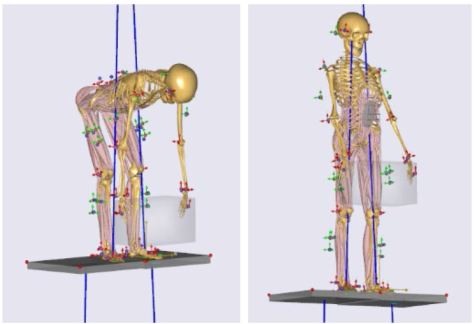
Musculoskeletal Modelling The AnyBody musculoskeletal modelling system (AnyBody Modelling system software v.8.1 (AMS), AnyBody Technology, Aalborg, Denmark) was used to model spinal loading. The AnyBody modelling system has been previously validated and used to study spinal loading across a range of tasks (Bassani et al., 2017; Kitagawa et al., 2020). A subject-specific full-body model (AnyBody Managed Model Repository (V3.0.3)) was initially scaled and tracked using the C3D static and motion files (Figure 1). Inverse dynamic muscle recruitment was used to determine muscle and joint forces at the L5/S1 lumbar spine. Outcome measures were derived for L5/S1compression and shear forces at baseline (0 min), and at 10 min and 20 min.
Figure 1: Anybody musculoskeletal model of the handling task.
Responses to Manual Handling Training and Repetitive Lifting 1765
Statistical Analysis For the two lifting and lowering cycles at each time point, an average was taken of the peak L5/S1 compression and shear forces and peak rate of change (slope) of L5/S1 compression and shear forces when lifting. The peak slope was determined by finding the maximum derivative between the start of the lift and the peak force. The average area under the compression force-time curve (cumulative load or impulse) during the complete lifting and lowering cycle was also calculated and normalised with respects to time (N).
Descriptive statistics and a repeated measures analysis of variance (3*2 ANOVA) was used to determine main effects of time (0 min, 10 min, 20 min) and prior training (self-selected vs MH training) for each dependent measure. Where time had a significant effect, pairwise comparisons were undertaken with Bonferroni correction for multiple tests. All participants completed the 20 min of lifting task, contributing data to each time point. Statistical analysis was conducted in SPSS (IBM SPSS Statistics, version 29.0.0) and a p value of <0.05 was considered significant.
RESULTS
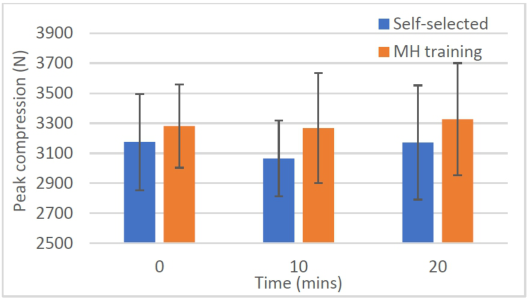
Compression Forces Training prior to the MH task had a significant main effect on peak L5/S1 compression forces (p=0.028), with peak forces being higher following the training session (mean 3.29 kN vs 3.14 kN) (Figure 2). There was no significant main effect of time or an interaction (session x time) for peak compression forces. Prior training did not have a significant effect on cumulative or rate of change in compression force during the lift.
Figure 2: Peak L5/S1 compression forces at the three time points during the repetitive lifting and lowering task.
A main effect of time was found when comparing the normalised cumulative compression forces between the initial (0 min) and second (10 min) (p=0.033), and the initial (0 min) and third (20 min) time points (p=0.003) (Table 1). The slope of the compression force curve during the lift was significantly different between the initial and the final time points (p=0.011).
Table 1: Normalised cumulative compression (kN; mean (SD)) and the slope of the compression force curve during the lift (kN/s; mean (SD)) for self-selected versus MH training.
Table available in the original PDF paper.
Forces Measures 0 Min 10 Min 20 Min Normalised cumulative compressive force 1.88 (0.28) vs 1.97 (0.29) 1.73 (0.26) vs 1.83 (0.31) 1.68 (0.24) vs 1.74 (0.32) Compressive force slope during the lift
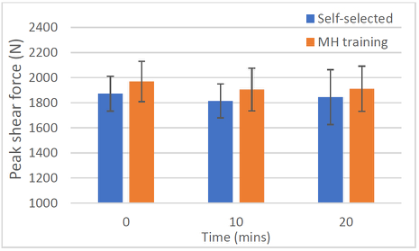
5.56 (1.23) vs 5.76 (1.56) 6.29 (2.02) vs 6.31 (1.19) 6.93 (2.70) 7.30 (2.39) Training prior to lifting had a significant main effect on L5/S1 shear forces (p=0.024), with peak forces being higher following the training session (mean 1.93 kN vs 1.84 kN) (Figure 3). There was no significant main effect of time or an interaction (session x time) for peak shear forces. Prior training did not have a significant effect on cumulative or the slope of the shear force during the lift.
A main effect of time was found when comparing the normalised cumulative shear force between the initial and second (p=0.004), and the initial and third time points (p<0.001) (Table 2). There was no significant effect of time on the slope of the shear force during lifting.
Figure 3: Peak L5/S1 shear forces at the three time points during the repetitive lifting and lowering task.Table 2: Normalised cumulative shear force (kN; mean (SD)) and the slope of the shear force curve during the lift (kN/s; mean (SD)) for self-selected versus MH training.
Table available in the original PDF paper.
Forces Measures 0 Min 10 Min 20 Min Normalised cumulative shear force 1.10 (0.12) 1.16 (0.15) 1.01 (0.12) 1.05 (0.14) 0.97 (0.12) 0.99 (0.17) Shear force slope during the lift
Responses to Manual Handling Training and Repetitive Lifting 1767
DISCUSSION
Adopting a self-selected lifting technique resulted in lower peak L5/S1 compression and shear forces when compared to a recommended lifting technique, often referred to as the squat lift. Therefore, this led to a rejection of our initial hypothesis that a recommended squat lifting technique would reduce spinal loading when lifting. The study also found that there was no effect of time on peak spinal compression or shear forces, with peak forces being consistently higher for each of the time points during the repetitive lifting task when the session involved prior MH training.
There is conflicting evidence for the beneficial effects of adopting a squat lift over other lifting strategies on spinal loads. von Arx et al., (2021) found freestyle lifting generated larger spinal loads than squat lifting when using a full-body musculoskeletal model (OpenSim). In contrast, Kingma et al., (2010) found no difference between freestyle lifting and those of the squat or stoop on peak L5/S1 compression and shear forces.
Reason for these differences may be due to variations in training provided to participants, and differences in the experimental lifting conditions and biomechanical modelling approaches adopted between studies. In contrast to the current study, where participants placed their feet adjacent to the lifting platform, von Arx et al., (2021) estimated spinal loads for lifting a box from the floor with the feet 15 cm from the box. Horizonal displacement of the hands from the lower back is an important factor governing spinal loading (Boocock et al., 2024) and would probably have affected the ability to adopt appropriate postures. The instructions given to participants about lifting posture also appeared to differ between studies. In this study, lifting posture focussed on maintaining the normal (standing) arch of the lower back, rather than the overall trunk posture. The instructions for squat lifting by von Arx et al., (2021) focussed on keeping “the back as straight as possible” and bending the knees. As Beach et al., (2018) found, the instructions given to participants are important in influencing spinal postures during lifting and lowering.
An important finding of this study was that whilst peak compression and shear forces did not change with respect to time (fatigue), measures of cumulative compression and shear forces and the slope of the compression curve when lifting did show difference over time. It appears that participants did change lifting strategies due to fatigue, reducing cumulative effects and likely performing the lifts faster. This was consistent irrespective of what training had been provided.
The study has its limitations in that the sequence of sessions could not be randomised. Therefore, there may have been some potential carry over effects of exposure to the lifting task that influenced the MH training session. Limitations with the marker-based approach to motion capture typically arise from movement artifacts associated with markers and the soft tissue, primarily skin, subcutaneous fat and muscles. The handling task performed was controlled and involved a simple, symmetrical lifting and lowering of a box, which is rarely seen in industry or service sectors.
CONCLUSION
MH training targeting “safe lifting” increased peak compression and shear forces on the lumbar spine which may increase the risk of lower back injury. Training resulted in higher peak forces for each of the time points during the 20 min repetitive lifting and lower task. MH training focussing on one specific handling technique may be inappropriate and discourage some individuals from adopting recommended handling practices. Training in MH should consider the wider context of work, be job and task-specific, challenge individuals to be adaptative to the work situations, and be based on a sound andragogical rationale.
ACKNOWLEDGMENT
The authors would like to acknowledge the help of Erik Hilton in analysing data appropriate to this project.
REFERENCES
Bassani, T., Stucovitz, E., Qian, Z., Briguglio, M., and Galbusera, F. (2017).
Validation of the AnyBody full body musculoskeletal model in computing lumbar spine loads at L4L5 level. J Biomech 58, 89–96. Beach, T. A. C., Stankovic, T., Carnegie, D. R., Micay, R., and Frost, D. M.
(2018). Using verbal instructions to influence lifting mechanics – Does the directive “lift with your legs, not your back” attenuate spinal flexion? Journal of Electromyography and Kinesiology 38, 1–6. Boocock, M. G., Mawston, G. A., and Taylor, S. (2015). Age-related differences do affect postural kinematics and joint kinetics during repetitive lifting. Clinical Biomechanics 30(2), 136–143. Boocock, M., Naudé, Y., Saywell, N., and Mawston, G. (2024). Obesity as a risk
factor for musculoskeletal injury during manual handling tasks: A systematic review and meta-analysis. Safety Science 176. Gagnon, M. (2003). The efficacy of training for three manual handling strategies based on the observation of expert and novice workers. Clin Biomech (Bristol, Avon) 18(7), 601–611. Hogan, D. A., Greiner, B. A., and O’Sullivan, L. (2014). The effect of manual
handling training on achieving training transfer, employee’s behaviour change and subsequent reduction of work-related musculoskeletal disorders: A systematic review. Ergonomics 57(1), 93–107. Kingma, I., Faber, G. S., and van Dieen, J. H. (2010). How to lift a box that is too large to fit between the knees. Ergonomics 53(10), 1228–1238. Kitagawa, K., Nishisako, Y., Nagasaki, T., Nakano, S., Hida, M., Okamatsu,
S., and Wada, C. (2020). Regression Equation between Required Force and Lumbar Load of Caregiver in Supporting Standing-up Motion via Computational Musculoskeletal Simulation. Pertanika Journal of Science and Technology 28(S2). Kugler, H. L., Taylor, N. F., and Brusco, N. K. (2024). Patient handling training interventions and musculoskeletal injuries in healthcare workers: Systematic review and meta-analysis. Heliyon 10(3), e24937. Resnick, M. (1996). Postural changes due to fatigue. Computers and Industrial
Engineering 31(1–2), 491–494.
Responses to Manual Handling Training and Repetitive Lifting 1769
Verbeek, J., Martimo, K. P., Karppinen, J., Kuijer, P. P., Takala, E. P., and Viikari- Juntura, E. (2012). Manual material handling advice and assistive devices for preventing and treating back pain in workers: A Cochrane Systematic Review. Occup Environ Med 69(1), 79–80. von Arx, M., Liechti, M., Connolly, L., Bangerter, C., Meier, M. L., and Schmid,
S. (2021). From Stoop to Squat: A Comprehensive Analysis of Lumbar Loading Among Different Lifting Styles. Front Bioeng Biotechnol 9, 769117. WHO. (2022). “Musculoskeletal Health.” 2025, from https://www.who.int/newsroom/fact-sheets/detail/musculoskeletal-conditions. WorkSafe. (2025). “Data Centre.” from https://data.worksafe.govt.nz/.
LISTED IN THE AHFE DIGITAL BOOKSTORE CATALOGUE
Explore the complete digital volume
Human Factors in Design, Engineering, and Computing
Read this individual research paper free through the original publisher, or explore the full digital proceedings book.
ISBN 978-1-964867-75-5
Explore this ISBN in the AHFE Bookstore ↗Listed in the July 2026 bookstore catalogue; search by ISBN to confirm current availability · Digital book purchase optional