Jerry Davis, Ruoliang Tang, Rich Sesek, Sean Gallagher (2019). Evaluating Firefighter Crawling Performance in a Controlled Environment. In: Advances in Safety Management and Human Factors. AHFE Open Access, vol. 5. https://doi.org/10.54941/ahfe100143
State mandated firefighter training is both highly structured and physically challenging. Firefighting is typically performed in harsh environments, necessitating personal protective equipment (PPE) which adds weight, restricts mobility, and decreases metabolic heat removal. For the most part, firefighter training is highly controlled and repetitive in nature, with each trainee performing required training exercises numerous times under close supervision. One such skill involves crawling, which is a physically intensive activity that firefighters utilize during training exercises, indoor fire suppression, and search and rescue activities. The ability to have firefighters crawl nearly identical, closely observed, routes is not easily accomplished for many fire departments. This pilot study observed trainees participating in a fire department training school using a unique crawling apparatus in their curriculum. Young, healthy male firefighter trainees (N=10) participated in a crawling exercise conducted in a modified commercial semi-trailer that was configured with varying crawling paths and fitted with infra-red cameras. Trainees crawled in full turnout gear while wearing forced air respirators to complete the course. Dependent variables included heart rate, compressed air usage, and time to complete the course. Incorporating such observations and measures into firefighting training curriculums has the potential to provide instantaneous feedback to trainees on their performance, potential areas of improvement, and facilitates the comparison of their physiological performance to the demands of the crawling task.
Firefighting has long been known to be both physically challenging and present significant risk, in both training and emergency response situations. Many aspects of the physical demands associated with various firefighting activities (carrying people, dragging charged hoses, climbing ladders and stairs, etc.) and the subsequent physiological responses to such demands have been systematically studied, yet little work exists pertaining to the evaluation of firefighters crawling in various aspects of their job. Morrissey, George & Ayoub (1985) and Davis (2011) investigated metabolic and physiological aspects of subjects crawling in ‘tightly controlled environments’, namely on a treadmill. Kady & Davis (2009), and Nagai, Fukamachi & Nagatani (2006) reported on subjects’ crawling performance on ‘controlled tracks/layouts’ predominantly focusing on speeds (velocity) and times. More recently, Davis & Gallagher (2014) studied the physiological demands accompanying firefighters crawling while performing a team search activity, and Davis, Gallagher, Tang & Sesek (2014) evaluated the physiological demands of rapid intervention team (RIT) members dragging a fallen firefighter to safety. RIT’s are comprised of two or more firefighters dedicated solely to the search and rescue of other firefighters in distress. It is easy to conclude that crawling by itself, is a very demanding and highly fatiguing activity for humans to perform.
The State of Alabama requires trainees to take and pass a standardized physical fitness evaluation known as the Candidate Physical Ability Test (CPAT, 2014). Comprised of eight sections (stair climb, hose drag, equipment carry, ladder raise and extension, forcible entry, search, rescue, ceiling breach and pull), the search event is performed in a restricted ‘tunnel or maze’ that is approximately 3’ high, 4’ wide and 94’ long. Containing various obstacles, two 90° turns, and narrowed spaces, as this event is intended to simulate searching for a victim with restricted mobility and visibility.
After the initial CPAT is passed, some departments incorporate a structured course (maze) into their initial training school and/or periodic refresher training courses. The inclusion of such a course promotes a consistent experience for trainees. A maze constructed with an open top may allow for the performance to be directly observed and recorded for subsequent critique and training purposes. Other departments choose to cover the top of the maze, resulting in a darker more restrictive and realistic training environment. To add more realism, allow greater flexibility, and enhance training, manufacturers such as Drager design and sell custom training trailers to fire departments (Drager, 2014). Though training trailers offer a number of distinct advantages, some lack the ability to visually follow the trainee through the maze, and/or monitor the physiological responses both for performance purposes, and more importantly, quick detection of an emergent medical condition. Many distractions can be added to mazes, such as noise, sirens, radio traffic, reduced lighting, and theatrical smoke, to enhance the training experience.
Fire departments spend significant time and resources to make training scenarios as realistic and practical to realize their training goals in a cost effective and efficient manner. The use of a standardized testing apparatus may assist in reaching the desired results.
The purpose of the study was to determine if wireless devices (infra-red cameras, heart rate transmitters) could be used inside the trailer to successfully track firefighter physiological response and progress while crawling through the maze in full turnout gear.
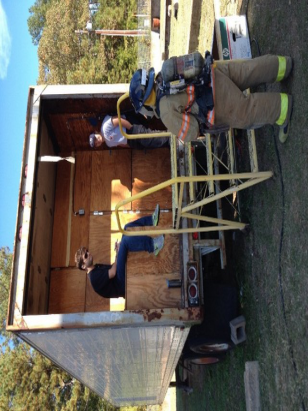
Apparatus This pilot study was performed during firefighting training school for candidates hired by local fire departments around Lee County, Alabama. The firefighter training facility, located in Opelika, Alabama, utilizes a converted freight trailer (tractor-trailer) to serve as a self-contained training aid used to teach firefighter trainees to navigate dark, restrictive, obstructive, multi-level crawling paths (see Figure 1). This 1977 Great Dane Trailer has internal box measurements of 45’ (length) x 8’ (width) x 8’ (height). A retired fire department officer designed and constructed the crawling course mostly from framing lumber (2”x6”) and plywood. Looking inward from the rear doors, the trailer is essentially divided into square and rectangular sections, allowing access to one or more crawling paths. The center section is designed to facilitate walking almost the entire length of the interior, allowing the training officer easy access to modify the crawling paths by sliding walls, unlatching/latching gates/doors, uncovering/covering holes between levels within the trailer, and also provides rapid access to almost any point in the maze for rescue situations.
Figure 1. Trailer Used in Crawling Simulation.
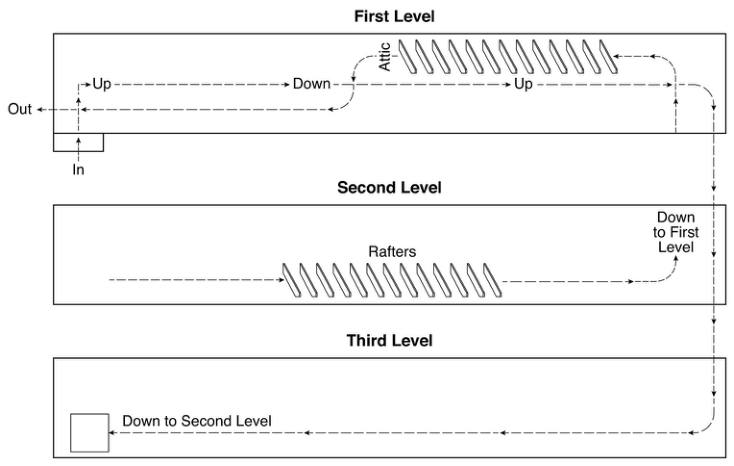
This flexible configuration allows the training officer to vary the length of expected completion of the course between approximately five (5) and twenty (20) minutes, depending on the scenario (see Figure 2). Permanent lighting is installed at various points throughout the trailer to assist in the set-up of the various training routes, and to facilitate a rescue if necessary. The crawling course can be modified to include elevation changes between levels (ramps, stairs, ladders, openings), tight turns, lengthy restricted paths, obstacles (wiring, trash, debris), dead ends, and crawling on ceiling joists and under rafters to simulate attic conditions. For this study, the training officers set- up the maze to take approximately five (5) minutes to complete.
Figure 2. ‘Sample’ Crawling Path Configuration.
Methodology
Ten young, healthy, physically fit male firefighter trainees were randomly selected to be instrumented while performing a mandatory crawling exercise integral to the training curriculum. All firefighter trainees participating in the pilot trials provided informed consent. Fire department training officers established the intended route to be crawled within the trailer by sliding/swinging various wooden panels, and adding/removing other panels to essentially structure the maze for the intended exercise. A researcher crawled throughout the maze with a training officer to ascertain specific nuances of the paths to be travelled. Based on this reconnaissance, five wireless infra-red security cameras were installed at key points of the maze to capture subject behavior and performance at various points in the exercise. Infra-red capability is critical in this application since the environment is totally dark upon entry.
Firefighters were instrumented with heart rate monitors, measured (height) and weighed in their station uniform, and again in full turnout gear over the uniform. Researchers recorded the initial Self Contained Breathing Apparatus (SCBA) pressure (psig) and air tank ratings (volume and pressure), while firefighters received mission and safety briefs about the pending exercise. Firefighters entered the rear of the trailer at pre-determined intervals, crawled in restrictive (height & width) pathways by feeling their way in total darkness over (around, under and through) a number of obstacles (floor joists, ceiling joists, rafters) and different surface conditions (ramps, vertical openings) to complete the course, and exited the rear of the trailer via a different opening. Firefighters were subsequently debriefed on their performance and experiences, while researchers recorded the elapsed time, the final SCBA air tank pressure (psig), and removed the heart rate monitor.
Researchers and training officers monitored the subjects progress through the maze in real-time from a command center outside the trailer.
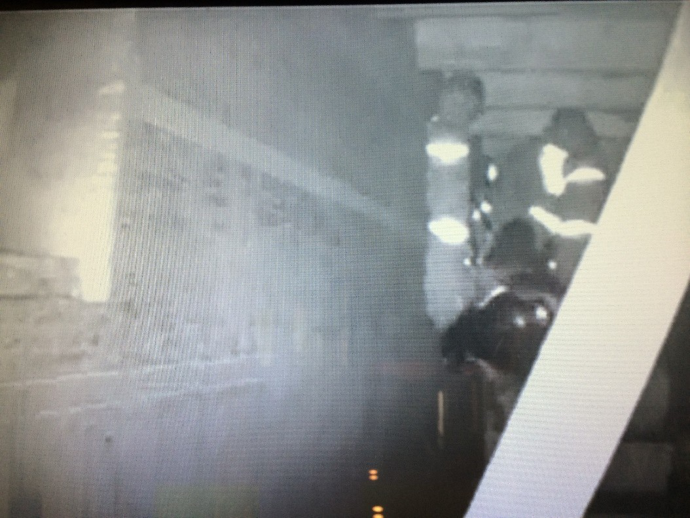
A debrief session was held later in the course to present the results to the class including heart rate data, crawling times, air usage, and analysis of the security video footage (an example can be seen in Figure 3).
Figure 3. Firefighter Crawling Over Ceiling Joists and Under Rafters.
Results
The average time for the trainees to crawl through the maze was 5:53 (mm:ss) and ranged from 3:50 to 7:45 (mm:ss). This time, which slightly exceeded the intended five minutes, may have been inflated by two trainees who took a ‘wrong turn’ resulting in completion times of 7:06 and 7:24. The mean pressure reduction in the SCBA tank was 1335 psig, ranging between 1000 and 1900 psig. These results are representative of air consumption reported in previous studies while crawling (Davis & Gallagher, 2014; and Davis et al., 2014). Air management is a priority in all firefighting evolutions, but it is critically important when the firefighter is working near peak physical capacity, as is the case with crawling in full turnout gear (Marino, 2006). Similarly, the average maximum heart rate experienced during the crawl was 171.4 bpm. Though heart rate traces vary by individual, they generally follow a pattern similar to that seen in Figure 4. The maze was entered with a heart rate of ~100 bpm. Heart rate quickly jumped to ~165 bpm within ~ one minute of initiating crawling, remained elevated and peaked at ~175 bpm, and returned fairly quickly back to ~ 100 bpm when the crawling ceased. Previous crawling studies (Davis & Gallagher, 2014; Davis et al., 2014; and Davis, 2011) have reported similar increases, elevated plateaus, and subsequent decreases for heart rate during crawling activity.
Heart Rate Response While Crawli
200
180
160
Heart Rate (bpm)
140
120
Figure 4. Heart Response in the Maze.
Figure available in the original PDF paper.
Conclusions
The following conclusions were reached from the pilot study:
1) The use of wireless technology is possible in an environment such as the interior of a semi-trailer, though signal repeaters/boosters may need to be added, to overcome signal distortion. 2) Knowing that crawling is a physically intensive event, it is prudent to monitor trainee cardiac performance during such exercises, particularly when the trainee is out of sight for extended exercise periods. 3) Air management training can be enhanced by the use of repetitive training exercises in controlled/structured environments, accompanied with physiologic monitoring and measuring associated air consumption rates. 4) Video footage provides real time monitoring of trainee performance, can aid in the identification of a trainee experiencing problems, and is valuable after the fact to assist the training officer and firefighter to identify strengths and weaknesses associated with a specific scenario.
Recommendations & Future Studies A number of recommendations were realized from this pilot study:
1) Any consideration of using an ‘enclosed/confined’ space for training purposes must first be preceded by a determination of environmental conditions in accordance with OSHA’s confined space standard (OSHA, 2014) and specific planning for rescuing a trainee who might succumb (heart attack, stroke, seizure, panic attack, fatigue, become stuck or entangled, etc.) prior to commencing the training. 2) Wireless infra-red cameras and heart rate monitoring equipment allow immediate observation and evaluation. Reasonably priced security systems have the capability to record and display up to sixteen (16) cameras, allowing multiple trainees to be observed simultaneously at various points in the training exercise. 3) Future studies might consider using additional wireless physiological monitoring equipment to capture other dependent variables of interest.
Acknowledgement
Thanks to Training Officer John Lankford of the Auburn (AL) Fire Department for providing access to the firefighting training school curriculum. We thank the firefighter trainees for their participation in this study.
Conflict of Interest None declared.
References
CPAT (2014). Downloaded on 2/25/2014. http://www.iaff.org/HS/CPAT/cpat_index.html Davis, GA, Gallagher, S (2014). “Physiological Demand on Firefighters Crawling During a Search Exercise”. Manuscript in review, International Journal of Industrial Ergonomics, January 26, 2014. Davis, GA, Gallagher, S, Tang, R, Sesek, RF (2014). “Physiological Response of Firefighters Performing a Crawling Rescue”.
Forthcoming. Manuscript in review, Applied Ergonomics, February 28, 2014. Davis, Ryan A (2011). “A Comparison of Physiological Effects of Traditional Walking Locomotion to Crawling”. Thesis, East Stroudsburg University of Pennsylvania, East Stroudsburg, PA. Drager (2014). Downloaded on 2/25/2014.
http://www.draeger.com/sites/en_aunz/Pages/Fire-Services/Fire-simulation-trailer-mobile.aspx Kady R, Davis, GA (2009a). “The Effect of Occupant Characteristics on Crawling Speed in Evacuation”. Fire Safety Journal (44). pp. 451–457. Kady, R, Davis, GA (2009b). “The Impact of Exit Route Designs on Evacuation Time for Crawling Occupants”. Journal of Fire
Sciences (27). pp. 481-493. Marino, Dominick (2006). “Air Management: Know Your Air-Consumption Rate. Fire Engineering”. Downloaded on 1/5/2014: http://www.fireengineering.com/articles/print/volume-159/issue-10/features/air-management-know-your-air- consumption-rate.html Morrissey SJ, George CE, Ayoub, MM (1985). “Metabolic Costs of Stoop Walking and Crawling”. Applied Ergonomics 16(2).
pp. 99–102. Nagai, R, Fukamachi, M, Nagatani, T (2006). “Evacuation of Crawlers and Walkers from Corridor through an Exit”. Physica A (367). pp. 449-460. OSHA (2014). 29CFR1910.146. Downloaded on 2/25/2014.
Read this individual research paper free through the original publisher, or explore the full digital proceedings book.
ISBN 978-1-4951-2100-5
Explore this ISBN in the AHFE Bookstore ↗Listed in the July 2026 bookstore catalogue; search by ISBN to confirm current availability · Digital book purchase optional