Sari Tappura, Noora Nenonen (2019). Safety Leadership Competence and Organizational Safety Performance. In: Advances in Safety Management and Human Factors. AHFE Open Access, vol. 5. https://doi.org/10.54941/ahfe100157
Center for Safety Management and Engineering, Department of Industrial Management, Tampere University of Technology, P.O. Box 541, FI-33101 Tampere, Finland ↗
Safety leadership is a key factor in promoting safety performance in organizations. Managers need safety leadership competencies when motivating employee safety participation and compliance, as well as in improving the related safety outcomes. Based on the current research, certain safety leadership styles are vital with regard to safety performance. By developing these competencies, organizations may improve their effectiveness via better safety performance. Information on a managers’ safety leadership competence is required in order to develop their competencies and to develop safety training for managers. The objective of this study is to suggest efficient safety leadership competencies for managers, and discuss the importance of developing managers’ safety leadership competence. The results are based on a literature review and 18 interviews carried out in a Finnish expert organization. The results were structured according to the transactional and transformational leadership facets based on leadership theory. The results point out the importance of all traditional facets of transactional and transformational leadership with relation to safety performance, and the idealized influence leadership facet was emphasized. Other important facets were inspirational motivation, intellectual stimulation, and management by exception. Both the transactional and transformational safety leadership competencies of the managers should be trained and developed.
Safety research generally addresses managers’ critical roles in promoting occupational health and safety (OHS). Managers are commonly considered key factors in safety improvements and implementing safety management sys- tems, since they have the capacity and power to make decisions on safety investments and can influence the safety culture (e.g., Dedobbeleer and Béland, 1998; DeJoy et al., 2004; Fernández-Muñiz et al., 2009; Flin, 2003; Flin et al., 2000; Flin and Yule, 2004; Hale et al., 2010; Hofmann and Stetzer, 1996; Rundmo, 1996; Rundmo and Hale, 2003; Zohar, 1980). Nowadays, safety leadership is seen as important in the development of the safety culture, cli- mate, and performance, and has been actively studied in recent years (e.g., Barling et al., 2002; Conchie et al., 2013; Eid et al., 2012; Hoffmeister et al., 2014; Hofmann and Morgeson, 2004; Kapp, 2012; Künzle et al., 2010; Lu and Yang, 2010; O’Dea and Flin, 2001; Wu et al., 2008; Zohar, 2010). As Zohar (2010) argues, according to his 30-plus years of experience in safety climate research, the time has come for moving to the next phase, namely, safety lead- ership issues.
Safety leadership is one component of the management competence areas. Organizationally-specific safety proce- dures and safety culture may be supported by management practices, at least to fulfill the regulatory requirements related to the physical and psychosocial well-being of all of the employees. (Tappura and Hämäläinen, 2011) In or- der to promote safety performance, leadership is a key factor in motivating both safety participation and the compli- ance of the employees (Kapp, 2012). Moreover, safety leadership may also affect the productivity of an organization via the employees’ motivation and commitment, fluency of work, as well as costs related to accidents, absences, conflicts, or quality (e.g., Biron and Bamberger, 2012; Lewis, 2009; Sievänen et al., 2013; Tappura et al., 2013). Thus, lack of leadership skills may impede the overall improvement actions and safety performance (Tappura and Hämäläinen, 2012).
Previous literature has suggested various leadership styles suitable for safety performance improvements (e.g., Bar- ling et al., 2002; Clarke, 2013; Eid et al., 2012; Hale et al., 2010; Kapp, 2012), as presented in the following section. In spite of the awareness of the importance of safety leadership, managers tend to have little safety training, and lim- ited understanding about their important roles (Tappura and Hämäläinen, 2012). Moreover, the managers’ compe- tence requirements are unclear (Hardison et al., 2014; Tappura and Hämäläinen, 2012). In their articles, Hardison et al. (2014) identified supervisors’ knowledge-based safety competencies, and Tappura and Hämäläinen (2011; 2012) defined an outline for managers’ OHS competence areas and training. In their study, Biggs and Biggs (2013) devel- oped a construction safety competency framework, which included the identification of the knowledge, skills and behaviors required for safety management tasks. However, the research of the managers’ safety competence is defi- cient, especially related to effective safety leadership competencies.
In this article, the efficient safety leadership styles are discussed. The objective is to suggest efficient safety leader- ship competencies for managers. The relevant safety leadership competencies are identified on the basis of the safety literature and empirical findings, and structured according to leadership theory. Moreover, the importance of devel- oping a manager’s safety leadership competence in an organization is discussed.
THE RELATIONSHIP BETWEEN SAFETY LEADERSHIP AND SAFETY PERFORMANCE According to Yukl (2008), organizational effectiveness consists of an organization’s ability to survive, perform its mission, as well as maintain favorable earnings, financial resources, and asset values. Organizational effectiveness depends on the performance determinants, namely the efficiency of the internal processes and adaptation to the ex- ternal environment. Besides the type of industry and turbulence in the external environment, leaders’ actions and de- cisions influence the determinants. Leaders can improve their performance by using specific leadership behaviors, as well as deciding on an organizational structure and competitive strategy. According to Bass and Avolio (1990), ef- fective leadership is based on transactional leadership, and transformational leadership builds on this by broadening the leader’s effect on performance.
In this article, the focus is on leadership behaviors when striving for safety performance improvements, which may be considered to be a subsystem of organizational performance (Wu et al., 2008). Safety performance is the concept of safety-related actions and behaviors that workers exhibit in almost all kinds of work in order to promote the safety and health of themselves or others (Burke et al., 2010). Good safety performance impacts on, for example, effi- ciency through reduced accident costs or improved productivity (Sievänen et al., 2013; Tappura et al., 2014). It may also have effects on adaptations to changing customer needs and preferences.
Leadership style and leader-member exchange relations influence subordinates’ performance and outcomes (e.g., Bass and Avolio, 1990; Michael et al., 2006; Stinghamber and Vandenberghe, 2003). According to Hofmann and Morgenson (1999), employees’ safety performance improves when they have a clear understanding of safe proce- dures and the consequences of unsafe behaviors, and when their safety behaviors are supported by their supervisors. Safety coaching and control have both been found to be important elements of safety leadership (Blair, 2003; Cooper, 1998; Williams, 2002; Wu et al., 2008). They affect the safety compliance and safety participation (Griffin and Neal, 2000) of employees, resulting in compliance with safety rules and procedures, as well as improving work- place safety (Kapp, 2012). Similarly, transactional leadership (Bass, 1985) impacts safety compliance and transfor- mational leadership (Bass, 1985), and the overall safety performance of employees (Kapp, 2012).
The study by Köper et al. (2009) links OHS to overall business issues (performance and competitiveness). The re- sults of their study support a correlation of health-related issues and organizational performance, whereas adverse work conditions had a negative impact. Improving health, job satisfaction, and motivation have positive effects on performance, and these factors may be influenced by a transformational leadership style (Bass and Avolio, 1990). Moreover, developing a positive safety climate requires that managers visibly and regularly demonstrate their com- mitment and actions toward safety (Wu et al., 2008).
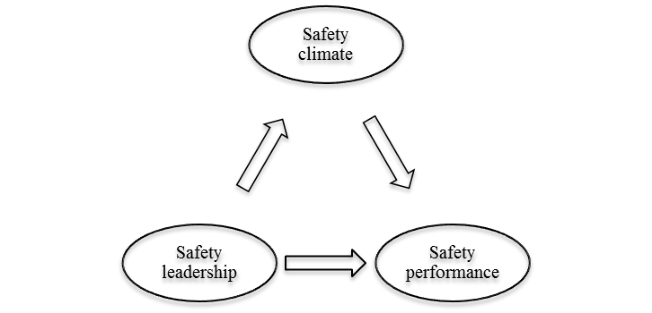
In their studies, Wu et al. (2008) and Clarke (2013) suggest that safety leadership and safety climate are important predictors of safety performance. Leadership has also been identified as a major factor in the safety climate (Barling et al., 2002; Zohar, 2010). Similarly, Blair (2003) argued that both the safety climate and safety leadership must be improved with regard to safety performance, thus, the quality of leadership impacts on safety performance in two ways (see Figure 1).
Figure 1. The relationship between safety leadership, safety climate, and safety performance (Wu et al., 2008)
A safety performance evaluation is mostly based on accident rates, climate scores, audit scores, and expert judgment (e.g., Bigelow and Robson, 2005; Chang and Liang, 2009; Hale et al., 2010). In the scientific evaluation of success- ful safety interventions by Hale et al. (2010), the safety performance measurement was mainly based on output indi- cators (e.g., accident rate and lost days) and expert judgment. Intermediate indicators (e.g., safety climate scores, dangerous situation reports, and observation rounds) were used when available. They used the safety-related key performance indicators presented in Table 1.
Table 1: Examples of output indicators and intermediate measures related to safety performance measurement (Hale et al., 2010)
Table available in the original PDF paper.
Indicator type Indicator Output indicator Lost time accident rate, LTI Total accidents Lost days Absence per accident First aid treatment rate
Intermediate measures Reports of dangerous situations Safety climate scores (RIGO 2005) Actions on dangerous situations reports Measures of observed unsafe/safe behavior Wearing of PPE
Incorporation of safety in toolbox-meetings Behavioral observation rounds with dialogue
In the Hoffmeister et al. study (2014), safety climate scores were considered to be the most important safety perfor- mance indicators. From the point of view of this study, the safety climate is a relevant indicator, since climate is in- fluenced by the leaders’ actions and leadership styles (e.g., Eid et al., 2012; Hoffmeister et al., 2014; Kapp, 2012; Wu et al., 2008).
THE THEORETICAL FRAMEWORK FOR SAFETY LEADERSHIP Safety leadership research leans on leadership theory. Transactional and transformational leadership styles (Bass, 1985) have raised interest among safety researchers (e.g., Barling et al., 2002; Christian et al., 2009; Conchie and Donald, 2009; Kapp, 2012; Kelloway et al., 2006; Michael et al., 2006; Zohar, 2002). However, among safety re- searchers, the focus has been more on transformational than transactional leadership (Clarke, 2013). In their study, Eid et al. (2012) suggest that authentic leadership (Gardner et al., 2005) is a suitable construct for safety-focused leadership due to its explicit emphasis on personal and social identification processes, role modelling, and value based leadership (Avolio and Gardner, 2005). Also, the leader-member exchange theory (Dansereau et al., 1975) has been used to explain the influence of leadership on safety outcomes (e.g., Hofmann and Morgeson, 1999; Hofmann et al., 2003; Michael et al., 2006). In this study, the transactional and transformational leadership theories are applied to structure the findings, due to their demonstration of positive safety impacts on employees’ safety compliance and participation, as well as the safety climate (Barling et al., 2002; Clarke, 2013; Griffin and Hu, 2013; Hoffmeister et al., 2014; Kapp, 2012).
Transactional leadership involves the leader establishing goals (e.g., safety-related goals), actively monitoring the employee’s performance with regard to these goals, and providing rewarding or corrective feedback about the em- ployee’s performance (e.g., safe behavior). Transformational leadership achieves results by increasing the employ- ees’ acceptance of these goals, for example, in safety-related behavior. Leaders serve as role models, inspire com- mitment to achieving the goals, show an active interest in the individual employee, and challenge the employees to overcome obstacles that prevent them from achieving these goals (Barling et al., 2002; Bass, 1985; Kapp, 2012). Both the transactional and transformational leadership styles are related to effective leadership, with the best leaders demonstrating both (Bass, 1985; Hoffmeister et al., 2014). Transactional and transformational leadership consists of theoretically distinct multidimensional constructs and can be divided into more specific leadership facets (Bass, 1985), which may affect safety in different ways and for different reasons (Hoffmeister et al., 2014). The character- istics of major leadership facets related to transactional and transformational leadership are summarized in Table 2.
Table 2: Characteristics of transactional and transformational leadership facets Transactional leadership Transformational leadership
Table available in the original PDF paper.
Contingent Reward: Providing appropriate rewards and recognition for positive behaviors (Bass, 1985). Clearly communicating desired behaviors and reward contingen- cies to employees, and actually recognizing accomplish- ments to reinforce desired behaviors (Bass, 1985; 1990).
Idealized Influence: Instilling pride, evoking integrity, trust, and re- spect in employees (Bass, 1990; Bass and Riggio, 2006), who ulti- mately view leaders as role models (Bass and Riggio, 2006). Individualized Consideration: Giving personal attention (Bass, 1990). Attends to the individual differences in the needs of employ- ees. Coaching and mentoring employees in order to help them reach their full potential (Avolio, 1999; Bass and Riggio, 2006). Management by Exception: Discouraging negative be- havior. Active management by exception is proactive and focused on prevention (Bass, 1985). Employee per- formance is actively monitored to detect deviations from rules and standards, taking corrective action. Passive management by exception is reactive intervening, only if
Inspirational Motivation: Leader's clear articulation of a com- pelling vision and the need for employees to work towards this mission, resulting in more inspired employees. Encouraging em- ployees to strive for something beyond their individual goals (Bass, 1985). Intellectual Stimulation: Promoting intelligence, rationality, and standards are not met (Bass, 1985; 1990). careful problem solving (Bass, 1990). Reflects the extent to which a leader solicits employees' perspectives on problems and considers a wide variety of opinions in making decisions. Inspiring employ- ees to think creatively and innovatively (Bass, 1985).
METHODS
A review of the literature was carried out using the electronic databases of scientific journals (e.g., Science Direct Elsevier), and the main search terms used were related to safety leadership. Studies related to safety leadership were browsed and those with associations to safety performance measures were included in the review. The safety man- agement literature was also reviewed to determine the interconnections between the good practices of safety man- agement and safety leadership. A couple of major reviews (Hale and Hovden, 1998 as cited in Hale et al., 2010; Shannon et al., 1997 as cited in Hale et al., 2010), which have identified organizational factors affecting safety man- agement and performance, were the major sources used. A framework of competencies was built on the basis of the appropriate literature. Thematic interviews were carried out in a Finnish expert organization to empirically supple- ment the framework; and, in total, 18 line managers were interviewed. The interviewees were mostly senior, experi- enced managers, and they were asked about their considerations of effective safety leadership. The results of the lit- erature review and interviews were compared to and structured according to the transactional and transformational leadership facets (see Table 2).
RESULTS
Transactional leadership The interview results did not include leadership proficiencies related to transactional leadership. In the safety litera- ture, the following leadership proficiencies related to transactional leadership were discussed:
- Contingent reward: o Having a reward or incentive system (Hale and Hovden, 1998 as cited in Hale et al., 2010) and re- warding employees’ safety behaviors (Lu and Yang, 2010; Zohar, 2002) - Management by exception:
o Monitoring employees’ safety/unsafe behaviors (Griffin and Hu, 2013; Shannon et al., 1997 as cited in Hale et al., 2010; Zohar, 2002; Zohar and Luria, 2003), correcting employee behaviors (Lu and Yang, 2010), enforcing employees to obey safety regulations (Wu et al., 2008) and sanction- ing rule violations (Hale and Hovden, 1998 as cited in Hale et al., 2010).
Both of the leadership proficiencies related to the contingent reward and management-by-exception leadership facets were linked to lower injury rates (Hale and Hovden, 1998 as cited in Hale et al., 2010; Zohar, 2002) and better safety climate scores (Zohar, 2002; Zohar and Luria, 2003). Both were also positively associated with employee safety behaviors, such as compliance (Griffin and Hu, 2013; Lu and Yang, 2010), participation (Lu and Yang; 2010), housekeeping, and the use of protective equipment (Zohar and Luria, 2003).
Transformational leadership Idealized influence
Related to idealized influence, the interviewees mentioned such leadership proficiencies as:
- Speaking respectfully about employees. - Treating all employees well and even-handedly. - Complying with organizational procedures and rules. - Being present. - Having an open-door policy to enable subordinates to discuss relevant issues when necessary. - Believing in employees’ expertise. Safety Management (2019)
- Broaching discussion on conflicting issues and working out the problems.
In the literature, the following proficiencies related to idealized influence were found:
- Stressing the importance of safety (Hale and Hovden, 1998 as cited in Hale et al., 2010; Lu and Yang, 2010), being a role model for safety (Lu and Yang, 2010), and demonstrating the true and consistent prior- ity of the employees' safety (Törner, 2011). - Managers' commitment (Hale and Hovden, 1998 as cited in Hale et al., 2010; Hoffman and Morgeson, 1999) and personal commitment (Hale and Hovden, 1998 as cited in Hale et al., 2010). - Managers' active role (Shannon et al., 1997 as cited in Hale et al., 2010), participative leadership style (Hale and Hovden, 1998 as cited in Hale et al., 2010), and the amount of energy and creativity injected by the managers (Hale et al., 2010). - Informal organization (Hale and Hovden, 1998 as cited in Hale et al., 2010), and good (Hoffman and Morgeson, 1999; Michael et al., 2006; Shannon et al., 1997 as cited in Hale et al., 2010) and trusting (Hale and Hovden, 1998 as cited in Hale et al., 2010; Kelloway et al., 2012; Törner, 2011; Zacharatos et al., 2005) relationships between the management and workforce, promoting cooperation (Törner, 2011). - Interpersonal/group communication (Hale and Hovden, 1998 as cited in Hale et al., 2010) and constructive dialogue (Hale et al., 2010) between managers and the workforce. - Availability, openness to criticism, and work as a source of pride (Hale and Hovden, 1998 as cited in Hale et al., 2010).
Demonstrating true safety concerns, managers’ commitment and active roles, and high-quality relationships with constructive dialogue have all been linked to lower injury rates (Hale and Hovden, 1998 as cited in Hale et al., 2010; Shannon et al., 1997 as cited in Hale et al., 2010) and safety incidents (Michael et al., 2006; Zacharatos et al., 2005). These kinds of leadership behaviors support trust and a position of safety as the prime organizational goal (Törner, 2011), and support the employee reporting of safety concerns (Hoffman and Morgeson, 1999). Trusting relation- ships (Törner, 2011) support the realization of safety behaviors (Lu and Yang, 2010). The level of trust in managers mediates personal-safety orientations (i.e., safety knowledge, safety motivation, safety compliance, and safety initia- tive) and has a positive relationship with employee psychological well-being (Kelloway et al., 2012). Constructive dialogue between the shop-floor and line management has been identified as a key factor to successful safety inter- ventions with improvements in safety performance (a combination of several measures, e.g., accidents, unsafe be- havior, dangerous situations, safety climate) (Hale et al., 2010).
Individual consideration In the interviews, the respondents mentioned the following leadership proficiencies related to individualized consid- eration:
- Asking how they feel. - Offering help proactively. - Accepting differences in personalities. - Accepting different kinds of expressions. - Creating prerequisites for working efficiently.
Respectively, the following proficiencies found in the literature were classified to relate to individualized leadership facets:
- Caring culture (Hale and Hovden, 1998) and providing individualized support (Törner, 2011), reflecting care and concern for the well-being of employees (Mearns and Reader, 2008). - Human resources planning (Hale and Hovden, 1998 as cited in Hale et al., 2010) and modified work provi- sion after accidents (Shannon et al., 1997 as cited in Hale et al., 2010).
Support, taking into account individual needs, promotes employee safety behavior (Mearns and Reader, 2008) and therefore their contribution to the organizational goals (Törner, 2011), such as lower accident rates (Hale and Hov- den, 1998 as cited in Hale et al., 2010).
Inspirational motivation In the interview results, there were no leadership facets that could have been directly linked to inspirational motivation. The findings from the literature were, however, as follows:
- Promoting safety (Hale and Hovden, 1998 as cited in Hale et al., 2010) and motivating and inspiring safety (Griffin and Hu, 2013; Hale and Hovden, 1998 as cited in Hale et al., 2010; Shannon et al., 1997 as cited in Hale et al., 2010; Törner, 2011):
- for example, by using inspirational appeals (using emotional language to emphasize the impor- tance of a new task and arouse enthusiasm) (Clarke and Ward, 2006), empowering leader behavior (Martínez-Córcoles et al., 2011), and encouraging the workforce toward long-term commitment (Shannon et al., 1997 as cited in Hale et al., 2010). - Having goals, standards, and resources defined and used (Hale and Hovden, 1998 as cited in Hale et al., 2010; Lu and Yang, 2008), fostering group goals (Törner, 2011), and communicating safety (Hoffman and Morgeson, 1999; Michael et al., 2006).
Promoting safety and motivating to it result in lower accident rates (Hale and Hovden, 1998 as cited in Hale et al., 2010; Shannon et al., 1997 as cited in Hale et al., 2010) through an improved safety climate (Clarke and Ward, 2006; Martínez-Córcoles et al., 2011; Törner, 2011) and employee safety participation (Griffin and Hu, 2013). The proper declaration of safety goals and fostering them also supports better relations in a group climate, and can be linked to safety-related events and lower accident rates (Hale and Hovden, 1998 as cited in Hale et al., 2010). Com- municating safety can help employees to feel freer to raise safety concerns (Hoffman and Morgeson, 1999), and can be linked to fewer safety events (Michael et al., 2006) and accidents (Hoffman and Morgeson, 1999).
Intellectual stimulation The two following themes, which were mainly linked to intellectual stimulation, came up in the interviews:
- Encouraging employees to contemplate solutions along with their supervisor or colleagues. - Asking them for their interpretations.
In the literature, such issues were mentioned with relation to intellectual stimulation:
- Coordination, centralization, (Hale and Hovden, 1998 as cited in Hale et al., 2010) and delegation of safety activities (Shannon et al., 1997 as cited in Hale et al., 2010). - Empowering (Hale and Hovden, 1998 as cited in Hale et al., 2010; Shannon et al., 1997 as cited in Hale et al., 2010) and consulting (Clarke and Ward, 2006) with employees. Using a coalition, that is, co-workers to create pressure to comply (Clarke and Wards, 2006). - Having a problem solving (Hale and Hovden, 1998 as cited in Hale et al., 2010) and learning (Griffin and Hu, 2013) approach to safety. Using logical arguments and factual evidence (rational persuasion) to moti- vate safety (Clarke and Ward, 2006).
According to Clarke and Ward (2006), leadership behaviors such as coalition, consultation, and rational persuasion influence employee safety participation. Empowering the workforce in different ways contributes to safety perfor- mance through an improved climate (Clarke and Ward, 2006; Törner, 2011), trust and relationships between em- ployees and leaders (Törner, 2011). According to Griffin and Hu (2013), safety monitoring will have a positive ef- fect on safety participation when the leader encourages safety-related learning. Both a problem-solving approach and employee empowerment are associated with lower accident rates (Hale and Hovden, 1998 as cited in Hale et al., 2010; Shannon et al., 1997 as cited in Hale et al., 2010).
DISCUSSION
Managers need safety leadership competencies when motivating employee safety participation and compliance, as well as improving related safety outcomes. Based on current research, certain safety leadership styles and competen- cies are vital with regard to the safety performance of an organization. By developing these competencies, organiza- tions may improve their effectiveness via better safety performance.
According to the results of this study, safety leadership competencies linked to safety performance in the literature were found to be related to all of the studied leadership facets. This indicates each of them is important with regard to safety performance. The idealized influence leadership facet was emphasized both in the literature and in the in- terview findings. This is in line with the study of Hoffmeister et al. (2014), who found that idealized attributes and behaviors were the most important leadership facets explaining the safety outcomes studied (safety climate, safety behaviors, injuries, and pain). Many of the literature findings were also related to inspirational motivation, intellec- tual stimulation, and management by exception. The findings in the literature were less often related to individual consideration and contingent rewards.
In the interviews, the idealized influence, individual consideration, and intellectual stimulation were emphasized. The major difference in the results was that individual consideration was less emphasized in the literature than in the interviews. It is possible that individual consideration is less studied in the safety literature. Nevertheless, Hoffmeis- ter et al. (2014) found that individualized consideration was less important with regard to safety performance. The fact that the interviews were carried out in an expert organization may explain the fact that individual consideration and intellectual stimulation were highlighted in the interviews. The expert organization may also explain the result that there was no support for transactional leadership facets in the interviews. Contrary to the findings of Hoffmeis- ter et al. (2014), there was support for the management by exception leadership in the literature. Additionally, Clarke (2013) argued that active management by exception has rarely been featured in safety studies, but should be empha- sized when encouraging safety participation.
It should be noted that the classification of safety leadership practices to leadership facets is subjective. In addition, there are many interconnections between different practices and different leadership facets. Here, each practice was classified to the facet in which characteristics the practice was mainly related to. For example, communication can involve evoking trust in employees (i.e., idealized influence), but also individualized consideration, when personal attention is paid to the employees. Moreover, in many studies, the influence of some leadership styles to the safety outcomes is studied, while there is less research on specific leadership practices related to different leadership styles (e.g., Christian et al., 2009).
Based on the current study, all the traditional leadership facets of transactional and transformational leadership are relevant to safety leadership. Also, several previous studies have suggested transformational and transactional lead- ership to be suitable constructs for safety leadership (e.g., Barling et al., 2002; Clarke, 2013; Kapp, 2012; Michael et al., 2006). In her meta-analysis, Clarke (2013) found that a combination of transformational and active transactional leadership styles is the most effective in managing workplace safety. Thus, effective interventions to improve safety leadership require both the transactional and transformational leadership facets. Most of the previous interventions have focused on transformational leadership, and the leaders would benefit from a wider range of safety leadership styles, as well as a more situational approach (Clarke, 2013). According to Bass and Avolio (1990), the general lead- ership training programs are often based on transactional leadership, and many aspects of effective leadership are missing when the transformational aspect is undervalued. However, both the transactional and transformational lead- ership styles are worth the training, education, and development. Safety leadership competencies may be evaluated and developed as a part of the general competence development of managers. According to Kapp (2012), safety-spe- cific transformational leadership training may improve safety performance, resulting in the improved safety partici- pation of employees. Thus, information on the managers’ safety leadership competence requirements is valuable in order to develop their competence as well as to develop safety training for managers.
Safety leadership is often studied separately from safety management. However, as the results of this study showed, safety management and the related studies may also include elements of safety leadership. For example, the partici- pation of employees is considered to be one of the key elements for effective safety management. Nevertheless, the extent to which a leader solicits employees' perspectives on problems and considers a wide variety of opinions in making decisions is part of the intellectual stimulation leadership. Hence, in many companies, safety management practices could provide easy ways to incorporate safety leadership competencies into existing practices.
Further research is needed to better define the contextual factors and situational flexibility of leadership styles, as well as efficient leadership practices. Moreover, authentic leadership is another interesting construct for safety lead- ership (Eid et al., 2012), and should be further implemented in safety research in the future.
ACKNOWLEDGEMENTS
The authors sincerely wish to thank the Finnish Work Environment Fund and the participating organizations for their funding of this study. The interviewees are also thanked for their contributions to this study.
REFERENCES
Avolio, B.J., Gardner, W.L. (2005), “Authentic leadership development: getting to the root of positive forms of leadership”, The Leadership Quarterly 16, pp. 315–338. Avolio, B.J. (1999), “Full Leadership Development: Building the Vital Forces in Organizations”. Thousand Oaks, CA: Sage
Publications. Barling, J., Loughlin,C., Kelloway, E. (2002), “Development and test of a model linking safety-specific transformational leadership and occupational safety”, Journal of Applied Psychology 87, pp. 488–496. Bass, B.M. (1985), “Leadership and Performance Beyond Expectation”. New York: The Free Press. Bass, B.M., Avolio, B.J. (1990), “Developing Transformational Leadership: 1992 and Beyond”, Journal of European Industrial
Training 14(5), pp. 21-27. Bass, B.M. (1990), “From Transactional to Transformational Leadership: Learning to Share the Vision”, Organizational Dynamics 18(3), pp. 19-31. Bass, B.M., Riggio, R.E. (2006), “Transformational Leadership”. Mahwah, NJ: Lawrence Erlbaum Associates. Biggs, H.C., Biggs, S.E. (2013), “Interlocked projects in safety competency and safety effectiveness indicators in the construction
sector”, Safety Science 52, pp. 37–42. Bigelow, P., Robson, L. (2005), Occupational Health and Safety Management Audit Instruments: A Literature Review. Toronto Institute for Work & Health Website: http://www.iwh.on.ca/sys-reviews/occupational-health-and-safety-management-au- dit-instruments-a-literature-review. Biron, M., Bamberger, P. (2012), “Aversive Workplace Conditions and Absenteeism: Taking Referent Group Norms and Supervi-
sor support Into Account”, Journal of Applied Psychology 97(4), pp. 901-912. Blair, E. (2003), “Culture & leadership: Seven key points for improved safety performance”, Professional Safety 48(6), pp. 18–
22. Burke, M.J., Sloane M. Signal, S.M. (2010), “Workplace safety: a multilevel, interdisciplinary perspective”, in: Research in Personnel and Human Resources Management, H. Liao, J.J. Martocchio, A. Joshi (Eds.), Research in Personnel and Human Resources Management Volume 29; Emerald Group Publishing Limited. pp.1-47. Chang, J.I., Liang, C-L. (2009), “Performance evaluations of process safety management systems of paint manufacturing facili-
ties”, Journal of Loss Prevention in the Process Industries 22, pp. 398-402. Christian, M.S., Bradley, J.C., Wallace, J.C., Burke, M.J. (2009), “Workplace safety: a meta-analysis of the roles of person and situation factors”, Journal of Applied Psychology 94, pp. 1103–1127. Clarke, S. (2013), “Safety leadership: A meta-analytic review of transformational and transactional leadership styles as an-
tecedents of safety behaviours”, Journal of Occupational and Organizational Psychology 86, pp. 22–49. Clarke, S., Ward, K. (2006), “The Role of Leader Influence Tactics and Safety Climate in Engaging Employees’ Safety Participation”, Risk Analysis 26, pp. 1175–1185. Conchie, S.M., Donald, I.J. (2009), “The moderating role of safety-specific trust on the relation between safety-specific leader-
ship and safety citizenship behaviors”, Journal of Occupational Health Psychology 14, pp. 137–147. Conchie, S.M., Moon, S., Duncan, M. (2013), “Supervisors’ engagement in safety leadership: Factors that help and hinder”, Safety Science 51, pp. 109–117. Cooper, D. (1998), “Improving safety culture: A practical guide”. UK: Wiley. Dansereau, F., Graen, G.B., Haga, W.J. (1975), “A vertical dyad linkage approach to leadership within formal organizations”,
Organizational Behavior and Human Performance 13, pp. 46–78. Dedobbeleer, N., Béland, F. (1998), “Is risk perception one of the dimensions of safety climate?”, in: Occupational Injury: Risk, Prevention and Intervention, A. Feyer,, A. Williamson (Eds.). London: Taylor and Francis. DeJoy, D.M., Schaffer, B.S., Wilson, M.G., Vandenberg, R.J., Butts, M.M. (2004), “Creating safer workplaces: assessing the
determinants and role of safety climate”, Journal of Safety Research 35, pp. 81–90. Eid, J., Mearns, K., Larsson, G., Laberg, J.C., Johnsen, B.H. (2012), “Leadership, psychological capital and safety research: Conceptual issues and future research questions”, Safety Science 50, pp. 55-61. Fernández-Muñiz, B., Montes-Peón, J. M., Vázques-Ordás, C. J. (2009), “Relation between occupational safety management and
firm performance”, Safety Science 47, pp. 980-991 Flin, R. (2003), “Danger – Men at Work: Management influence on Safety”, Human Factors and Ergonomics in Manufacturing 13(4), pp. 261-268. Flin, R., Mearns, K., O'Connor, P., Bryden, R. (2000), “Measuring safety climate: identifying the common features”, Safety Sci-
ence 34, pp. 177-192. Flin, R., Yule, S. (2004), “Leadership for safety: industrial experience”, Quality and Safety in Health Care 13, pp. 45–51. Gardner, W.L., Avolio, B.J., Luthans, F., May, D.R., Walumba, F. (2005), “Can you see the real me? A self-based model of authentic leader and follower development”, The Leadership Quarterly 16, pp. 343–372.
Griffin, M.A., Hu, X. (2013), “How leaders differentially motivate safety compliance and safety participation: The role of monitoring, inspiring, and learning”, Safety Science 60, pp. 196-202. Griffin, M.A., Neal, A. (2000), “Perceptions of safety at work: a framework for linking safety climate to safety performance,
knowledge, and motivation”, Journal of Occupational Health Psychology 5, pp. 347–358. Hale, A.R., Guldenmund, F.W., van Loenhout, P.L.C.H., Oh, J.I.H. (2010), “Evaluating safety management and culture interventions to improve safety: Effective intervention strategies”, Safety Science 48, pp. 1026-1035. Hardison, D., Behm, M., Hallowell, M.R., Fonooni, H. (2014), “Identifying construction supervisor competencies for effective
site safety”, Safety Science 65, pp. 45–53. Hoffmeister, K., Gibbons, A.M., Johnson, S.K., Cigularov, K.P., Chen, P.Y., Rosecrance, J.C. (2014), “The differential effects of transformational leadership facets on employee safety”, Safety Science 62, pp. 68–78. Hofmann, D.A., Morgeson, F.P. (1999), “Safety-related behavior as a social exchange: The role of perceived organizational
support and leader-member exchange”, Journal of Applied Psychology 84, pp. 286-296. Hofmann, D.A., Morgeson, F.P. (2004), “The role of leadership in safety”, in: The psychology of workplace safety, J. Barling, M. R. Frone (Eds.). Washington, DC: APA. pp. 159-180. Hofmann, D.A., Morgeson, F., Gerras, S. (2003), “Climate as a moderator of the relationship between leader–member exchange
and content specific citizenship: safety climate as an exemplar”, Journal of Applied Psychology 88(1), pp. 170–178. Hofmann, D.A., Stetzer, A. (1996), “A cross-level investigation of factors influencing unsafe behaviours and accidents”, Personnel. Psychology 49, pp. 307–339. Kapp, E.A. (2012), “The influence of supervisor leadership practices and perceived group safety climate on employee safety per-
formance”, Safety Science 50, pp. 1119–1124. Kelloway, E.K., Mullen, J., Francis, L. (2006), “Divergent effects of transformational and passive leadership on employee safety”, Journal of Occupational Health Psychology 11 (1), pp. 76–86. Kelloway, E.K., Turner, N., Barling, J., Loughlin, C. (2012), “Transformational leadership and employee psychological well-be-
ing: The mediating role of employee trust in leadership”, Work & Stress 26, pp. 39-55. Künzle, B., Kolbe, M., Grote, G. (2010), “Ensuring patient safety through effective leadership behavior: A literature review”, Safety Science 48, pp. 1-17. Köper, B., Möller, K., Zwetsloot, G. (2009), “The Occupational Safety and Health Scorecard – a business case example for
strategic management”, Scandinavian Journal of Work, environment & Health 35(6), pp. 413-420 Lewis, C. (2009), “The definitive guide to Workplace Mediation & Managing conflict at work”. Surrey: Robert Penberthy Publishing Ltd. Lu, C.-S., Yang, C.-S. (2010), “Safety leadership and safety behavior in container terminal operations”, Safety Science 48, pp.
123-134. Martínez-Córcoles, M., Gracia, F., Tomás, I., Peiró, J.M. (2011), “Leadership and employees' perceived safety behaviours in a nuclear power plant: A structural equation model”, Safety Science 49, pp. 1118-1129. Mearns, K.J., Reader, T. (2008), “Organizational support and safety outcomes: An un-investigated relationship”, Safety Science
46, pp. 388-397. Michael, J., Guo, Z., Wiedenbeckt, J., Ray, C. (2006), “Production supervisor impacts on subordinates’ safety outcomes: an investigation of leader–member exchange and safety communication”, Journal of Safety Research 37 (5), pp. 469–477. O’Dea, A., Flin, R. (2001), “Site managers and safety leadership in the offshore oil and gas industry”, Safety Science 37, pp. 39-
57. Rundmo, T., (1996), “Associations between risk perception and safety”, Safety Science 24, pp. 197–209. Rundmo, T., Hale, A. (2003), “Managers’ attitudes towards safety and accident prevention”, Safety Science 41, pp. 557–574. Sievänen, M., Nenonen, N., Hämäläinen, P. (2013), “The economic impacts of occupational health and safety interventions - a critical analysis based on the nine-box model of profitability”, Proceedings of the 45th Nordic Ergonomics & Human Fac- tors Society (NES) conference, August 11-14, 2013, Reykjavik, Iceland. Stinglhamber, F., Vandenberghe, C. (2003), “Organizations and supervisors as sources of support and targets of commitment: A
longitudinal study”, Journal of Organizational Behavior 24, pp. 251–270. Tappura, S., Hämäläinen, P. (2011), “Promoting occupational health, safety and well-being by training line managers”, Proceedings of the 43th Nordic Ergonomics Society (NES) Conference, September 18-21, 2011, Oulu, Finland. pp. 295-300. Avail- able: http://www.kotu.oulu.fi/nes2011/docs/Proceedings_NES2011_Oulu.pdf. Tappura, S., Hämäläinen, P. (2012), “The occupational health and safety training outline for the managers”, in: Advances in So-
cial and Organizational Factors. Advances in Human Factors and Ergonomics Series Vol. 9, P. Vink (Ed.). Taylor and Francis, CRC Press. pp. 356-365. Available: http://www.crcnetbase.com/doi/pdf/10.1201/b12314-44. Tappura, S., Nenonen, N., Heikkilä, J. Reiman, T., Rasa, P.-L., Ratilainen, H. (2013), “Estimating overall costs of occupational accidents in the Finnish industry”, Proceedings of the 45th Nordic Ergonomics and Human Factors Society (NES) Confer- ence, August 11-14, 2013, Reykjavik, Iceland Tappura, S., Sievänen, M., Heikkilä, J., Jussila, A., Nenonen, N. (2014), “A Management Accounting Perspective on Safety”,
Safety Science (in press), http://dx.doi.org/10.1016/ j.ssci.2014.01.011. Törner, M. (2011), “The ‘‘social-physiology’’ of safety. An integrative approach to understanding organisational psychological mechanisms behind safety performance”, Safety Science 49, pp. 1262–1269. Williams, J.H. (2002), “Improving safety leadership: Using industrial/organizational psychology to enhance safety perfor-
mance”, Professional Safety 47(4), pp. 43–47. Wu, T.-C., Chen, C.-H., Li, C.-C. (2008), “A correlation among safety leadership, safety climate and safety performance”, Journal of Loss Prevention in the Process Industries 21, pp. 307–318. Yukl, G. (2008), “How leaders influence organizational effectiveness”, The Leadership Quartely 19, pp. 708-722. Zacharatos, A., Barling, J., Iverson, R.D. (2005), “High-performance work systems and occupational safety”, Journal of Applied
Psychology 90, pp. 77-93. Zohar, D. (1980), “Safety climate in industrial organizations: theoretical and applied implications”, Journal of Applied Psychology 65, pp. 95–102 Zohar, D. (2002), “The effects of leadership dimensions, safety climate, and assigned priorities on minor injuries in work
groups”, Journal of Organizational Behavior 23, pp. 75–92.
Zohar, D. (2010), “Thirty years of safety climate research: Reflections and future directions”, Accident Analysis and Prevention 42(5), pp. 1517-1522. Zohar, D., Luria, G. (2003), “The use of supervisory practices as leverage to improve safety behavior: A cross-level intervention
model”, Journal of Safety Research 34, pp. 567-577.
LISTED IN THE AHFE DIGITAL BOOKSTORE CATALOGUE
Explore the complete digital volume
Advances in Safety Management and Human Factors
Read this individual research paper free through the original publisher, or explore the full digital proceedings book.
ISBN 978-1-4951-2100-5
Explore this ISBN in the AHFE Bookstore ↗Listed in the July 2026 bookstore catalogue; search by ISBN to confirm current availability · Digital book purchase optional