Iván Nail Ulloa, Michael Zabala, Mauricio Henriquez Schott, Sean Gallagher (2025). From Lab to Field: Translating Inertial Motion Capture into Applied Ergonomic Risk Assessment and Intervention. In: Human Factors and Wearable Technologies. AHFE Open Access, vol. 175, pp. 30–40. https://doi.org/10.54941/ahfe1006356
Wearable inertial motion capture (IMC) systems enable biomechanical assessments in environments where traditional optical systems are impractical. This presentation highlights three studies using the Xsens Awinda IMC system. The first validated IMC-based estimates of L5/S1 moments against optical motion capture (OMC) and force plates across varied lifting conditions, finding ~12–13% underestimation and RMSEs of 19–21 Nm. The second deployed IMC in an automotive plant to assess cumulative low back exposure using a fatigue failure-based framework. Cumulative damage estimates, derived from modeled lumbar moments, were significantly associated with self-reported low back pain (OR = 2.16). The third evaluated the Power Hook, an assistive tool for manhole cover lifting. IMC data revealed up to 36% reductions in peak L5/S1 moments and decreases in shear and compressive forces of up to 20% and 30%, respectively. Collectively, these studies illustrate how IMC and biomechanical modeling support ergonomic risk assessment and intervention in both laboratory and field settings.
Accurately quantifying biomechanical loading in occupational settings remains a persistent challenge in ergonomics and human factors research. Traditional laboratory-based approaches using optical motion capture (OMC) and force platforms offer high precision but are constrained by infrastructure, cost, and their limited applicability in dynamic, real-world environments (Cutti et al., 2010; Robertson et al., 2014). These limitations hinder the ability to assess physical risk factors in industrial contexts where task variability, movement freedom, and environmental constraints often preclude the use of lab-based systems. Recent advances in wearable technology—particularly inertial motion capture (IMC) systems—present a viable alternative for measuring whole-body kinematics in unconstrained
From Lab to Field: Translating Inertial Motion Capture 31
settings. Systems such as Xsens Awinda allow researchers and practitioners to capture movement data with reasonable accuracy, minimal setup time, and full portability (Zhou and Hu, 2008; Picerno, 2017). However, questions remain regarding their validity, reliability, and practical integration into biomechanical modeling frameworks for risk assessment and ergonomic design (Al-Amri et al., 2018).
This paper presents a series of three independent but methodologically aligned studies from that explore and extend the use of IMC for ergonomic evaluation across multiple settings. First, a laboratory validation study assessed the accuracy of lumbar moment estimation using IMC compared to gold-standard OMC and force plates. Second, we deployed the system in an automotive manufacturing plant to implement a fatigue failure-based framework for predicting cumulative lumbar exposure and associated injury risk. Finally, we applied the IMC in a field study to evaluate the ergonomic impact of a novel assistive tool—the Power Hook—for utility workers lifting manhole covers. Together, these studies illustrate the translational potential of inertial motion capture when coupled with biomechanical modeling. They also demonstrate the value of IMC in supporting evidence-based ergonomic interventions across the spectrum of controlled experiments, real-world industrial tasks, and field-based product evaluations.
STUDY 1 (S1): LABORATORY VALIDATION OF INERTIAL MOTION CAPTURE AGAINST OPTICAL MOTION CAPTURE This section summarizes the findings of a previously published validation study (Nail-Ulloa, Huangfu et al., 2024) that investigated the accuracy of a wireless inertial motion capture (IMC) system in estimating lumbar moments during manual lifting. The full article provides detailed methods and statistical analysis and is available in the International Journal of Industrial Ergonomics. The study is particularly relevant as it forms the methodological foundation for the field-based applications discussed in the subsequent sections.
S1 – Participants and Experimental Setup Thirty-six adult participants (18 males, 18 females) completed three trials under each of nine lifting conditions. The task design followed a full-factorial arrangement with three levels of load (10, 20, 30 lbs), three asymmetry angles (0
, 30
, 60
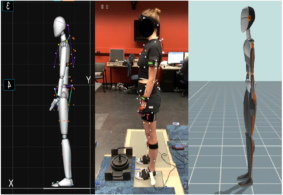
), and three lifting heights (60 cm, 100 cm, 140 cm). Participants lifted a box from a lower to an upper shelf and lowered it back while wearing a 17-sensor Xsens Awinda system (MVN Awinda, Xsens Technologies B.V., Enschede, the Netherlands) and reflective markers for an optical motion capture (OMC) system. Ground reaction forces were simultaneously recorded using force plates. Figure 1 illustrates the compared systems.
Figure 1: Side-by-side comparison: (left) OMC model avatar, (middle) participant, (right) IMC model avatar (Nail-Ulloa, Huangfu et al., 2024).
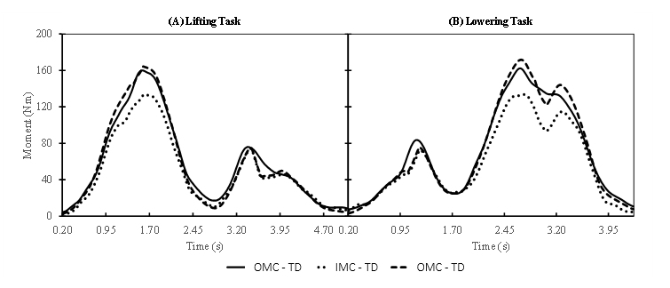
S1 – Data Collection and Modeling Lumbar moments at the L5/S1 level were estimated from both IMC and OMC data using inverse dynamics approaches. For the OMC-derived model, a bottom-up approach incorporating force plate data was used. In contrast, the IMC-derived moments were calculated from a top-down inverse dynamics model driven solely by body kinematics captured from the IMU suit. Figure 2 illustrates an example of the collected trials, comparing two OMC derived models (top-down and bottom-up) with the IMC top-down model.
Figure 2: L5/S1 Moment during one of the lifting (A) and lowering (B) trials (Nail-Ulloa, Huangfu et al., 2024).
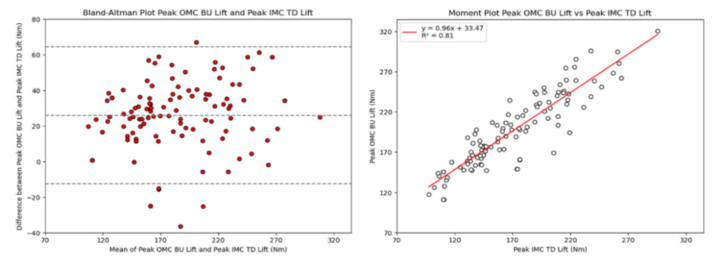
S1 – Results The study reported consistent underestimation of peak L5/S1 moments by the IMC-based approach relative to the OMC benchmark. The average underestimation ranged from 12% to 13%, depending on the direction of analysis. Root mean square error (RMSE) values ranged from 19 to 21 Nm. Despite these differences, correlation coefficients exceeded 0.81 across all lifting conditions, indicating strong linear agreement. Bland–Altman analysis showed acceptable bias and limits of agreement, suggesting that the IMC system produced sufficiently accurate moment estimates for field applications. A more detailed illustration of the results is shown in Figure 3.
From Lab to Field: Translating Inertial Motion Capture 33
Figure 3: (Left) Bland-Altman plot for peak moments for the lifting tasks. (Right) Scatter plot for peak moments for the lifting tasks (Nail-Ulloa, Huangfu et al., 2024).
S1 – Interpretation While the IMC approach tended to slightly underestimate spinal moments, the magnitude of the error was within a range considered acceptable for ergonomic assessments outside of laboratory settings. These findings support the application of IMC systems for lumbar loading estimation in contexts where optical systems and force platforms are not feasible. The validation of the IMC-based approach was a necessary step before extending its use to more variable and uncontrolled environments, as explored in the following studies.
STUDY 2 (S2): ESTIMATING CUMULATIVE LUMBAR DAMAGE IN INDUSTRIAL SETTINGS USING A FATIGUE FAILURE FRAMEWORK The case study conducted by Nail-Ulloa et al. (2025) explored a novel approach to injury risk assessment by applying fatigue failure theory to continuous biomechanical data collected through inertial motion capture (IMC) in an automotive manufacturing environment. By capturing workers’ movement patterns and estimating spinal loading over time, the study introduced a practical method for evaluating cumulative low back stress in real-world conditions. The research highlights the potential of wearable sensors not just for instantaneous measurement, but for quantifying prolonged exposure to risk factors. A comprehensive description of the methods and statistical modeling techniques can be found in the original article, A fatigue failure framework for the assessment of highly variable low back loading using inertial motion capture: A case study, published in Ergonomics.
S2 – Participants and Settings Eight full-time assembly workers from an automotive manufacturing plant participated in the study. Each worker performed multiple repetitions of their normal tasks. In total, 108 task trials were recorded. Workers wore the IMC system during each trial, enabling full 3D kinematic capture under natural working conditions.
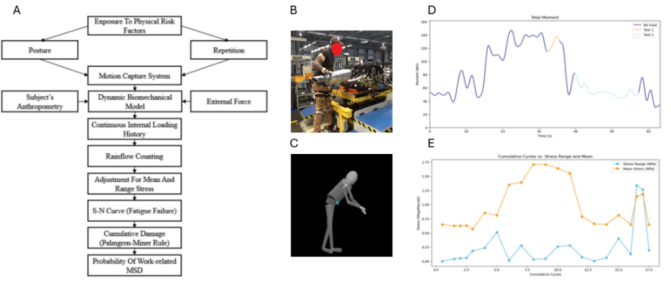
S2 – Modeling Framework L5/S1 moments were estimated using a top-down inverse dynamics model driven by the IMC kinematics. The overall framework for data processing is illustrated in Figure 4. Each time series of lumbar moment were processed through fatigue failure methods:
Rainflow counting was applied to the moment history to extract individual load cycles.
The Goodman method corrected each cycle for mean and alternating moment components.
Cycles were summed using the Palmgren–Miner rule to calculate a dimensionless cumulative damage (CD) value per trial.
Figure 4: (A) Fatigue failure-based framework for data processing, (B) worker during one of the trials, (C) biomechanical model based on the IMC system, (D) example of a continuous moment trial over a minute working cycle, (E) stress mean and range for the equivalent decomposed cycles over the continuous loading spectrum of (D). Figures from Nail-Ulloa et al., (2025).
The CD value represents the proportion of spinal tolerance consumed by repetitive loading during each task, thereby incorporating biomechanical magnitude of risk factors such as posture, repetition and external load.
S2 – Association With Reported Pain To evaluate the framework validity, the cumulative damage values were entered into a stepwise logistic regression model predicting self-reported low back pain. Workers’ discomfort reports were obtained through self-report. The model revealed that increases in cumulative damage were significantly associated with higher odds of reporting low back pain (OR = 2.16, 95% CI: 1.30–3.57), suggesting a meaningful link between mechanical loading history and musculoskeletal outcomes.
From Lab to Field: Translating Inertial Motion Capture 35
Table 1: Resulting stepwise logistic regression results for self-reported low back injuries from Nail-Ulloa et al., (2025).
Table available in the original PDF paper.
Variable Coefficient Std Error Coef/SE p Value Constant −4.95 1.22 −4.07 <0.01 CD 0.77 0.26 3.00 <0.01 Subject 0.06 2.27 2.27 0.02
S2 – Interpretation and Contributions This study extends conventional ergonomic risk assessment by integrating posture, repetition, and external load into a unified modeling framework grounded in fatigue failure theory. Unlike observational methods that rely on task snapshots or peak metrics, this approach captures the time- varying nature of spinal exposure, allowing for individualized risk profiling over complex task cycles. By combining IMC data with fatigue modeling principles, the study provides a scalable method for evaluating cumulative loading in highly variable environments and supports data-driven strategies for musculoskeletal injury prevention.
STUDY 3 (S3): FIELD EVALUATION OF THE POWER HOOK: A BATTERY-POWERED ERGONOMIC INTERVENTION FOR MANHOLE COVER LIFTING This section summarizes findings from a field-based study that evaluated the effectiveness of the Power Hook, a battery-powered assistive device designed to reduce physical demands during the lifting of utility manhole covers. The full study, published by Marklin et al. (2024), employed IMC to quantify changes in trunk posture and spinal loading when workers used the Power Hook compared to conventional methods (Jay hooks). Full methodological details are available in the original publication A Battery-Powered Tool to Move Utility Manhole Covers: Field Data and Proof of Concept, available in the journal Ergonomics in Design. The study provides a strong example of how wearable technologies can be used to evaluate ergonomic interventions in real-world conditions.
S3 – Task Analysis and Device Design Manhole cover lifting is traditionally performed using steel hooks or crowbars, which often require workers to bend forward deeply while generating large external forces through long lever arms. These postures place substantial mechanical stress on the lumbar spine, increasing the risk of musculoskeletal injury. The Power Hook was designed to replace these manual tools by providing powered assistance, thereby reducing both the effort required and the spinal loads imposed on the worker.
The initial phase of the project involved a site visit to a utility company, where three experienced workers performed standard manhole cover lifting tasks while instrumented with the IMC system. The motion data was analyzed to identify postures, movement patterns, and time points associated
with peak biomechanical loading. Specifically, the analysis focused on estimating L5/S1 moments using a top-down inverse dynamics model.
This preliminary assessment revealed that peak lumbar loading, when using the Jay hooks, occurred during the final phases of cover lifting—when workers flexed the trunk forward while simultaneously applying high pulling forces through the hooks. These insights informed the design of the Power Hook by highlighting the need to (1) reduce the lever arm length required for force generation, (2) assist with vertical lifting torque, and (3) promote more upright trunk posture throughout the lift.
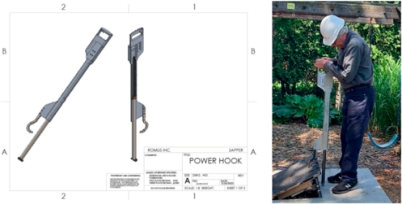
S3 – Participants and Setting Following the development of the prototype (Figure 5), the Power Hook was evaluated under real-world conditions with trained utility workers. The study was conducted in situ during actual manhole cover removal tasks. Each participant performed a series of lifting trials using both the traditional steel hook (baseline) and the Power Hook (intervention). Environmental and task conditions were kept consistent between conditions to enable a fair comparison of biomechanical demands.
Figure 5: Left: CAD drawing of the battery-powered manhole tool, dubbed the “power hook”. Right: Power hook prototype lifting a simulated manhole cover. Note that the tool allows a worker to stand in an upright posture and exert minimal force to lift the cover from its rim (Marklin et al., 2024).
S3 – Instrumentation and Methods During the evaluation phase, full-body kinematics were again recorded using the IMC. L5/S1 moments were estimated from IMC data, and trunk flexion angles were computed to quantify postural load. In addition, compressive and shear forces at the lumbar spine were estimated using biomechanical models. All trials were video recorded for verification, and biomechanical outcomes were extracted and averaged for comparison between the two tool conditions.
S3 – Results The Power Hook substantially reduced biomechanical exposures compared to the traditional lifting method. Trunk flexion was reduced by approximately 25%, resulting in more upright working postures. Peak L5/S1
From Lab to Field: Translating Inertial Motion Capture 37
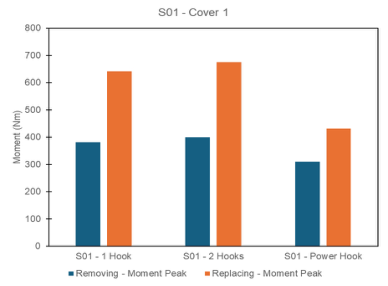
moments decreased by up to 36%, and estimated compressive and shear spinal forces were reduced by 30% and 20%, respectively. These results demonstrate the device’s effectiveness in minimizing lumbar loading during a high-risk task. An example for one of the trials for a 88.28 kg cover is shown in Figure 6.
Figure 6: L5/S1 Peak moment when removing and replacing a manhole cover with either one hook, a pair of hooks, and with the Power Hook (Marklin et al., 2024).
S3 – Implications This study highlights how IMC can be used not only for evaluation but also for early-stage ergonomic analysis and intervention design. By identifying the events that contribute most to lumbar loading, the research team was able to engineer a solution directly targeting those demands. The Power Hook serves as an example of how wearable sensor data can bridge the gap between biomechanics research and practical risk mitigation strategies. Its successful implementation and demonstrated reductions in biomechanical stress support the integration of such tools into safety programs aimed at preventing low back injuries in utility work.
CONCLUSION
This paper presented a progression of studies showcasing the use of IMC as a versatile tool for ergonomic assessment, moving from laboratory validation to real-world application and intervention evaluation. Together, the findings demonstrate that IMC systems, when paired with biomechanical modeling techniques, can provide actionable data for identifying physical risk factors and designing effective workplace interventions.
The initial laboratory study confirmed that IMC can yield lumbar moment estimates with acceptable accuracy for applied ergonomics research. The subsequent field study introduced a fatigue failure framework capable of quantifying cumulative loading, a construct increasingly recognized as central to understanding musculoskeletal injury risk (Gallagher and Barbe, 2022). The final study highlighted how IMC-based evaluation can inform the
ergonomic value of assistive technologies like the Power Hook, which are often difficult to assess using traditional tools.
Despite these contributions and many others (Koopman et al., 2018; Faber et al., 2020; Larsen et al., 2020; Nail-Ulloa et al., 2021; Skals et al., 2021; Nail-Ulloa, Zabala, et al., 2024), the implementation of IMC in occupational settings is still evolving. Several avenues for future research should be prioritized. First, integrating IMC with additional wearable technologies, such as pressure insoles (Matijevich et al., 2021), or electromyography (EMG) (Alberto et al., 2018), could improve the estimation of joint kinetics and better account for individual variability in muscle recruitment strategies.
In parallel, advances in machine learning and artificial intelligence offer promising avenues for automating risk classification and identifying hazardous movement patterns. Recent studies have demonstrated the feasibility of using IMU-based datasets to classify postural risk or repetitive strain exposure through supervised learning algorithms (Baklouti et al., 2024). These approaches could facilitate real-time monitoring and feedback systems in occupational settings, allowing interventions before harmful exposures accumulate.
Additionally, there is increasing interest in deploying wearable systems for longitudinal surveillance to capture the evolving interplay between mechanical loading and recovery over time. Long-duration monitoring— spanning entire shifts or multiple workdays—has the potential to detect early signs of overexertion and support dynamic work-rest scheduling (de Looze et al., 2016). However, achieving this requires improvements in data management, sensor durability, and user compliance, which remain important areas for development.
As the accessibility and accuracy of wearable motion capture systems continue to improve, their role in field-based ergonomics is likely to expand. The studies described here contribute to a growing body of evidence supporting the integration of wearable sensors into occupational health strategies. Ultimately, the ability to monitor movement, posture, and loading continuously and unobtrusively has the potential to transform how ergonomic risks are measured and mitigated in complex work environments.
ACKNOWLEDGMENT
The first two studies shown were supported by research funding from the Centers for Disease Control and Prevention (CDC)/National Institute for Occupational Safety and Health (NIOSH, Grant N
: R21OH011208-01-00) and through the Deep South Center for Occupational Health and Safety at the University of Alabama-Birmingham (UAB) and Auburn University (Grant # T42OH008436). The findings and conclusions are those of the authors and do not necessarily represent the views of the CDC/NIOSH. The third study was supported by EPRI Occupational Health and Safety program 62. The authors would like to acknowledge the automotive manufacturer of the second study, and the workers from Consolidated Edison for the third study.
From Lab to Field: Translating Inertial Motion Capture 39
REFERENCES
Al-Amri, M. et al. (2018) ‘Inertial Measurement Units for Clinical Movement Analysis: Reliability and Concurrent Validity’, Sensors 2018, Vol. 18, Page 719, 18(3), p. 719. Available at: https://doi.org/10.3390/S18030719. Alberto, R. et al. (2018) ‘Wearable Monitoring Devices for Biomechanical Risk
Assessment at Work: Current Status and Future Challenges—A Systematic Review’, International Journal of Environmental Research and Public Health 2018, Vol. 15, Page 2001, 15(9), p. 2001. Available at: https://doi.org/10.3390/ IJERPH15092001. Baklouti, S. et al. (2024) ‘A Novel IMU-Based System for Work-Related Musculoskeletal Disorders Risk Assessment’, Sensors 2024, Vol. 24, Page 3419, 24(11), p. 3419. Available at: https://doi.org/10.3390/S24113419. Cutti, A. G. et al. (2010) “‘Outwalk”: A protocol for clinical gait analysis based on inertial and magnetic sensors’, Medical and Biological Engineering and Computing, 48(1), pp. 17–25. Available at: https://doi.org/10.1007/S11517-009- 0545-X/TABLES/2. Faber, G. S. et al. (2020) ‘Validation of a wearable system for 3D ambulatory L5/
S1 moment assessment during manual lifting using instrumented shoes and an inertial sensor suit’, Journal of Biomechanics, 102, p. 109671. Available at: https:// doi.org/10.1016/j.jbiomech.2020.109671. Gallagher, S. and Barbe, M. F. (2022) ‘The impaired healing hypothesis: A mechanism by which psychosocial stress and personal characteristics increase MSD risk?’, Ergonomics, 65(4), pp. 573–586. Available at: https://doi.org/ 10.1080/00140139.2021.1974103. Koopman, A. S. et al. (2018) ‘Estimating the L5S1 flexion/extension moment
in symmetrical lifting using a simplified ambulatory measurement system’, Journal of Biomechanics, 70, pp. 242–248. Available at: https://doi.org/10.1016/ j.jbiomech.2017.10.001. Larsen, F. G. et al. (2020) ‘Estimation of Spinal Loading During Manual Materials Handling Using Inertial Motion Capture’, Annals of Biomedical Engineering, 48(2), pp. 805–821. Available at: https://doi.org/10.1007/s10439-019-02409-8. de Looze, M. P. et al. (2016) ‘Exoskeletons for industrial application and their
potential effects on physical work load’, Ergonomics, 59(5), pp. 671–681. Available at: https://doi.org/10.1080/00140139.2015.1081988. Marklin, R. W. et al. (2024) ‘A Battery-Powered Tool to Move Utility Manhole Covers: Field Data and Proof of Concept’, Ergonomics in Design, p. 10648046241260452. Available at: https://doi.org/10.1177/ 10648046241260451. Matijevich, E. S., Volgyesi, P. and Zelik, K. E. (2021) ‘A Promising Wearable Solution for the Practical and Accurate Monitoring of Low Back Loading in Manual Material Handling’, Sensors, 21(2), p. 340. Available at: https://doi.org/10.3390/ s21020340. Nail-Ulloa, I. et al. (2021) ‘Validation of a Wireless Sensor System for the Estimation
of Cumulative Lumbar Loads in Occupational Settings’, Proceedings of the Human Factors and Ergonomics Society Annual Meeting, 65(1), pp. 489–494. Available at: https://doi.org/10.1177/1071181321651078. Nail-Ulloa, I., Huangfu, R., et al. (2024) ‘Assessing the accuracy of a wireless sensor system for estimating lumbar moments during manual lifting tasks considering the effects of load weight, asymmetry, and height’, International Journal of Industrial Ergonomics, 103, p. 103636. Available at: https://doi.org/10.1016/ J. ERGON.2024.103636.
Nail-Ulloa, I., Zabala, M., et al. (2024) ‘Estimating Compressive and Shear Forces at L5-S1: Exploring the Effects of Load Weight, Asymmetry, and Height Using Optical and Inertial Motion Capture Systems’, Sensors, 24(6), p. 1941. Available at: https://doi.org/10.3390/s24061941. Nail-Ulloa, I. et al. (2025) ‘A fatigue failure framework for the assessment
of highly variable low back loading using inertial motion capture – a case study’, Ergonomics, pp. 1–17. Available at: https://doi.org/10.1080/ 00140139.2025.2460695. Picerno, P. (2017) ‘25 years of lower limb joint kinematics by using inertial and magnetic sensors: A review of methodological approaches’, Gait & Posture, 51, pp. 239–246. Available at: https://doi.org/10.1016/J. GAITPOST.2016.11.008. Robertson, G. et al. (2014) Research Methods in Biomechanics. 2nd edn. Edited by
Human Kinetics. USA. Skals, S. et al. (2021) ‘Manual material handling in the supermarket sector.
Part 2: Knee, spine and shoulder joint reaction forces’, Applied Ergonomics, 92, p. 103345. Available at: https://doi.org/10.1016/j.apergo.2020.103345. Zhou, H. and Hu, H. (2008) ‘Human motion tracking for rehabilitation—A survey’, Biomedical Signal Processing and Control, 3(1), pp. 1–18. Available at: https:// doi.org/10.1016/J. BSPC.2007.09.001.
LISTED IN THE AHFE DIGITAL BOOKSTORE CATALOGUE
Explore the complete digital volume
Human Factors and Wearable Technologies
Read this individual research paper free through the original publisher, or explore the full digital proceedings book.
ISBN 978-1-964867-51-9
Explore this ISBN in the AHFE Bookstore ↗Listed in the July 2026 bookstore catalogue; search by ISBN to confirm current availability · Digital book purchase optional