Victoria Steane, Sophie Hart, Jemma Oakes, Samson Palmer, Mark Chattington (2023). Using EAST to inform Systems Architecture Design: Considerations relating to the use of UAVs in Search and Rescue missions. In: Human Factors in Robots, Drones and Unmanned Systems. AHFE Open Access, vol. 93, pp. 132–141. https://doi.org/10.54941/ahfe1003755
There has been much interest in the use of Uncrewed Aerial Vehicles (UAVs) to support and extend missions within the Search and Rescue (SAR) space. However, detecting a human in the wilderness is a particularly challenging task. In the future, fitment of automated image classification aids may support UAV teams in correctly identifying targets within the environment thereby providing greater levels of support to ground search teams. The impact of such technology on the wider sociotechnical system however needs to be understood. This is because increasing the level of automation within a system can lead to degraded situation awareness, inappropriate calibration of trust and issues relating to complacency and technology overreliance. Within a SAR context, performance issues such as these could have disastrous consequences. In order to ensure systems are designed and integrated appropriately, it is essential that operator tasks are understood and that wider interactions are considered. This paper uses the Event Analysis of Systemic Teamwork (EAST) framework to sharpen the questions surrounding anticipated user and task requirements for UAV equipped SAR missions. A series of interviews with active members of Mountain Rescue teams across the United Kingdom were conducted using a condensed version of the Schema Action World (SAW) taxonomy. The subsequent analysis and network representations afforded by EAST appear to provide a platform in which the human view of the system can be investigated with a number of design recommendations proposed.
Search and Rescue (SAR) operations are typically deemed to be time critical meaning that any delay has the potential to elicit catastrophic consequences (Anderson et al., 2021; Waharte & Trigoni, 2010). However, the UK Mari- time & Coastguard Agency (Spires, 2020) suggested that Uncrewed Aerial Vehicles (UAVs), also referred to as Unmanned Aerial Vehicles, have “enor- mous potential” in providing critical support to SAR operations as they are agile, fast and can inform resource allocation. This provides the opportunity
Using EAST to Inform Systems Architecture Design 133
to extend and enhance missions (Anderson et al., 2021). UAVs are typically deployed to support the detection of lost persons through infrared sensing, detection of a mobile phone signal and image recognition technology (Dinh et al., 2019). Much research has focussed on the technical requirements of UAV technology to provide support in such missions. In other words, systems have been created based around technical requirements, often without any consideration for ‘who’ will need to use and make sense of these systems. For hybrid teams in particular (i.e., teams comprised both human and non-human agents), this is particularly problematic given the requirement for interopera- bility. However, there is currently very little guidance demonstrating how best to design such teams. Whilst attempts have been made to integrate ‘Human Views’ into mainstream acquisition and systems engineering processes (e.g., via defence industry architecture frameworks, consortia developed frame- works and open source frameworks), they are not widely used in practice. Indeed, Meister and Farr (1967) cited a number of possible barriers to the adoption of Human Factors considerations including lack of time and resou- rces, perceived cost and risk and failing to see the importance of Human Factors to the programme of work. Such issues still remain relevant in the present day (Bruseberg, 2008; Salmon et al., 2022).
Bruseberg (2008) argued that good Human Factors Integration (HFI) see the role of human factors practitioners bridging the gap between users and system engineers through the application of methods that can retrieve and translate user needs into design requirements. However, Salmon et al. (2022) highlighted a ‘research practice gap’ whereby more advanced methodologies and approaches are not widely used in practice. Early HFI investigations are an essential component in identifying key areas for more in depth empirical studies (Bruseberg, 2008). Thus, in addition to literature surveys, expert eva- luations and feedback can be particularly powerful in generating insight into key HFI areas of influence for onward exploration within context.
To address this ‘research-practice gap’, this study explores the utility of the Event Analysis of Systemic Teamwork (EAST; Walker et al., 2006) fra- mework to explore underlying human factors considerations in the design of technologies to support SAR missions. The case study of SAR was chosen given recent emphasis on creating image classification algorithms capable of supporting operators identify targets within the environment. Whilst such technology has obvious benefits, the integration of these in practice requires careful consideration. This is because ‘automation complacency’ has been highlighted as a significant risk to system performance (Parasuraman et al., 1993; Rodriguez et al., 2019). Inappropriate trust calibration has been impli- cated in a number of high profile incidents. For example, on March 18, 2018, an Uber-owned self-driving car struck a pedestrian whilst they were crossing the road in Tempe, Arizona. The vehicle at the time was operating in ‘auto- nomous mode’ and the safety driver was reported to be watching a television programme on their mobile phone. They were therefore not paying atten- tion to any potential vehicle anomalies. The National Transportation Safety Board (2019) found six contributory factors that led to the accident, one of which was ‘automation complacency’. They argued that the safety driver paid insufficient attention to the automated system due to the perception that the
output was reliable. Whilst not directly comparable to SAR, one can specu- late that an image classification algorithm that performs accurately, most of the time, may also lead to the formation of automation complacency. Care- ful consideration is needed to ensure that such systems are integrated into SAR missions appropriately – this requires understanding of the 5 Ws and 1H (why, who, when, where, what and how).
METHOD
EAST utilises three, interlinked network representations (Walker et al., 2006). The task network provides analysts with a means to demonstrate the proces- ses that are involved in attaining the network goals (Salmon et al., 2014). They essentially describe the sequence and inter-dependencies between indi- vidual subtasks that must be completed in order to achieve these goals. Social networks can be used to analyse the structure of the system in terms of com- munications occurring between different system agents (Walker et al., 2006). Finally, information networks represent the aspects of communication that are used to underpin the completion of a task as well as the relationships that exist between them.
In order to develop the network representations, five participants from Mountain Rescue Teams (MRT) across the United Kingdom were recruited to take part in semi-structured interviews using a condensed version of the Schema Action World (SAW) taxonomy that forms part of the Schema-World- Action Research Method (SWARM; Plant & Stanton, 2016). Participants were presented with a hypothetical SAR scenario. The basic premise of the scenario involved a missing person who had been reported missing at a Nati- onal Park. The scenario was intentionally designed to enable participants to use their knowledge of SAR operations without being constrained by the contextual details of a single event. They were asked to discuss this from two perspectives: how work is currently done and how work may be done in the future with more sophisticated UAV technologies.
Prior to starting the interview, participants were invited to read through the participant information sheet and provide informed consent if they were happy to proceed. All interviews were recorded using a Dictaphone to permit later transcription. The study received ethical approval from the University of Bristol Ethics Committee (Reference 10785).
DATA ELICITATION AND MODEL REFINEMENT Analysts familiarised themselves with the transcribed data to develop preli- minary composite models that could be updated in an iterative cycle. The networks were presented to an independent Subject Matter Expert (SME) who was able to provide feedback and validate the process flows, agents involved and relationships/interactions between them.
FINDINGS Task Network
The default position of any MRT effort is to conduct a ground search, perhaps with support from other external agencies (e.g., Coastguard) if
Using EAST to Inform Systems Architecture Design 135
appropriate. Upon receiving an alert from the emergency services, a MRT Search Manager will seek to gather as more information as possible about the missing person (e.g., basic description, last known location and so on). This data, along with other contextual considerations (e.g., weather, time of day, terrain in search location) will all be used to help determine the urgency of the situation. This assessment will be used to inform the development of a search plan. In addition to this, the Search Manager must determine the resources available to support the mission. The process of preparing a plan incorpo- rates a number of subtasks including, but not limited to: identifying areas of interest, conflict and risk; developing mission timings, identifying a set of alternatives; consulting with others and discussing the impact of any plans; developing mission timings and assigning individuals to specific tasks. The implementation of the search strategy requires continuous dialogue between members of the MRT as they share information about their location and any other relevant information to support the Search Manager in calculating pro- babilities of success. The search plan will continue to develop and change as more information becomes known.
In contrast, the availability of a UAV to support SAR missions appears to change the nature of the task network as they are viewed as tools capable of discounting search areas, enhancing the navigation of ground search teams and/or casualties and searching hard to reach places more quickly. There is likely to be an extensive array of ‘new’ subtasks and risks to be considered in the implementation of such searches. Some of these additional subtasks are presented in Table 1. Whilst this is not intended to be an exhaustive list, it does demonstrate the increasing levels of complexity within the system that a Search Manager would need to be mindful of whilst coordinating the search effort.
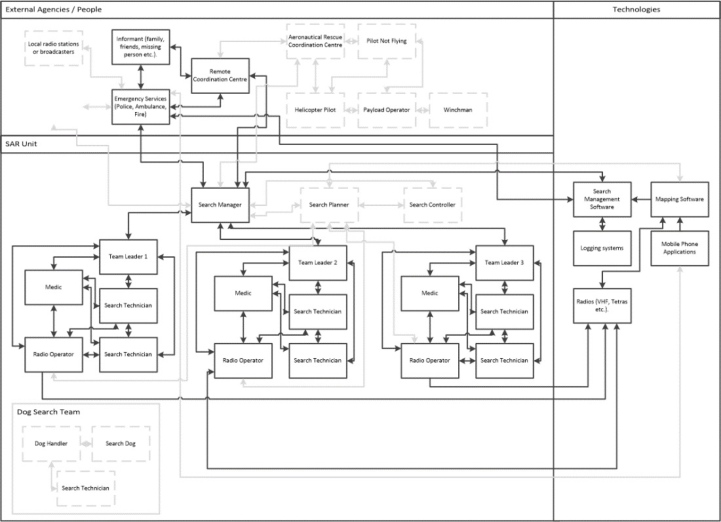
Social Network The composition of the SAR team will be unique to each individual set of circumstances and availability of personnel. However, a typical search consi- sts of 20–25 personnel across multiple search areas. Not all of these personnel are part of the MRT per se; instead the broader SAR team is made up of individuals from a number of external agencies and some key technologies. The network is likely to be highly interconnected given the importance of communication between agents within the network. Of course, it is impor- tant to remember that the social network for any SAR mission ultimately remains a function of requirement and may dynamically change as the mis- sion progresses. For some SAR missions, it may be appropriate to utilise search dogs. In these scenarios, the number of SAR personnel on the ground must be minimised to increase the likelihood of the dog being able to pick up human scent within a designated search area. By way of example, Figure 1, shows ‘Dog Search Team’ as a separate entity within the MRT for this rea- son. If a search dog is used, other SAR personnel are likely to be dispatched to alternative search areas, although environmental conditions (e.g., wind direction) would need to be considered by the Search Manager prior to dispatch.
Table 1. Additional subtasks introduced through the adoption of UAV technology.
Table available in the original PDF paper.
Activity Exemplar subtasks Exemplar outputs
Check weather (Determine if weather suitable for UAV launch.)
Indication of whether UAV is available and/or suitable for use
Gather information and intelligence Determine urgency of situation
Check time of day – determine how many daylight hours remain (Are conditions favourable for a UAV?)
Knowledge of search team composition
Determine resources available
Determine availability of qualified UAV personnel
Determine status of UAV (i.e., battery life, sensor capabilities) Flight plan Prepare plan
Identify flight path
Contact Civil Aviation Authority (CAA) to seek permission for launch
Wait for permission (typically 20–30 minutes)
Re-assess weather conditions prior to launch
Ensure availability of additional batteries Engage in search
Launch UAV
Analyse data from UAV
Decide whether the data provides any evidence surrounding the location of the missing person Updated risk assessment
Alternative view of search area and pictures enables search manager to dynamically update search plan Modify search plan
Understand status of assets and/or resources (i.e., battery life, sensor capabilities, storage limitations)
Re-assess weather conditions and risks posed by terrain of operation -
Extract / recover missing person
Assess condition of casualty – may require additional support from other agencies Administer basic first aid (if required)
UAV supported missions are likely to increase the complexity of the social network. Similar to the ‘Dog Search Team’, a ‘UAV Team’ may be integrated into the SAR Unit as a separate sub-team or become embedded with a sub- team. As a separate sub-team, the ‘UAV Team’ would likely be designated to alternative search areas to ensure maximum coverage. Embedded in a sub- team, there is a greater degree of proximity to the other team members, thus more reliable communication links to the wider team are maintained. Whilst in the short term, UAV supported SAR missions are unlikely to significantly alter the social network, in the long term, remotely piloted operations would see the UAV Pilot and UAV Payload Operator being able to conduct their role in the search from either an external location (i.e., a base station) or perhaps at the Control Vehicle to improve proximity to the Search Manager. The former scenario will see the social network changing slightly, with the UAV
Using EAST to Inform Systems Architecture Design 137
Figure 1: Exemplar social network showing the distribution of entities across the MRT with ‘Dog Search Team’ comprising a separate unit within the SAR team.
Pilot and Payload Operator no longer being part of the SAR Unit. Instead, they could become an ‘external agency’, similar to that of Coastguard.
Overall, the nature of SAR missions dictate that many of the existing roles will be maintained, regardless of any technological innovation. However, social networks themselves may become more geographically dispersed if UAV operations can be performed remotely (i.e., from a control vehicle or fur- ther afield). Beyond line of sight operations and autonomous UAV operations may permit single crew operations but this would require higher level regu- latory changes and also improvements to the technology itself (e.g., extended battery life, improved communications infrastructure etc.).
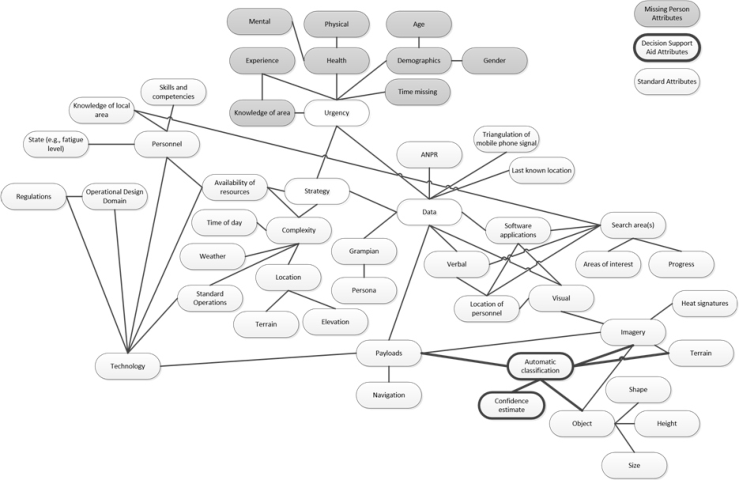
Information Network Throughout the duration of a SAR mission, an abundance of information is gathered, analysed and presented to agents within the network from multi- ple sources. An amalgamated information network is presented in Figure 2. Standard nodes refer to the type of information that is considered standard, or required, across all missions. Missing person attributes represent informa- tional elements that may be available to MRTs via external agencies (typically the Police). This data feeds directly informs the sense of urgency for the mis- sing person case. This sense of urgency will have an impact upon the strategy that will be used to conduct the search along with data that becomes available as the mission progresses. The UAV supported missions will produce greater
Figure 2: SAR information network.
volumes of information via the payload sensors on-board. The type of sen- sors installed will vary on the size of the UAV used but commonly include Global Positioning System (GPS), Inertial Navigation System (INS), standard cameras, thermal sensors, light detection and ranging (LiDAR), and Radar sensors (Arfaoui, 2017).
Information networks are useful because in order for designers to cre- ate technologies to support SAR missions. They must consider the type of information they use during search. For an image classification module, for example, this includes aspects like shape, height, size, and heat of targets but also information about the terrain.
DISCUSSION
Human Factors modelling approaches are particularly valuable as they can be used throughout the design process. For novel systems in particular, they provide a relatively cheap approach to simulating how technical and social elements may interact and function alongside each other. Models permit the testing of alternative design philosophies and system configurations without the requirement to build and test sophisticated simulations. They can demon- strate how the addition of technology into an already complex system has the potential to accommodate new tasks and considerations, new pathways to success and failure, and new capabilities and complexities.
The models presented here provide a platform in which the human view of the system can be investigated. This means that in terms of systems architecture design, the network representations afforded by EAST (Walker et al., 2006) could be advantageous in adhering to the NATO Architecture
Using EAST to Inform Systems Architecture Design 139
Framework Version 4 (NAFv4) and the International Organisation for Stan- dardisation’s ISO/IEC/IEEE 42020 (2019). Specifically, the models help to sharpen the questions surrounding anticipated user and task requirements. In the context of SAR, the following observations can be made:
1. UAV support increases the complexity of the task network through the addition of new tasks and considerations. This needs to be considered in the context of the broader system as in some instances, existing MRT personnel may assume the role of UAV Pilot / UAV Payload Operator. Role transitions will need to be handed quickly and efficiently by the Search Manager who holds global situation awareness of the situation. 2. UAV support changes task sequencing, but the subtasks associated with “work-as-done” remain central to the execution of the mission. This means that traditional ways of working must not be overlooked. This is because not all SAR scenarios will permit the use of a UAV and therefore the default in a mountain rescue will always be traditional ground search. A UAV in this instance is simply a support aid rather than a replacement. 3. Decision support aids (e.g., an automatic image classification tool) would be useful in the context of SAR. This is because UAV supported missions produce greater volumes of information within the network due to addi- tional payload data being available. However, there is a risk that it may be misconstrued as an autonomous crewmember, replacing the work done by the UAV Payload Operator. In order to overcome this, the capabilities of the system must be transparent to the user through means of training and feedback on the user interface. For example, confidence estimates relating to these automatic classifications must be of sufficient accuracy in order facilitate the development of trust in the system and user ado- ption (O’Donovan & Smyth, 2005). Even so, a process of validation will still be required and this work is still likely to be conducted by a human operator on the ground. This is because improved transparency can also lead to inappropriate levels of trust that could in turn lead to automation complacency (Parasuraman et al., 1993). 4. In order to support SAR personnel appropriately, designers of any deci- sion support aid must consider the type of information they use during search. For an image classification module, for example, this includes things like shape, height, size, and heat of targets but also information about the terrain. These variables should therefore be considered in the design of such an aid.
More broadly, the following recommendations can be made:
1. End user engagement, early on in the design lifecycle, is essential so that designers understand how “work-is-done” before considering how any ‘new’ system (whether that be an extension to a current system or an entirely novel system) can be properly integrated. This may be achieved through the inclusion of the following approaches. These are not inten- ded to be an exhaustive list but an indication of the type of methodologies that should be considered:
a. Focus groups or workshops; b. Interviews; and c. User walkthroughs / observation
2. Human Factors modelling techniques should be integrated into systems architecture design. This may be achieved through the inclusion of task and user impact analyses early on in the design process to provide insight into: a. The 5 W’s and 1H (why, who, when, where, what and how); b. Human performance (i.e., current performance vs. future performa- nce in alternative configurations) via basic calculations of functional loading and/or critical path analysis; and c. Dependencies and interdependencies between different agents within the system via network analysis.
3. We should explore safety and risk management approaches in the context of SAR. This is in recognition that HFI is more than focussing on human- system interaction. We must also consider the likelihood and probability of system failure and strive to ensure that appropriate mitigations are in place.
ACKNOWLEDGMENT
This material was funded and delivered in partnership between the Thales Group and the University of Bristol and with the support of the UK Engi- neering and Physical Sciences Research Council Grant Award EP/R004757/1 entitled Thales-Bristol Partnership in Hybrid Autonomous Systems Enginee- ring (T-B PHASE).
REFERENCES
Anderson, T., Fogarty, K., Kenkel, H., Raisigel, J., Zhou, S., Reggia, L. M., Manizade, S. G., Lesniak, D. R. and Gerling, G. J., 2021, September. User experience design for human-machine teaming in commanding a distributed constellation of unmanned assets in search and rescue. In Proceedings of the Human Factors and Ergonomics Society Annual Meeting (Vol. 65, No. 1, pp. 62–66). Sage CA: Los Angeles, CA: SAGE Publications. Arfaoui, A., 2017. Unmanned aerial vehicle: Review of onboard sensors, application
fields, open problems and research issues. International Journal of Image Process, 11(1), pp. 12–24. Bruseberg, A., 2008. Presenting the value of Human Factors Integration: guidance, arguments and evidence. Cognition, Technology & Work, 10(3), pp. 181–189. Dinh, T. D., Pirmagomedov, R., Pham, V. D., Ahmed, A. A., Kirichek, R., Glushakov,
R. and Vladyko, A., 2019. Unmanned aerial system–assisted wilderness search and rescue mission. International Journal of Distributed Sensor Networks, 15(6), pp. 1–15. ISO/IEC/IEEE 42020:2019. Software, systems and enterprise – Architecture Processes. Meister, D. and Farr, D. E., 1967. The utilization of human factors information by
designers. Human Factors, 9(1), pp. 71–87.
Using EAST to Inform Systems Architecture Design 141
National Transportation Safety Board. 2019. Collision Between Vehicle Controlled by Developmental Automated Driving System and Pedestrian, Tempe, Arizona, March 18, 2018. Highway Accident Report NTSB/HAR-19/03. Washington, DC. NATO Architecture Framework Version 4: Architecture Capability Team Consul-
tation, Command & Control Board, January 2018, Document Version 2020.09. Available at: https://www.nato.int/cps/en/natohq/topics_157575.htm O’Donovan, J. and Smyth, B., 2005, January. Trust in recommender systems. In Proceedings of the 10th International Conference on Intelligent User Interfaces (pp. 167–174). Parasuraman, R., Molloy, R. and Singh, I. L., 1993. Performance consequences of
automation-induced ‘complacency’. International Journal of Aviation Psychology, 3(1), pp. 1–23. Plant, K. L. and Stanton, N. A., 2016. The development of the Schema World Action Research Method (SWARM) for the elicitation of perceptual cycle data. Theoretical Issues in Ergonomics Science, 17(4), pp. 376–401. Rodriguez, S. S., O’Donovan, J., Schaffer, J. A. and Höllerer, T., 2019, April. Kno-
wledge complacency and decision support systems. In 2019 IEEE Conference on Cognitive and Computational Aspects of Situation Management (CogSIMA) (pp. 43–51). IEEE. Salmon, P. M., Lenne, M. G., Walker, G. H., Stanton, N. A. and Filtness, A.,
2014. Using the Event Analysis of Systemic Teamwork (EAST) to explore con- flicts between different road user groups when making right hand turns at urban intersections. Ergonomics, 57(11), pp. 1628–1642. Salmon, P. M., Read, G. J., Walker, G. H., Stevens, N. J., Hulme, A., McLean, S. and Stanton, N. A., 2022. Methodological issues in systems Human Factors and Ergonomics: Perspectives on the research–practice gap, reliability and vali- dity, and prediction. Human Factors and Ergonomics in Manufacturing & Service Industries, 32(1), pp. 6–19. Spires, J., 2020, February. UK coastguard looks into drones for Search and
Rescue. Available at https://dronedj.com/2020/02/06/uk-coastguard-drones-searc h-rescue/ Waharte, S. and Trigoni, N., 2010, September. Supporting search and rescue operations with UAVs. In 2010 International Conference on Emerging Security Technologies (pp.142–147). IEEE. Walker, G. H., Gibson, H., Stanton, N. A., Baber, C., Salmon, P. and Green, D., 2006.
Event analysis of systemic teamwork (EAST): A novel integration of ergonomics methods to analyse C4i activity. Ergonomics, 49(12-13), pp. 1345–1369.
LISTED IN THE AHFE DIGITAL BOOKSTORE CATALOGUE
Explore the complete digital volume
Human Factors in Robots, Drones and Unmanned Systems
Read this individual research paper free through the original publisher, or explore the full digital proceedings book.
ISBN 978-1-958651-69-8
Explore this ISBN in the AHFE Bookstore ↗Listed in the July 2026 bookstore catalogue; search by ISBN to confirm current availability · Digital book purchase optional