Marian Wnuk (2023). Analysis of the Influence of Military Radio Stations on the Operator’s Health. In: Safety Management and Human Factors. AHFE Open Access, vol. 105, pp. 132–144. https://doi.org/10.54941/ahfe1003078
Human exposure to artificial electromagnetic fields has increased significantly in recent decades. For this reason, scientists and the public are interested in its influence on health, even when exposure is much lower than the applicable standards. The intensity of electromagnetic fields in the human environment is increasing and is now reaching very high levels that living organisms have never experienced before. A process that has a great impact on people is the direct penetration of electromagnetic radiation into the tissues. Therefore, the important question is to what extent we risk our health in the environment in which we live and in the workplace during direct contact with electromagnetic fields.Research shows that the electromagnetic field affects the cell membranes in our body. The cell membrane is the membrane that protects the cells of the body and provides a constant environment inside the cell. Electromagnetic fields cause disturbances in the work of the membrane, which can lead to various types of disturbances in the body. One of such disorders is, for example, the organism's decreased resistance to external factors. The paper presents the results of research on the impact of a selected military radio station, the purpose of which was to investigate whether electromagnetic fields from military radio stations pose any threat to the operator's health. The conducted analysis of the issues of safety of staying in the area of the electromagnetic field of military antennas and radio stations as well as the results of the research on the intensity of the field emitted by the RRC-9200 military radio station, which were carried out in this paper, can be considered as having a negative impact on the functioning of the human body. Due to the fact that the radio operator is exposed to the electromagnetic field emitted by it, its adverse impact on the human body should be investigated (especially regarding the biological effects that may occur). Polish standards regarding electromagnetic fields are very strict, while the actual effects of this field are still unknown. Carrying out more research in this field broadens the knowledge on the subject and enables the introduction of limitations of exposure to electromagnetic field and the rational approach of people to the problem.Tests were carried out with a military radio station, which is equipped with the Polish army, along with its antenna at the maximum power level (10 W). It was found that when receiving the signal, it did not exceed the permissible level of the electromagnetic field, then after pressing the tangent it did. The level of electromagnetic field emission when the radio is carried on the operator's back while transmitting, in virtually every case exceeds the permissible values of the magnetic and electric fields. This can lead to undesirable health consequences for the operator of such a radio. It was found that due to the fact that the electromagnetic field emitted by the radio stations while transmitting at full power of 10 W is high and significantly exceeds the permissible value, therefore, the radio station should not be used in direct contact. You should take into account your own health and the negative effects that may be caused by the use of the radio station from a short distance. Due to the obtained results of the field emitted by the tested radio, it is recommended to use it from the greatest possible distance, in the shortest possible time, and with the lowest power (0.5W). This will help minimize the operator's exposure to the electromagnetic field emitted by the radio, as well as reduce possible negative effects on his health.Suggestion: poster session
Human exposure to artificial electromagnetic fields has increased significan- tly in recent decades. For this reason, the interest of scientists and the public in its impact on health, even during exposure much lower than the applicable
Analysis of the Influence of Military Radio Stations on the Operator’s Health 133
standards. The intensity of electromagnetic fields in the human environment is increasing and now reaches very high levels, never before experienced by living organisms. A process that has a major impact on humans is direct tissue penetration electromagnetic radiation. So it’s important the question to what extent we endanger our health in the environment in which we live and in the workplace during direct contact with electromagnetic fields (M. Kowalczyk and others).
For over 30 years, there have been sporadic studies that showed the nega- tive effects of electromagnetic fields, but they were not based on any reliable evidence. the effects of the electromagnetic field are not fully. Research condu- cted for almost two decades has been focused on any effect of electromagnetic fields on the formation of cancer in humans. Although numerous hypotheses have been put forward that have suggested how such exposure may promote carcinogenesis, the evidence for this remains inconclusive. There were two types of data. The first were epidemiological observations on the occurre- nce of cancer in childhood and adulthood in various exposure conditions at the place of residence and work. The second type of data was reproducible research, which concerned the influence of the electromagnetic field on the formation of carcinogenic changes in cells, tissues and laboratory animals.
That is why it is so important, both for scientific and societal reasons, to investigate issues such as the possibility of impairment of human health or biological effects.
The electromagnetic field, affecting the human body, can lead to various biological effects. In accordance with Directive 2013/35/EU, direct biophy- sical effects may occur under the influence of the electromagnetic field in the human body (J. Karpowicz, and others). The factors that determine the magnitude of these effects and their distribution inside the body are prima- rily the level of the electromagnetic field, frequency, or the conditions in which the exposure occurred. Biophysical effects can be divided into ther- mal and non-thermal. Non-thermal effects are, for example, stimulation of nerves and muscles, as well as sensory organs, due to the influence of the field that is induced in the human body. This agitation may lead to tempo- rary disturbances, such as dizziness, or may affect the person’s ability to safely perform work activities. The described mechanism of interaction is characte- ristic of the electromagnetic field, the frequency of which does not exceed several hundred kilohertz. The thermal effects of tissue heating are the ther- mal load of the human body through the energy of the electromagnetic field absorbed by it. Such a mechanism occurs when human beings are exposed to high-frequency fields or microwaves (over 100 kHz, and it is dominant at frequencies above 10 MHz) (archiwum.ciop). By using numerical simulati- ons, where numerical models of the human body are used, it is possible to determine what will be the direct effects of the electromagnetic field on the human body.
PROTECTION AGAINST NON-IONIZING RADIATION AT THE WORKPLACE In the case of thermal effects that occur directly when exposed to an electro- magnetic field with a frequency of 100 kHz - 6 GHz, their measure is the
134 Wnuk
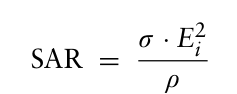
SAR (Specific Absorption Rate), expressed in [W/kg] (dziennik-ustaw). It is a measure of the rate of absorption of electromagnetic energy, which is conver- ted into heat in the human body. In practice, however, it means the power absorbed by a unit of body mass. The permissible value of the SAR factor during exposure to the electromagnetic field in the frequency range of 100 kHz - 10 GHz is:
- 0.4 [W/kg] - average value for the whole body - 10 [W/kg] - this is the local SAR value, referring to the head and torso - 20 [W/kg] - this is the local SAR value, referring to the limbs The SAR values shown are averaged over any 6-minute period. In addition, local values are averaged over any 10 g of compact tissue. The formula for SAR (1) is shown below:
Equation reproduced from the original PDF.
i ρ (1)
where: Ei - effective value of electric field strength in tissue [V/m] σ - conductivity of body tissue [S/m] ρ - body tissue density [kg/m3] The electrical parameters of organs and tissues of the human body, such as relative permittivity and electrical conductivity, change with the frequency of the electromagnetic field. These parameters are listed in Table 1.
We can read from it that the electrical conductivity increases, while the relative permittivity decreases with increasing frequency, as well as with the state of human health. However, during the simulation, averaged values corresponding to healthy adults are used.
Although physical human models (phantoms) are built specifically for dosimetry purposes, they are incomparably simpler than numerically gene- rated models. The results of measurements on previously made phantoms give a reliable approximation of the SAR value. The lack of precise guide- lines regarding the employee models used in numerical calculations, both in the directive and in other international documents, has led to the fact that over 30 different models of the adult human body are currently used in numerical simulations. Adult models are characterized by various anthropo- metric values, such as height (160 cm - 199 cm) or weight (47 kg - 119.5 kg) (edadocs.software.keysight.com).
The role of legal means of protection against the impact of electromagnetic fields is fulfilled by the standards and regulations of the relevant authori- ties, specifying the permissible values of electromagnetic fields in specific environments and the methods of their measurement.
Table 1. Electrical conductivity and relative permeability of muscle, fat and bone tissue of the human body [6].
Analysis of the Influence of Military Radio Stations on the Operator’s Health 135
Over the years, there has been a systematic development of legal regulati- ons regarding protection against electromagnetic fields in the work environ- ment (mainly for people employed at radiation sources) and in the generally accessible environment. It can be seen that the number of parameters taken into account has increased and their values have become more detailed in a wide range of frequencies.
In earlier regulations concerning the measurement of electromagnetic fields, the values of electric field strength E and magnetic field strength H (or equivalently magnetic field induction B) in the frequency range from 0 to 300 MHz were used. For higher frequencies, the radiation power density S was determined. According to the latest regulations, the electric field strength E must be measured in the frequency range 0÷300 GHz, while the magnetic field strength H is measured in the frequency range 0÷3 GHz.
Electromagnetic fields and radiation at the workplace are also chara- cterized by the frequency spectrum. Determining this parameter allows, in a certain frequency range, to identify individual components of the electromagnetic field spectrum and their values.
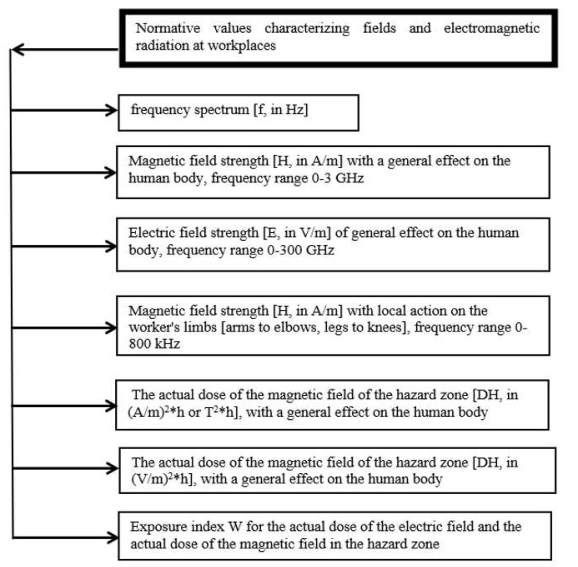
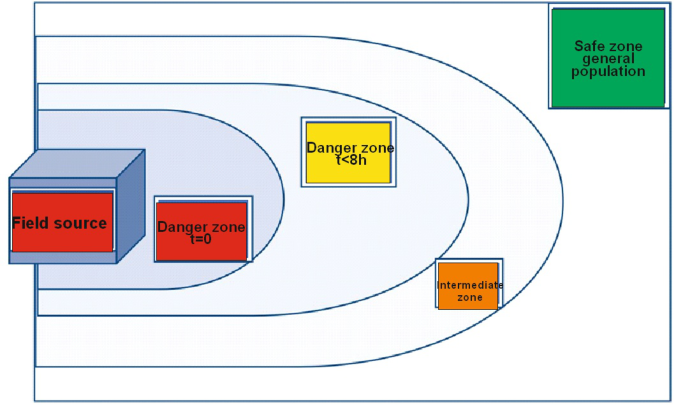
Figure 1 presents a list of normative values used to determine the ele- ctromagnetic environment at workstations. Figure 2 shows the types of protection zones in areas in the vicinity of field sources, introduced in
Figure 1: List of normative values used to determine the electromagnetic environment at workstations.
136 Wnuk
Figure 2: Protection zones [11].
order to protect against the harmful effects of electromagnetic radiation 9 (Michałowska-Samonek).
Determining protection zones in the work environment is closely related to the dose of radiation and the exposure index. The permissible dose of the electric (or magnetic) field is considered to be the value of the product of the square of the electric (or magnetic) field strength, separating the hazard zone from the intermediate zone, and the exposure time per person exposed to electromagnetic radiation, expressed in hours (T = 8 h - working shift) (P. Zradzi´nski). The basic principles of radiation protection are that any deci- sion that changes the radiation exposure situation should do more good than harm. All exposures should be kept as low as reasonably achievable, taking into account economic and social factors and individual exposure limitations to reduce inequities in dose distribution. The principle of application of dose limits, according to which the total dose to any person from sources of ele- ctromagnetic radiation should not exceed the relevant recommended limits. The actual index of exposure to the dose of the electromagnetic field WH or WE is a measure of the exposure of the human body during one shift at work. The field exposure factor is the total ratio of the actual dose to the allowable field dose at a given frequency. The exposure index W is the typi- cal value of a worker’s total exposure to magnetic and electric fields during a work shift and is the sum of WH (magnetic field index) and WE (electric field index) (JL. Phillips). Figure 2 shows the zones of electromagnetic fields for the human body. These zones have been determined based on the value of electromagnetic radiation emission, which is higher or lower depending on the distance from the radiation source. Also based on how long the human body is exposed to.
A danger zone is an area where people are not allowed. In the danger zone, it is permissible for people to stay near the sources of the electromagnetic field for a limited time, which is less than 8 hours. In the intermediate zone, the
Analysis of the Influence of Military Radio Stations on the Operator’s Health 137
presence of people is allowed and determined by the time during one work shift. The last is the safe zone, which defines the area beyond the coverage of the protection zones. In the case of designating a protection zone, it is associ- ated with exposure to electromagnetic radiation. The permissible dose is the product of the squares of the electric or magnetic field strength separating the hazard zone from the intermediate zone and expressed in working hours. The temporary dose, on the other hand, is characterized by the employee’s expo- sure to the electromagnetic field, where the intensity of this field is variable, when changing workstations.
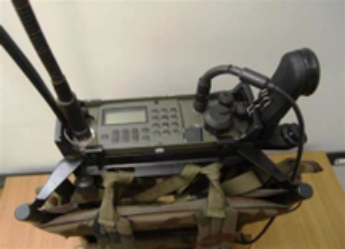
MEASURING THE ELECTROMAGNETIC FIELD OF A MILITARY RADIO STATION The tested object is the RRC-9200A (TRC-9200A) military radio set with a tape antenna, which are shown in Figure 3. The radio station was used to check compliance with safety requirements. The document that regulates the protection of soldiers against electromagnetic radiation in the workplace where military communication systems are located is the defense standard NO-06-A200 (Normy Obronne), which was amended and approved on July 27, 2012 by Decision No. 222/MON of the Minister of National Defense. This standard regulates the limit levels of spurious emissions and immunity by soldiers exposed to electromagnetic fields. The STANAG 2345 edition 3 standard of February 13, 2003 also applies. This standard regulates the permissible SAR limit in the workplace of soldiers. All standards do not regulate a workplace equipped with a room that is electromagnetically sea- led, i.e. so-called ‘containers’. During the transmission, soldiers stay outside the container at their own risk. The requirements regulating electromagnetic radiation emissions are divided into three categories:
- KRE-01 requirements - apply to radiation emissions that come from sheaths of connecting cables and subsystem equipment, also with electri- cal cable connections with frequencies in the range from 30 Hz to 100 kHz. This requirement does not apply to electromagnetic radiation from antennas. - KRE-02 requirements - apply to radiation emissions that come from shea- ths of connecting cables and equipment, as well as from antennas attached to Equipment Under Test permanently (receivers and transmitters in the receive/standby mode) at frequencies from 10 kHz to 18 GHz. It is impor- tant that frequencies above 30 MHz are referenced to a field that is both vertically and horizontally polarized. - KRE-03 requirements - apply to radiation emissions that come from tran- smitters together with antennas intended for them with frequencies in the range from 10 kHz to 40 GHz. If the level of electromagnetic field emission meets the KRE-02 requirement, then the KRE-03 requirement is automatically met. The above requirement is met if the transmitting or transceiver device whose harmonics (excluding the second and third harmonics) and all other unwanted emissions are at least 80 dB below
138 Wnuk
Figure 3: RRC-9200A radio station with antenna [13].
the level of the fundamental frequency signal. The second and third harmonics should be suppressed:
- to the level of -20 dBm, or - to a level at least 80 dBm below the level of the fundamental frequency signal The maximum value of the SAR coefficient, in accordance with the STANAG 2345 standard, is 0.4 W/kg at frequencies from 100 kHz to 6 GHz.
Guidelines for measuring the electromagnetic field and a description of the measurement method excluding the SAR factor are available in the Polish Standard PN-T-06580-3 (Polska Norma), which was established by the Polish Committee for Standardization on October 7, 2002. Due to the frequency range of the tested radio station and the antenna used (30 - 87.975 MHz) equipped with a radio station used to transmit and receive radio signals, it is appropriate to meet the requirements of KRE-02 and KRE-03 contained in the defense standard NO-06-A200 (requirement KRE-01 does not include antennas). The above requirements, however, do not regulate the value of the electromagnetic field strength in the operating frequency range, and beyond it. Therefore, in the operating frequency range of 30 - 87.975 MHz, the safe limit frequencies are the values of the electromagnetic field strength at the boundaries of the safe and intermediate zones (which meet the requirements of the STANAG 2345 standard).
METHOD OF MEASURING THE ELECTROMAGNETIC FIELD AT MEASURED OBJECTS Due to the fact that the RRC-9200A radio station is operated by one person, the measurements will be carried out using one measuring plumb represen- ting the service directly at the antenna and one measuring plumb positioned 3 m from the antenna, representing a single soldier staying nearby. In addi- tion, measurements were made directly of the radio station itself. The entire measurement was carried out in a non-reflective, electromagnetically sealed semi-anechoic chamber for several selected operating frequencies from the entire available operating band.
Analysis of the Influence of Military Radio Stations on the Operator’s Health 139
Electric and Magnetic Field Intensity Measurement The field strength measurements were carried out in an area in which we consider the total space as the space of the operator’s workplace surrounded by field sources, in which the employee will be able to stay while performing work.
The measurement of the intensity of electromagnetic fields was carried out vertically and horizontally. The lines subjected to field emission were routed along the worker’s body. The measurements performed concerned an employee who was at a properly set distance from a source of electromagnetic radiation of appropriate intensity. It was established that the measurement plumb is 2 [m], so the field will affect the worker during tests up to this height. The margin of error is 0.05 [m]. Measurement verticals were selected for the tests of the military radio station, one at a distance of 3 [m], and the other in direct contact with the radio station and its antenna. The measuring station was located inside a chamber that provides high attenuation of the external signal.
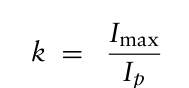
In the case of magnetic field measurement, a frame sensor was used. The current induced in it is measured using a measuring device. These are special meters that are able to measure the rms value. For the correct measurement, the mere measurement from the meter is not enough. The so-called correction factor (2) must be used to convert the measured instantaneous value into the value of the maximum operating current.
(2)
Equation reproduced from the original PDF.
where: Imax – the highest allowable current value Ip – current value during the measurement In the case of electric field measurement, a dipole sensor is used. The cur- rent induced on it is measured using a measuring device. These are special meters that are able to measure the rms value. For the correct measurement, the mere measurement from the meter is not enough. The correction factor (3) must also be used to convert the measured instantaneous value into the value of the maximum operating voltage.
Equation reproduced from the original PDF.
Up
where: Umax – the highest permissible voltage value Up – voltage value during the measurement The Wandel & Goltermann EMR-300 meter was used for the measure- ments in this work
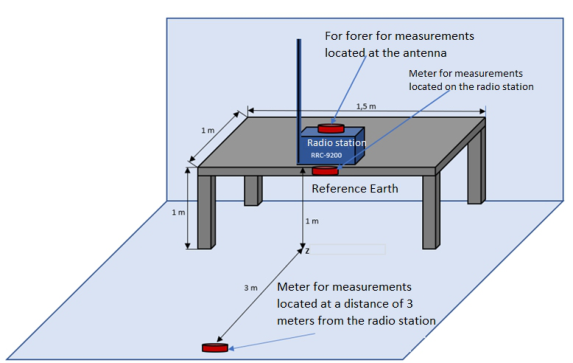
The measurement stand for the tested object, which is the RRC-9200A radio station, which meets the measurement criteria is shown in Figure 4. This stand was located in the anechoic chamber The radio station for testing had the following settings:
140 Wnuk
Figure 4: Measuring stand for measuring the intensity of the electromagnetic field emitted by the RRC-9200A military radio.
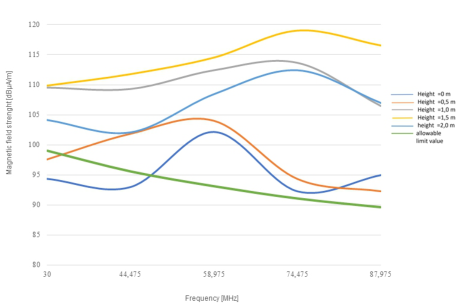
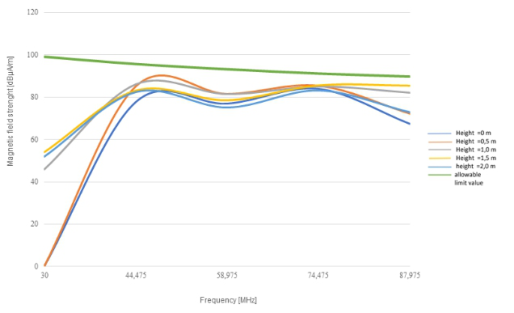
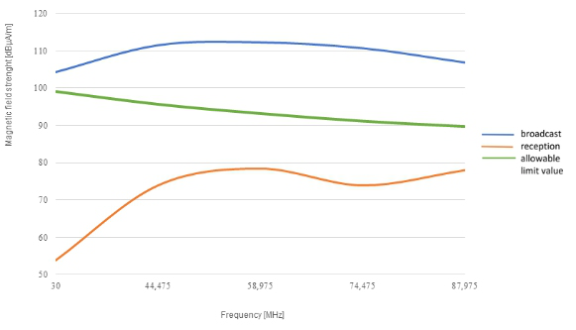
RESULTS OF MEASURING MAGNETIC FIELD INTENSITY OF A MILITARY RADIO STATION The results of the measurements are shown in Figures 5, 6, 7.
ANALYSIS OF THE RESULTS OF THE PERFORMED MEASUREMENTS The results of the measurements of the RRC-9200A military radio station brought an unexpected result. In principle, for each of the frequencies, when
Figure 5: Graph of the magnetic field strength of the RRC-9200A military radio on a logarithmic scale, measured at a distance of 0 meters from the radio.
Analysis of the Influence of Military Radio Stations on the Operator’s Health 141
Figure 6: Diagram of the magnetic field strength of the RRC-9200A military radio station on a logarithmic scale, measured at a distance of 3 meters from the radio station.Figure 7: Diagram of the magnetic field strength of the RRC-9200A military radio station on a logarithmic scale for transmitting and receiving.
measurements are made at a distance of 0 [m] from the radio station or antenna, the measurements exceed the permissible level of both magnetic and electric field strength at all of the tested heights. The situation in the case of measurements made at a distance of 3 [m] is similar. When testing the magne- tic field strength, the permissible level is exceeded at all tested frequencies and heights. An interesting phenomenon occurs when measuring the electric field strength at a distance of 3 [m]. The limit value is exceeded at all test altitu- des at operating frequencies of 30 MHz and 44.475 MHz and 58.975 MHz. However, at the frequencies of 74.475 MHz and 87.975 MHz at all heights, at this distance the situation normalizes and we obtain a result that does not exceed the permissible value of the electric field strength. Taking into account the measurements with the meter set directly at the handset for the released tangent and pressing it, a certain regularity can be observed. When transmitting, both the electric and magnetic field strength levels are greatly
142 Wnuk
exceeded. However, in the case of signal reception (when the radio station is not transmitting), the measurement is normal (does not exceed the permissi- ble value). It should be clearly emphasized that the obtained results concern the measurements of electric and magnetic fields. In the case of an analysis of the impact of these fields, it would be necessary to determine the amount of energy absorbed by the operator. But in this case, the parameters of the radio station operator are necessary.
The assessment of exposure to the electromagnetic field in the work envi- ronment is based on the principles of good laboratory practice, such as, for example, employee competence and qualifications, as well as on appropri- ate measuring equipment and procedures. Each of the listed pillars is of great importance with regard to the correctness of the obtained results. It should be noted that a manual electromagnetic field meter was used to perform the mea- surements, therefore, despite carrying out each measurement several times, divergent results were often obtained, especially when measuring at a distance of 0m from the radio station or its antenna. There is also a large influence of the human factor here. The first is the scope of competence, while the second is the technical scope. This is, for example, the impact of the body of the per- son taking the measurement on the spatial distribution of the electromagnetic field (changes in the strength of the electric and magnetic field, which may result from reflections from the human body or damping of the human body), the impact of temperature or air humidity. Compliance with measurement procedures should lead to reproducibility and repeatability of measurements. However, this is not always sufficient to ensure the representativeness of the results. While the obtained results may contain many measurement errors, a comprehensive picture is obtained that can be analyzed.
CONCLUSION
The analysis of the safety issues of staying in the electromagnetic field of military antennas and radio stations, as well as the results of research on the field strength emitted by the RRC-9200A military radio station, which were carried out in this work, can be considered as having an adverse effect on the functioning of the human body. Due to the fact that the operator of the radio station is exposed to the electromagnetic field emitted by it, its adverse impact on the human body should be investigated (especially the biological effects that may occur). The current lack of an indisputable opinion regarding the impact of the electromagnetic field on the human body forces us to con- duct further research on the impact of the electromagnetic field on the human body. This will allow us to better understand the effects of human exposure in and out of the workplace and therefore find ways to protect ourselves. Polish standards regarding electromagnetic fields are very rigorous, but the actual effects of this field are still unknown. Carrying out more research in this area expands knowledge on the subject and allows the introduction of restrictions on exposure to electromagnetic fields and people’s approach to the problem in a rational way. The tested RRC-9200A military radio with its antenna at the maximum power setting (10 W), if during signal reception it
Analysis of the Influence of Military Radio Stations on the Operator’s Health 143
does not exceed the permissible level of the electromagnetic field, after pres- sing the tangent it does. The emission level of the electromagnetic field when the radio is carried on the back by the operator, when transmitting, practi- cally in every case exceeds the permissible values of magnetic and electric fields. This can lead to undesirable health effects for the operator of such a radio station. When the RRC-9200A military radio is used at a distance of 3 [m] from the operator, the results of the conducted tests give much lower values of the electromagnetic field. Unfortunately, this level is not low enough to be considered safe. It would be necessary to carry out research that could determine what are the safe zones for the use of this radio station. Howe- ver, no attempt was made to determine the border of these zones, because it was not the purpose of this work. Due to the fact that the electromagne- tic field emitted by the radio during transmission at full power of 10 W is large and significantly exceeds the permissible value, the radio should not be used in direct contact. You should take into account your own health and the negative effects that may be caused by using the radio from such a short distance in the long term, and possibly also in the short term. In connection with the obtained results of research on the field emitted by the RRC-9200A radio station, it is recommended to use it at the greatest possible distance, in the shortest possible time, and with the lowest power setting (0.5W). This will help to minimize the operator’s exposure to the electromagnetic field emitted by the radio station, as well as limit the possible negative impact on his health. These are the results of the test without the participation of the operator. Otherwise, the consent of the medical ethics committee is required.
REFERENCES
D. Halliday, R. Resnick, J. Walker, Podstawy fizyki. Tom 3. Elektryczno´s´c i magnetyzm, Wydawnictwo Naukowe PWN 2015. D. Halliday, R. Resnick, J. Walker, Podstawy fizyki. Tom 4. Fale elektromagnetyczne,
Wydawnictwo Naukowe PWN 2015. F. Stanley: Origins of Neuroscience: a history of explorations in brain function; Oxford University Press, New York 1994, str. 41–42. http://archiwum.ciop.pl/11497 http://malopolska.btsearch.pl/PM/3_2.phphttps://pem.itl.waw.pl/artyku%C5%82y/pole-
elektromagnetycznych-w-srodowisku-18933691 https://www.radmor.com.pl/product/military/23 J. Karpowicz, A. Bortkiewicz, K. Gryz, R. Kubacki, R. Wiaderkiewicz, Pola i promieniowanie elektromagnetyczne o cze˛stotliwo´sci z zakresu 0 Hz – 300 GHz, 2008. J. Michałowska-Samonek, Aktualne zasady dotycza˛ce badania pól elektromagnet-
ycznych wysokiej cze˛stotliwo´sci, 2008. JL. Phillips, NP. Singh, H. Lai Electromagnetic fields and DNA damage. Pathophysiology, 2009.
144 Wnuk
M. Kowalczyk, J. Kwiecie´n, W. Latoszek, R. Lech, J, M. Batalla, M. Olender-Skorek, R. Pawlak, B. Regulska, E. Rokita, K. Sienkiewicz, A. Stolarczyk, M. Sylwestrzak, G. Tato´n, A. Wójcik, J. ˙Zurek, Pole elektromagnetyczne a człowiek, Warszawa 2019. Norma Obronna NO-06-A200, Kompatybilno´s´c elektromagnetyczna. Dopuszczalne
poziomy emisji ubocznych i odporno´sci na nara˙zenia elektromagnetyczne, MON 2012. Norma Obronna NO-06-A500, Kompatybilno´s´c elektromagnetyczna. Procedury bada´n zakłóce´n elektromagnetycznych i odporno´sci na nara˙zenia elekromagnet- yczne, MON 2012. P. Zradzi´nski, Uwarunkowania wykorzystania numerycznych modeli pracowników
do oceny zagro˙ze´n bezpo´srednich wynikaja˛cych z nara˙zenia na pole elektroma- gnetyczne, 2016. P. Zradzi´nski, J. Karpowicz, D. Roman-Liu, K. Gryz, Zasady modelowania zagro˙ze´n elektromagnetycznych, 10.2006. Polska Norma PN-T-06580-3, Ochrona pracy w polu i promieniowaniu elektroma-
gnetycznym o cze˛stotliwo´sci od 0 Hz do 300 GHz. Cze˛´s´c 3: Metody pomiaru i oceny pola na stanowisku pracy, Warszawa 2002. R. Krawczak, Wykłady z przedmiotu “Urza˛dzenia radiokomunikacyjne 1 i 2”(wersja 1.6), Warszawa 2016. STANAG 2345 (Edition 3), Evaluation and control of personnel exposure to radio
Frequency fields – 3kHz to 300 GHz, NATO Standardization Agency, 2003. W. Traczyk, A. Trzebski, “Fizjologia człowieka z elementami fizjologii stosowanej i klinicznej”, Wydawnictwo Lekarskie PZWL 2004, str. 56–60.
LISTED IN THE AHFE DIGITAL BOOKSTORE CATALOGUE
Explore the complete digital volume
Safety Management and Human Factors
Read this individual research paper free through the original publisher, or explore the full digital proceedings book.
ISBN 978-1-958651-81-0
Explore this ISBN in the AHFE Bookstore ↗Listed in the July 2026 bookstore catalogue; search by ISBN to confirm current availability · Digital book purchase optional