M Liphadzi, Clinton Aigbavboa (2023). Ethical elements influencing leadership development in the South African Construction industry: A Delphi study. In: Sustainable Construction in the Era of the Fourth Industrial Revolution. AHFE Open Access, vol. 107, pp. 54–65. https://doi.org/10.54941/ahfe1003092
SHSCRC, Sustainable Human Settlement Construction Research Centre, Faculty of Engineering and the Built Environment, University of Johannesburg,2006, South Africa ↗
This study aims to establish whether different ethical elements impact leadership development in the South African construction industry (SACI). This Delphi study revealed 16 moral elements that affect leadership development in the construction industry. All sixteen ethical elements recorded high Impact (HI:7.00-8.99) on leadership development in the South African construction industry. The study established that ethical elements that impact the SACI include adhering to organizational ethical values, developing the right moral identity, developing accountability features, and speaking out when something is morally wrong. These ethical elements are similar to those of other industries. It is recommended that leaders in the SACI should cultivate the right conduct in adhering to procedures and policies. This study informs industry stakeholders of the relevant ethical elements that impact leadership development in the South African construction industry.
Ethical conduct in the South African construction industry (SACI) has become a burning public issue because of many cases of corruption that have been report and the payment of inducements to attain contracts. Tagoe (2006) defines ethics as the analysis of moral value of human behaviour and of the rules and principles that are set to govern the social, religious, or civil behaviour of a particular society or profession. Similarly, Oxford English Dictionary defines Ethics as “relating to morals, treating of moral questions” (Sykes, 1987). Recently in the construction industry attention has been dire- cted on how construction personnel have become aware of ethical dilemmas and how they articulated and resolved them in the daily practice of the built environment (Sindelar, 2003). The effects of unethical activities in a constru- ction industry are devastating and they can have unbearable consequences for both individuals and the organization. Unethical activities can take place at every phase of a construction project, they can either take place while the project is still on planning and design, during pre-qualification and ten- der phase, during construction phase or during operation and maintenance
Ethical Elements Influencing Leadership Development in the South African Construction 55
phase. Regardless of whether the number of ethical failures in the constru- ction industry is effectively rising or growing, it is imperative to note that we are during a ‘leadership crisis’. Therefore, this study aims to establish ethical elements that determine leadership development in the construction industry.
It worth highlighting that ethical elements are specific to a particular indu- stry and country. Hence, depending on dominant political, economic, and political factors of a specific country or industry, the ethical approach will be different. Therefore, it would be inaccurate to assume that ethical elements are generic and are applicable to all industries and countries. Likewise, rel- ying on ethical elements that impacted ethical behavior in generic research to be the same in the South African construction industry (SACI) will be a great misrepresentation, even though there may be some similarities between other industries or nations around the globe and South Africa. Hence, empirically establishing ethical elements that impact leadership development in the SACI is very important. Therefore, the aim of the study is to find an answer to the question: Which ethical elements impact leadership development in the SACI, and to determine to what extent does each element influence the deve- lopment of leaders? The Delphi procedure was utilised to validate the ethical elements that impact leadership development in the SACI, which were iden- tified through a literature review and based on consensus in experts’ views. This is due to the fact that the nature of the data required can only be attained from certain some experts in the construction industry. Thus, Miller (1993) argued that Delphi method is appropriate for soliciting experts’ opinions. The objective of this study are as follows; to establish the ethical elements that impact leadership development and to determine the relative impact of each element on Leadership Development. The remainder of this research has been structured under the following sections: literature review, methodology, results and discussions, and conclusions.
ETHICAL LEADERSHIP FEATURES: A SURVEY OF RELEVANT EXISTING LITERATURE In most cases when the issues relating to ethics are being mentioned, the researchers ethical conduct of leaders always takes foremost attention from researchers. According to Ciulla (1998), ethics and integrity are the core of leadership and leadership development and for the business to succeed the ethics and integrity should be taken seriously. Price (2003) demonstrated that ethical leadership reduces employee absenteeism, misconduct and impro- ves job satisfaction and performance. Similarly, Rubin, Dierdorff and Brown (2010) also attest that managers who are ethical leaders are often perceived to be more suitable to opportunities for promotion.
Although, ethics and morality of leadership has always been delibera- ted in normative terms in philosophical work (Ciulla, 1998), however the latest expressive work inspired more researchers to have turn their atten- tion into the field of leadership ethics (Brown, Treviño, & Harrison, 2005; De Hoogh & Den Hartog, 2011).
According to Moccia (2018), the characteristics and attitudes needed to effectively lead an organization in a modern world include the need for having
56 Liphadzi and Aigbavboa
inward-looking character, where the leader leads by example or an outward- facing ethos by which employees are expected to embody. These elements fur- ther include gratitude, humility, integrity and resilience. Similarly, Gini (1997) alluded that a leader would be deemed ethical when they do not have inten- tions to cause harm to others and always have respect to everyone who followers them. Furthermore, Kanungo (2001) stated that the ethical lea- der must always avoid harmful acts towards others, must be able to develop an honest character, and must have selfless motives rather than being self- centered. In the year 2005, the government of the Republic of South Africa launched an initiative called the “Batho Pele”, which means people first in Sesotho, the aim of the initiative was to improve the integrity in public admi- nistration by monitoring closer the performance of public and to ensuring that they comply with ethical practices (Raga and Taylor, 2005). Essentially, the initiative helped the officials to gain confidence in delivering efficient, ethical, and accountable services.
BACKGROUND ON ETHICAL THEORIES In clarifying the ethical elements, different ethical theories were explored. Shultz and BrenderIlan (2004) deliberated how the different ethical theories are significant on the practice of human relations within organizations. In addition, Reidenbach & Robin (1990) also noted that different people use different ethical theories based on the context. According to Singer (2022) the field of ethics involves organising, defending, and recommending concepts of right and wrong behaviour. Moreover, according to Fisher (2014) there are three general branches of ethical theories, namely: metaethics, normative eth- ics, and applied ethics. Reidenbach & Robin (1990) describes ethical egoism as the normative theory in which the human beings must act solely in their self-interest. Hence, the moral principle of ethical egoism alludes that a beh- aviour is ethical when it encourages the person’s long-term interest (Shultz & Brender-Ilan, 2004). In addition, Kant (1998) noted that the actions that are morally correct, are those that are carried out with a sense of duty. Hence, it is the intention behind an action that makes an action morally correct rather than its consequences (Bowie, 2002).
In accordance with the theory of moral rights, there are certain funda- mental rights that humans have which should be respected in all decisions, namely: the right to free consent, privacy, freedom of conscience, free spe- ech, and due process (Cavanagh, Moberg and Velasquez, 1981). A right can be described as condition of existence that permits a person to enjoy a certain object or state of being. However, considering the study, there are varying views as to the specific theoretical elements that enhance leadership development in the construction industry. It could also be inferred from the literature that some of the views are also closely connected. Hence, a synth- esis in the current study of the views advanced by the various authors gives a more holistic framework to guide this study. Table 1 presents the theore- tical conceptualization of the ethical theories that guided the current study. These theories are predominant in the literature reviewed and appear to be a representation of the views the numerous studies have espoused.
Ethical Elements Influencing Leadership Development in the South African Construction 57
Table 1. Ethical theories.
Table available in the original PDF paper.
Ethical Theories Authors (s) Ethical Egoism (Reidenbach & Robin, 1990; Jones et al., 2007) Utilitarianism (Bentham, 1789; Mill, 1957; Brandt, 1979; Rachels, 1999) Deontology (Kant, 1998; Bowie; 1999) Ethics of care (Gilligan, 1982; Dillon, 1992) Rights theory (Cavanagh et al., 1981) Theory of Justice (Jones, 2007; Rawls 1971)
METHODOLOGY
The research methodology adopted to highlight ethical elements that influe- nce leadership development in the South African construction industry is the Delphi technique. The Delphi technique relate to both quantitative and qua- litative research (Fletcher and Marchildon; Tengan and Aigbavboa, 2018). According to Miller (1993); Leung (2001); Tengan and Aigbavboa (2018), Delphi technique contains the use of structured questionnaires to implore views from expert panellists and the consensus is formulated from their responses through rounds of questionnaires. Tengan and Aigbavboa (2018) assert Delphi technique is a rigorous tool for capturing data when underta- king quantitative study. Likewise, Aigbavboa (2014) noted that the strength of qualitative research is embedded on the rigorousness of the methodology that is utilised.
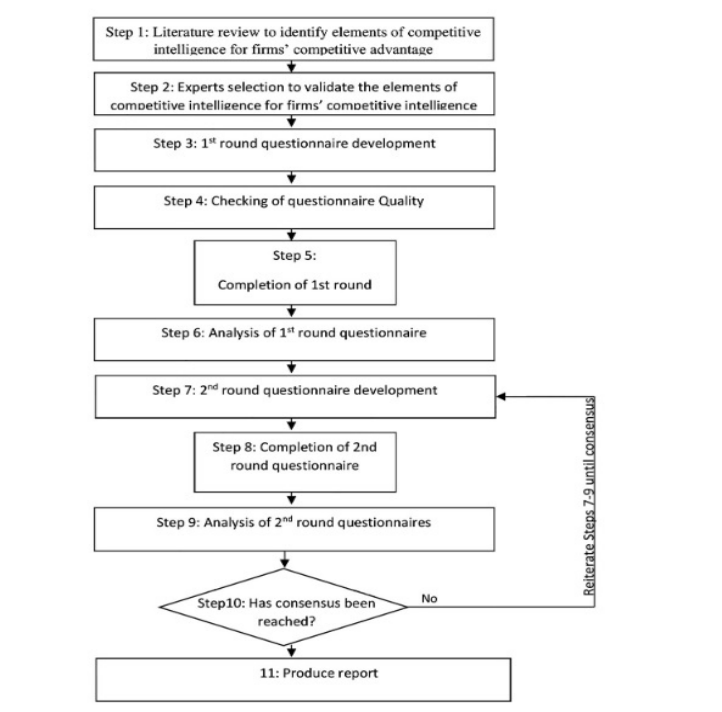
This study employed the detailed Delphi process outlined on Figure 1 below, by Aigbavboa (2014). Literature review was the first step of the Delphi process that was undertaken in this study. This played a crucial role in iden- tifying the relevant ethical elements that impact leadership development. The second step that was undertaken was to select the panel of experts to partake in a study. The experts were carefully selected from the industry and academia to represent a broad range of opinion on ethical elements being investigated (Tilakasiri, 2015). The checklist in Appendix 1 was used to prequalify the panel of experts. Fourteen (14) experts that were selected participated in all 3 rounds of the survey. The Delphi process was concluded after the third round when the strong consensus amongst the panel of experts was achie- ved. The sample size of fourteen (14) experts for the study was in line with the study undertaken by Tengan and Aigbavboa (2018).
According to Gustafson (1975), the panel consisting of 10 to 15 experts is sufficient to undertake a Delphi study provided the background of the pan- elists is consistent. Subsequently, the instructions and the questionnaires for round three of the Delphi survey were sent to the experts (See Appendices 2). All Fourteen experts responded to all the rounds of the survey. After each round of the Delphi survey, a statistical estimate of the experts’ views was calculated and analysed using the standard deviation, interquartile devia- tion, median, and relative impact index. The identity of the experts was kept confidential in line with the ethical considerations of a Delphi study (Aig- bavboa, 2014; Tengan and Aigbavboa, 2018). In relation to respondents’
58 Liphadzi and Aigbavboa
Figure 1: Diagram of the Delphi process, Source: Adapted from Aigbavboa (2014).
demographic characteristics, Table 2 shows that 14% of the experts were from construction industry, while 28% of the experts were from the educa- tion and training industry. All the experts had more than five years of work experience. Therefore, the demographic characteristics of the experts sug- gested that they had the required knowledge and experience on ethics for leadership development. A minimum mark of 5 points was required from the experts before they can become a part of a panel. Impressively, 6 points was the minimum mark that was obtained from the experts. Therefore, the experts were accepted to partake in the Delphi study. The questionnaire for the study was developed based on the findings of the critical literature review this study undertook. The pilot study was used to test the eminence of the questionnaire i.e. clarity and duration to complete it, among others.
The mean, median, standard deviation, interquartile deviation (IQD), and relative importance index utilised on previous studies was used to analyse and determine consensus in experts’ responses. A similar approach was employed by Raskin (1994) and, most recently it was utilised in several studies (see Aigbavboa, 2014; Adnan et al., 2018; Tengan and Aigbavboa, 2018). In this
Ethical Elements Influencing Leadership Development in the South African Construction 59
Highest Qualification Doctor of Philosophy (PhD) 3 Master of Science (MSc) 6 Bachelor of Science or an equivalent degree. 5 Total 14 Field of specialization Education and Training 4 Building Construction 2 Construction development 1 Financial industry 1 Civil Engineering 2 Construction Management 2 Project Management 2 Total 14
Years of experience 1–5 0 6–10 3 11–20 5 21–30 5 Over 31 1 Total 14
study, the consensus was measured using the following 10-point impact scale, where1 and 2 represent no impact; 3 and 4 represent low Impact; 5 and 6 represent medium Impact; 7 and 8 represent high Impact; 9 and 10 represent very high Impact: (1) Strong consensus – median 9–10, relative impact index 0.80–1.00, interquartile deviation (IQD)≤1. (2) Good consensus – median 7–8.99, relative impact index 0.60–0.79, IQD ≥1, 1≤2; and (3) Weak consensus – median ≤6.99, relative impact index ≤0.59, and IQD ≥2, 1≤3.
According to Bryman (2001), Sarantakos (2005), and Tengan and Aigba- vboa (2018) the validity, reliability, and generalizability of Delphi findings are embedded on the rigorousness of the data collection. Thus, a rigorous methodological process was adapted for the study (See Figure 1); further- more, the study was reinforced with the ethical theories (Bentham, 1789; Mill, 1957; Brandt, 1979; Rachels, 1999). Furthermore, the experts were constantly engaged individually, and they were offered an opportunity to fre- ely maintain or effect changes to their response and provide reasons for the latter, that constant engagement with the experts was done to ensure internal validity of Delphi findings.
60 Liphadzi and Aigbavboa
RESULTS AND DISCUSSIONS Delphi Round 3 Results
The aim of the third round of the Delphi survey is to ascertain ethical ele- ments that impact leadership development in the South African construction industry. Sixteen ethical elements were identified from the literature review and they were validated by the expert panelists during all three rounds of the Delphi survey. These elements proved to have impacted leadership develo- pment in the South African construction industry. All 16 elements had a high impact on leadership development (HI: 7.00–8.99) good consensus levels (see table 3). Likewise, the consensus levels among the elements varied while the standard deviation scores suggested strong levels of consistency.
Table 3. Leadership development ethical elements.
Table available in the original PDF paper.
Leadership Development Ethical Elements
8 8,29 1,07 1,00
Leaders... M Mean SD IQD … cultivate the right conduct procedures and policies 8 8,07 0,83 0,00 … develop relational transparency 7 7,36 0,74 1,00 … adhere to organisational ethical values 8 8,07 1,33 0,00 … develop the right moral identity 7 7,21 1,05 0,00 … understand national laws 7 7,29 0,61 0,00 … adhere to industry regulations and best practices 7 7,36 0,84 0,00 … respect personal beliefs 8 7,79 0,89 0,00 … develop empathy for team members 8 7,71 1,14 0,00 … develop a positive corporate culture 8 7,79 0,58 0,00 … develop honesty features 8 8,14 1,10 0,75 … ensure organisational actions align with organisational values
7 7,43 1,16 1,00
… understand social responsibility 8 7,68 0,89 0,50 … partner with responsible organisations 7 7,21 1,12 1,00 … develop accountability features 8 7,79 0,87 0,88 … create a conversation about ethics and values with team members … speak out when something is morally wrong 8 8,21 1,19 0,75
DISCUSSIONS This study aimed to establish whether the ethical elements found generic eth- ical research impacts leadership development in the construction industry. Sixteen ethical elements were found to impact leadership development. All 16 elements detailed high Impact with a median score range (HI: 7.00–8.99). Some of the elements were that leaders should develop the right conduct procedures and policies that had an IQD of 0.00. In addition, leaders need to develop honesty features with an IQD of 0.75. This is consistent with the study by Gini (1997) that leaders should develop an honest approach of leading in the construction industry. As discussed above, all ethical ele- ments recorded high Impact with a median score range (HI: 7.00–8.99). Though the level of consensus varied among the elements, the respective
Ethical Elements Influencing Leadership Development in the South African Construction 61
IQD scores indicated a strong consensus with IQD being less than 1. Adh- ering to organizational ethical values had an IQD of 0 in the construction industry; developing the right moral identity had an IQD of 0; leaders who understand social responsibility had an IQD of 0, and leaders who seek to develop accountability features recorded an IQD of 0.88 in the constru- ction industry. These findings support those of previous studies that are adhering to organizational ethical values is important to develop leaders (Langvardt, 2012) and that construction companies should train the leaders’ organizational ethical values (Sinha et al., 2011). More so, leaders should develop the right moral identity, consequently supporting the assertion of Ofori (2009).
One of the outstanding ethical elements was the need for industry lea- ders to speak out when something is morally wrong, with an IQD value of (0.75). This is in line with the findings of the study Pearl, Bowen and Makanjee (2005). This further supports the argument by Ofori (2009) that governments and industry players play a key role in the construction industry and that, among other things, ethical conduct in the constru- ction industry is perilous. None of the elements was found not to have impacted leadership development in the SACI. More so, the respective standard deviation values, as well as the IQD values, indicated strong levels of consistency and consensus in the views expressed by the expert panelists.
CONCLUSION
This study was considered with the aim of establishing whether the eth- ical elements found in ethical literature are relevant in the South African construction industry for leadership development. Sixteen ethical elements were found to have an impact on leadership development in the South African construction industry. These elements were consistent with ethical components from earlier studies. Thus, the study recommends that ethi- cal leaders in the construction industry should adhere to the right moral identity, understand national laws, respect personal beliefs, and develop empathy for their team members. Moreover, construction industry stakeh- olders should develop leaders who can possess accountability features. This study has theoretical, practical, industry policy, and curriculum implicati- ons. It empirically unravels ethical elements for leadership development in the South African construction industry. Theoretically, the study advances that ethical features in the construction industry embody sixteen essential elements. Practically, the study demonstrates the impact that each of the sixteen elements has. This should inform the stakeholders in the constru- ction industry who has aimed at developing leaders in the construction industry. In addition, it should also inform the upcoming curriculum evalu- ations to make the content of the existing curriculum more aligned with the needs of the construction industry, as it brings to the fore emerging ethical elements.
62 Liphadzi and Aigbavboa
Appendix 1. Criteria/checklist for constituting the panel of experts for the Delphi study.
Questionnaire Items Possible Marks
Minimum expected Mark
Minimum Obtained Marks
Maximum Expected Mark
0 Point
Q1 Please indicate you highest level of education Higher National Diploma Bachelor’s degree 2 Points 1 point Master’s degree 3 Points 2 points Doctroroal degree 4 Points 4 points Q2 Please indicate your years of experience in the construction industry. Below 5 years 1 Point 1 point 6 to 10 years 2 Points 11 – 15 years 3 Points 3 Points Above 15 years 4 Points 4 points
Total Points 8 points 2 Points 5 points Note: the minimum obtained mark of 5 points qualified an expert to be part of the Delphi panel
Q3. Please also list ethical elements for leadership development in the South African construction industry.
Note: Reference can be made to the attached list generated from the literature review. Ethical elements for leadership development.
1. cultivate the right conduct procedures and policies 2. develop relational transparency 3. adhere to organisational ethical values 4. develop the right moral identity 5. understand national laws 6. adhere to industry regulations and best practices 7. respect personal beliefs 8. develop empathy for team members 9. develop a positive corporate culture 10. develop honesty features 11. ensure organisational actions align with organisational values 12. understand social responsibility 13. partner with responsible organisations 14. develop accountability features 15. create a conversation about ethics and values with team members 16. speak out when something is morally wrong
Appendix 2: Delphi Round 3 and Questionnaire Instructions Attached is the response computed group median for each of the ethical ele- ments from round two of the Delphi survey. You are at liberty to either accept the group response as computed, indicate a new response, or maintain your
Ethical Elements Influencing Leadership Development in the South African Construction 63
Leadership Development Ethical Elements From no impact to very high Impact
Group Median
8
Leaders... 1 2 3 4 5 6 7 8 9 10 … cultivate the right conduct procedures and policies 8 … develop relational transparency 8 … adhere to organisational ethical values 8 … develop the right moral identity 8 … understand national laws 8 … adhere to industry regulations and best practices 8 … respect personal beliefs 8 … develop empathy for team members 8 … develop a positive corporate culture 8 … develop honesty features 8 … ensure organisational actions align with organisational values
8
… understand social responsibility 8 … partner with responsible organisations 8 … develop accountability features 8 … create a conversation about ethics and values with team members … speak out when something is morally wrong 8
Reasons/Comments
own response in round one. In cases where your response differs from the group median, please provide a reason/comments. Also, new elements are identified from round two. Based on your knowledge and experience, please indicate the extent to which the underlisted ethical elements impact leader- ship development in the construction industry by placing ‘X’ in the boxes provided against each ethical element using a 10-point scale, whereby 1 = no impact to 10 = very high impact.
ACKNOWLEDGMENT
Acknowledging Prof Clinton Aigbavboa and Prof Wellington Thwala.
REFERENCES
Aigbavboa, C. O. 2014. “An Integrated Beneficiary Centered Satisfaction Model for Publicly Funded Housing Schemes in South Africa.” Doctoral Thesis, University of Johannesburg. Bowie, N. E. 2002. “A Kantian Approach to business Ethics. in Frederick, R. E. A
Companion to Business Ethics”, Blackwell, UK. Bowie, N. E. 1999. “Business Ethics: A Kantian Perspective”. Malden, Mass: Blackwell. Brown, M. E., & Mitchell, M. S. 2010. “Ethical and Unethical Leadership: Exploring
New Avenues for Future Research.” Business Ethics Quarterly, 20(4), 583–616. Brown, M. E., Treviño, L. K., & Harrison, D. A. 2005. “Ethical leader- ship: A social learning perspective for construct development and testing.” Organizational Behavior and Human Decision Processes, 97(2), 117–134. https://doi.org/10.1016/j.obhdp.2005.03.002
64 Liphadzi and Aigbavboa
Bryman, A. 2001. Social Research Methods.” Oxford, UK: Oxford University Press Cavanagh, G. F., Moberg, D. J. &Velasquez, M. 1981. “The ethics of Organizational Politics,” The Academy of Management Review, 6(3), 363–374. Available at: https://doi.org/10.2307/257372. Ciulla, J. B. 1998. “Ethics, the Heart of Leadership.” Westport, CT: Quorum Books. De Hoogh, A. H., & Den Hartog, D. N. 2008. “Ethical and despotic leadership, rela-
tionships with leader’s social responsibility, top management team effectiveness and subordinates’ optimism: A multi-method study.” The Leadership Quarterly, 19(3), 297–311. https://doi.org/10.1016/j.leaqua.2008.03.00 Dillon, R. S. 1992. “Care and Respect.” In E. Browning Cole, & S. Coultrap- MCQuin (Eds), Explorations in Feminist Ethics: Theory and Practice (pp. 69–81). Bloomington, IN: Indiana University Press. Fisher, A. 2014. “Metaethics: An introduction.” London: Routledge. Gilligan, C. 1982. “In a Different Voice: Psychological Theory and Women’s
Development.” Cambridge, MA: Harvard Univ. Press. Gini, A. 1997. “Moral leadership and business ethics.” Journal of Leadership Studies, 4(4), 64–81. Jones, D. A. 2009. “A Novel Approach to Business Ethics Training: Improving Moral
Reasoning in Just a Few Weeks.” Journal of Business Ethics, 88: 367–379. Kant, I. 1998. “Critique of Pure Reason.” Edited by Paul Guyer and Allen W. Woods.
Cambridge: Cambridge University Press. Kanungo, R. N., & Mendonca, M. 1996. “Ethical dimensions of leadership”(Vol. 3).
Beverly Hills, CA: Sage Publications. http://dx.doi.org/10.4135/9781452220536 Langvardt, A. W. 2012. “Ethical Leadership and the dual roles of examples.”Business Horizons. 55: 373–384 Loo, R. 2002. “The Delphi Method: A Powerful Tool for Strategic Management,
Policing.” An International Journal of Police Strategies and Management 25(4): 762–769. Mill, J. S. 1957. “Utilitarianism. Indianapolis.”: Bobbs-Merrill. Miller, M. M. 1993. “Enhancing Regional Analysis with the Delphi Method.”Review of Regional Studies 23 (2): 191–212. Moccia, S. (2012). “Leadership that gets results: lessons from Don Quixote.” Review
of Business, Vol. 33(1), 5–18. Ofori, G. 2009. “Ethical leadership: Examining the relationships with full range leadership model, employee outcomes, and organizational culture.” Journal of Business Ethics, 90(4), 533. Pearl, R, Bowen, P, and Makanjee N. 2005. “Professional ethics in the South
African construction industry -a pilot study.” In (Ed.), “The Queensland Uni- versity of Technology Research Week International Conference”, 4–8 July 2005, Queensland University of Technology, Brisbane, Australia. Price, T. L. 2003. “The ethics of authentic transformational leadership.” The Leadership Quarterly, 14(1), 67–81. Raga, K., & Taylor, D. 2005. “Impact of accountability and ethics on public service
delivery: A South African perspective.” Public Manager, 34(2), 22, 244–254. Rawls, J. 1971. “A Theory of Justice” Cambridge, MA: Harvard Univ. Press. Reidenbach, R. E. and Robin, D. P. 1990. “Toward the Development of a Multidimensional Scale for Improving Evaluations of Business.” Ethics. Journal of Business ethics, 9:8, 639–653. Sarantakos, S. 2005. “Social Research.” 3rd ed. Palgrave Macmillan. Sindelar, M., 2003. “Assessing Engineering Students’ Abilities to Resolve Ethical
Dilemmas.” Frontiers in Education Conference. Nov: 25–31
Ethical Elements Influencing Leadership Development in the South African Construction 65
Singer, P. 2022. “Ethics.” Encyclopedia Britannica. https://www.britannica.com/top ic/ethics-philosophy Sinha, S., Thomas, H. 2010. “Integrating Ethics into the Engineered Constru-
ction Curriculum.” Journal of Professional Issues Engineering Education practice., 133(4): 291–299. Sykes, J. B. 1982. “The Concise” Oxford Dictionary. Oxford University Press, 331. Tagoe, C. N. B. 2006. “Teaching of Ethics of Science and Technology: Diversity in Ethics Teaching in Africa”. 5th Session of the World Commission on the Ethics of Science and Technology. Dakar, Senegal. Tengan, C., and C. Aigbavboa. 2018. “Validating Factors influencing Moni-
toring and Evaluation in the Ghanaian Construction Industry: A Delphi Study Approach.” International Journal of Construction Management, 1–12. doi:10.1080/15623599.2018.1512353. Tilakasiri, K. K. 2015. “Development of New Frameworks, Standards and Principles via Delphi Data Collection Method.” International Journal of Science and Research4, (9):1189–1194.
LISTED IN THE AHFE DIGITAL BOOKSTORE CATALOGUE
Explore the complete digital volume
Sustainable Construction in the Era of the Fourth Industrial Revolution
Read this individual research paper free through the original publisher, or explore the full digital proceedings book.
ISBN 978-1-958651-83-4
Explore this ISBN in the AHFE Bookstore ↗Listed in the July 2026 bookstore catalogue; search by ISBN to confirm current availability · Digital book purchase optional