Vadym Bilous, Kirill Sarachuk (2023). SMEs Ready for AI Embedded Mobile Robots? Current Challenges and Possible Solutions. In: Human Interaction & Emerging Technologies (IHIET 2023): Artificial Intelligence & Future Applications. AHFE Open Access, vol. 111, pp. 285–296. https://doi.org/10.54941/ahfe1004035
1 Chair of Automation Technology, Brandenburg Technical University of Cottbus-Senftenberg, Siemens-Halske-Ring 14, 03046 Cottbus, Germany ↗
2 Chair of Business Administration, Planning and Innovation, Brandenburg Technical, University of Cottbus-Senftenberg, Erich-Weinert-Str. 1, 03046 Cottbus, Germany ↗
The introduction of both mobile robots (MR) and AI-embedded mobile robots (AIMR) into the industry is very slow compared to other types of industrial robots (IR) and automation systems. Many scientific articles and studies are focused on the programming and design of MR. At the same time, integration issues, topical problems and related obstacles are almost entirely absent from the scientific literature. The authors of this paper acknowledge that the complete analysis of this area is a very challenging task. Therefore, for the purposes of this study, we focus on the local problem of analysing the introduction of MR and AIMR in small and medium-sized enterprises (SMEs). The authors offer the analysis of the current challenges and trends in the introduction of mobile robots into SMEs. They also propose solutions to these problems based on their own as well as external experience in the design, programming and implementation of mobile robots.
Global automation has emerged as a synergy of results of second industrial (also known as the technological (Muntone, 2013) and digital revolutions (Casini, 2022) and has found a place primarily in mass production (automo- tive, food processing, textile manufacturing, chemical industry etc. (Bolton, 2003). During these processes, the dominant role has shifted to universal industrial robots (IR) (Bahrin et al., 2016; Khouja & Offodile, 1994; Rubio, Valero, & Llopis-Albert, 2019).
Most robots used in industry are stationary: they are generally anchored in place and cannot be moved freely (MRC, 2022). At the beginning of the third industrial revolution, however, that was not a strong disadvan- tage for the IR due to their main tasks (surface processing, welding, fitting parts to machines). In other way, it simplified the communications, power lines and security for the robotised area. At the same time, the immobility of IR logically reduced their field of application significantly, for instance, transportation options.
Mobile and mobile industrial robots (MR and MIR), on the contrary, can be used to transport various objects, to carry out inspection operations in places that are difficult to access for people, and in health-endangering or potentially dangerous environments. Also, MIR could be equipped with systems that could execute a number of technical operations on the trans- ported workpiece/product during its transfer between global production hubs. Combined with a variety of manoeuvrability enhancement systems, such as omni-directional or continuous alternate wheels (CAW), this allows the usage of MIRs in the existing industrial environments (Taheri & Zhao, 2020). For the purposes of this study, by the term mobile industrial robots we understand all autonomous mobile free programmable systems (including flying drones) in industrial use.
Despite the fact that many studies and projects focus on mobile industrial robots, very few of them address the problem of the whole IR market: for instance, the problem of MIR programming or free movement among the industrial plants stands apart. While conventional IR usually simply perform the movement between pre-programmed waypoints, MIR often should be able to respond and adapt to the changes in the environment. Thus, the suc- cessful and efficient deployment of MIR in industry is integrally related to the development of artificial intelligence systems (AI) for the flexible adaptation to the industrial environment, new tasks, and constantly changing market conditions (VDE, 2019).
Given the complexity of analysing the slow introduction of mobile robots in industry, authors will focus on small and medium-sized businesses (SMEs) in this review1. We will briefly show the general trends in the IMR market, highlight several major problems in the implementation of mobile robots by SMEs, and suggest a couple of solution with respect to the pricing issue. Authors believe that this article may be useful both for specialists designing new plants and factories, entrepreneurs and economists analysing specific trends and challenges in the digital economy.
BACKGROUND INFORMATION Literature Overview
The ongoing interest towards MR occurs mainly thanks to the technological advantages in robotics, AI and ultra-broadband coverage although the latter is distributed unevenly, sometimes even within countries (Sarachuk & Mißler- Behr, 2020; Sarachuk & Missler-Behr, 2022). Still, disparities in physical infrastructure are not among the major drawbacks for the IR market.
Prior to all, SMEs are usually limited in resources and do not have much workload that hampers the robotisation process significantly (Vaher et al., 2021). In fact, mobile robots have to be efficient in many ways, and this effi- ciency has to be clear for entrepreneurs, as for instance in case of collaborative
1The reason for that is that SMEs generate the bulk of production in most industrialised countries, pro- vide manufacturing flexibility but are also responsible for high employment rates among scientific and engineering specialists. Additionally, SMEs represent about 90% of businesses and more than 50% of employers worldwide (Small and Medium Enterprises (SMEs) Finance, 2022).
SMEs Ready for AI Embedded Mobile Robots? Current Challenges and Possible Solutions 287
robots (Baumgartner, Kopp & Kinkel, 2022). That may partially explain the paradox why along with the growing demand for robots in industry, their use in SMEs remains very restricted: in most cases, their area of application is limited to data collection concerning the surrounding environment from various sensors (Gongora & Gonzalez-Jimenez, 2019; Jung et al., 2020), pro- duction automatization using collaborative robot-based systems (Zhou et al., 2022) or creation of collision-free space (Kasaei et al., 2021; Li et al., 2021). Regretfully, not all robots are designed for industrial purposes; actually, their area of application is much broader. According to the recent studies, less than 10 percent of mobile robots may be directly attributed to the industrial use (P&S Intelligence, 2020; GVR, 2021), and share of those ones which could be of interest to SMEs is even lower.
Furthermore, engineering and digital literacy, or more precisely mismatch between industrially applied knowledge and academic knowledge, is usu- ally mentioned as one more potential problem (Fabling & Grimes, 2021; Hengstebeck et al., 2016). This gap increased dramatically over the last years, meaning SMEs if they really would like to facilitate the competences’ trans- fer, have to invest much more time and resources. Also, given a high expertise level is need to set the robot up, configure and operate it, or at least to teach employees to do that (Shu & Solvang, 2021), companies have to find and hire such high-qualified personnel, but not always able to do that, and not due to limited financial resources, but due to the fact such high-skilled professionals are not available on labour markets.
Market and Patents While universal robots for in industrial use massively dominated in the automation, the whole market2 even despite an ongoing COVID outbreak showed significant annual growth by nearly five percent and reached the volume of nearly $55 billion by the end of first pandemic year with nearly 2, 7 million operating units worldwide (Placek, 2021). Three major sub-markets may be pointed out here: unmanned ground vehicles (UGV) with approximately 3/4 of units world-wide, aerial vehicles (UAV) with a share of nearly 1/5, and underwater vehicles (AUV). Both conservative and optimistic expert forecasts state all these submarkets are projected to grow further and expect to beat the $150 billion by the end of decade, thus showing a compound annual growth rate at 10% to 15% (Statista, 2021).
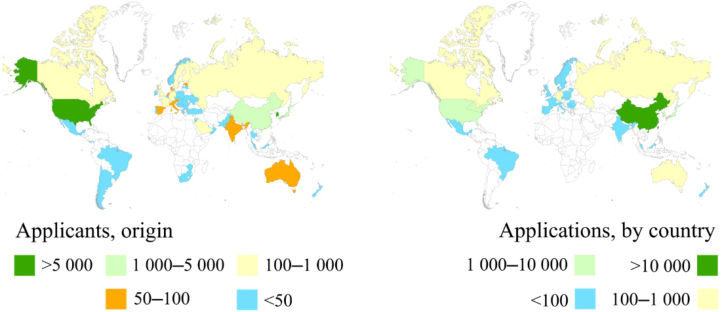
These projections are mostly based on the recent records of the number of filed patents that positively correlates with the appearance of inventions: a significant increase in the number of annually registered patents has been observed in the last five years. At the same time the rapid development of the robotics market to a large extent can be attributed to the Asian region as most new patent applications on MIR originate from China, Japan, and
2Previously, we mentioned that MR are understood as the generalised collection of autonomous mobile free-programmable systems (including flying drones) in practical use, in their variety regarding models and systems, while MIR are part of a variety of mobile robots. Here the market data is presented for MR including MIR.
288 Bilous and Sarachuk
South Korea, albeit most applicants come from US and then followed by South Korea and China (Fig. 1, below).
As expected, in the nearest decades the technological development in robotics will occur primarily in neural network-based systems (Gao et al., 2020; Shoeibi & Shoeibi, 2019). Neural networks (NN) are only one group of technologies in the field of AI, but they are already successfully imple- mented in practice. NN are used to control the movement of MR, create motion paths, improve the collision avoidance and the visual recognition of environment – in case whether the MP is equipped with cameras (Li et al., 2020).
Figure 1: Number of patents by applicants and countries, 2010-2021.
Features of Mobile Robots Most of mobile robots on the market fall into one of two categories – flying drones (for inspection tasks and delivery of small goods) or ground-based robots (underwater robots are not common). Ground-based MR are mainly equipped with tracks and wheels. A wheel drive can use the conventional design or a variety of CAW systems like omnidirectional, universal or Mecanum wheels (Park et al., 2016). Despite offering the highest manoeu- vrability, CAW systems require a smooth and hard surface to move around on. Robots for outdoor areas (primarily, for delivery) are normally equipped with conventional wheels and wheel hub motor (Jennings & Figliozzi, 2019; Choi et al., 2019; Sun et al., 2019). Ground-based robots are mainly used for transportation purposes and usually by huge companies such as Amazon3. Some of them fall into solutions for automatic parking (AP) which is a bit special and generally used at airports (for example, in Paris, Lyon and Lon- don); these systems are operated under neural networks for routing (Bejar & Moran, 2019).
With respect to the energy storage system, most MR models use a variety of integrated and rechargeable electric batteries, mainly lithium-ion, while 3More than 200 000 transport MR operate every day in the warehouses of Amazon: their manufacturer was Kiva Systems which Amazon bought in 2012 and renamed into Amazon Robotics in 2015 (Li & Liu, 2016; Jain & Sharma, 2017).
SMEs Ready for AI Embedded Mobile Robots? Current Challenges and Possible Solutions 289
models with replaceable batteries are less common; these robots use electrical drives for motion. Some larger MR models for outdoor inspection tasks can be equipped with petrol engine and hydraulic transmission (like Big Dog, see Nelson, Saunders, & Playter, 2019).
Payload capacity is another important factor of most mobile robots as many of them are used for goods transportation, though most of them do not carry much weight. Robot models with a payload capacity of more than 50 kilograms are already referred to as heavy robots (Fukui et al., 2020) and are in greater demand, for instance, in medicine (Chang, 2015; Weiner, 2019), albeit not many manufacturers offer them. The focus of these mobile platforms is on in-factory use, such as robots from KUKA.
While early MR often used classical software solutions, the increasing complexity of practical tasks and the rapid development of AI led to the emergence of companies that began experimenting with AI control systems, mainly for navigation (Yudha et al., 2019), motion planning (Gan et al., 2021) and collaborative tasks (Fragapane et al., 2020). Still, most of these projects are aimed at flying drones: for security tasks and CCTV inspec- tion (including aerial photography, see Bera et al., 2021), simulation and programming environment (Olawale, Dimililer & Al-Turjman, 2020) and last-mile-logistic (Hua & Zhang, 2019). Notwithstanding, such solutions are available on the market and are offered by companies working close with mobile robot manufacturers.
The latter peculiarity of mobile robots is its flexibility which mainly applies to the ability to modify the robot after purchase or leasing. These are gen- erally mobile platforms and normally require the deployment of additional equipment (Fukui et al., 2020).
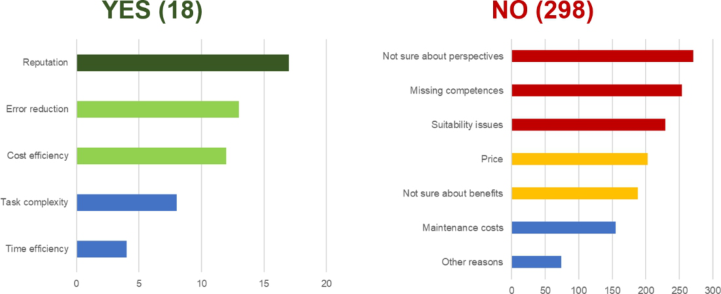
PROBLEMS AND CHALLENGES Even though mobile robots sometimes bring very clear benefits to the firms, not every small or medium enterprise is ready to purchase it due to the large variety of reasons. While some of them were discussed before, we also decided to prove their match with the reality. Figure 2 shows the results of our short survey of nearly three hundred technologically driven SMEs from Germany.
Here we asked the founders – or top-managers – whether they or their firm would be ready to purchase any form of mobile robot for their everyday needs. The results, however, demonstrate straightforwardly a scepticism of German SMEs as the overwhelming majority of companies do not consider to buy a mobile robot. Among the main reasons are uncertainty about the feasibility of such a purchase or whether it can be used for current tasks, or lack of knowledge and skills in the company to maintain the robot. Price aspect and concerns about benefits were also mentioned by more than a half of respondents. On the contrary, among the small number of firms that would be willing to buy, reputation stays above the real benefits such as error reduction or efficiency.
Truly, a cost issue is often mentioned as an important deterrent: the robot itself may not cost much, but the AI software solutions unavoidably entail additional installation costs which may pile up to $60 thousand per unit.
290 Bilous and Sarachuk
Figure 2: SMEs’ readiness to purchase a mobile robot. (N = 316. Surveyed people are founders or top-managers. Only one response per firm counts. Multiple answers allowed).
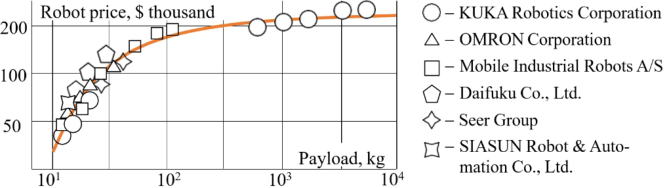
It may, however, be argued that the more tasks a robot is able to perform, the greater is the benefit to companies (as for instance in case of transport robots where the price of a robot per each kilogram of its payload capabil- ity decreases with the increasing payload, see Figure 3). However, not every small or medium company will benefit from such complex robots due to a small (market) size or narrow area of specification. At the same time, cheaper solutions – such as flying drones – are used quite successfully and extensively, but for a very limited number of tasks.
Figure 3: Payload to price ratio of some heavy mobile robots.
Aside from pure robot pricing, software and competences of employees may be pointed out as further issues. In some specific cases, the installation price may exceed the unit price tenfold. As most models on the market are not equipped with AI control systems, companies have to allocate additional programming positions primarily for MIR maintenance to which, however, they are usually unprepared. Moreover, there is a severe lack of specialists with a suitable background for introduction and maintenance of AI software. This also applies to the development of AI modules for mobile robots; even large firms experience staff shortages. Obviously, programming AI systems for MR requires a lot of engineering and digital literacy (also the program- ming of flying drones is different from MR), so that employees require a large number of training ground- type MR for practical exercises, while such practical training systems are not cheap at the moment.
SMEs Ready for AI Embedded Mobile Robots? Current Challenges and Possible Solutions 291
The latter issue is connected with the general awareness about robots and their features. It is also linked to lower digital literacy in the society (which in particular in Germany does not seem to be extremely high), but also with the fact that the general public does not know too much about the cutting-edge technologies. While this last issue may be solved without significant prob- lems in the short term by stimulating interest in mobile robots and increasing general technical literacy, other mentioned problem requires deeper solving approaches.
SUGGESTED APPROACHES FOR PROBLEM SOLVING In this part, we discuss a couple of possible solutions to problems which may have an impact on attitude of SMEs towards use of mobile robots. Both refer mainly to the pricing while this issue was mentioned by our respondents and is also the most frequently encountered in the academic literature.
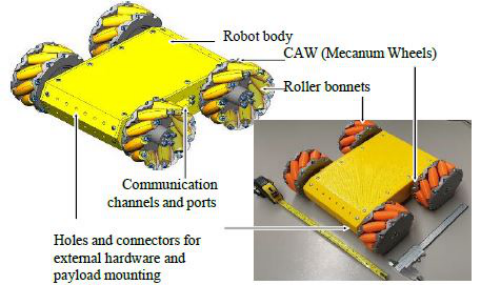
3D-Printing The high price of mobile robots for industry (applied to land-based systems) does not only arise from the relatively small series of such machines (com- pared to the automotive industry, for example). From our previous experience in mobile robot development (Bilous et al., 2014; Bilous, Andulkar, & Berger, 2018) and ongoing communication with such mobile robot developers as KUKA and OMRON, exactly the large number of non-standard components plays a major role. Given that many robot components have to be milled, turned or welded and even assembled manually, that affects the final unit price considerably. Hence, the problem may be solved either through mass production of robot series or abandoning conventional pro- duction methods. 3D printing refers to the second method and suites the low-volume produc- tion perfectly, especially for production of very complex shapes (Cotteleer & Trouton, 2018). In this way, a robot body with all internal electronics fix- tures, communication channels and motor mounting plates can be printed in single run, thus avoiding high manual assembly costs.
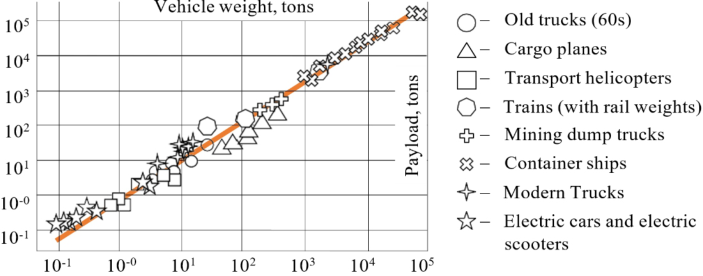
An example of such a mobile land robot is shown in Fig. 4. All its compo- nents are freely available on the market, the body and wheels are made on a 3D printer and the unit cost does not exceed $300. Some major parameters of this unit are presented in the Table 1. Payload ratio of the presented robot (the weight of the maximum payload divided by the weight of the empty vehi- cle) is about 110 % (common value is estimated between 100% and 150%, see Fig. 5 and (Melenbrink et al., 2020; Kukchin, 2019). Compliance with this requirement (applicable for newly designed mobile robots) may be a fac- tor of market success: for instance, a mobile robotic platform E375 by KUKA has a payload capability of 3 metric tons (mt) at a self-weight 2 mt, thus with a payload ratio of 150%.
Open-Source Software There are examples of free open-source software development that is capable to solve complex industrial problems in practice, mainly CAD and CAM sys- tems such as FreeCad and CURA. The latter one is particularly illustrative:
292 Bilous and Sarachuk
Figure 4: 3D Model and prototype of 3D-printed low-cost mobile robot for embedding and training of AI programming.Table 1. Technical parameters of proposed low-cost learning platform for AI programming (LoCoLeP).
Table available in the original PDF paper.
Parameter Value Parameter Value Full mass 2,7 kg Wheel numbers 4 Ground clearance 25 mm Wheel type mechanum wheel Payload capability 2,8 kg Motor type NEMA 17 stepper or 360
-servos maximum robot height 110 mm Basic controller (for tests only)
$32
Raspberry Pi 4 Model B robot track width 280 mm full printing time 72 h. (about 3 days) robot length 280 mm assembly time 4 h robot speed 4 km/h full component price $260 basic battery capacity 10 000 mA/h printing material price
Figure 5: Payload ratio for common transport vehicles (Melenbrink et al., 2020; Kukchin, 2019).
CURA is an open source 3D model slicer for 3D printers with more than mil- lion worldwide users and 1.4 million weekly print jobs (Dhore et al., 2021). It is also the preferred 3D printing software for Ultimaker 3D printers, but also compatible with other printers.
SMEs Ready for AI Embedded Mobile Robots? Current Challenges and Possible Solutions 293
These and other examples demonstrate that even complex tasks as machine tool motion-tracing or a 3D printer’s modules can be solved with the help of open-source software, so the problem of AI control software excessive costs may be solved. However, that requires the creation of open libraries and knowledge exchange among the developers of such AI systems. Consequently, SMEs still need to allocate funding to create separate workspaces or delegate development to third-party teams, albeit the authors believe that creating a broad network of AI developers for MR software will reduce the price of such products.
The problem of AI system implementation and introduction is slightly more complex. The roots, however, lie in the training and increasing of competences of specialists. Additionally, a constant exchange of experience within the innovation system and between experts may incite synergy effects when scientists, researchers and qualified professionals in firms will be able to generate innovative ideas and implement them in solutions for industrial AI control systems for mobile robots.
CONCLUDING REMARKS Mobile robots belong to a very fast-growing sector of technology. Despite the COVID-19 pandemic, the market for industrial and mobile robots demon- strated a rapid growth in the past two years, and forecasts predict the same tendency for this decade. However, while some publications appear to present their significant benefits for SMEs, very little evidence of its practical usage to this point of time has been recorded.
Due to multiple reasons, SMEs remain reluctant to adopt both conven- tional and AI-enabled MR. Several important factors as resource shortages, pricing or missing competences were recorded in scientific literature and found validation in a mini-survey we conducted among high-tech German companies. On the other hand, existing solutions are not always aimed on needs of SMEs, being sometimes too specific or complex in terms of maintenance.
While some of the listed problems – like lack of skilled employees (mainly programmers) and cooperation between firms and universities, or overall technical literacy – generally cannot be solved apart from public intervention, the pricing aspect remains the main area where significant improvements, aimed for instance at increasing attractiveness for SMEs, are still possible. Massive usage of 3D printing, as well as collaboration on open-source soft- ware, are the most likely avenues by which to lower the entry price threshold for small firms and allow them to experience the benefits of mobile robots as well.
Our paper, however, covers mainly issues relevant the ground-based sys- tems – which are at most globally spread – but does not involve flying drones or underwater vehicles. Furthermore, our suggested solutions refer to the pricing issue only, while others – sometimes more important for compa- nies – are not covered with this study. We still believe that our overview may be useful in multiple ways – for engineers and programmers working in MR design, for policy makers and, of course, for businesses planning
294 Bilous and Sarachuk
to implement MR (AIMR). Authors also expect to enrich the research base on design and manufacturing of low-cost MR with AI control systems as a learning platform for students and AI researchers that may support young scientists. We also suggest that further analysis may be carried out to develop solutions to the other problems described in this paper.
REFERENCES
Bahrin, M. A., Othman, M. F., Azli, N. H., & Talib, M. F. (2016). Industry 4.0: A review on industrial automation and robotic. Jurnal teknologi, 78. Baumgartner, M., Kopp, T., & Kinkel, S. (2022). Analysing Factory Workers’ Accep-
tance of Collaborative Robots: A Web-Based Tool for Company Representatives. Electronics, 11, 145. Bejar, E., & Morán, A. (2019). Reverse parking a car-like mobile robot with deep reinforcement learning and preview control. 2019 IEEE 9th Annual Computing and Communication Workshop and Conference (CCWC). Bera, B., Wazid, M., Das, A. K., & Rodrigues, J. J. (2021). Securing Internet of Drones
Networks Using AI-Envisioned Smart-Contract-Based Blockchain. IEEE Internet of Things Magazine, 4, 68–73. Bilous, V., Andulkar, M., & Berger, U. (2018). Design of a novel spherical robot with high dynamic range and manoeuvrability for flexible applications. ISR 2018; 50th International Symposium on Robotics, (S. 1–6). Bilous, V., Safonov, A., Schmucker, U., & Telesh, A. (2014). Design of an All-
Terrain Spherical Jumping Robot With High-Dynamic Motion. In Mobile Service Robotics (S. 495–502). World Scientific. Bolton, W. (2003). Mechatronics: electronic control systems in mechanical and electrical engineering. Pearson Education. Casini, M. (January 2022). Building digital revolution. Chang, A. (15. April 2015). Pricy robots ‘Tug’ hospital supplies. CNBC. Choi, S., Kim, D., Lee, J.-Y., Park, S. H., Seo, B.-S., Park, B.,... Cho, J.-I. (2019).
Logistics and Delivery Robots in the 4 th Industrial Revolution. Electronics and Telecommunications Trends, 34, 98–107. Cotteleer, M., & Trouton, S. (March 2018). 3D opportunity: Additive manufacturing paths to performance, innovation, and growth, Deloitte Review issue 14. Dhore, G., Jagtap, R., Bhakad, S., Yadav, P., Sutar, M. A., & Sawrate, M. S. (2021).
Exploring 3D Printing using CURA: A Slicing software. Int. J. of Adv. Sc. R. & Eng. Trends, 5, 212–222. Fabling, R., & Grimes, A. (2021). Picking up speed: Does ultrafast broadband increase firm productivity? Information Economics and Policy, 57, 1–13. Fragapane, G., Hvolby, H.-H., Sgarbossa, F., & Strandhagen, J. O. (2020).
Autonomous mobile robots in hospital logistics. IFIP International Conference on Advances in Production Management Systems, (S. 672–679). Fukui, R., Yamada, Y., Mitsudome, K., Sano, K., & Warisawa, S. (2020).
HanGrawler: Large-payload and high-speed ceiling mobile robot using crawler. IEEE Transactions on Robotics, 36, 1053–1066. Gan, C., Zhou, S., Schwartz, J., Alter, S., Bhandwaldar, A., Gutfreund, D.,... others.
(2021). The threedworld transport challenge: A visually guided task-and-motion planning benchmark for physically realistic embodied AI. unpublished. Gao, H., Zhu, J., Li, X., Kang, Y., Li, J., & Su, H. (2020). Automatic parking control of unmanned vehicle based on switching control algorithm and backstepping. IEEE/ASME Transactions on Mechatronics.
SMEs Ready for AI Embedded Mobile Robots? Current Challenges and Possible Solutions 295
Gongora, A., & Gonzalez-Jimenez, J. (2019). Olfactory telerobotics. A feasible solution for teleoperated localization of gas sources? Robotics and Autonomous Systems, 113, 1–9. GVR (2021). Autonomous Mobile Robots Market Size, Share & Trends Analysis
Report. Grand View Research. Hengstebeck, A., Weisner, K., Klöckner, M., Deuse, J., Kuhlenkötter, B., & Roßmann, J. (2016). Formal modelling of manual work processes for the application of industrial service robotics. Procedia CIRP, 41, 364–369. Hua, H.-y., & Zhang, Z. (2019). Application of artificial intelligence technol-
ogy in short-range logistics drones. 2019 8th International Symposium on Next Generation Electronics (ISNE), (S. 1–4). MRC (2022). Industrial Robotics Market Size, Share & Trends Analysis. Global Report. Jain, D., & Sharma, Y. (2017). Adoption of next generation robotics: A case study
on Amazon. Perspect. Case Res. J, 3, 9–23. Jennings, D., & Figliozzi, M. (2019). Study of sidewalk autonomous delivery robots and their potential impacts on freight efficiency and travel. Transportation Research Record, 2673, 317–326. Jung, J.-W., Park, J.-S., Kang, T.-W., Kang, J.-G., & Kang, H.-W. (2020). Mobile
robot path planning using a laser range finder for environments with transparent obstacles. Applied Sciences, 10, 1–22. Kasaei, S. H., Melsen, J., van Beers, F., Steenkist, C., & Voncina, K. (2021). The State of Lifelong Learning in Service Robots. Journal of Intelligent & Robotic Systems, 103, 1–31. Khouja, M., & Felix Offodile, O. (1994). The industrial robots selection problem:
Literature review and directions for future research. IIE transactions, 26, 50–61. Kukchin, E. (28. January 2019). The Spring Civilisation. Automation in construction. Li, J., Sun, J., Liu, L., & Xu, J. (2021). Model predictive control for the tracking of autonomous mobile robot combined with a local path planning. Measurement and Control, 1319–1325. Li, J.-t., & Liu, H.-j. (2016). Design optimization of amazon robotics. Automation,
Control and Intelligent Systems, 4, 48–52. Li, Q., Gama, F., Ribeiro, A., & Prorok, A. (2020). Graph neural networks for decentralized multi-robot path planning. 2020 IEEE/RSJ International Conference on Intelligent Robots and Systems (IROS). Melenbrink, N., Werfel, J., & Menges, A. (2020). On-site autonomous construc-
tion robots: Towards unsupervised building. Automation in construction, 119, 103312. Muntone, S. (2013). Second industrial revolution. Nelson, G., Saunders, A., & Playter, R. (2019). The petman and atlas robots at boston dynamics. Humanoid Robotics: A Reference, 169, 186. Olawale, O. P., Dimililer, K., & Al-Turjman, F. (2020). AI simulations and program-
ming environments for drones: an overview. Drones in Smart-Cities, 93–106. Park, Y. K., Lee, P., Choi, J. K., & Byun, K. S. (2016). Analysis of factors related to vertical vibration of continuous alternate wheels for omnidirectional mobile robots. Intelligent Service Robotics, 9, 207–216. Placek, M. (2021). Size of the global industrial robotics market 2018-2028. Size of
the global industrial robotics market 2018–2028. Statista & Inkwood Research. P&S Intelligence (2020). Global Autonomous Mobile Robots Market Report. Raibert, M., Blankespoor, K., Nelson, G., & Playter, R. (2008). Bigdog, the roughterrain quadruped robot. IFAC Proceedings Volumes, 41, 10822–10825.
296 Bilous and Sarachuk
Rubio, F., Valero, F., & Llopis-Albert, C. (2019). A review of mobile robots: Concepts, methods, theoretical framework, and applications. International Journal of Advanced Robotic Systems, 16, 1–22. Sarachuk, K., & Mißler-Behr, M. (2020). Is ultra-broadband enough? The relation-
ship between high-speed internet and entrepreneurship in Brandenburg. Int. J. Tech., 11, 1103–1114. Sarachuk, K., & Missler-Behr, M. (2022). Broadband development and firm creation: Dif-in-dif estimates for Germany. Shoeibi, N., & Shoeibi, N. (2019). Future of smart parking: automated valet parking
using deep Q-learning. International Symposium on Distributed Computing and Artificial Intelligence, (S. 177–182). Shu, B., & Solvang, B. (2021). Architecture for task-dependent human-robot collaboration. 2021 IEEE/SICE International Symposium on System Integration (SII), (S. 207–212). Statista (2021). Global Industrial Robotics Market Forecast 2021–2028. Sun, Y., Guan, L., Chang, Z., Li, C., & Gao, Y. (2019). Design of a low-cost indoor
navigation system for food delivery robot based on multi-sensor information fusion. Sensors, 19, 4980. Taheri, H., & Zhao, C. X. (2020). Omnidirectional mobile robots, mechanisms, and navigation approaches. Mechanism and Machine Theory, 153, 1–28. Vaher, K., Mahmood, K., Otto, T., & Riives, J. (2021). Simulation based feasibility
analysis of autonomously movable robot arm. IOP Conference Series: Materials Science and Engineering, 1140, S. 012055. VDE (2019). Tech Report 2019: Industrielle KI Die nächste Stufe der Industrialisierung? Weiner, S. (12. July 2019). Robots make the rounds. Association of American
Medical Colleges. Von https://www.aamc.org/news-insights/robots-make-rounds abgerufen Yudha, H. M., Dewi, T., Hasana, N., Risma, P., Oktarini, Y., & Kartini, S. (2019).
Performance comparison of fuzzy logic and neural network design for mobile robot navigation. 2019 International Conference on Electrical Engineering and Computer Science (ICECOS), (S. 79–84). Zhou, Z., Li, L., Fürsterling, A., Durocher, H. J., Mouridsen, J., & Zhang, X. (2022).
Learning-based object detection and localization for a mobile robot manipulator in SME production. Robotics and Computer-Integrated Manufacturing, 73, 1–12.
Read this individual research paper free through the original publisher, or explore the full digital proceedings book.
ISBN 978-1-958651-87-2
Explore this ISBN in the AHFE Bookstore ↗Listed in the July 2026 bookstore catalogue; search by ISBN to confirm current availability · Digital book purchase optional