Vadym Bilous, Kirill Sarachuk (2023). Can small and medium enterprises benefit from AR technology? Current challenges and trends. In: Human Interaction & Emerging Technologies (IHIET 2023): Artificial Intelligence & Future Applications. AHFE Open Access, vol. 111, pp. 333–348. https://doi.org/10.54941/ahfe1004040
1 Chair of Automation Technology, Brandenburg Technical University of Cottbus-Senftenberg, Siemens-Halske-Ring 14, 03046 Cottbus, Germany ↗
2 Chair of Business Administration, Planning and Innovation, Brandenburg Technical, University of Cottbus-Senftenberg, Erich-Weinert-Str. 1, 03046 Cottbus, Germany ↗
Albeit augmented reality (AR) technologies first have been discovered in the third quarter of the 20th century, their widespread use began just two decades ago. Existing paper trails show that AR has a wide range of industrial application: it simplifies human-machine communication, improves human-machine interfaces (HMI) for quick information exchange in training (including feedback to study the workflow), correction of errors, machine maintenance, assembly assistance etc. However, broader industrial acceptance of AR, prior to all by small and medium-sized enterprises (SMEs), recently faced considerable problems and the expansion of AR solutions does not match the high potential it has demonstrated. That results in a limited practical use, mainly for demonstration and advertising purposes. This short review is to present the state of the art of the industry, challenges that SMEs face in adopting AR technologies, and several practical examples of a (commercial) adoption of AR. Some prospects for further development of AR and its ongoing integration into industry are briefly discussed in the summary.
Augmented reality (AR) is a technology that allows to enhance and enrich real environment with computer-generated information and objects of different nature – whether it be auditory, visual, or any other sensory informa- tion. Systematically, AR offers real-time interactions is based on accurate registration of both virtual and physical elements. The sensory informa- tion overlay can be either constructive – adding virtual information to the physical background – or destructive when it masks certain real-world ele- ments. Using AR technology assists in highlighting the features of the real world and visualize information for audio purposes, expert, or relevant knowledge.
Previously, the successful adoption of AR was mainly the matter of har- dware1 development (which is now commercially available and affordable), nowadays software and the development of information and communication technologies2 (ICT) play a crucial role. With respect to the latter, the modern AR milieu may well boast of an established ecosystem of AR applications that developers can access (Ciupe et al., 2020; Glover and Linowes, 2019): with the introduction of ARCore and ARKit, AR becomes available on more than 700 million devices (without considering third-party apps), so end-users are also ready to benefit from it (Lizano, 2019).
Recent coronavirus pandemic has changed existing business pattern com- pletely; in new realities, firms must reconsider the tools they use, must be technologically advanced and diverse. Hence, a large influx of new custo- mers, mainly small and medium-sized enterprises (SMEs), were able to test benefits of AR. Yet SMEs hire a huge number of engineers and scientists, generate a bulk of production in high-industrialized countries and represent 90% of all business ventures (more than 50% worldwide employers), they still do not enjoy these cutting-edge technologies to a full extent, while large firms (like Rolls-Royce or BMW) are integrating AR solutions in own pro- ducts actively (Jalo, Pirkkalainen, and Torro, 2021). Therefore, in this review authors primarily address the set of challenges that SMEs face during the implementation of AR technologies and try to identify possible decisions to the stated problems. Authors will support the text with some relevant exam- ples and present further research suggestions. Thus, this review article can be useful for researchers involved in the implementation of AR for solving pro- blems in the industry. Also, the information presented by the authors can help management staff in analysing the benefits and risks of AR solutions and help economists in analysing AR trends and challenges in the digital economy.
The paper is structured as follows. State-of-the-art in AR, covering short background, market, and main issues and trends, is presented in Chapter 2. Chapter 3 deals with the AR adoption by SMEs and corresponding chal- lenges. In Chapter 4, authors provide a brief overview on some practical examples helping to overcome existing problems and Chapter 5 summarizes the review.
STATE OF THE ART Background Information
AR technologies date back to 1968 when a computer scientist Ivan Suther- land, then a professor at Harvard University, invented first head-mounted display sys- tem (Sutherland, 1968). Followed by this invention, national agencies, scientific labs, and independent companies spent next decades to develop functional AR systems to deliver immersive mixed reality experiences 1For AR purposes, hardware components compromise a computing (smartphone, mobile computer, tablet etc.) and a display device (either screen or a specialized AR device, e.g., Google Glass, Microsoft HoloLens, EyeTap, Vuzix, etc.). Wearable and mobile devices are also used in some cases (see Berger, Bilous and Andulkar, 2016 for reference). 2Existing disparities in broadband provision which were observed even for techno- logically advanced countries (see Sarachuk & Mißler-Behr, 2020; Sarachuk, Missler- Behr, & Hellebrand, 2020) for more information may hamper the successful adoption of AR technologies.
Can Small and Medium Enterprises Benefit From AR Technology? 335
to end-users, superimpose virtual data over physical environment and allow a huge variety of simulations (Williams, 2017). The first commercial appe- arance of AR experiences took place in leisure and video-gaming businesses (Solbiati, Gennaro and Muglia, 2020) and afterwards has been transferred to other spheres of life, like education (Bicen and Demir, 2020; Chidambaram et al., 2021), telecommunications (Coleta et al., 2019), healthcare (Yeung et al., 2021), tourism (Cranmer, Dieck, and Fountoulaki, 2020), training (Plunkett, 2019), product design and even industrial manufacturing (Rosales et al., 2021).
Existing literature is full of examples of benefits that the introduction of AR technologies brings with it – from global reports (Jalo, Pirkkalainen and Torro, 2021; Anshari and Almunawar, 2021; Bottani and Vignali, 2019) to more detailed reviews with the focus on particular industries, as for example non-destructible tests in manufacturing (Ababsa, 2020) or AR usage in ship- building (Fraga-Lamas et al., 2018). Research on the success factors of AR application is studied poorly so far and is mainly represented by industrial surveys (Masood and Egger, 2019).
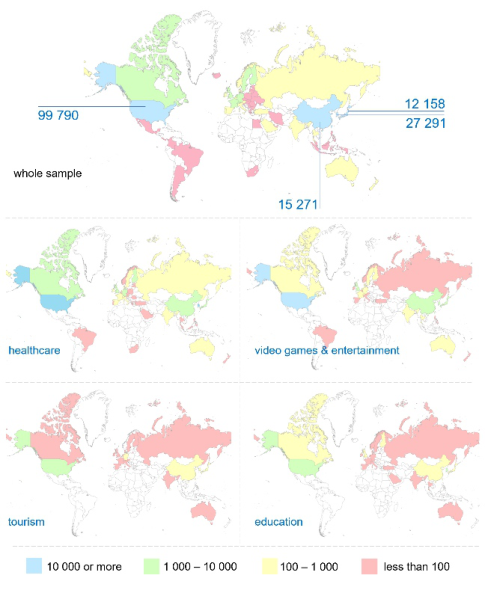
Market Recent years have seen a boom in the development of AR technology and the emergence of a significant number of patent applications in this field. Most patents are registered in four leading countries China, Japan, South Korea, and US – albeit solely US has as much individual researchers and research teams all other countries together (see Fig. 1). US is dominating almost in every market where AR technologies are used, followed by South Korea with more focus on AR solutions in healthcare, education and video gaming, Japan focusing on leisure and tourism and China with more expertise in industrial manufacturing.
The size of the AR technology market varies between $15 billion and nearly $17,7 billion as of 2020–2021 according to latest reports (Wood, 2020). Moreover, expert agree that the AR technology market will grow fur- ther: the most optimistic forecasts predict and 10-fold increase of AR/VR market by more than $160 billion in the following five years; the market’s growth momentum will accelerate at a CAGR of 46% (Technavio, 2022), while nearly third of the market growth will originate from APAC during the forecast period. Surveys also show the number of firms in the most advanced industrial countries which are thinking about adoption of AR technologies steadily grows. For example, in Germany three out of four companies either use virtual or augmented reality or are planning to do so in the future, and 77% of the companies stated that VR/AR projects bring the hoped-for success (PTC, 2022).
Technical Issues and Trends AR Hardware. Hardware AR solutions can be categorized according to the im- age transmission method (type of display) and its mobility (or usage). AR devices can be quite clearly divided into mobile devices (these are usually tablets) and wearable devices (AR/VR glasses and smartphones paired with special Card- Boards or HeadSets, see Parekh et al., 2020; Ababsa, 2020).
336 Bilous and Sarachuk
Figure 1: Patent applicants (team and individuals) worldwide, 2011-2022. Countries with less than 10 applicants excluded. Source: Espacenet.
Image transmission covers two different methods, optical see-through display (OSTD) and a video see-through display (VSTD, see Pfeil et al., 2021; Kiyokawa, Kurata and Ohno, 2000). The OSTD method uses a transparent monitor that overlays AR objects over the field of view (so the user literally looks through the AR hardware device). VSTD technology works in a diffe- rent way: first, the outer environment is captured through a camera, then the augmented with AR objects image is processed, and finally displayed to the user on a conventional monitor.
While OSTD hardware is more convenient, it is usually much more expen- sive and requires special technology (so-called smart glasses). Starting with Google Glass, many other models flooded the market, which, however, had practically no effect on the price exceeding $1000 per unit and even $3000 for top models (e.g., Microsoft Holo Lens). However, the ease of use, the ability to create AR applications with the most common development tools and the computational parameters created a market niche even to expensive devices (Wei et al., 2018; Huang, Shakya and Zhu, 2019; Park, Bokijonov and Choi, 2021). Aside from glasses, OSTD format comes in form of smart helmets (or smart helms, SH). SH stand out from the rest thanks to greater proces- sing power and higher battery capacity but are less popular as overload the cervical spine.
Can Small and Medium Enterprises Benefit From AR Technology? 337
Another OSTD form is contact lenses which are extremely convenient due to their compact size but, on the other hand, require complex microelectro- nics technology and have several production problems such as power supply or temperature dissipation. Still, AR lenses has been extensively researched by the scientific community (Chen et al., 2019; Xiong et al., 2020; Kumar et al., 2020) but they are far away from the market (Bizwit Research, 2021).
VSTD technologies are much easier as they do not require specific har- dware and may be used with ordinary tablets and smartphones. Moreover, VSTD tech- nologies are versatile: while OSTDs are suitable for AR only, VSTD can also be used for VR or for demonstration, communication, and other tasks. The integration of VSTD is good traceable in the existing studies (Halim, 2018; Ababsa, 2020; Fraga-Lamas et al., 2018); also, authors used mobile gadgets in all their projects (Berger, Bilous, & Andulkar, 2016; Bilous et al., 2022).
Thus, we suggest that VSTD technologies play a major role for the further successful adoption of AR technologies in the industry in general and in the SME area. The steady trend of ever-increasing computing power of smartph- ones and tablets suggests that there will be no significant hardware problems of AR adoption. Development Tools. The technological background of AR may be represented as a combination of hard- and software solutions. However, this simple divi- sion does not give a clear overview of those technical aspects of AR systems which lie at the intersection (e.g. tracking systems).
A development environment should be considered an important, even if not the main, part of AR software3. However, more complex development environments are getting more practical attention. For instance, industrial AR applications mainly rely on game engines (GE)4 mainly thanks to their versatility and flexibility (because of these reasons GE are so popular in digi- tal entertainment) and the large community of developers. This makes GE so popular for AR in the digital entertainment sector. Not only leisure indu- stry but also design and data transfer are greatly simplified with GE as the result of interaction between AR application and the elements of the tech- nical environments (plants, laboratory units etc.). In general, this lowers the entry threshold into the development process for those team members who have not previously participated in AR.
The usage of GE for the AR developing requires usually an additio- nal augmented reality software development kit (AR SDK, see Amin and Govilkar, 2015; Vakaliuk and Pochtoviuk, 2021). For example, it is a Vuforia AR SDK for Unity3D. The process of developing an AR application itself
3A large share of AR applications is designed for Android devices which allows to use both common developer tools such as Microsoft Visual Studio (Amin & Govilkar, 2015) and a regular set of programming languages as Java, C/C++, Python, C\# etc. (Furht, 2011; Clark and Dünser, 2012; Glover and Linowes, 2019). 4Two most prominent and widely applied engines are Unity3D and Unreal Engine. For Unity3D, Glover and Linowes (2019) gathered all major aspects of AR application development in the Unity3D including the AR element optimisation, optimal script programming, speculative resolution, and avoidance of AR hardware operating system features. A similar summary for Unreal Engine was made by Mack and Ruud (2019), but rather with a shift to the VR applications.
338 Bilous and Sarachuk
usually begins with creating a variety of 2D and 3D AR elements (arrows, pointers, information panels, etc.), textures and colours for these elements and even the simplest animations. This can be done either in GE itself or in third-party programs and then imported into the main development environ- ment (e.g., Unity3D support even the import of animated 3D objects). Then, the development of the so-called operating logic (OL) is required, which means that the predetermined information and associated objects are demon- strated in the AR user application depending for example on the current plant state with one-to-one mapping between them (Glover and Linowes, 2019; Bilous, Kudelina and Staedter, 2022).
Based on our own experience in AR projects and other studies (Rosales et al., 2021; Anshari and Almunawar, 2021; Chidambaram et al., 2021; Um, Popper and Ruskowski, 2018), authors consider following logical requirements as important while choosing an AR application development environment for SMEs:
low entry threshold due to simple interface and use of common program- ming languages,
large community of users and developers,
variability of tasks to be able solved,
ability to import different elements of the application (both scripts and 2D/3D objects) from other programs and development environments, and
ability to transfer data between the final product (AP application) and ele- ments of the machine environment (usually PLC).
AR ADOPTION BY SMEs. PROBLEMS AND CHALLENGES Despite a wide range of obvious benefits, the integration speed of AR tech- nologies in industrial processes of SMEs remains very moderate. Yet the industrial implementation of new technologies requires more than just a tech- nical assessment (for instance, economic efficiency), in case of AR/VR the major problem is the readiness to use which remains insufficient. One of the up- to-date surveys by Jalo, Pirkkalainen and Torro (2021) including 46 inte- rviews and additional data from more than 250 respondents in nine European countries showed that most of the companies in the sample (nearly 60%) were using neither AR nor VR, while only 15% of surveyed firms claimed they us both technologies quite often. Furthermore, while nearly two-thirds of all respondents responded they can imagine their company to use AR or VR in the future, and even are familiarized with the potential benefits, they did not undertake any actions for their adoption so far. This and further study by Anshari and Almunawar (2021) call into question the theoretical possibility of broader industrial implementation of AR and VR, but notwithstanding confirm the importance of both technologies and their relevance for modern industry.
However, the mentioned outcome seems to be rather stunning because cutting-edge AR technologies already present in everyday life for quite a long time. A market analysis based on Gartner Hype Cycle (GHC, see Steinert and Leifer, 2010) prove that AR reached a state of maturity much earlier
Can Small and Medium Enterprises Benefit From AR Technology? 339
than experts expected; actually, by the end of 2018 it was not considered an emerging technology anymore, but rather a mature one (Gartner Inc, 2017; Bitforge, 2019; Herdina, 2020), commercially usable and applicable for investments5.
Tasks and Benefits Most common fields of AR application include aviation industry (17% off all application), plant and (21%) mechanical (29%) maintenance, diagno- stics, and training (Palmarini et al., 2018). Among all the industries where AR found their direct application, aerospace sector (including civil and mili- tary aviation) remains one of the most promising areas due to the variety of highly complex components (del Amo et al., 2020; Müser and Fehling, 2022). Existing training methods fail to fit the requirements of the indu- stry: for example, an aircraft maintenance worker requires a lot of hours of education and still may be confused by comprehensive manuals. Cost benefits. The main benefit of AR adoption (or similar technology) for the firm is the cost reduction, as expenditures on education and training, deployment and technical support, training and other business-related routi- nes are shrinking significantly. With respect to the latter case, AR integrated systems may acquire some functional and managerial tasks without any addi- tional costs to the firm (Anshari and Almunawar, 2021; Bottani and Vignali, 2019): according to some studies, over a third of companies using AR/VR solutions have opted for remote assistance applications (PTC, 2022). User-friendly environment. Another important but not production-related benefit of AR lies in marketing, advertisement, and finally customer commu- nication, thus increasing the overall consumer satisfaction, broadening the sales network, and reducing the competitive pressure (Chaffey, 2016). This notion must be of particular interest for SMEs that normally are not able to compete on equal footing with large companies, but thanks to the wide adoption of virtual features and their interactive component, they still may seduce the consumer emotionally and promote own products or service effici- ently (Jalo et al., 2021; Bottani and Vignali, 2019; Masood and Egger, 2019). Moreover, AR can be used to communicate important information directly to the user, considering any action taking place in his immediate environ- ment. As a result, that reduces the efforts of maintenance staff (e.g. referring to manuals for the relevant information), thus reducing the service time and diminishing the number of human-injected errors, but also the pressure on employees (Bilous et al., 2022; Fraga-Lamas et al., 2018). Advanced possibilities while maintenance and assembly. One more benefit addresses increasingly complex installation and maintenance operations in all kinds of enterprises - the real-time collaboration between experts and field engineers through mobile collaborative AR systems. It suggests the even
5According to this evaluation method, there are five key phases (Chaffey, 2016) of a technology’s life cycle, which represent the complex state of the technology and the attitudes of developers, investors, and the public towards it. The GHC methodology provides a graphic representation of the maturity but also problem solving and new opportunities exploiting applications.
340 Bilous and Sarachuk
those employees with no or little experience are still able to support the custo- mers - of course when such inexperienced staff is supported by skilled remote specialists. In other words, AR allows the remote expert to superimpose addi- tional information (markers, markings, diagrams etc.) directly in front of the field engineer (for example, with the help of smart glasses) that keeps his hands free to simultaneously perform fixes. The same scheme may be used for training purposes without on-site presence of supervisor. If we consider that SMEs generally experience lack of resources - in many cases workfo- rce and competences, - such mobile collaborative AR concept may become a fruitful opportunity for them. Additionally, SMEs may use AR to provide own services globally, with a consistent quality.
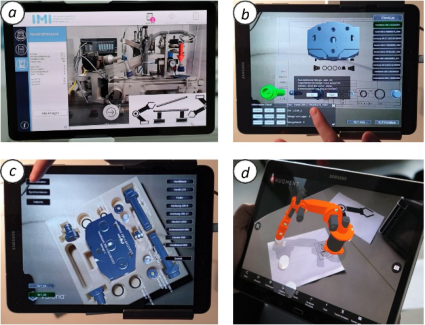
Fig. 2 shows four examples of small projects that illustrate the above- mentioned benefits. All these applications were developed as a part of AR research at the Chair of Automation Technology in the Brandenburg University of Technology Cottbus-Senftenberg (BTU).
Figure 2: AR examples of BTU projects: (a) staff training AR application for the transport plant, (b) AR assembly guideline for the hydraulic value, (c) AR interactive application to check the component availability and (d) AR application for the robot demo.
Challenges in Implementation and Adaptation A general problem that is generated by the application of AR technologies is their complexity. That covers much more than just hard- and software solutions, as various industrial, scientific, and social aspects must be consi- dered upon and within development and integration processes (Glover and Linowes, 2019; Jalo et al., 2021). Contrast to that, usually under AR a vir- tual information overlay over the reality is understood, while the knowledge background stays apart. While that holds true for demonstration and simple training purposes, beyond these fields AR is tightly connected with following challenges.
Furthermore, an innovative organizational milieu is the prerequisite to the successful adaptation of AR solutions in industrial processes. Generally, that means that managers must be familiarized with AR at least at the basic level
Can Small and Medium Enterprises Benefit From AR Technology? 341
so they would be able to understand the workflow and provide employees with enough time to explore those technical novelties and determine in which way they could be used to bring the most benefit to the business. In addition, a direct integration of AR applications into the industrial environment suggests the workforce flexibility, but also their desire to modify working experience on a continuous basis. Such a continuous improvement, for instance, may be reached via cooperation with industry associations, research institutions and universities, or vendor demonstrations (Jalo et al., 2021; Bottani and Vignali, 2019). Finally, there are no general models (or even a model for local area, like for example industrial plant maintenance) to identify the feasibility of solving a particular task using the AR in general or the prediction of AR implementa- tion results. The development of such models needs a comprehensive analysis of all parameters influencing the development and implementation of AR technologies (AR inputs). The Comprehensive analysis and review of all ach- ievable results and benefits by the solving of task with AR compared to other conventional solutions (AR outputs) is also required.
A separate cohort of issues relate to technical side; prior to all, a data tran- sfer problem between industrial environment (for instance, programmable logic controllers) and AR hardware remains to be acute. Moreover, it beco- mes more relevant with the growing scale of solution (Fraga-Lamas et al., 2018), i.e., covering several units instead of one. Still, while these problems are investigated within research teams, it entails several disadvantages (such as method simplicity which may be compensated by lower data transmission rates, which yet not always possible).
One further problem, a so-called problem of user activity indication, is connected to the two-way communication between personal and industrial environment which finally requires the ability to identify each user intera- ction with the industrial plant. That results in an increasing required number of additional sensors as follows from our previous experience (Bilous et al., 2022). Additionally, new plants in the automation industry are different in the terms of development, maintenance, and operation processes. A search for an appropriate solution for a novel unit may thus be a task from the scra- tch; however, not too many researchers try to describe this problem in more details. A modular approach, however, may be helpful here (Um et al., 2018); BTU is also underway in developing its own modular solution within MoDeARA project, or Modular-Designed AR Application.
PRACTICAL EXAMPLES For a better comprehension of the current state of the art in the application and implementation of AR applications, authors would like to present some examples of practical use of AR technologies in industry with a more detailed description. Part of the projects shown in this section have been developed at the Chair of Automation Technology of the BTU. Assembly, Maintenance & Repair. Starting with assembly, AR technologies mainly reduce human errors by generally do not reduce the completion times.
342 Bilous and Sarachuk
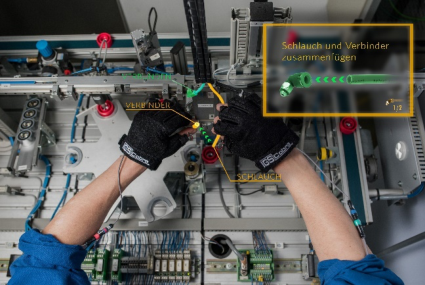
For instance, Uva et al. (2018) describe a project on motorbike engine and evaluate the effectiveness in conveying technical instructions with AR; the result clearly shows the increasing performance of an operator and a better user acceptance. In maintenance, AR can improve safety and reduce errors caused by employees and operators and reduce extra heat on engineering staff. An example of such AR assistant is shown on the Fig. 3.
Figure 3: Example of using the AR assistant for assembly of the plants’ components.
With respect to the repair process, we may point out the project to find an assistance solution for maintenance staff working on railway carriages called Re- pAIreality. RepAIreality is a subproject of WIR – Wandel durch Innovation in der Region (eng. Change through innovation in the region) which is initiated by the Federal Ministry of Education and Research in Ger- many aimed at facilitating sustainable business partnerships and alliances to strengthen regions that currently do not have an advanced industry (Bun- desministerium für Bildung und Forschung, 2021). As a part of solution, the required information (for example, arrows that navigate the assemble process or the location of tools required for the current step) is projected in front of the worker through smart glasses or a tablet de- vice. In such a case, inexperi- enced employees would be capable to perform the tasks that they are not yet familiar with (Koteleva, Zhukovskiy and Valnev, 2021). Albeit the presented solution is primarily intended to work in a technological environment related to railways, similar solutions with minor adjustments may be developed for other kinds of maintenance so other SMEs could benefit from that.
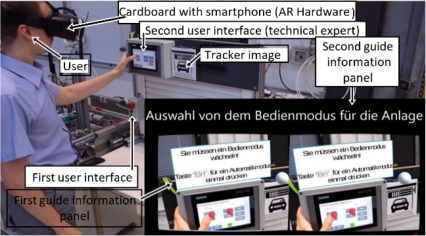
It should be noted that the usage of AR as an assistant system for the assembly, repair and maintenance tasks is currently implemented in mostly large companies. For example, DIOTA has developed such a system for Rolls-Royce (Ababsa, 2020), which uses an AR application to assist the maintenance of jet engines. Human-Machine Interaction and Error Correction. Chair of Automation of BTU Cottbus-Senftenberg developed an example of laboratory facility to illu- strate how AR in machinery may be helpful to debug and correct errors caused by non-experts (see Fig. 4). The development team faced the problem of communication between the PLC and the AR application (this project was mentioned in Chapter III). As the results, a simple and scalable data transfer
Can Small and Medium Enterprises Benefit From AR Technology? 343
method was created; the suggested prototype demonstrated an AR applica- tion for troubleshooting and error correction in real-time, even on mobile or wearable devices, while working in a laboratory unit to simulate and solve various errors. The information about the state of the system was availa- ble in real-time. The system was in- tended to be used for training purposes to achieve more efficient error correction and faster repair rates. In a field test on more than one hundred users for the pilot and thirty users for beta version, the result showed that all testers were fulfilling the laboratory unit requirements for the first time in an error situation while guided by the AR application.
Figure 4: Laboratory unit (small doors) and all AR elements from the project (Bilous et al., 2022).
The outcome clearly demonstrated that even complex applications requi- ring data transfer can be developed by SMEs without additional financial or time investments. A crucial point in this case is the choice of the application architecture and the selection of the right parameters for optimization. Thus, interactive AR guide applications (Bilous et al., 2022; Berger et al., 2016) may reduce the complexity of unit maintenance within SMEs and diminish the burden placed on the most qualified specialists. User Manuals. In 2015, Hyundai introduced AR user manuals for the first time in car industry (Halim, 2018; Gattullo et al., 2017). Consumers recei- ved repair and maintenance instructions directly on their smartphones or tablets: Hyundai Virtual Guide with 2D/3D tracking technologies provided a detailed information about different car parts (eg. engine compartment). The app included guidance videos, 3D overlay images that users were demon- strated when they scanned different areas of the vehicle, and a considerable number of information guides. Later, Hyundai expanded its AR operation manual program. A successful example of Hyundai shows that even inex- perienced individuals may perform complex tasks without any professional assistance when they receive step-by-step instructions as AR overlays. This outcome is of a particular interest to SMEs as that may reduce the overload of customer support in some cases. On the other hand, such solution may incre- ase the customer satisfaction thanks to reduced downtime and may seduce customers for further purchases, thus creating a customer loyalty. These bene- fit factors are especially important for SMEs in an increasingly competitive environment.
344 Bilous and Sarachuk
Marketing and Advertisement. One more advantage to SMEs delivered by AR technologies is their ability to create a unique customer experience and strengthen the brand. For instance, via AR retailers give their customers the opportunity to try out the product before making a purchase (like jewellery or cosmetics); in architecture, people can visit the virtual models of the buildings during the project development phase and offer the minor adjustments with- out extra time consumption. Smartphones and tablets in this context serve as the AR platforms for shopping environment for customers, thus creating a paradigm shift from traditional stores or e-commerce strategies.
For instance, the US company Theia Interactive recently introduced its AR app (Bosset, 2018) that provides a virtual shopping experience so customers may create their own bike design and try different shapes, seats, and further equipment. Their mobile solution fully supports hard- and further relevant software (e.g. order placement tailored to the customer preferences in a user- friendly interface. Generally, such customer-oriented AR applications could be developed much easily as they do not require active data exchange with laboratory units or industrial premises; as the result, the ease of application development coupled with end-user visibility can significantly increase brand awareness, and therefore may be of interest to SMEs.
SUMMARY In this short review, authors tried to present the actual state of technology in AR relevant to the small and medium-sized enterprises. Our modest overview covers both problems and challenges of AR technologies as well existing areas of application and successful practical examples. We suggest following upcoming development in AR solutions may be relevant to SMEs. Hardware. The solutions available on the market are already adequate to launch rather large (in terms of hardware requirements) AR applications. If the demand for the AR does not decrease, it is logical to expect a gradual reduction in the price of technical support devices, especially with the release of their new generations. At the same time, a radical change in the design of AR hardware, for example, wearable AR contact lenses, might not be the primary idea to expect in the next ten to fifteen years. Software. The further development of modular solutions may be applicable in this field, both regarding commercial and freeware areas. New offers on the commercial AR software market will increasingly reduce the programming knowledge requirements of the application developers. Gradually, more and more AR software vendors will strive to make building applications with their products interactive and accessible. It is possible that semi-automated and automated AR application generation projects will be started, but the authors of this article, based on their experience and analysis of current projects, anticipate that such projects will be purely scientific for a relatively long time. Implementation and modifications of the AR applications. If the interest in AR for SMEs remains sufficiently high for a prolonged period, the com- munity of both AR application developers and firms creating environments for their development / template packages for these environments will possi- bly expand. Nowadays, this has been already observed in physical engines.
Can Small and Medium Enterprises Benefit From AR Technology? 345
For example, focusing on the Unity3D engine, there is a huge community of programmers who develop new products and create databases with fini- shed projects or blocks of those projects. In this way, one can hope to create a similar database for new AR applications with the necessary AR element templates, program scripts, etc. Further progress in this direction may allow to build new AR applications literally in hours. The problem of the planning system for development and implementation of AR solutions. Currently there are no studies that first forecast (for example, using a particular methodology or model) the degree of the AR usage bene- fit for a defined task, and then verify the correctness of this prediction. For example, no scientific study aims at achieving a defined and predetermined value of a required efficiency indicator (e.g., already mentioned reduction of assembly or maintenance time) by the AR usage in the project scopes follo- wed by the analysis of the resources required for that. For wide introduction of AR not only in large firms, but also in SMEs, planning systems and models are needed that consider the resources invested (time and money), the quali- fications of developers and managers, the type and kind of tasks to be solved and many other factors, which build the complete collection of aspects that can influence the development and subsequent usage of AR technology.
REFERENCES
Ababsa, F. (2020). Augmented reality application in manufacturing industry: Maintenance and non-destructive testing (NDT) use cases. International Conference on Augmented Reality, Virtual Reality and Computer Graphics, (pp. 333–344). Amin, D., & Govilkar, S. (2015). Comparative study of augmented reality SDKs.
International Journal on Computational Science & Applications, 5, 11–26. Anshari, M., & Almunawar, M. (2021, January 01). Adopting open innovation for SMEs and industrial revolution 4.0. Journal of Science and Technology Policy Management. Berger, U., Bilous, V., & Andulkar, M. (2016). Anwendung von der Augmented
Reality für die Mensch-Roboter Interaktion bei der Fehlerbeseitigung und bei der Maschinenbedienung. 3D SENSATION-transdisziplinäre Perspektiven. Bicen, H., & Demir, B. (2020, April). A Content Analysis on Articles Using Augmented Reality Technology and Infographic in Education. Postmodern Openings, 11, 33–44. Bilous, V., Kudelina, L., & Staedter, P. (2022, April). Modular-Designed AR Applica-
tion for Improved Human-Machine Interaction and Real-Time Error Correction in Laboratory Units. unpublished, Singapore. Bilous, V., Städter, J. P., Gebauer, M., & Berger, U. (2022). Usage of Augmented Reality for Improved Human-Machine Interaction and Real-Time Error Correction of Laboratory Units. Cham: Springer International Publishing. Bitforge. (2019, November 10). Augmented Reality offiziell kein Hype mehr. Bizwit Research (2021). Augmented Reality Market Size, Share & Trends Analy-
sis Report By Component, By Display (HMD & Smart Glass, HUD, Handheld Devices), By Application, By Region, And Segment Forecasts, 2021–2028. Bosset, P. (2018, March 22). Check out a Full-Scale Motorcycle in AR with Theia Interactive. Check out a Full-Scale Motorcycle in AR with Theia Interactive.
346 Bilous and Sarachuk
Bottani, E., & Vignali, G. (2019, March). Augmented reality technology in the manufacturing industry: A review of the last decade. IIE Transactions, 51, 284–310. Bundesministerium für Bildung und Forschung. (2021, December 01). WIR! –
Wandel durch Innovation in der Region - BMBF Innovation & Strukturwan- del. WIR! – Wandel durch Innovation in der Region - BMBF Innovation & Strukturwandel. Chaffey, D. (2016). Digital Marketing, 6th Edition. Pearson. Chen, J., Mi, L., Chen, C. P., Liu, H., Jiang, J., & Zhang, W. (2019). Design of foveated contact lens display for augmented reality. Optics express, 27, 38204–38219. Chidambaram, S., Huang, H., He, F., et al. (2021, June). ProcessAR: An Augmen-
ted Reality-Based Tool to Create In-Situ Procedural 2D/3D AR Instructions. Proceedings of the Designing Interactive Systems Conference, (pp. 234–249). Ciupe, A., et al. (2020). Oxford University Press, Oxford Advanced Learner’s Dictionary 10th edition. Lingua. Language and Culture. Clark, A., & Dünser, A. (2012). An interactive augmented reality coloring book.
2012 IEEE symposium on 3D user interfaces (3DUI), (pp. 7–10). Coleta, G. F., Cardoso, A., Júnior, E. A., & de Lima, G. F. (2019). Telecommunications Field Operations Supported by Augmented Reality–a Systematic Review. 2019 21st Symposium on Virtual and Augmented Reality (SVR), (pp. 77–83). Cranmer, E., Tom Dieck, M. C., & Fountoulaki, P. (2020, July). Exploring the value
of augmented reality for tourism. Tourism Management Perspectives, 35, 100672. del Amo, I. F., Erkoyuncu, J., Frayssinet, R., Reynel, C. V., Roy, R., et al. (2020). Structured authoring for AR-based communication to enhance efficiency in remote diagnosis for complex equipment. Advanced Engineering Informatics, 45, 1–17. Fraga-Lamas, P., Fernández-Caramés, T., Blanco-Novoa, Ó., & Vilar-Montesinos,
M. (2018, February). A Review on Industrial Augmented Reality Systems for the Industry 4.0 Shipyard. IEEE Access, 6, 13358–13375. Furht, B. (2011). Handbook of augmented reality. Springer Science & Business Media. Gartner Inc. (2017, August 15). Top Trends in the Gartner Hype Cycle for Emerging
Technologies, 2017. Gattullo, M., Uva, A., Fiorentino, M., et al. (2017). From Paper Manual to AR Manual: Do We Still Need Text? Procedia Manufacturing, 11, 1303–1310. Glover, J., & Linowes, J. (2019). Complete Virtual Reality and Augmented Rea-
lity Development with Unity: Leverage the power of Unity and become a pro at creating mixed reality applications. Packt Publishing. Héder, M. (2017, August). From NASA to EU: the evolution of the TRL scale in Public Sector Innovation. Innovation Journal, 22, 1. Halim, A. Z. (2018, February). Applications of Augmented Reality For Inspection
and Maintenance Process in Automotive Industry. Herdina, M. (2020, September 25). Augmented Reality Disappeared From Gartner’s Hype Cycle – What’s Next? Augmented Reality Disappeared From Gartner’s Hype Cycle – What’s Next? Huang, Y., Shakya, S., & Zhu, L. (2019). Capabilities of mixed reality applica-
tions for architecture and construction: A comparative review with HoloLens. Computing in Civil Engineering 2019: Visualization, Information Modeling, and Simulation, 162–168. Jalo, H., Pirkkalainen, H., & Torro, O. (2021, January 6). The State of Augmented Reality, Mixed Reality and Virtual Reality adoption and use in European small and medium-sized manufacturing companies in 2020.
Can Small and Medium Enterprises Benefit From AR Technology? 347
Kiyokawa, K., Kurata, Y., & Ohno, H. (2000). An optical see-through display for mutual occlusion of real and virtual environments. Proceedings IEEE and ACM International Symposium on Augmented Reality (ISAR 2000), (pp. 60–67). Koteleva, N., Zhukovskiy, Y. L., & Valnev, V. (2021, February). Augmented reality
technology as a tool to improve the efficiency of maintenance and analytics of the operation of electromechanical equipment. Journal of Physics: Conference Series, 1753, 012058. Kumar, M. B., Kang, D., Jung, J., Park, H., Hahn, J., Choi, M.,... Park, J. (2020).
Compact vari-focal augmented reality display based on ultrathin, polarization- insensitive, and adaptive liquid crystal lens. Optics and Lasers in Engineering, 128, 106006. Lizano, A. (2019, September). Augmented Reality Strategy: Why Brands Need to Embrace It. Augmented Reality Strategy: Why Brands Need to Embrace It. Müser, S., & Fehling, C. D. (2022). AR/VR. NRW–Augmented und Virtual Reality
in der Hochschullehre. HMD Praxis der Wirtschaftsinformatik, 59, 122–141. Mack, K., & Ruud, R. (2019). Unreal Engine 4 Virtual Reality Projects: Build Immersive, Real-world VR Applications Using UE4, C++, and Unreal Blueprints. Packt Publishing Ltd. Masood, T., & Egger, J. (2019, August). Augmented reality in support of Industry
4.0—Implementation challenges and success factors. Robotics and Computer- Integrated Manufacturing, 58, 181–195. Palmarini, R., Erkoyuncu, J. A., Roy, R., & Torabmostaedi, H. (2018). A systematic review of augmented reality applications in maintenance. Robotics and Computer- Integrated Manufacturing, 49, 215–228. Parekh, P., Patel, S., Patel, N., & Shah, M. (2020). Systematic review and meta-
analysis of augmented reality in medicine, retail, and games. Visual computing for industry, biomedicine, and art, 3, 1–20. Park, S., Bokijonov, S., & Choi, Y. (2021). Review of microsoft hololens applications over the past five years. Applied Sciences, 11, 7259. Pfeil, K., Masnadi, S., Belga, J., Sera-Josef, J.-V. T., & LaViola, J. (2021). Distance
perception with a video see-through head-mounted display. Proceedings of the 2021 CHI Conference on Human Factors in Computing Systems, (pp. 1–9). Plunkett, K. N. (2019). A simple and practical method for incorporating augmented reality into the classroom and laboratory. PTC (2022). Marktstudie zu Augmented und Virtual Reality Einblicke in die
Marktreife immersiver Technologien. Rosales, J., et al. (2021). IIoT based Augmented Reality for Factory Data Collection and Visualization. Procedia Manufacturing, 53, 618–627. Sarachuk, K., & Mißler-Behr, M. (2020). Is ultra-broadband enough? The relati-
onship between high-speed internet and entrepreneurship in Brandenburg. Int. J. Tech., 11, 1103–1114. Sarachuk, K., Missler-Behr, M., & Hellebrand, A. (2020). Ultra-High-Speed Broadband Internet and Firm Creation in Germany. International Scientific Conference on Innovations in Digital Economy, (pp. 40–56). Solbiati, L., Gennaro, N., & Muglia, R. (2020). Augmented reality: From video
games to medical clinical practice. Augmented reality: From video games to medical clinical practice, 43, 1427–1429. Springer. Steinert, M., & Leifer, L. (2010, August). Scrutinizing Gartner’s hype cycle approach., (pp.1–13). Sutherland, I. E. (1968, December). A head-mounted three dimensional display.
AFIPS ‘68 fall joint computer conference, 58, 757–764. Technavio (2022, October). Augmented Reality and Virtual Reality Market by Technology, Application, and Geography - Forecast and Analysis 2023–2027.
348 Bilous and Sarachuk
Um, J., Popper, J., & Ruskowski, M. (2018, May). Modular augmented reality platform for smart operator in production environment., (pp. 720–725). Uva, A., Gattullo, M., Manghisi, V., et al. (2018, January). Evaluating the effe-
ctiveness of spatial augmented reality in smart manufacturing: a solution for manual working stations. The International Journal of Advanced Manufacturing Technology, 94. Vakaliuk, T., & Pochtoviuk, S. (2021). Analysis of tools for the development of augmented reality technologies. Wei, N. J., Dougherty, B., Myers, A., & Badawy, S. M. (2018). Using Google Glass
in surgical settings: systematic review. JMIR mHealth and uHealth, 6, e9409. Williams, D. (2017, December 6). The History of Augmented Reality. The History of Augmented Reality. Wood, L. (ed.) (2020, November). Augmented Reality and Virtual Reality Market
with COVID-19 Impact Analysis by Offering (Hardware & Software), Device Type (HMD, HUD, Gesture Tracking), Application (Enterprise, Consumer, Com- mercial, Healthcare), and Geography - Global Forecast to 2025. Xiong, J., Tan, G., Zhan, T., & Wu, S.-T. (2020). Wide-view augmented reality display with diffractive cholesteric liquid crystal lens array. Journal of the Society for Information Display, 28, 450–456. Yeung, A. W., et al. (2021, February). Virtual and Augmented Reality Applicati-
ons in Medicine: Analysis of the Scientific Literature. Journal of Medical Int. Research, 23.
Read this individual research paper free through the original publisher, or explore the full digital proceedings book.
ISBN 978-1-958651-87-2
Explore this ISBN in the AHFE Bookstore ↗Listed in the July 2026 bookstore catalogue; search by ISBN to confirm current availability · Digital book purchase optional