Thobani Mhlongo, Lizette De Wet, Silas Verkijika (2023). Determining the user experience and continuance use of a mobile application and an online portal. In: Human Interaction & Emerging Technologies (IHIET 2023): Artificial Intelligence & Future Applications. AHFE Open Access, vol. 111, pp. 419–429. https://doi.org/10.54941/ahfe1004048
The increasing number of users with access to the internet, computers, and mobile devices propels most institutions to avail their services through online portals and mobile applications. However, there are instances where users underutilise or completely opt out of these platforms. This is a cause for concern since funds are invested in their development, with the anticipated return on investment. Against this backdrop, this study aimed to compare the user experience and continuance use of a mobile application and online portal for an organization in South Africa. This single case study followed an explanatory sequential design, where the initial phase consisted of data collection using a self-administered questionnaire. For the second phase, the data was collected using an interview protocol. The results established that the study participants had a positive experience with the online portal but not so much with the mobile application. The contributing factors to the online portal's positive user experience were its efficiency, attractiveness, perspicuity, dependability, novelty, and stimulation. The interview results corroborated the quantitative results, as participants indicated overall positive experiences with the online portal. In contrast, participants had negative experiences with the mobile application, citing its limited features and lack of user-friendliness, understandability, and learnability. Regarding continuance use, the quantitative and qualitative results suggested that participants were keen to use the online portal in the future. However, the quantitative results for the mobile application indicated no participant interest in using the mobile application again in future, despite the interview results indicating otherwise. Participants identified improvement in efficiency and visual appeal as conditions for their future re-use of the mobile application.
Designing and developing user-friendly products is critical for the overall adoption and continuous use of the product. The usability and overall user experience (or UX as it is generally referred to) of a product are the cornersto- nes that determine whether the product will be used as intended or whether
the users will consider the product as part of their daily lives (i.e., continu- ance use). The juncture between the user and the product lies in the user interface of the product (Reynoso and Romo, 2020). User interaction with these products is generally via a well-defined user interface. The interaction may evoke a positive or negative experience, perception, or attitude towards the product. According to Knijnenburg et al. (2012), the extent to which the user has a positive experience with the product depends on the user’s need for self-reliance, the capability to perform tasks at hand, and stimulation invoked when one uses the product. These needs are more important for self-service oriented products due to the limited availability of user support.
The preceding discussion highlighted two concepts: user experience, and continuance use. There is a gap in the body of knowledge regarding studies that compare the different service platforms for similarities and differences, if any, in terms of UX and continuance use. This study intended to fill this gap with specific reference to a mobile and an online portal of a South African institution. The primary research questions for this study were: (1) How does the user experience of a mobile application and its associated online portal compare in terms of user satisfaction? (2) How does the continuance use of a mobile application and its associated online portal compare in terms of continuance intentions?
CONCEPTUALISING USER EXPERIENCE The conceptualisation of UX is premised on the users’ perceptions of the product. The definition of UX is often tied to the adopted model. The UX White Paper (Roto et al., 2011) defines UX as “the outcomes and memories” the user has upon interacting with the product. The paper differentiates UX based on the time span the user interacts with the system, which can be a specific change of feeling during interaction (momentary UX), appraisal of a specific usage episode (episodic UX), views on a system as a whole after using it for a while (cumulative UX), or before using it (anticipated UX). This paper will focus on the cumulative timespan (i.e., the user’s feelings about the product a while after use).
Similarly, ISO 9241-210:2010 defines UX as a “person’s perceptions and responses that result from the use/anticipated use of a product, system or service”(International Organization for Standardization, 2010). The intrinsic nature of UX is such that there is an overlap between the factors of usability and UX, particularly with satisfaction and efficiency. This paper considers satisfaction and efficiency as part of both usability and UX. However, UX extends to attractiveness, perspicuity, dependability, stimulation, and novelty (Schrepp et al., 2014).
User Experience Models Multiple UX models give rise to multiple perspectives of what constitutes UX. Roto et al. (2011) identify user affect, interpretation, and meaning as attribu- tes underscoring UX and attributes that inform it. Bevan (2008) approaches UX in terms of the goals and consequences of using the product. The pro- duct goals consist of pragmatic goals (i.e., effectiveness and efficiency) and
Determining the User Experience and Continuance Use of a Mobile Application 421
hedonic goals (i.e., stimulation, identification, and evocation), whereas con- sequences include pleasure, likability and comfort, and trust. For Morville (2004), UX encapsulates how useful, usable, findable, credible, accessible, desirable, and valuable the system/product is.
The ideographic nature of UX results in different UX dimensions and inter- pretations. There are many different UX dimensions/models (Følstad, 2010; Hussain et al., 2021). Each model/dimension presents and defines UX within the scope of the concerned model/dimension. Hassenzahl’s UX model (Han et al., 2018) has been widely used to assess UX. This model is premised on the user, the product and the interaction between the product and the user. For this study, the UX attributes identified by Schrepp et al. (2017) are considered determinants of product UX, as the accompanying User Experience Question- naire (UEQ) has been extensively validated (Izabal et al., 2018; Kusumo and Hartono, 2019; Isnainiyah and Triwahyono, 2021; Martono, 2021). These attributes consist of attractiveness, perspicuity, novelty, stimulation, depen- dability, and efficiency. The identified attributes emanate from pragmatic and hedonic qualities from Hassenzahl’s Model.
CONTINUANCE USE OF AN INFORMATION SYSTEM PRODUCT The success of a product depends on its continuance use beyond the first encounter (Wangpipatwong et al., 2008). Even more critical is the prolonged use of an information system (IS) product (Wu et al., 2022). The continuance use mainly depends on how much the product meets the users’ needs. It is also seen as an extension of customer loyalty.
Customer loyalty results from inertia, where the bond between the custo- mer and the product is tied and indistinguishable, such that the user has no appetite to use or try alternative products. According to Wang et al. (2019), inertia is an attitudinal tendency where the user does not see the need to try available alternatives. In a non-competitive environment such as e-government, continuance use is a more applicable term and very important for IS success (Alanazi, 2013).
While the continuance use concept did not originate from the information systems discipline, the concept has been incorporated into the informa- tion systems field through models like the Expectation-Confirmation Model (ECM).
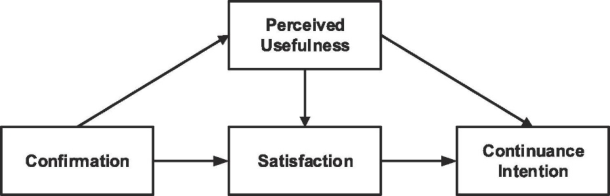
In the ECM (see Figure 1), perceived usefulness relates to the first phase of the continuance intention. The critical part of the ECM is its confirmation
Figure 1: Expectation confirmation model (Ambalov, 2021).
aspect. In terms of confirmation, the user may have used the IS to be in a better position to determine whether the expectations are met or the extent to which they are met.
METHOD
This study followed a mixed-methods approach. The quantitative phase of this study was descriptive, whereas the qualitative phase further explained the descriptive results. This latter phase was used to overcome the shor- tcoming of the quantitative approach. For instance, quantification does not provide an explanation and/or understanding of the results beyond the visual presentation of numerical data (Leedy and Ormrod, 2021). A better understanding of behavioural patterns and establishing a deeper mea- ning of the phenomenon are achieved using a qualitative approach (Babbie, 2021).
Participants The units of analysis for this study consisted of the existing users a mobile application and an online portal of a South African organization responsible for company, cooperative, and intellectual property registra- tion, and maintenance. The inclusion criteria for this study were the following: participants should be at least 18 years old and must have used the organization mobile application and online portal within the past 12 months.
Procedure Two data collection tools were used: a self-administered questionnaire and a semi-structured interview protocol. The questionnaire consisted of close- ended questions to obtain UX and continuance use data from the partici- pants’ viewpoint for the organization’s mobile application and their online portal. It was administered online through the online survey hosting provi- der (questionpro.com) from 01 July to 27 August 2021. An e-mail invitation containing an introduction to and overview of the study, ethical clearance information, and the organization permission letters was sent to the poten- tial participants requesting them to complete the online questionnaire. Two hundred and nine fully completed questionnaires were received, accounting for a 39% response rate.
The follow-up semi-structured interviews were conducted with 13 partici- pants in October 2021 to solicit further explanation for a deeper understan- ding of participants’ UX and continuance use opinions of the organization mobile application and its online portal. The follow-up interviews allowed the researchers to gain meaning and insight into the unanticipated results from the quantitative analysis (Morgan, 2014; Williamson and Johanson, 2018).
Determining the User Experience and Continuance Use of a Mobile Application 423
RESULTS
Mobile Application and Online Portal User Experience The findings indicated that participants had a negative experience with the mobile application, including all UX sub-constructs: attractiveness, depen- dability, efficiency, perspicuity, stimulation, and novelty. In contrast, the participants had a positive experience with the online portal, encompassing its UX sub-constructs, except for novelty. The comparison in Table 1 establi- shed if the differences between the mobile application and online portal UX were statistically significant.
The results indicated statistically significant differences between the online portal and mobile application UX (t(208)=5.896, p < 0.05). This shows that the difference between the online portal and mobile application UX did not happen by chance. Furthermore, the results indicated statistically significant differences between the online portal and mobile application attractiveness (t(208) = 5.855, p < 0.05), efficiency (t(208) = 5.689, p < 0.05), perspi- cuity (t(208) = 5.162, p < 0.05), dependability (t(208) = 6.365, p < 0.05), stimulation (t(208) = 5.066, p < 0.05), and novelty (t(208) = 5.070, p < 0.05).
The interview responses corroborated these findings as the participants were mainly negative about their experience with the mobile application. They cited efficiency, errors, business process, limited functionality, and the lack of user-friendliness of the mobile application as the root causes of their negative experience. Examples of the errors experienced included the system timeout due to prolonged processing time, business process-related errors where the application did not proceed without the user providing the related information, or the application did not show progress or successful transaction completion.
The online portal’s efficiency, user-friendliness, full features, and under- standability featured prominently in their positive experience. In addition, when the system was under maintenance, the participants indicated that they received notices on time and thus were not surprised by the online portal downtime.
Table 1. Comparing mobile application and online portal user experiences.
Table available in the original PDF paper.
x σx t df p
.638 .109 5.855 208 .000
Online portal UX - mobile application UX .606 .103 5.896 208 .000 Online portal attractiveness – mobile application attractiveness
.626 .110 5.689 208 .000
Online portal efficiency - mobile application efficiency
.595 .115 5.162 208 .000
Online portal perspicuity - mobile application perspicuity
.642 .101 6.365 208 .000
Online portal dependability - mobile application dependability
.587 .116 5.066 208 .000
Online portal stimulation - mobile application stimulation
.548 .108 5.070 208 .000
Online portal novelty - mobile application novelty
Mobile Application and Online Portal Continuance Use The composite mean score for the mobile application continuance intenti- ons indicated that participants were less likely to use the mobile application in future than the online portal. In Table 2, the difference between the mobile application and online portal’s continuance intentions was tested to determine whether the difference in mean scores was statistically significant.
Table 2. Comparing mobile application and online portal continuance intentions.
Table available in the original PDF paper.
x σx t df p
.664 0.115 5.789 208 .000
Online portal continuance intentions – Mobile application continuance intentions
The results indicated a statistically significant difference between the online portal and mobile application’s continuance intentions (t(208) = 5.789, p < 0.05). One may conclude that participants were more likely to conti- nue using the online portal than the mobile application. The standard error of the mean score for the online portal and mobile application continuance intentions was less than the corresponding mean score, suggesting that the mean score was a reliable measure of the population mean in relation to continuance intentions.
From the interviews, the participants identified limited features, efficie- ncy, errors, and business processes as the aspects that should be reconsidered for improving the mobile application. They also identified the features, fast processing, and easy navigational design as the online portals’ aspects that exceeded their expectations. Most participants indicated their interest in using the online portal in the future. The main reasons cited were the online portal’s stability, efficiency, and effectiveness.
DISCUSSION
Mobile Application and Online Portal User Experience The organization mobile application and online portal comparison in terms of UX were measured using the UEQ. The findings on the UX of the mobile application and online portal revealed that participants had a more posi- tive experience with the online portal than with the mobile application. No known study has compared the UX of a mobile application and its asso- ciated online portal. However, previous studies on website UX pinpointed the importance of hedonic qualities in website UX (Wani et al., 2017). For instance, Ritonummi (2020) found in their study that the company’s web- site was usable, yet the UX was poor due to design problems. In contrast, this study saw the organization’s online portal scoring high in both cases (i.e., usability and UX), notwithstanding that the relationship between pro- duct UX and usability does not arise naturally (Haaksma et al., 2018). In particular, the online portal scored positively for the hedonic and pragmatic qualities, namely attractiveness, novelty, stimulation, perspicuity, dependa- bility, and efficiency, respectively. However, this finding is contrary to the findings of Merˇcun and Žumer (2017), who established that, in respect of
Determining the User Experience and Continuance Use of a Mobile Application 425
UX, the pragmatic aspects of the product resonated more with the partici- pants than the hedonic aspects. There was no evidence suggesting that the differences were attributed to to types of systems evaluated.
Unlike the mobile application, participants always had a positive expe- rience with the online portal. The exception, however, was that some participants had a negative experience with the online portal, which later changed into a positive experience. The change to a positive experience arose from the fixed defects in the online portal that was problematic. The parti- cipants’ experiences in terms of all the UX factors measured for the mobile application were negative in this study. In addition, the interview results cor- roborated these findings, as participants were mainly negative about their experience with the mobile application. Among the causes of these nega- tive experiences were, to a larger extent, the mobile application’s inefficiency, errors, limited functionality, and lack of user-friendliness. To a lesser extent, participants had concerns about the business processes (e.g., communication between the organization and its customers).
However, similar studies on mobile application UX contradicted this study’s findings. Instead, the users portrayed a positive experience with the mobile applications investigated (Davidaviˇcien˙e et al., 2019; Wicahyono et al., 2019; Setiaji et al., 2020; Astuti et al., 2021). Setiaji et al. (2020), in their study of a secured mobile exam application, associated its UX solely with its quality. In addition, despite obtaining positive UX ratings, Wicahyono et al. (2020) identified novelty and efficiency as areas of impro- vement for the Pregnancy Monitoring Mobile Application.
Mobile Application and Online Portal Continuance Use The investigation of continuance intentions in this study involved compa- ring the organization online portal and mobile application, considering the participants’ experience with these products. The findings on the mobile application and online portal’s continuance intentions revealed that parti- cipants were more likely to consider using the online portal in future than the mobile application. This finding was supported by the interview results concerning the online portal. The prevailing reasons for future use of the online portal were its effectiveness, stability, efficiency, navigational ease and the availability of sufficient features, as opposed to the mobile application, which has limited features.
Various studies (Vatanasombut et al., 2008; Ambalov, 2021) have iden- tified trust in technology as a precursor for continuance intentions on web-based applications. In addition, subjective norms, enjoyment, useful- ness, and ease of use significantly impacted the continuance intentions for information systems (Almutairi et al., 2021). While other studies pin conti- nuance intentions on user satisfaction (Franque et al., 2020; Almutairi et al., 2021), Zareravasan and Ashrafi (2019) established no correlation between satisfaction and continuance intentions for the future use of the learning management system. The latter resonates with this study’s findings on online portal satisfaction. In addition, participants had misgivings about business processes (e.g., back-office communication and implemented business rules)
as the hindrance to their positive UX with the online portal, which relates to their dissatisfaction with it.
Regarding the mobile application, the interview results somewhat contra- dicted the questionnaire findings, as participants indicated their willingness to use it in the future owing to its efficiency and effectiveness. However, the mobile application’s limited features, errors, and efficiency appeared promi- nently as areas of improvement for the mobile application’s future use. In contrast, Mubarokah and Hidayanto (2020) identified user satisfaction as a determining factor for continuance use intentions of the Internal Activity Report Application.
CONCLUSION
The primary objective of this study was to compare the user experience and continuance use of a mobile application and online portal in terms of user satisfaction and continuance intentions. This study gave insight into the mobile application and online portal user experience and continuance use from its users’ perspective. The findings showed that the participants had a more positive experience with the online portal than with the mobile applica- tion. Furthermore, the continuance use of the mobile application and online portal was somewhat linked to their experience with these products. Study participants were more likely to use the online portal in future, and not so for the mobile application. Therefore, this study gave insight into the fact that user experience and continuance use phenomena were applicable to mobile applications, as well as online portals (i.e., user experience and continuance use are as important for the mobile application as they are for the online portal). The UEQ has been used extensively to evaluate UX in previous stu- dies. Its use, though, was mainly limited to individual products (i.e., mobile applications or online portals, with no comparison). The use of UEQ in com- paring the mobile application and online portal confirmed its relevance in the comparison of mobile applications and online portals alike. This study further provided empirical evidence to extend the established importance of UX in products’ continuance use through the comparison of a mobile appli- cation and an online portal. Practitioners may use the findings to re-examine the importance of developing products for user experience as part of product development, not as a standalone component irrespective whether it is for a mobile application or an online portal. The development of mobile applicati- ons, as compared to online portals, should take into account the pain points identified by the participants in relation to both usability and user experience, as continuance use hinges on these aspects.
REFERENCES
Alanazi, J. (2013) ‘E-government continuance from an expectation confirmation theory perspective: survey research on citizen experience’, p. 224. Almutairi, I. L. F. H., Alazemi, B. F. and Almutairi, F. L. F. H. (2021) ‘Kuwaiti
hospital patients’ continuance intention to use telemedical systems in the wake of the COVID-19 pandemic’, Healthcare Technology Letters, 8(6), pp. 159–168. Available at: https://doi.org/10.1049/htl2.12019.
Determining the User Experience and Continuance Use of a Mobile Application 427
Ambalov, I. A. (2021) ‘An investigation of technology trust and habit in IT use continuance: a study of a social network’, Journal of Systems and Informa- tion Technology, 23(1), pp. 53–81. Available at: https://doi.org/10.1108/JSIT-05- 2019-0096. Astuti, I. A., Farida, L. D. and Hidayat, T. (2021) ‘Measuring the UX of Mobile
Application Attendance Lectures Feature Using Short-User Experience Questions (UEQ-S)’, in 2021 3rd East Indonesia Conference on Computer and Information Technology (EIConCIT). 2021 3rd East Indonesia Conference on Computer and Information Technology (EIConCIT), pp. 286–291. Available at: https://doi.org/ 10.1109/EIConCIT50028.2021.9431891. Babbie, E. (2021) The practice of social research. 15th edn. Boston: Cengage. Bevan, N. (2008) ‘Classifying and selecting UX and usability measures’, in Meaningful Measures: Valid Useful User Experience Measurement. COST294-MAUSE Workshop, pp. 1–6. Davidaviˇcien˙e, V., Raudeli¯unien˙e, J. and Viršilait˙e, R. (2019) ‘User experience
evaluation and creativity stimulation with augmented reality mobile applicati- ons’, Creativity Studies, 12(1), pp. 34–48. Available at: https://doi.org/10.3846/ cs.2019.3576. Følstad, A. (2010) ‘The relevance of UX models and measures’, Academia.edu, p. 3. Franque, F. B. et al. (2020) ‘A meta-analysis of the quantitative studies in continuance intention to use an information system’, Internet Research, 31(1), pp. 123–158. Available at: https://doi.org/10.1108/INTR-03-2019-0103. Haaksma, T. R., de Jong, M. D. T. and Karreman, J. (2018) ‘Users’ Personal Concepti-
ons of Usability and User Experience of Electronic and Software Products’, IEEE Transactions on Professional Communication, 61(2), pp. 116–132. Available at: https://doi.org/10.1109/TPC.2018.2795398. Han, D.-I., Tom Dieck, M. C. and Jung, T. (2018) ‘User experience model for augmented reality applications in urban heritage tourism’, Journal of Heri- tage Tourism, 13(1), pp. 46–61. Available at: https://doi.org/10.1080/1743873X .2016.1251931. Hussain, A., Mkpojiogu, E. O. C. and Husin, M. Z. (2021) ‘Dimensioning
UX Models for Design and Evaluation’, Turkish Journal of Computer and Mathematics Education (TURCOMAT), 12(3), pp. 1878–1883. Available at: https://doi.org/10.17762/turcomat.v12i3.1018. International Organization for Standardization (2010) ‘ISO 9241-210: Ergonomics of human-system interaction — Part 210: Human-centred design for interactive systems’. Isnainiyah, I. N. and Triwahyono, B. (2021) ‘Assessing User Experience of the Online
Petition System in Indonesia based on UEQ’, International Journal of Informatics and Computer Science), 5(2), pp. 145–150. Izabal, S., Aknuranda, I. and Az-Zahra, H. (2018) ‘Evaluasi dan Perbaikan User Experience Menggunakan User Experience Questionnaire (UEQ) dan Focus Group Discussion (FGD) pada Situs Web FILKOM Apps Mahasiswa Fakultas Ilmu Komputer Universitas Brawijaya | Jurnal Pengembangan Teknologi Infor- masi dan Ilmu Komputer’, Journal of Information Technology Development and Computer Science, 2(9), pp. 3224–3232. Knijnenburg, B. P. et al. (2012) ‘Explaining the user experience of recommender
systems’, User Modeling and User-Adapted Interaction, 22(4–5), pp. 441–504. Available at: https://doi.org/10.1007/s11257-011-9118-4. Kusumo, A. H. and Hartono, M. (2019) ‘The evaluation of academic website using eye tracker and UEQ: a case study in a website of xyz’, IOP Conference Series: Materials Science and Engineering, 703(1), p. 012049. Available at: https://doi.or g/10.1088/1757-899X/703/1/012049.
Leedy, P. D. and Ormrod, J. E. (2021) Practical research: planning and design. 12th edn. Essex: Pearson. Martono, K. T. (2021) ‘Analysis on User Experience Using UEQ Method in the Infor-
mation System of Web-Based Child Development Monitoring’, SSRN Electronic Journal [Preprint]. Available at: https://doi.org/10.2139/ssrn.3794981. Merˇcun, T. and Žumer, M. (2017) ‘Exploring the influences on pragmatic and hedonic aspects of user experience’, in Proceedings of the Ninth International Conference on Conceptions of Library and Information Science. Uppsala, Swe- den: The University of Borås, p. 1. Available at: https://informationr.net/ir/22-1/ colis/colis1621.html (Accessed: 26 April 2022). Morgan, D. L. (2014) Integrating qualitative and quantitative methods. Los Angeles:
Sage. Morville, P. (2004) User Experience Design, Semantic Studios. Available at: https: //semanticstudios.com/user_experience_design/ (Accessed: 7 January 2022). Mubarokah, I. and Hidayanto, A. N. (2020) ‘Analysis of Continuance Use Intention
and Satisfaction on Implementation of ALKI (Internal Activity Report Applica- tion) in Ministry of Industry’, in 2020 International Conference on Informa- tics, Multimedia, Cyber and Information System (ICIMCIS). 2020 International Conference on Informatics, Multimedia, Cyber and Information System (ICI- MCIS), pp. 307–312. Available at: https://doi.org/10.1109/ICIMCIS51567.2020. 9354278. Reynoso, J. M. G. and Romo, L. I. S. (2020) ‘Measuring the Effectiveness of Designing End-User Interfaces Using Design Theories’, International Journal of Information Technologies and Systems Approach (IJITSA), 13(2), pp. 54–72. Available at: ht tps://doi.org/10.4018/IJITSA.2020070103. Ritonummi, S. (2020) User Experience on an E-commerce Web- site – A Case Study. Jyväskylä University. Available at: https://jyx.jyu.fi/bitstream/handle/123456789/68647/URN%3aNBN%3afi%3ajyu- 202004232856.pdf?sequence=1&isAllowed=y (Accessed: 26 April 2022). Roto, V. et al. (2011) ‘User Experience White Paper - Bringing clarity to the concept
of user experience’, in Dagstuhl Seminar on Demarcating User Experience, p. 12. Schrepp, M., Hinderks, A. and Thomaschewski, J. (2014) ‘Applying the user experience questionnaire (UEQ) in different evaluation scenarios’, in Design, User Experience, and Usability. Theories, Methods, and Tools for Designing the User Experience: Third International Conference, Heraklion, Crete: Springer International Publishing, pp. 383–395. Schrepp, M., Hinderks, A. and Thomaschewski, J. (2017) ‘Construction of a Bench-
mark for the User Experience Questionnaire (UEQ)’, International Journal of Interactive Multimedia and Artificial Intelligence, 4(4), p. 40. Available at: https://doi.org/10.9781/ijimai.2017.445. Setiaji, B. et al. (2020) ‘Assessing User Experience of a Secure Mobile Exam Application using UEQ+’, in 2020 3rd International Conference on Information and Communications Technology (ICOIACT). 2020 3rd International Confere- nce on Information and Communications Technology (ICOIACT), pp. 246–251. Available at: https://doi.org/10.1109/ICOIACT50329.2020.9332091. Vatanasombut, B. et al. (2008) ‘Information systems continuance intention of web-
based applications customers: The case of online banking’, p. 10. Wang, W.-T., Ou, W.-M. and Chen, W.-Y. (2019) ‘The impact of inertia and user satisfaction on the continuance intentions to use mobile communication applica- tions: A mobile service quality perspective’, International Journal of Information Management, 44, pp. 178–193. Available at: https://doi.org/10.1016/j.ijinfomgt. 2018.10.011.
Determining the User Experience and Continuance Use of a Mobile Application 429
Wangpipatwong, S., Chutimaskul, W. and Papasratorn, B. (2008) ‘Understanding Citizen’s Continuance Intention to Use e Government Website: a Composite View of Technology Acceptance Model and Computer Self Efficacy’, Electronic Journal of e-Government, 6(1), pp. 55–64. Wani, M. et al. (2017) ‘Beyond utilitarian factors: User experience and travel
company website successes’, Information Systems Frontiers, 19(4), pp. 769–785. Available at: https://doi.org/10.1007/s10796-017-9747-1. Wicahyono, G. et al. (2019) ‘Pregnancy Monitoring Mobile Application User Experience Assessment’, in 2019 International Conference on Information and Com- munications Technology (ICOIACT). 2019 International Conference on Infor- mation and Communications Technology (ICOIACT), pp. 872–877. Available at: https://doi.org/10.1109/ICOIACT46704.2019.8938446. Williamson, K. and Johanson, G. (2018) Research methods: information, systems,
and contexts. 2nd edn. Cambridge, MA: Elsevier. Wu, C. et al. (2022) ‘Understanding the Mechanism Between IT Identity, IT Mindfulness and Mobile Health Technology Continuance Intention: An Extended Expectation Confirmation Model’, Technological Forecasting and Social Change, 176, p. 121449. Available at: https://doi.org/10.1016/j.techfore.2021.121449. Zareravasan, A. and Ashrafi, A. (2019) ‘Influencing factors on students’ continua-
nce intention to use Learning Management System (LMS)’, in Proceedings of the 9th International Conference on Information Communication and Management. ICICM 2019: The 9th International Conference on Information Communica- tion and Management, Prague Czech Republic: ACM, pp. 165–169. Available at: https://doi.org/10.1145/3357419.3357429.
Read this individual research paper free through the original publisher, or explore the full digital proceedings book.
ISBN 978-1-958651-87-2
Explore this ISBN in the AHFE Bookstore ↗Listed in the July 2026 bookstore catalogue; search by ISBN to confirm current availability · Digital book purchase optional