Prasheenaa Jeyaranjan, Rukshan Alexander (2023). The use of gamification in the knowledge management practices. In: Human Interaction & Emerging Technologies (IHIET 2023): Artificial Intelligence & Future Applications. AHFE Open Access, vol. 111, pp. 498–507. https://doi.org/10.54941/ahfe1004056
This study develops a new conceptual model through an extensive review of previous literature and explains how gamification artifacts such as points rewarding is inducing intrinsic motivation and how those motivational factors like knowledge self-efficacy and playfulness are influencing the employees' knowledge sharing attitudes, through which the intentions are shaped. The Theory of Reasoned Action and the Motivational Affordances Perspective (MAP) model are used to explain the mediation effect of intrinsic motivation on the relationship between the gamification artifact and employees' attitudes towards knowledge sharing. This study also focuses on identifying the factors that improve the predictability of attitudes towards knowledge sharing. In a managerial context, this study helps practitioners recognize the importance of devising strategies and creative ideas to include and advance the features of gamification artifacts in their gamification systems to enhance their intrinsic motivation and drive an inner change in employees to share knowledge with others.
Organizations always seek to improve the knowledge management practice to achieve the competitive advantage (Helm et al., 2007). The Survey con- ducted by International Data Corp has revealed that around 31.5 billion losses are being incurred to the fortune 500 companies as they fail to share knowledge within organizations (Babcock, 2018). The organizations have realized the value of knowledge sharing inside their work environment and are taking more initiatives like adopting technological tools to boost the knowledge sharing behavior of employees (Deng et al., 2022), through the learning and training practices.
Gamification, a recent trend, is the integration of game aspects into appli- cations or areas that do not typically feature games, has started to garner attention in the academic and industrial fields. Gamification is defined as the use of game design elements/ artifacts and game design thinking in non-game contexts to digitally engage people to achieve goals (Deterding et al., 2011; Robson et al., 2015). It is easy to start engaging with learners and employees via a few basic game design elements or features or artifacts for example, chal- lenges, scores, points rewards, leaderboards, progress bar, and badges that is the form to symbolize the achievements of learners and trainers (Baptista & Oliveira, 2017; Robson et al., 2015; Xu et al., 2015). This ground-breaking
The Use of Gamification in the Knowledge Management Practices 499
idea is used to motivate and behaviour people to reach goals more efficiently or turn unpleasant tasks into fun ones (Koivisto & Hamari, 2019). Thus, the use of games in areas other than pure entertainment got more attention in the Human-Computer Interaction research domain to study the effects of gamification for learning and training in the workplace.
Though there is a debate about whether gamification is Saviour (beneficial) or Satan (harmful) for the knowledge management practices in organizations, there is little systematic research in this space. We address the research gap by developing a new conceptual model through extensive review of previ- ous literatures. This conceptual model can be used to study the mediating effect of intrinsic motivation on the relationship between the gamification artifact and employees’ attitude towards knowledge sharing. The develop- ment of the conceptual model also considers the influences over the intention to share knowledge which in turn leads to the knowledge sharing behaviour. This study will help to investigate how the game design element, for example points rewarding, created in the gamification system boosts the intrinsic moti- vation and how will the established intrinsic motivation mediate the impact of game design elements on the attitude and intention towards knowledge sharing.
DEVELOPMENT OF THE CONCEPTAL MODEL Prior research has used the Theory of Reasoned Action (TRA) for the inves- tigation of employee’s attitudes and intentions leading to actual behaviour in the context of knowledge sharing (Chow & Chan, 2008; Hsu & Lin, 2008; Radaelli et al., 2015); it is also concluded that the Theory of Rea- soned Action model could be better used to study employee’s knowledge sharing behaviours. However, a variation of the comparative importance of attitudes and subjective norms could be observed across different behaviours in predicting the intentions (Fishbein & Ajzen, 1975).
Even though the prior research has used Theory of Reasoned Action to identify the antecedent factors that boost knowledge sharing, it was criti- cized that the theory fails to investigate the intrinsic motivations that boost the attitudes leading to intentions towards knowledge sharing (Lin 2007). Still, the prior research has studied the intrinsic motivation as a separate vari- able which will be influencing on the knowledge sharing attitudes (Chedid et al., 2020), but the focus of the intrinsic motivation as an antecedent factor of attitudes and intention towards knowledge sharing needs to be explored (Lin, 2007).
The relationship between the gamification system and the motivation cre- ated among the users to pursue a certain behaviour is being explained by the Motivational Affordances Perspective (MAP) model (Zhang, 2008). This MAP model explains how the game design elements or artifacts will boost cer- tain intrinsic motivational factors; these motivational factors will be leading to the desired behaviour that is being intended to achieve using the gamified system.
Further prior studies have also been undertaken to investigate the influ- ence of game design elements on the intrinsic motivations which lead to the
500 Jeyaranjan and Alexander
desired behaviour (Feng et al., 2018). For example, Feng et al. (2018) found that the certain game design elements or artifacts used in the gamification system will be boosting the intrinsic motivation and will be leading to the behaviour intended to be achieved using the gamification system. Therefore, this study proposes an extension of the Theory of Reasoned Action model by developing a new conceptual model. This conceptual model can be used to investigate the mediating role of intrinsic motivation on the impact of gamification artifacts on the attitude towards knowledge sharing leading to knowledge sharing intention through the lens of MAP model (Zhang, 2008).
Research model that helps to study the mediation effect of intrinsic moti- vation on the relationship between the gamification artifacts and employees’ attitude towards knowledge sharing is limited. Therefore, this research devel- ops a conceptual model by modelling the factors that drive employees’ intentions toward knowledge sharing, in the context of learning and train- ing in organisation. Internal motivating factors like knowledge self-efficacy and playfulness as well as the technological factors like gamification artifacts have been chosen to construct the relation to the attitude towards knowl- edge sharing, which in turn shapes the intention towards knowledge sharing. The following section details the factors considered to develop the conceptual model.
Attitudes Toward Knowledge Sharing on Employee’s Intentions to Share Knowledge According to the Theory of Reasoned Action (TRA) by Fishbein and Ajzen (1975), individuals’ attitude tends to reflect their intention to participate in a particular behavior (Rutter & Bunce, 1989). Prior studies have used the Theory of Reasoned Action to examine the impact of attitude toward inten- tion to engage in behaviour (Allah Pitchay et al., 2019; Hamari & Koivisto, 2015, Troudi & Bouyoucef, 2020). Furthermore, Bock et al. (2005) have investigated the positive influence of attitude toward knowledge sharing on the individuals’ intentions to share knowledge.
An individual’s attitude toward knowledge is seems to be reflected in their willingness to share knowledge (Kolekofski & Heminger, 2003). This study refers attitudes toward knowledge sharing as the employees’ positive or negative assessments of knowledge sharing behavior. Based on Theory of Reasoned Action’s perspective and the explanation provided above, the hypothesis is constructed as follows.
The Impact of Subjective Norms on Intentions of Employees to Share Knowledge The Theory of Reasoned Action (TRA) by Fishbein and Ajzen (1975) defines the Subjective Norm as the perceived pressure that is put on users whether to perform or not to execute certain action by their relevant referents (Zhang & Ng, 2013). Supervisors and peers are examples of referents in the context of an organization. When an employee believes that her or his knowledge
The Use of Gamification in the Knowledge Management Practices 501
sharing activity is being recognized by the referent groups, her, or his intention to share knowledge increases (White Baker et al., 2007). From prior studies to the contemporary, the subjective norm is being examined in study works as an important antecedent that progresses the behavioral intention of individuals (Bock et al., 2005; Mathieson, 1991; Zhang & Ng, 2013). Considering this, the following hypothesis is developed.
Impact of Gamification Artifacts on the Employee’s Attitude Towards Knowledge Sharing Gamification has recently been utilized as an interactive tool of Information Technology (Udjaja et al., 2018), in which game design elements or artifacts, such as point rewarding is designed to provide an interactive environment for users to make them more active in non-gaming contexts. This allows the user to feel good, which promotes the desired behavioural improvements (Koivisto & Hamari, 2019). Gamification is therefore considered to be an interactive tool for reinforcing or changing people’s attitudes and behaviours.
According to prior studies, it is revealed that the gamification artifact such as point rewarding, tends to provide many benefits to its users. For example, the perceived utility and hedonic user experiences created using the gamifi- cation element can change the mindset of the users and start generating more positive attitude and intention towards the desirable behaviours (Hamari & Koivisto, 2015). Taking this evidence into consideration, hypothesis is developed.
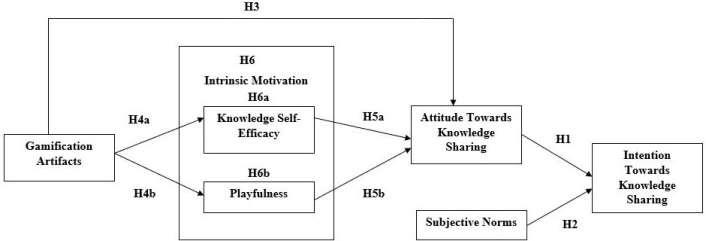
Proposition 3: Gamification artifact has a positive impact on the attitude towards knowledge sharing.
Impact of Gamification Artifacts on Boosting the Intrinsic Motivation of the Employees Gamification can be an effective method for increasing human motivation and behaviour. Prior research from Ryan and Deci (2000) and Sailer et al. (2017) discovered that gamification can motivate people, particularly intrin- sically motivate people to engage behaviour. When analysing the effectiveness of gamification, the results appear to be mixed (Koivisto & Hamari, 2019). Some studies support the argument and show that gamification increases user motivation (Hamari et al., 2014; Sailer et al., 2017), whereas others disagree with the argument (Hanus & Fox, 2015). However, it has been proven in the prior research that the way gamification artifacts are created tends to improve user motivation (Xi & Hamari, 2019).
When seeing in this manner, the gamification artifact in the gamified system, for example, point-rewarding tend to boost user motivation by dis- playing their current state of learning and progress over time, encouraging them to learn new skills and increase their competency to achieve the highest positions in the leaderboards (Sailer et al., 2017). In the context of gamifica- tion, Ryan et al. (2006) identified physiological demands such as competence, autonomy, and relatedness as antecedents of enjoyment. Furthermore, it has
502 Jeyaranjan and Alexander
been suggested that gamification artifacts such as point rewarding tend to satisfy users’ competence, autonomy, and relatedness needs (Xi & Hamari, 2019). This, in turn, will increase the users’ playfulness, which relates to the experience of enjoyment and fun in performing an activity (Feng et al., 2018). Using the evidence from the prior research, this study seeks to investigate the influence of gamification artifacts on the intrinsic motivation of users. The following hypothesis is developed.
Proposition 4: Gamification artifact has a positive impact on intrinsic motivation.
Proposition 4a: Gamification artifact has a positive impact on knowledge self-efficacy.
Proposition 4b: Gamification artifact has a positive impact on playfulness.
Impact of Intrinsic Motivation on the Employee’s Attitude Towards Knowledge Sharing Prior research indicates that knowledge sharing occurs when employees are motivated to do so. Regardless of the type of knowledge, motivational factors have a significant influence in moulding employees’ attitudes and intentions toward knowledge sharing (Kwok & Gao, 2016). The benefits achieved by gamification, whether measurable, such as points and/or financial prizes, or immeasurable, such as reciprocity and/or reputation, will intrinsically moti- vate employees to share their knowledge with others in the organization (Xi & Hamari, 2019).
According to the research work of Hau et al. (2013), employees who are intrinsically motivated by perceived enjoyment and experiences foster a pos- itive attitude toward knowledge sharing, which promotes their intention to share knowledge. Taking this evidence into account, the purpose of this study is to determine the impact of intrinsic motivation on the employee’s attitudes toward knowledge sharing. As a result, it was hypothesized that.
Proposition 5: Intrinsic Motivation has a positive impact on the attitude towards knowledge sharing.
Proposition 5a: Knowledge self-efficacy has a positive impact on the attitude towards knowledge sharing.
Proposition 5b: Playfulness has a positive impact on the attitude towards knowledge sharing.
Mediating Role of Intrinsic Motivation on the Relationship Between Gamification Artifacts and Employee’s Attitude Towards Knowledge Sharing Intrinsic motivation is the desire to perform an action that arises within a per- son and is not reinforced by environmental stimulation (Davis et al., 1992). The internally motivated person will engage behaviour as it is enjoyable and challenging, rather than because of external motivations such like rewards, recognition, rewards, or pressures (Ryan & Deci, 2000). Moving from the antecedents of intrinsic motivation in the gamified environment to the con- sequences of intrinsic motivation, prior research shows that intrinsically motivated employees will be developing positive outcomes as like enhanced
The Use of Gamification in the Knowledge Management Practices 503
performance (Mekler et al., 2017) and have a positive attitude toward knowl- edge sharing, that will be leading to the behaviour of knowledge sharing (Alavi & Leidner, 2001).
It is apparent that the fun, perceived enjoyment, and reciprocal benefits that employees obtain from through the gamification artifacts when partic- ipating in gamified planforms will enable their curiosity and inclination to seek out new techniques to pursue games, apply the new techniques learned, and share the knowledge of new techniques learned with their colleagues (Friedrich et al., 2020). In other words, gamification artifacts and tools will improve employees’ perceived gamification experiences, which will in turn influence their attitude toward a behavior (Deterding, 2015; Lieberoth, 2014). Gamification artifacts such as badges and points increase competence, compassion, and relatedness, resulting in positive, challenging, and enjoyable gamification experiences (Xi & Hamari, 2019). Employees will be intrin- sically motivated because of gamification artifacts such as point rewards (Mekler et al., 2017).
Hsu and Lin (2008) shown that intrinsic motivation has a direct impact on people’s intention to use technology. Similarly, Feng et al. (2018) discovered that intrinsic motivation has a direct impact on attitude towards engaging in an activity. Considering this argument, the purpose of this research is to examine whether intrinsic motivation has a direct impact on attitudes toward knowledge sharing. Considering this, it was hypothesized that.
Proposition 6: Intrinsic motivation mediates the relationship between gamification artifacts and attitudes towards knowledge sharing.
According to the intrinsic motivational view, people’s behaviour will be influenced by their desire to feel self-efficacy (Crown, 1977). Self-efficacy can be defined as people’s assessment of their capacity to organize and carry out actions to attain the desired level of outcomes (Wood & Locke, 1987). Employees will be motivated to share their knowledge because of their self- efficacy within the originations (Bock & Kim, 2002).
When considering gamification artifacts such as point rewarding, it will boost employee’s competency, making them feel competitive and enjoyable. These enjoyable emotions will increase their competence and self-mastery potential (Hamari et al., 2018), which in turn will enhance employees’ self- efficacy. Furthermore, prior studies have discovered that employees with confidence regarding their abilities to share knowledge are more likely to perform well (Bock & Kim, 2002; Constant et al., 1994). Employees who trust in their competence to address important problems at workplace and increase job efficiency appear to have a high level of Knowledge self-efficacy (Constant et al., 1996; Luthans, 2002).
Considering this, individuals believing in them that they can resolve significant organizational challenges by knowledge sharing will acquire a positive attitude toward knowledge sharing. Considering this, the following hypothesis is being proposed as follows.
Proposition 6a: Knowledge self-efficacy mediates the relationship between gamification artifacts and attitudes towards knowledge sharing.
Playfulness refers to the feeling of enjoyment and fun in doing a behaviour (Feng et al., 2018). Gamification artifacts such as point rewarding will
504 Jeyaranjan and Alexander
increase hedonic desires and induce pleasure and satisfaction from play- ing games (Hau et al., 2013). Furthermore, these gamification artifacts will improve interpersonal interactions and provide a sense of fun and enjoyment while playing the games (Shiau et al., 2018). This, in turn, will increase play- fulness through playing experiences. Prior research also demonstrated that employees who are intrinsically motivated will be inclined to behave in a particular manner (Deci & Ryan, 1985). Employees will acquire a positive attitude and intention toward knowledge sharing and be more driven to share knowledge if they receive happiness and delight from sharing their knowl- edge earned by engaging in the gamification process. After synthesizing the preceding arguments, the following hypothesis is being proposed.
Proposition 6b: Playfulness mediates the relationship between gamifica- tion artifacts and attitudes towards knowledge sharing.
Based on the above propositions, the conceptual model, as given in Figure 1, could be derived as follows.
Figure 1: Conceptual model.
CONCLUSION
Organizations continue to experience failures when attempting to implement knowledge management at the organizational level (Akhavan & Pezeshkan, 2014). This study aims to advance current knowledge about the potential influencing that could have an impact on knowledge sharing intention and encourage people to engage in it. This study develops a comprehensive and systematic model to explain the underlying intrinsic motivations through which gamification artifacts affect knowledge sharing intention.
Research in gamification has suggested that people may be intrinsi- cally evoked to share knowledge in the existence of gamification artifacts (Friedrich et al., 2020; Swacha, 2015). This research has theoretically iden- tified specific intrinsic motivational factors on whether gamification satisfies the intrinsic needs (Xi & Hamari, 2019). Future research should validate the model with empirical evidences and examine the mediating effects between the gamification artifacts and employee’s knowledge sharing intentions.
This study also opens several fascinating directions for future studies. This study demonstrates how employee’s intrinsic motivations and attitudes toward knowledge sharing are affected by one typical gamification artifact, for example, point rewarding. However, there are several gamification arti- facts whose causal pathways are still unknown. This study promotes further
The Use of Gamification in the Knowledge Management Practices 505
research to study the effect of other gamification artifacts including leader- boards, badges, challenges, and so forth, and how these gamification artifacts influence employee attitudes toward knowledge sharing.
ACKNOWLEDGMENT
This research is a part of the MBA study that is undertaken in the Post- graduate Institute of Management (PIM) - affiliated to the University of Sri Jayewardenepura, Sri Lanka. The authors would like to thank the staff attached to the PIM for their unceasing support and generous sharing of information.
This research’s Participant Registration fee is partially sponsored by Blue- bell Dentistry & Aesthetics UK, accessible at https://bluebelldp.co.uk/.
REFERENCES
Akhavan, P. and Pezeshkan, A., 2014. Knowledge management critical failure factors: a multi-case study. VINE: The journal of information and knowledge management systems, 44(1), pp. 22–41. Alavi, M. and Leidner, D. E., 2001. Knowledge management and knowledge man-
agement systems: Conceptual foundations and research issues. MIS quarterly, pp. 107–136. Allah Pitchay, A. B., Mohd Thas Thaker, M. A. B., Azhar, Z., Mydin, A. A. and Mohd Thas Thaker, H. B., 2020. Factors persuade individuals’ behavioral intention to opt for Islamic bank services: Malaysian depositors’ perspective.Journal of Islamic Marketing, 11(1), pp. 234–250. Babcock, P., 2004. Shedding light on knowledge management. HR magazine, 49(5),
pp. 46–51. Baptista, G. and Oliveira, T., 2017. Why so serious? Gamification impact in the acceptance of mobile banking services. Internet Research, 27(1), pp. 118–139. Bock, G. W. and Kim, Y. G., 2002. Breaking the myths of rewards: An exploratory
study of attitudes about knowledge sharing. Information Resources Management Journal (IRMJ), 15(2), pp. 14–21. Bock, Z., R., Kim, Y., & Lee, J., 2005. Behavioral intention formation in knowledge sharing: Examining the roles of extrinsic motivators, social-psychological forces, and organizational climate. MIS quarterly, 29(1), pp. 87–111. Chedid, M., Alvelos, H. and Teixeira, L., 2022. Individual factors affecting attitude
toward knowledge sharing: an empirical study on a higher education institu- tion. VINE Journal of Information and Knowledge Management Systems, 52(1), pp. 1–17. Chow, W. S. and Chan, L. S., 2008. Social network, social trust and shared goals in organizational knowledge sharing. Information & management, 45(7), pp. 458–465. Constant, D., Kiesler, S. and Sproull, L., 1994. What’s mine is ours, or is it? A
study of attitudes about information sharing. Information systems research, 5(4), pp. 400–421. Constant, D., Sproull, L. and Kiesler, S., 1996. The kindness of strangers: The usefulness of electronic weak ties for technical advice. Organization science, 7(2), pp. 119–135. Crown, S., 1977. [Review of the book Intrinsic Motivation by E. L. Deci]. British
Journal of Psychiatry, 131(3), pp. 322–323.
506 Jeyaranjan and Alexander
Davis, F. D., Bagozzi, R. P. and Warshaw, P. R., 1992. Extrinsic and intrinsic motivation to use computers in the workplace1. Journal of Applied Social Psychology, 22(14), pp. 1111–1132. Deci, E. L. and Ryan, R. M., 2013. Intrinsic motivation and self-determination in
human behavior. Springer Science & Business Media. Deng, H., Duan, S. X. and Wibowo, S., 2023. Digital technology driven knowledge sharing for job performance. Journal of Knowledge Management, 27(2), pp. 404–425. Deterding, S., 2015. The lens of intrinsic skill atoms: A method for gameful
design. Human–Computer Interaction, 30(3-4), pp. 294–335. Feng, Y., Jonathan Ye, H., Yu, Y., Yang, C. and Cui, T., 2018. Gamification artifacts and crowdsourcing participation: Examining the mediating role of intrinsic motivations. Computers in Human Behavior, 81, pp. 124–136. Fishbein, M. and Ajzen, I., 1975. Belief, Attitude, Intention and Behavior: An
Introduction to Theory and Research. Addison-Wesley. Friedrich, J., Becker, M., Kramer, F., Wirth, M. and Schneider, M., 2020. Incentive design and gamification for knowledge management. Journal of Business Research, 106, pp. 341–352. Hamari, J. and Koivisto, J., 2015. “Working out for likes”: An empirical study
on social influence in exercise gamification. Computers in human behavior, 50, pp. 333–347. Hamari, J., Hassan, L. and Dias, A., 2018. Gamification, quantified-self or social networking? Matching users’ goals with motivational technology. User Modeling and User-Adapted Interaction, 28, pp. 35–74. Hamari, J., Koivisto, J. and Sarsa, H., 2014, January. Does gamification work?-
-a literature review of empirical studies on gamification. In 2014 47th Hawaii international conference on system sciences (pp. 3025–3034). Ieee. Hanus, M. D. and Fox, J., 2015. Assessing the effects of gamification in the classroom: A longitudinal study on intrinsic motivation, social comparison, satisfaction, effort, and academic performance. Computers & education, 80, pp. 152–161. Hau, Y. S., Kim, B., Lee, H. and Kim, Y. G., 2013. The effects of individ-
ual motivations and social capital on employees’ tacit and explicit knowledge sharing intentions. International Journal of Information Management, 33(2), pp. 356–366. Helm, R., Meckl, R. and Sodeik, N., 2007. Systematisierung der Erfolgsfaktoren von Wissensmanagement auf Basis der bisherigen empirischen Forschung. The Journal of Business Economics, 77(2), pp. 211–241. Hsu, C. L., 2008. LIN J c C. Acceptance of blog usage: the roles of technology
acceptance, social influence an d knowledge sharing motivation, 45(1), pp. 65–74. Koivisto, J. and Hamari, J., 2019. The rise of motivational information systems: A review of gamification research. International Journal of Information Management, 45, pp. 191–210. Kolekofski Jr, K. E. and Heminger, A. R., 2003. Beliefs and attitudes affecting
intentions to share information in an organizational setting. Information & management, 40(6), pp. 521–532. Kwok, S. H. and Gao, S., 2005. Attitude towards knowledge sharing behavior. Journal of computer information systems, 46(2), pp. 45–51. Lieberoth, A., 2014. Shallow gamification: Testing psychological effects of framing
an activity as a game. Games and Culture, 10(3), pp. 229–248. Lin, H. F., 2007. Effects of extrinsic and intrinsic motivations on employee intentions to share knowledge. Journal of Information Science, 33(2), pp. 135–149.
The Use of Gamification in the Knowledge Management Practices 507
Luthans, F., 2002. Positive organizational behavior: Developing and managing psychological strengths. Academy of Management Perspectives, 16(1), pp. 57–72. Mathieson, K., 1991. Predicting user intentions: comparing the technology acceptance model with the theory of planned behavior. Information systems research, 2(3), pp. 173–191. Mekler, E. D., Brühlmann, F., Tuch, A. N. and Opwis, K., 2017. Towards under-
standing the effects of individual gamification elements on intrinsic motivation and performance. Computers in Human Behavior, 71, pp. 525–534. Radaelli, G., Lettieri, E. and Masella, C., 2015. Physicians’ willingness to share: a TPB-based analysis. Knowledge Management Research & Practice, 13, pp. 91–104. Robson, K., Plangger, K., Kietzmann, J. H., McCarthy, I. and Pitt, L., 2016.
Game on: Engaging customers and employees through gamification. Business horizons, 59(1), pp. 29–36. Rutter, D. R. and Bunce, D. J., 1989. The theory of reasoned action of Fishbein and Ajzen: A test of Towriss’s amended procedure for measuring beliefs. British Journal of Social Psychology, 28(1), pp. 39–46. Ryan, R. M. and Deci, E. L., 2000. Intrinsic and extrinsic motivations: Classic
definitions and new directions. Contemporary Educational Psychology, 25(1), pp. 54–67. Ryan, R. M., Rigby, C. S. and Przybylski, A., 2006. The motivational pull of video games: A self-determination theory approach. Motivation and Emotion, 30(4), pp. 344–360. Sailer, M., Hense, J. U., Mayr, S. K. and Mandl, H., 2017. How gamification moti-
vates: An experimental study of the effects of specific game design elements on psychological need satisfaction. Computers in human behavior, 69, pp. 371–380. Shiau, W. L., Dwivedi, Y. K. and Lai, H. H., 2018. Examining the core knowledge on facebook. International Journal of Information Management, 43, pp. 52–63. Swacha, J., 2015. Gamification in knowledge management: motivating for knowl-
edge sharing. Polish Journal of Management Studies, 12. Troudi, H. and Bouyoucef, D., 2020. Predicting purchasing behavior of green food in Algerian context. EuroMed Journal of Business, 15(1), pp. 1–21. Udjaja, Y., Guizot, V. S. and Chandra, N., 2018. Gamification for elementary math-
ematics learning in Indonesia. International Journal of Electrical and Computer Engineering (IJECE), 8(6). White Baker, E., Al-Gahtani, S. S. and Hubona, G. S., 2007. The effects of gender and age on new technology implementation in a developing country: Testing the theory of planned behavior (TPB). Information Technology & People, 20(4), pp. 352–375. Wood, R. E. and Locke, E. A., 1987. The Relation of Self-Efficacy and Grade Goals
to Academic Performance. Educational and Psychological Measurement, 47(4), pp. 1013–1024. Xi, N. and Hamari, J., 2019. Does gamification satisfy needs? A study on the relationship between gamification features and intrinsic need satisfaction. International Journal of Information Management, 46, pp. 210–221. Zhang, P. and Ng, F. F., 2013. Explaining knowledge-sharing intention in construc-
tion teams in Hong Kong. Journal of Construction Engineering and Manage- ment, 139(3), pp. 280–293. Zhang, P., 2008. Motivational affordances: Reasons for ICT design and use. Communications of the ACM, 51(11), pp. 145–147.
Read this individual research paper free through the original publisher, or explore the full digital proceedings book.
ISBN 978-1-958651-87-2
Explore this ISBN in the AHFE Bookstore ↗Listed in the July 2026 bookstore catalogue; search by ISBN to confirm current availability · Digital book purchase optional