Carmela Ilenia Amato, Martina Orlacchio (2023). Perspectives of Design for Recycling in Fashion System. Redefining fashion waste value models. In: Human Systems Engineering and Design (IHSED 2023): Future Trends and Applications. AHFE Open Access, vol. 112, pp. 359–367. https://doi.org/10.54941/ahfe1004148
Università degli Studi della Campania Luigi Vanvitelli, Faculty of Architecture and Industrial Design, Via San Lorenzo - Abbazia di San Lorenzo - 81031 - Aversa (CE), Italy ↗
The Fashion industry is facing significant structural and systemic challenges that require a paradigm shift. According to Agamben, the resilience of complex systems is the response to the ability to adapt and evolve through the adoption of innovative and alternative approaches that are able to transfigure reality by overcoming apparent difficulties. The notion of intempestivity, in particular, assumes a critical role in building resilience based on innovation and sustainability. It is defined as a dynamic form that requires a constant process of reinvention, using apparent damage as an opportunity to evolve toward substantial improvement. Calamities, pandemic threats, food crises, destruction of ecosystems and cultural heritages are just some of the negative phenomena, in many ways dramatic, with which design, increasingly has to deal from a survival perspective, returning to "new basic needs," as well as offering solutions to improve the quality of human life. In Europe, economic growth, closely dependent on increased production and consumption of resources generates harmful effects on the environment, eroding biodiversity, and altering climate stability, health and human well-being. Current production and consumption models do not follow sustainability criteria, triggering irreversible phenomena that require urgent intervention strategies. Earth Overshoot Day signals the date when humanity has used all the biological resources that the Earth regenerates throughout the year. While dramatic, the event stirs the consciousness of individuals, about the limits of the Planet and its depleted resources. An often overlooked but significant contributor to the environmental emergency is the overproduction of clothing. According to the World Bank, the Fashion sector is responsible for 10 percent of annual global carbon emissions. Despite approaches in terms of recycling and reuse, globally 88 percent of recycling refers to polyester from bottles, with only 12 percent of recycled material coming from pre-consumer and post-consumer textile waste; moreover, global production of sustainable materials is growing significantly, although there are still negative impacts due to resource leakage in processing. The European framework calls for more efficient management of textile waste, in relation to the development of circular processes in the relevant industry. The EU Strategy for Sustainable and Circular Textiles calls for textiles to be free of harmful substances, durable, recyclable, and made with mandatory minimum amounts of recycled fibers by 2030; a generic statement that without specific objectives, results in non-compliant outcomes. The textile and apparel manufacturing sectors experience damage along the supply chain that needs a thorough investigation into production processes, shining a spotlight on the real possibilities of post-consumer recycling, from sorting to waste management, according to circular economy principles. From the complex relationship between raw materials, design and production practices and ecosystems, innovative solutions are determined by considering fragilities, environmental and social, to restore the balance. The paper brings together several case studies discussing the effectiveness of changing sectors through recycling and upcycling processes, circularity of materials, and reduction through textile waste valorization. Investigating the dynamics governing the post-consumer waste system, it reveals the effectiveness of upcycling processes in tracing models and conditions useful for sustainable transformation. The desired response of the textile/clothing sector transposes the paradigm shift between sustainable logic and the design perspective of recycling.
INTRO THE RESILIENCE OF A FRAGILE AND COMPLEX SYSTEM The Fashion Industry is facing major structural and systemic challenges that require a paradigm shift. The pandemic from COVID-19 highlighted the fragilities of the system, while demonstrating, at the same time, the ability to respond in a critical context. Complex systems, such as social, economic and environmental systems, are characterized by an unstable nature, constantly exposed to external stresses and shocks, such as financial crises, natural dis- asters, epidemics and wars. Some of these systems demonstrate the capacity to adapt and strengthen in response to such events, while others are vulnera- ble and disintegrate. The ability to adapt and strengthen, includes the ability to benefit from various stresses, thus becoming stronger and more resilient. Resilience of complex systems is a crucial element in ensuring survival and adaptation to new conditions, especially in emergency situations. It is based on the system’s ability to withstand perturbations and return to its origi- nal equilibrium or evolve into a new form better suited to new challenges, foreshadowing a systemic transformation. According to Agamben (2008), intempestivity refers to everything that resists the present, that disrupts and tears away from custom, that does not bend to the demands of time and seeks to overcome it through reflection and action for the construction of a new form of community. In this systemic context, the notion of intempestivity assumes an important role, as it represents the ability to resist the pressures of the present and project oneself into a different future. As the author dis- cusses, intempestivity requires a radical critique of current conditions in order to overcome persistent limitations and build a more sustainable existence. The author refers to resilience not as a static form, but rather as a dynamic form that requires a constant process of reinvention, including creative rein- vention, using apparent damage as an opportunity for evolution. An example of resilience was demonstrated by the Fashion Industry during the pandemic by innovating production, marketing and sales processes. However, the pres- sures the industry faces in moving to a more sustainable and conscious model represent a major challenge toward a paradigm shift, based on a regenerative and reproductive logic, which requires the active and collective participa- tion of all actors in the supply chain. Fashion is, therefore, a dimension that embodies the importance of adopting responsible and sustainable practices
Perspectives of Design for Recycling in Fashion System 361
that consider the environmental, social and economic impact of the entire life cycle of products, from design to care and disposal. This includes the use of alternative energy resources, the implementation of advanced technologies and the promotion of sustainable and ethical practices. The ability to adapt and reinvent oneself, which characterizes the resilience of complex systems, is essential to facing the difficulties and insecurities of the future. Reducing fragilities, or enhancing them, is one of the first actions to be taken to take advantage of any mistakes and build a solid future.
SUSTAINABILITY AWARENESS IN THE NEW PARADIGM The fragility of the planet and the vulnerable nature of human beings means that consumers are developing a greater consciousness of the impact of their behaviors on the environment, which generates new needs and stimulates approaches toward sustainable development. The Fashion Industry has to take a systemic and integrated approach in addressing emerging problems, considering the whole system and the interactions between its elements. In the article “The Great Turning: From Empire to Earth Community,” pub- lished in Yes! Magazine in 2006, Korten emphasizes the urgent need for a cultural shift to address global environmental problems and promote sus- tainability. This reflection on the necessary new vision of the world is based on the collective consciousness about the interdependence with nature; it drives consumer choices and influences the demand for goods and services, finding an impact on the global economy. Environmental responsibility is reflected in consumers’ consciously choosing against compulsive buying, and instead considering the needs and requirements expressed according to a new dominant social paradigm - DSP (Armstrong and Le Hew, 2011).
DSP is an indicator of societal social behavior and plays a central role in maintaining unsustainable practices. Bottom-up movements of consumers, which demand more transparency in the production chain and active par- ticipation in the co-creation process, determine direct responsibility in pre- and post-consumer processes (Sbordone, 2022). According to Armstrong and LeHew (2011), DSP involves making products of apparel that are more effi- cient in material use, production, and utility for the consumer; it also takes into account the satisfaction of consumers’ underlying human needs, which are intrinsically more social than material. According to the new dominant social paradigm, clothing education promotes the development of skills to raise awareness of understanding human needs and ecosystem limitations, collaboration with the market, and understanding of local culture and tradi- tions. Human consciousness about the interconnection of natural and social systems, is reflected in the increased sense of responsibility in the efficient and effective use of natural resources and the environmental preservation. This provides an opportunity for the fashion industry to adopt economic and cultural logics whose concern is for environmental and social sustain- ability alongside economic profitability, as suggested by Fletcher (2016). This requires companies to engage in ethical and sustainable practices in all stages of the product life cycle, from production to consumption and disposal, in order to reduce the environmental and social impact of their business. Design
362 Amato and Orlacchio
has the potential to help systems be adaptive and offer innovative solutions to environmental and social problems. Consumers, who are increasingly aware of the impact of their choices, are demanding sustainable and responsible products and services. In recent decades, the role of Design has evolved, now involved in practices to reduce impacts, conserve energy and natu- ral resources through sustainable design of products, services and systems, rethinking how products are produced without depleting the planet’s natu- ral resources or compromising people’s well-being, both present and future (Vezzoli; Manzini, 2008). Sustainable design requires an open, flexible, long- term mindset that uses sustainability as a lever to generate competitiveness and improve performance without harming the planet’s natural resources or human well-being. Design plays a role as a mediator in emergency situa- tions, where limiting measures need to be adopted to preserve the planet’s resources and guide new consumer logics. In the Fashion and Textile sectors, the designer considers many factors, including material selection, produc- tion processes, product use and disposal, as well as social and economic impacts, such as labor standards, community health, and cultural sensitivity. Through the life cycle design approach, the designer identifies opportunities to reduce environmental impacts throughout the product life cycle by cre- ating products and systems that are able to regenerate, biodegrade, and use only environmentally friendly materials and renewable resources. Design for Fashion adopts a range of strategies to consider not only material aspects, but also socio-cultural aspects, placing design at the center of the ethical-social dimensions of sustainability (Ranzo, 2017).
FASHION WASTES IN INDUSTRIAL PROCESSES The Textile and Apparel sectors demonstrate remarkable resilience in its abil- ity to pursue a real revolution toward sustainability, despite delays in imple- menting circular practices throughout the production chain. The difficulty in implementing effective sustainable practices throughout the production chain and the absence of incentives to promote environmental and social sus- tainability are the main structural challenges facing the sector (Abdelmeguid et al., 2022; Battesini Teixeira, 2023). It is therefore necessary to involve all actors in the supply chain, adopting sustainable and responsible production practices, including reducing the environmental impact of textile production and fiber processing, reducing textile waste, reusing and recycling textile materials, and promoting the use of recycled materials and less toxic chem- icals. The industry’s unsustainability, in production processes, results from an inability to manage raw materials in an efficient way and a failure to have a long-term vision regarding environmental and social impacts. In fact, the monitoring of impacts is often limited to the single stage of production, neglecting the short- and long-term consequences along the entire product life cycle;. problems that are characterized by the length of the supply chain and the strong inclination to overproduction, which generate, moreover, a considerable amount of waste, including wastewater and pre-consumer and post-consumer solid waste.
The EU Strategy for Sustainable and Circular Textiles aims to promote the use of textiles that are free of harmful substances, durable, recyclable and
Perspectives of Design for Recycling in Fashion System 363
made with mandatory minimum amounts of recycled fibers by 2030. Despite the growth in global production of sustainable materials, the industry still faces the challenge of improving the relatively low recycling rate of around 15 percent. The phenomenon of overproduction requires intervention measures in the management of various types of textile waste.
Industrial textile wastes, generated during the production of fibers, yarns, fabrics, and clothing, are generally known for their fiber composition, pro- cessing chemicals, dyes, and finishes, making them suitable for recycling. These wastes refer to unsold stock and returned sales in stores and online, with quantities not well documented in Europe; and the fashion industry should avoid them if possible. Post-consumer textile wastes, consisting of clothing and fabrics that are no longer usable or desired by end consumers, may be heterogeneous in composition and contain complicated finishes, mak- ing their recycling more difficult. These may involve the implementation of innovative and sustainable recycling practices for treatment purposes, such as chemical recycling, mechanical recycling, or bio-based recycling. The man- agement process, however, is a global challenge, as most textile material is disposed of in landfills or incinerated to produce electricity or heat, while only 15 percent of the total is currently put through the recycling process. This requires countries to have structured facilities for the collection and recycling of textile materials; moreover, the very establishment of such facil- ities is a challenge for the textile industry, as it requires large investments in separation technologies and the construction of chemical processing sys- tems. It is important to clarify that thermal recovery is not considered as a recycling method for textile waste, as it does not contribute to the reduction of the amount of textile waste produced. On the contrary, it appears that the sale of second-hand clothing is working, although it has been criticized by politicians, economists, and NGO representatives because it can threaten local clothing industries in some Asian and African countries. To address this challenge, it is necessary to implement environmentally friendly production processes and create closed-loop production systems for recycling materi- als and waste. Designing products and systems that promote sustainable consumer behavior is another opportunity.
CASE STUDIES INVESTIGATIONS AND PERSPECTIVES The following case studies analyze the effectiveness of the fashion industry’s transition to more sustainable production models through the implementa- tion of new design strategies, recycling processes that enhance the circularity of materials, and the reduction of textile waste through their valorization. The article, “Scaling textile recycling in Europe-turning waste into value,” published by McKinsey’s & Company (2022), addresses the opportunities offered by recycling post-consumer textiles and the different systems that enable these materials to be given new value. Textile recycling presents an opportunity to limit overproduction and overconsumption by extending the life of products and designing materials more suitable for circularity. The report identifies mechanical recycling technologies as the most beneficial solution for reducing CO2 emissions, with the potential for a 60 percent
364 Amato and Orlacchio
to 90 percent reduction in all fiber types at yarn fiber levels. In order to achieve a circular value chain for textiles, immediate action must be taken to extend the necessary infrastructure for closed-loop collection, sorting and recycling of textile materials. This goal aligns with the ambitious plans of the ReHubs initiative, presented at the Techtextil 2022 conference in Frankfurt. The initiative brings together key players in the textile industry to address the challenge of recycling post-consumer and post-industrial textiles in Europe. The goal is to implement a sustainable and integrated textile waste man- agement system that enables the efficient and effective collection, recovery, reuse and recycling of textile materials (Euratex, 2022). The collaboration of producers, recycling centers, brands, consumers, and public authorities is crucial for textile waste management. The implementation of advanced technologies and efficient and sustainable collection and sorting systems is a critical step in achieving these goals and promoting the highest possi- ble sustainability. Specifically, projects address the transformation of textile waste into raw material, increasing the use of mechanically recycled fibers, solving technical challenges related to thermo-mechanical recycling of tex- tiles, and creating capsule collections using post-consumer recycled products. Recover™, a leader in mechanical recycling, is committed by helping to build the systems, standards and physical tests needed to close the textile loop in Europe.
Currently, it mainly uses post-industrial textiles as raw material (Fig. 1). In fact, mechanically recycled fibers, such as Recover™RColorBlend fibers, are a sustainable alternative to virgin fibers and further reduce CO2 emissions because they do not require post-production interventions. In fact, the fibers are made of recycled cotton from textile waste and recycled polyester, dyed with low impact, without the need for further dyeing interventions in the final production: these fibers retain their original color, avoiding the use of further dyeing in the later production phase.
Figure 1: Recover’s fiber color range (Recover, 2023).
From a systemic perspective, the ability of a product to be recyclable depends on the material and its inherent characteristics, but also on how it can be separated and the recycling steps that can be implemented (Vezzoli et al., 2021). Adopting an integrated approach in the design of sustainable clothing systems, through the use of reliable methods and tools, is an effec- tive strategy to guide design decisions toward innovative and sustainable
Perspectives of Design for Recycling in Fashion System 365
solutions. In this context, the Sustainable Clothing Product-Service System Design methodology (LeNSlab PoliMi, 2021) was created to help design- ers develop sustainable clothing systems by providing methodologies and toolkits to adopt strategies and decisions based on reliable priorities and opportunities. The method consists of several stages, from strategic analysis, exploration of system opportunities, product and/or service concept design, and detailed product and/or service design.
These stages are designed to develop enhancement solutions involving all actors in the production chain, support the designer in analyzing the context of intervention and identifying product and product-service system design priorities. In particular, it focuses on three types of services: Clothing product-oriented, which provides added value to clothing and/or clothing care products during the product life cycle; Clothing care-oriented, which provides clothing care platforms to customers; and Clothing result-oriented, which provides complete wearing and clothing care services to customers. The investigation of the dynamics governing the post-consumer waste system, moreover, reveals the effectiveness of upcycling processes, defining mod- els and conditions necessary for substantial sustainable transition beyond conventional recycling logics.
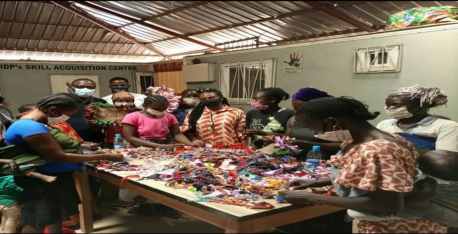
The Designer Nkwo Onwuka represents a virtuous example of how upcy- cling post-consumer textile waste can be a valid alternative in contexts where necessary conditions for textile disposal through recycling do not exist. Their new African fabric called Dakala was obtained through the manipulation (stripping - stitching - weaving) of discarded textiles, including denim, using the skills in traditional textile craftsmanship of local women in Abuja.
Particularly interesting is the approach that harnesses local resources to create new garments from the mountains of textile waste that Western countries send to landfills in Nigeria. The creation of textiles like Dakala rep- resents a concrete example of upcycling and sustainable sourcing that could be replicated in other parts of the world in order to reduce the environmental impact of waste and promote the circular economy (Fig. 2).
Figure 2: Dakala process with woman (Dakala, 2020).
The Asics Earth Day Pack collection is an example of sustainable and innovative production in the Fashion industry, adopting the principle of cir- cularity for shoe production. The collection uses 5 tons of textile waste to
366 Amato and Orlacchio
create new products, thus reducing the environmental impact of the fashion industry (Fig. 3). In addition, the collection features a low ecological foot- print technology, namely mass dyeing (solution dyeing) used for the tongue of the shoes, a technology that reduces CO2 emissions by 45 percent and the amount of water used by 33 percent compared to traditional dyeing pro- cesses. The percentage of recycled materials ranges from 30% for uppers to 40% for sportstyle and sneakers. The upcycling of recycled materials enables the creation of new product value by differentiating production through dif- ferent sources of recycled material and new shoe designs, directing the brand’s logic into new markets.
Figure 3: Asics Earth day pack prototype (Asics, 2021).
OPEN DISCUSSIONS The Fashion Industry has a significant impact on the environment and to ensure a sustainable future it is essential to adopt a systemic vision and pro- mote collaboration along the entire value chain. According to Agamben, the resilience of complex systems lies in the ability to adapt and evolve through the adoption of innovative and alternative approaches, capable of transfig- uring reality by overcoming apparent difficulties. The new dominant social paradigm promotes the development of skills to raise awareness of the under- standing of human needs and the limits of ecosystems, collaboration with the market, understanding of local culture and traditions. The promotion of tex- tile waste recovery strategies, combined with the identification of recycling technologies and Design-driven approaches for their valorisation, amplifies the scenario of solutions aimed at containing the phenomena of overproduc- tion and overconsumption, requiring a constant commitment on the part of all interested parties.
The complex relationship between raw materials, design and produc- tion practices and ecosystems determines innovative solutions considering environmental and social fragility, to restore balance. Fashion and Textile Design investigates the dynamics that govern the post-consumer waste sys- tem, revealing the effectiveness of upcycling processes for tracing models and conditions useful for sustainable transformation. The response of the textile/- clothing sector incorporates the paradigm shift between the sustainable logic and the design perspective of recycling.
Perspectives of Design for Recycling in Fashion System 367
REFERENCES
Abdulrahman, M., Hsuan, J., & Yuen, T. (2022). Investigating the challenges of applying the principles of the circular economy in the fashion industry: A systematic review. Sustainable Production and Consumption, 32, 505–518. Agamben, G. (2008). Che cos’è il contemporaneo?. Nottetempo. ARMSTRONG, C. M.; LEHEW, M. L. A. (2011). Sustainable Apparel Product
Development: In Search of a New Dominant Social Paradigm for the Field using Sustainable Approaches. Fashion Practice, v. 3, n. 1, p. 29–62. Battesini Teixeira, T. G., de Medeiros, J. F., Kolling, C., Duarte Ribeiro, J. L., & Morea, D. (2023). Redesign in the textile industry: Proposal of a methodology for the insertion of circular thinking in product development processes. Journal of Cleaner Production, 397, 136588. Euratex (2022). ReHubs 2022: Circulating Textile Waste into Value. Retrieved from. Fletcher, K. (2016). Craft of Use: Post-Growth Fashion. Routledge, p. 8. Garcia, M. M., Krebs, F., Lang, T., & Schmid, M. (2020). Scaling textile recycling in
Europe—turning waste into value. McKinsey & Company. Retrieved from. Sbordone, M. A., Sanches, R. A., De Luca, A., & Amato, C. I. (2022). Abordagem baseada em capacidade: reinventar relacionamentos viáveis com pessoas e materiais. Modapalavra e-periódico, 15(35), 17–69. Montagna, G., & Sbordone, M. A. (2020). Fashion and Textile Design Reconstruc-
tion. PAD Journal 20), pages 007–011. Vezzoli, C., & Manzini, E. (2008). Design for environmental sustainability. Springer- Verlag London Limited. Vezzoli, C., Ceschin, F., Diehl, J. C., & Kohtala, C. (2021). Fashion, Sustainability
and Design: From Linear to Circular. Springer. Vezzoli, C. (2018). Designing Sustainable Clothing Systems: The design for environmentally sustainable textile clothes and its Product-Service Systems. Routledge.
LISTED IN THE AHFE DIGITAL BOOKSTORE CATALOGUE
Explore the complete digital volume
Human Systems Engineering and Design (IHSED 2023): Future Trends and Applications
Read this individual research paper free through the original publisher, or explore the full digital proceedings book.
ISBN 978-1-958651-88-9
Explore this ISBN in the AHFE Bookstore ↗Listed in the July 2026 bookstore catalogue; search by ISBN to confirm current availability · Digital book purchase optional