Maria Moga, Dan Radu Moga (2023). Sit-standing posture and chairless chair. A prototype without ground contact. In: Human Systems Engineering and Design (IHSED 2023): Future Trends and Applications. AHFE Open Access, vol. 112, pp. 377–386. https://doi.org/10.54941/ahfe1004150
Currently there are many types of wearable devices for unconventional sitting. The devices are named suggestively: wearable chairless chair. What all these products have in common is an additional support behind the heel. The additional support, a ground contact behind the heel, appears to add more stability and at the same time increases the complexity of the product, the weight and the difficulty of wearing it.The research assumes that there is no need for additional support nor ground contact. The working method consisted of analyzing products on the market. The analysis was followed by understanding the functioning and the biomechanical cause for the existence of the posterior support. The analysis was carried out by relating the human silhouette, its body volumes and geometry, to the shape and structure of the devices. We focused on the side view because it is the one that gives the asymmetric behavior of the body volumes. In the biomechanical analysis we kept the premises of locating the center of mass, of spatial summation of the partial centers of mass (the head, the trunk and the limbs) as well as the reference to the ground support polygon of the soles. Biomechanical and static analysis was followed by the identification and isolation of that component of body geometry responsible for the need of posterior support. The analysis was then repeated in its absence. It was necessary to correct the geometry of the body and change the degree of flexion of the knees and ankles. The verification of the hypothesis has been achieved by developing a device that corresponds to a body geometry, does not provide posterior support and at the same time eliminates orthostatic muscle stress. Tests were carried out with primitive mock-ups and prototypes, with briefly articulated parts that meet the condition of being wearable through permanent contact with the leg and the thigh. The results were encouraging from the point of view of stability but were unsatisfactory from the point of view of the comfort offered by the primitive prototypes. Refinement of the prototype was achieved by developing the design of the thigh and leg interface components as well as the design of the flexion locking subsystem. Of particular concern was the contact between the product and the surface of the thigh and calf. Refined in this way the prototype unquestionably preserved the stability of the human subject and presented an improvement in comfort criteria.In conclusion, the research confirms the hypothesis. The no ground contact prototype allows a posture in which orthostatic stress is avoided, with good stability and with enough containment to be wearable.
Currently there are many types of wearable devices for unconventional sit- ting. The devices are named suggestively, like wearable chairless chair, passive exoskeleton. All these devices have in common a component that connects with the heel or the plantar surface, ensuring the transfer of body weight to the ground. Providing more stability, this structural component loads the device, not only in terms of weight, but also in terms of complexity.
Hypothesis The research assumes that there is no need for additional support nor ground contact. The objective was to create a prototype without contact with the ground.
Working Method The working method consisted in reviewing literature and understanding the biomechanical cause for the existence of the ground contact, followed by searching the way for balance without it. Verification of the hypothesis, first with primitive mock-ups, followed by a refined prototype helped us outline the answer to the hypothesis and draw conclusions.
Literature Review
The best-known products, already launched on the market, are Astride Bionix’s Lex, Chairless Chair By Noonee and Nitto’s Archelis. The three products have distinct solutions in terms of ground support. Lex provides support away from the heel, and the postural geometry approaches that of
a conventional sitting position. The Noonee’s support is a bit closer to the heel compared to the Lex’s. Archelis proposes a support under the feet arch. Similar variants and prototypes have been proposed in recent years. Studies have also been developed that address the functionality and efficiency aspects of these devices. Irawan et al., proposed a portable chairless chair prototype, starting from the analysis of the design proposed by Noonne (Irawan, 2019). It proposes a ground support very close to the rear edge of the heel. Thigh and calf tilts manage to provide relaxation and relief from postural stress. In addi- tion to the indisputable advantages of the proposed prototype, Ira Wan and collaborators mention the feeling of imbalance when using the prototype. We believe that the sensation felt by users is a consequence of the center of gravity being too close to the rear edge of the support polygon, similar to the Noonne, which however has a rear ground support that is a generous distance from the heel. Shah et al. advance a prototype in which ground support is achieved in the immediate vicinity of the heel, and the angle between the segments of the lower limb seems to bring the vertical center of gravity near the ankle joint (Shah et al., 2019). A prototype used in construction was proposed by Capitani (Capitani et al., 2021). The model responds to the additional stresses felt by the human body during shotcrete projection. Yong-Ku et al., con- ducted studies for personnel involved in agriculture, assessing muscle activity and working height for the CEX wearable device developed by Hyundai Motors (Yong-Ku at al., 2021). Spada at al., propose testing wearable devices by creating a virtual model that reproduces the postural angles of the users. The model suggests the importance of the exoskeleton taking up as much of the load as possible through transfer (Spada et al., 2018). It is precisely the logic of devices that have built-in ground anchors. Masood et al., propose an evaluation of wearable devices taking into account the user relationship, work tasks and operational safety (Masood et al., 2018). Du Zihao et al., developed a model (HUST-EC) with a thigh support parallel to the subject’s thigh and a ground support that takes the weight of the trunk (Du et al., 2021). Zhuo Ma developed a lockable lower limb exoskeleton that allows the human subject to adopt a sitt standing position (Zhuo Ma et al., 2022). The model comes closest to the hypothesis that formed the basis of our model, as locking the knee joint for a certain value is the key to the new solution. The prototype developed by Zhuo Ma has a ground support, how- ever, and the values for which the locking of the knee joint can be achieved are variable.
Posture Analysis The posture geometry for two main products was compared: when contact is located at a distance from the heels, and for the contact located under the arch of the foot (see Figure 1, Figure 2, Figure 3). Body volumes and skeletal structures were rendered at 1:5 scale, in side view. The side view allows the asymmetric relationships between body volumes to be highlighted and can better identify sources of imbalance. The common center of gravity of the whole body and the angles between the segments of the lower limb were
Sit-Standing Posture and Chairless Chair. A Prototype Without Ground Contact 379
deduced from the analysis of the presentation images. We drew the inter- articular axes of the lower limb and trunk segments and the ground support polygon. The presentation images were analysed and the distance between the posterior edge of the sole and the support of the sit standing device was assessed proportionally. We have marked the obtained distance on the side view drawing (see Figure 4, Figure 5).
Figure 1: Orthostatic position.
Figure available in the original PDF paper.
Figure 2: Archelis type of posture.
Figure available in the original PDF paper.
380 Moga and Moga
Figure 3: Noone type of posture.
Figure available in the original PDF paper.
Figure 4: Posture geometry for noone type of sitting.
Sit-Standing Posture and Chairless Chair. A Prototype Without Ground Contact 381
Figure 5: Posture geometry for archelis type of sitting.
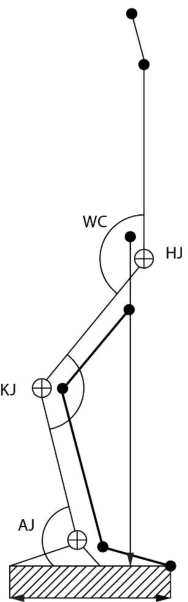
Equilibrium Condition Analysis We analyzed the balance condition of the whole body from the side view with respect to the support polygon. The vertical lowered from the common center of gravity will touch the support polygon in the area between the heel support and the device support. The support area of the sole is not sufficient to ensure balance. Additional support is needed.
The main factor that led to the vertical shift of the center of gravity is the insufficient dorsiflexion (dorsi-flexion) in the ankle joint, compared to the flexion in the knee and hip joints.
Comparing the posture with the conventional sitting one, we find similarities.
382 Moga and Moga
The thigh and partially the pelvic area rests on the device support. The weight of the torso is taken over by the resistance structure of the device and transmitted to the ground.
The vertical from the center of gravity is behind the plantar surface.
The differences are found in the degree of closure of the joints.
Flexion above 90 degrees at the hip and knee and dorsiflexion below 90 degrees at the ankle.
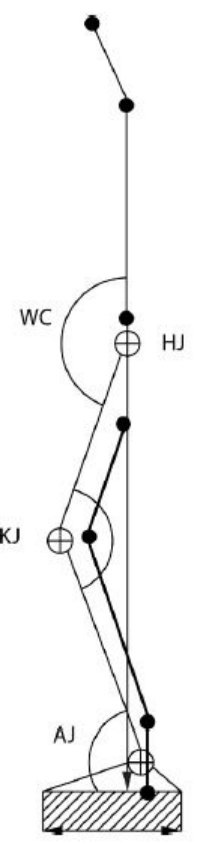
Balance Without Ground Contact/support The disappearance of the ground support would represent a simplification of the device’s structure. Postural geometry can be deduced using body segment analysis. We also chose the side view for modeling the sit standing station without rear support. On the schematic drawing, we modified the postural geometry in such a way that the vertical from the center of gravity projects before the ankle joint. The modification requires sufficient ankle dorsiflexion to accompany knee and hip flexion.
In the new configuration, ankle dorsiflexion and knee flexion rotate the centers of mass of the calf and thigh forward. The torso will keep the same configuration as in the orthostatic posture. The center of mass of the trunk will be lowered. The common center of gravity of the whole body can be projected in the same place as in the orthostatic posture (tarsal area, anterior to the ankle joint).
The biomechanical condition necessary to maintain this new posture resides in the ankle joint. Increasing dorsi-flexion means reducing the angle of the tibio-tarsal joint. The increase in the value of dorsiflexion must be achieved without reaching the functional limit. If we consider the limit at 20 degrees, the sensation of tension provided by the proprioceptors will be felt earlier. Three quarter of this value will provide the safety limit in maintaining ankle comfort.
Locking the flexion of the knee joint. Locking of flexion should be achieved to a sufficient value so that the tone of the lumbar muscles and abdominal antagonists is preserved. At the same time, too small a value of the angle between the thigh and the calf will put excessive stress on the knee. In the absence of a support on the ground, the weight of the trunk will be transmitted to the thigh through the hip joint. The prototype will drive the load to the back of the calf. From here, the transfer of the load will take place along the calf-ankle-plantar surface route.
The structural condition of the proptotype, necessary to maintain the new position, resides in knee flexion locking mechanism on demand. The mech- anism must allow climbing the steps, an activity for which the closing angle of the knee joint is lower than in the sit-standing position.
Also, another structural condition is the restraint on the calf and thigh, necessary to ensure wearability.Calf and thigh restraints must be indepen- dent of each other. The two contentions can be united precisely by the mechanism that ensures rotation in flexion-extension, as well as locking on demand.
Sit-Standing Posture and Chairless Chair. A Prototype Without Ground Contact 383
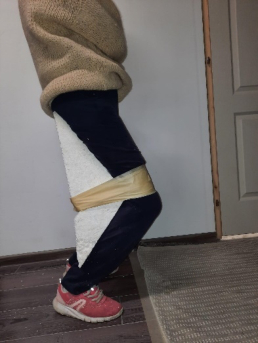
Verification of the Hypothesis The first attempt to test the hypothesis was to obtain a rapid primitive proto- type that would lock the knee flexion at a value of 120 degrees (see Figure 6). We proposed two triangular prisms, one for each knee. The prisms were cut from polystyrene for construction with a density of 40 kg per cubic meter. The prisms were placed in the popliteal fossa and were secured to the back of the thigh and calf by adhesive tapes. The relaxation of the postural muscles allowed bending the knee until the angle between the faces of the prism was reached (the chosen value being 120 degrees). The common center of gravity of the whole body remained above the tarsal region, providing a suitable bal- ance. Subjects successively tried the prototype in 15-minute intervals. Each time the subjects obviously felt the relaxation of the postural muscles but also the discomfort caused by the pressure exerted by the adhesive tapes.
Figure 6: Primitive prototype 1.
The second primitive prototype proposed three wooden pieces, articulated between them with a carpentry hinge (see Figure 7). Two pieces are attached to the thigh, respectively the calf, with the help of adhesive strips and the third can block the flexion by interposing between the first two. The flex lock value was chosen at the same value of 120 degrees. Thanks to the variable position, users were able to experience walking and sitting posture using this second primitive prototype. And for this case, the subjects reported relaxation at the level of the muscles of the posture. Due to the wooden material not adapted to the shape of the thigh and calf, discomfort was unavoidable.
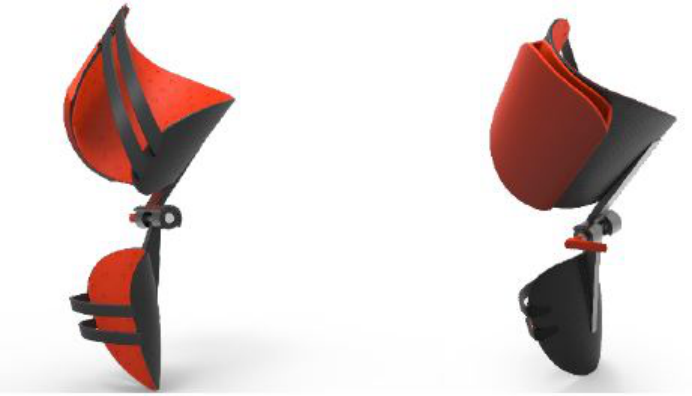
Once the postural muscle relaxation was achieved, it was necessary to con- tinue refining the prototype by developing the form and materials. Sketches and concept variants were developed for a better structure-form-user rela- tionship. One of the more structurally appropriate variants was agreed upon, providing lock at a fixed value, 150 degrees, manually actuated, consisting of three parts: the thigh restraint, the calf restraint, and the flexion hinge mechanism (see Figure 8). The hinge mechanism extends upwards and down- wards. The hinge extensions intervene in increasing the resistance, being
384 Moga and Moga
solidarized with the exoskeleton of the thigh and the calf, respectively. The coaxial components of the articulation mechanism also contain the flexion locking mechanism, to allow the transition to the sit standing posture.
Figure 7: Primitive prototype 2.Figure 8: 3D concept of the proposed wearable prototype.
After the 3D simulation stage, we were also able to create a prototype to support the hypothesis. In this case the resulting prototype presented major changes compared to the primitive models made at the beginning. We used plastic materials for the outer structure - polypropylene, and polyurethane foam for the inner part. The fastening on the lower limb was made with velcro strips. The articulation mechanism of the components together with the locking mechanism was made of steel. The prototype was worn by the
Sit-Standing Posture and Chairless Chair. A Prototype Without Ground Contact 385
team members for a much longer period of time, for the following activities: walking, climbing stairs and sit standing.
RESULTS
Positive results:
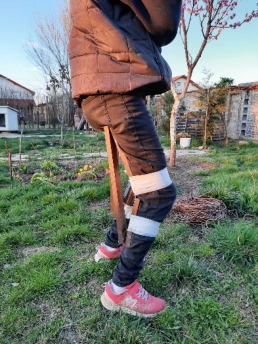
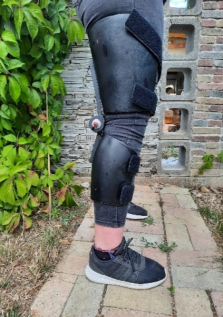
1. Postural muscle relaxation could be achieved for the sit standing position. 2. The comfort of the restraints is greatly improved thanks to the shape adapted to the morphology of the thigh and calf. 3. The support on the ground was achieved exclusively by means of the soles. 4. The user’s center of gravity has not changed its projection on the ground compared to the orthostatic posture. 5. Flexion locking is safe and easy to do. At the same time, getting out of the sit-standing position is done easily, by manually lifting and unlocking the mechanism (see Figure 9).
Figure 9: prototype worn by the user.
The prototype also showed some points that deserve improvement:
1. The entire hinge and locking mechanism, being made of solid steel, offered some degree of long-term discomfort. For safety reasons we opted for a significantly larger thickness than necessary for the steel components. 2. The adaptation of the restraint to the morphology of the thigh can be improved. 3. Cut-out thigh support allows for walking. However, there is still a ten- dency for the material of the contentions of the two thighs to rub against each other. 4. The fixed value of the knee flexion angle.
386 Moga and Moga
CONCLUSION
The prototype confirms the hypothesis, a wearable chairless chair/passive exoskeleton device can be developed, with no structural component in con- tact with the ground. The sit standing position is achieved only by locking the knee flexion while ensuring containment of the exoskeletal components on the thigh and calf. Locking the knee flexion provides sufficient relaxation of the postural muscles through hip flexion. Further refinement of the pro- totype, especially on the mentioned aspects, will improve the performance of the product.
ACKNOWLEDGMENT
The authors would like to acknowledge the contribution of the following partners: the Department of Design and Applied Arts within the Faculty of Arts and Design, West University of Timisoara, Triamed Romania, IT-Comp Service S.R.L.
REFERENCES
Capitani, S. L., Bianchi, M., Secciani, N. et al. (2021) Model-based mechanical design of a passive lower-limb exoskeleton for assisting workers in shotcrete projection. Meccanica 56, 195–210. https://doi.org/10.1007/s11012-020-01282-3 Du, Z., Yan, Z., Huang, T. et al. (2021) Mechanical Design with Experimen-
tal Verification of a Lightweight Exoskeleton Chair. J Bionic Eng 18, 319–332. https://doi.org/10.1007/s42235-021-0028-9 Irawan, A. P., Utama, D. W., Enru, A., Herlambang, S. (2019). Product design of chairless chair based on local components to provide support for active workers. IOP Conference Series. Materials Science and Engineering; Bristol Vol. 508, Iss. 1. DOI: 10.1088/1757-899X/508/1/012054. Masood, J., Dacal-Nieto, A., Alonso-Ramos, V., Fontano, M. I., Voilqué, A., Bou,
J. (2019). Industrial Wearable Exoskeletons and Exosuits Assessment Process. In: Carrozza, M., Micera, S., Pons, J.(eds) Wearable Robotics: Challenges and Trends. WeRob 2018. Biosystems & Biorobotics, vol 22. Springer, Cham. https://doi.org/ 10.1007/978-3-030-01887-0_45 Shah, M. D., Kulkarni, H. B., Joshi, R. S., Gejage, A. S., Kshirsagar, R. S., Todkari, K. N. (2019). Design and Fabrication of Wearable Chair. Journal of Emerging Technologies and Innovative Research, Volume 6, Issue 4, ISSN-2349-5162. Spada, S. et al. (2019). Physical and Virtual Assessment of a Passive Exoskeleton. In:
Bagnara, S., Tartaglia, R., Albolino, S., Alexander, T., Fujita, Y. (eds) Proceedings of the 20th Congress of the International Ergonomics Association (IEA 2018). IEA 2018. Advances in Intelligent Systems and Computing, vol 825. Springer, Cham. https://doi.org/10.1007/978-3-319-96068-5_28 Yong-Ku, Kong; Chae-Won, Park; Min-Uk Cho; Kim, Seoung-Yeon; Min-Jung, Kim; et al. (2021) Guidelines for Working Heights of the Lower-Limb Exoskele- ton (CEX) Based on Ergonomic Evaluations. International Journal of Envi- ronmental Research and Public Health; Basel Vol. 18, Iss. 10, (2021): 5199. DOI: 10.3390/ijerph18105199. Zhuo Ma, Jianbin Liu, Guoyu Ma, Jingshuo Gao, Baojun Chen, Siyang Zuo, (2022)
Lockable Lower Limb Exoskeleton Based on a Novel Variable-Stiffness Joint: Reducing Physical Fatigue at Squatting. Journal of Mechanisms and Robotics 15(5): 1-43 DOI: 10.1115/1.4055964.
LISTED IN THE AHFE DIGITAL BOOKSTORE CATALOGUE
Explore the complete digital volume
Human Systems Engineering and Design (IHSED 2023): Future Trends and Applications
Read this individual research paper free through the original publisher, or explore the full digital proceedings book.
ISBN 978-1-958651-88-9
Explore this ISBN in the AHFE Bookstore ↗Listed in the July 2026 bookstore catalogue; search by ISBN to confirm current availability · Digital book purchase optional