Xinyue Lei, Liqun Du (2023). The Past, Present and Future of the Metaverse Research: A Bibliometric Review. In: Human-Centered Design and User Experience. AHFE Open Access, vol. 114, pp. 706–714. https://doi.org/10.54941/ahfe1004291
Since the word “Metaverse” was first coined by the novelist Neal Stephenson in 1992, it has immediately shown endless charm and attracted many scientists, engineers, and geeks from all over the world to become its “vassals”. In recent years, with the development of virtual reality, blockchain and smart wearable devices, the idea of Metaverse seemed to be touchable and became a popular topic in academic literature. This study aims to highlight the influential authors, sources, institutions, and countries in the research of Metaverse through bibliometric analysis. 665 related documents from 1995 to 2023 January were collected and analyzed from the Web of Science Core Collection database. The R-tool Bibliometrix 4.0.0, and the software VOSviewer 1.6.19 were used to analyzed research trends. The results showed that almost 80% of the relevant documents was published in the past year. Wang Feiyue is the most relevant author with 17 articles. Sustainability, IEEE Access, and Applied Sciences Basel are influential journals in this field. Chinese Academy of Sciences is the most productive institution, and China is as well as the most productive country, while the United Kingdom is the most cited country. Furthermore, our study identified five research streams, which not only summarized current academic activities, but also provided potential directions for the future study.
Technological advancements consistently reshape society, propelling us into the burgeoning era of the metaverse—a fusion of physical reality and digi- tal simulation. In this realm, users, represented by avatars, engage within a virtual space reflective of the real world. The metaverse, spanning sectors from gaming and media to business and education, emphasizes a user-centric and immersive experience. Even in its infancy, the metaverse has witnessed impressive growth, with platforms like Decentraland, The Sandbox, Roblox, Somnium Space, and VoRtex emerging in response to heightened interest. Symbolic of a community, the metaverse operates on unique economic prin- ciples; NFTs and cryptocurrencies, for instance, serve as dominant currencies, and virtual assets range from intellectual property to digital collectibles and virtual real estate. Beyond merely being an application of computer science and engineering, the metaverse heralds a transformative phase in social civ- ilization, with potential impacts on human behaviours, emotions, laws, and
The Past, Present and Future of the Metaverse Research: A Bibliometric Review 707
ethics. Fundamentally, the metaverse represents a vision of the future internet society.
The academic community has exhibited a growing interest in metaverse research. Key research areas encompass the design of virtual environments (Cho et al., 2022), the conceptualization of avatars (Qi et al., 2022), the inno- vation in interaction technologies (Han et al., 2023), and the examination of social and economic dynamics (Shama et al., 2010) within virtual realms. Furthermore, scholars are delving into the ethical and legal ramifications of metaverses (Kshetri, 2022), addressing concerns related to privacy, owner- ship, and governance. Despite this flurry of activity, there remains a notable gap in bibliometric studies concerning the metaverse. A few have focused on niche areas, such as the application of the metaverse in education (Tas et al., 2022, Tlili et al., 2022), while others, due to their early publication dates, were limited by smaller dataset sizes of around 200 samples (Abbate et al., 2022, Feng et al., 2022). To address this gap, this paper offers a bibliometric examination of metaverse-centric literature, aiming to furnish a foundational schema for subsequent scholarly endeavours.
MATERIALS AND METHODS
For our study, we prioritized the Web of Science Core Collection (WoS) for data collection due to its high-quality metadata. Unlike Scopus, which stores the complete APA record within the manuscript, WoS provides detailed doc- ument information and pre-processes reference lists into discrete data points, such as first author, year, journal, and issue. On January 31st, 2023, we assembled a literature dataset using the search query “Topic=Metaverse*”. This captured articles with the term “Metaverse”or “Metaverses”in the title, abstract, or keywords. Initially, we identified 705 relevant documents from the WoS. After excluding 24 non-English articles and certain non-academic articles like book reviews, news items, and art exhibit reviews, our dataset was refined to 665 documents. For basic descriptive analysis, we employed the open-source tool, Bibliometrix 4.0.0 (Aria et al., 2017). It facilitated the collection of statistical results which we then consolidated into concise tables and visually engaging figures. For our science mapping analysis, we utilized the free software VOSviewer (van Eck et al., 2010). This tool enabled us to explore in-depth relationships and co-occurrence networks. Specifically, we presented a keyword co-occurrence clustering network. Given the dynamic nature of the Web of Science database, which often undergoes retrospective updates, we deliberately captured a snapshot of Metaverse research from 1995 to January 2023 by setting specific parameters. As the field continues to evolve, we anticipate that future bibliometric analyses could provide a richer and modified perspective on the topic.
RESULTS
Table 1 provides descriptive statistics of our dataset spanning from Jan- uary 1995 to 2023. Our dataset comprises 665 documents by 1,761 authors from 423 sources, with a total of 25,211 citations. There are 2,136 origi- nal author keywords, complemented by an additional 766 “keywords plus”
708 Lei and Du
generated by Clarivate’s algorithm. These “keywords plus” are sourced from common citation titles and can enhance bibliometric analysis accuracy. The average document is cited 5.135 times and has an age of 2.74 years, under- scoring the metaverse’s emergent research significance. Of the documents, 22.26% are single-authored, while 77.74% involve co-authors, averaging 3.44 co-authors per document. The international collaboration rate stands at 26.62%.
Table 1. Descriptive statistics.
Table available in the original PDF paper.
Description Results Timespan 1995-2023 Documents 665 Sources (Journals, Books, etc.) 423 Authors 1761 References 25211 Keywords Plus 766 Author’s Keywords 2136 Average Citations per Documents 5.135 Document Average Age 2.74 Single-authored Documents 148 Co-authored Documents 517 Co-authors per Documents 3.44 International Co-authorships % 26.62
Transitioning from the overall dataset characteristics, it’s pivotal to empha- size the interdisciplinary nature of Metaverse research. While the Web of Science database can allocate a single article to multiple related research areas, a clear concentration emerges as shown in Table 2. Predominantly, Metaverse studies align with science and technology sectors. The leaders are computer science (40.75% of total publications), followed by engineering and telecommunications. Despite the dominance of technology sectors, the inclusion of fields like business, economics, educational research, chemistry, environment, and physics within the top ten areas accentuates the breadth of Metaverse exploration. Together, these top ten fields account for 76.09% of all Metaverse-related publications, as discerned from our WoS data analysis.
Table 2. Research areas.
Table available in the original PDF paper.
Rank Research Areas Number of Documents Ratio 1 Computer Science 271 40.75% 2 Engineering 178 26.77% 3 Telecommunications 63 9.47% 4 Business, Economics 60 9.02% 5 Science Technology Other Topics 45 6.77% 6 Education, Educational Research 38 5.71% 7 Chemistry 35 5.26% 7 Materials Science 35 5.26% 9 Environmental Sciences, Ecology 30 4.51% 10 Automation Control Systems 29 4.36% 10 Physics 29 4.36%
The Past, Present and Future of the Metaverse Research: A Bibliometric Review 709
In tandem with the diverse range of research areas contributing to Meta- verse studies, the sources of these studies are equally diverse. Although the Metaverse topic has notably gained traction in just a year, making citation metrics like h-index and g-index less compelling currently, total publications serve as our benchmark for core sources, authors, institutions, and funding bodies. For clarity, the h-index measures both the productivity and citation impact of publications, while the g-index gives more weight to highly cited papers.
Table 3 elucidates the leading sources for Metaverse research based on productivity. Notable highlights include the journal Sustainability, leading in most bibliometric metrics with 20 publications and 55 citations, boasting an h-index of 5 and a g-index of 7. The 2022 IEEE Conference on Virtual Reality and 3D User Interfaces Abstracts and Workshops stands out as the most prolific conference, featuring 14 papers. On the publisher front, MDPI and IEEE dominate, underlining their pivotal role in cutting-edge technology research sectors, including the Metaverse.
Many papers in our sample involve collaborations, sometimes between authors from different countries. Therefore, we examined the countries of 638 corresponding authors in our dataset, excluding 27 documents due to missing corresponding author information. Table 4 displays the top ten most productive countries of these corresponding authors. Evidently, China leads with 169 documents, making up 26.5% of total publications. The United States and Korea trail closely with 80 and 77 documents, each account- ing for roughly an eighth of the total Metaverse-related publications. When considering international collaborations, European authors stand out. Ger- many boasts the highest rate of international co-publications at 50%, with the United Kingdom and Spain trailing at approximately 40% of their publications.
Table 4 also provides cumulative citation data by country or region. The United Kingdom’s publications top the list with the highest total citations (1,611) and an average citation count of 35.02, indicating significant aca- demic impact. The United States, South Korea, and China also excel in total citations, though their average per paper falls short when compared to the United Kingdom. The high average citation count for the United Kingdom suggests the superior quality of its scientific contributions.
710 Lei and Du
Table 4. Country statistics.
Table available in the original PDF paper.
Rank Country Total Publication Rank Country Total Citation Average Citation 1 China 169 1 UK 1611 35.02 2 USA 80 2 USA 523 6.54 3 Korea 77 3 Korea 366 4.75 4 UK 46 4 China 224 1.33 5 Turkey 23 5 France 64 5.82 6 Germany 22 6 Germany 56 2.55 7 Italy 21 7 Spain 50 2.63 8 Spain 19 8 Japan 48 3.69 9 Japan 13 9 Italy 46 2.19 10 Canada 12 10 Finland 38 7.60
Table 5. Funding agencies.
Table available in the original PDF paper.
Rank Funding Agency Total Publication
Country/ Region
12 China
1 National Natural Science Foundation of China 63 China 2 National Research Foundation of Korea 25 Korea 3 National Key Research and Development Program of China
8 Macau
4 Ministry of Science & ICT, Republic of Korea 10 Korea 5 Ministry of Education Moe, Republic of Korea 8 Korea 5 Science and Technology Development Fund Macau SAR
7 Korea
7 Ministry of Science & ICT Future Planning, Republic of Korea 8 European Commission 6 EU 8 Ministry of Education, Singapore 6 Singapore 8 National Research Foundation, Singapore 6 Singapore 8 National Science Foundation 6 USA
Table 5 lists the top ten funding agencies for Metaverse-related research in our dataset. The National Natural Science Foundation of China emerges as the leading sponsor, backing 63 documents, which account for 9.4% of total publications on the subject. It’s closely followed by the National Research Foundation of Korea, which funded 25 documents, representing 3.8%. Remarkably, four of the top ten sponsors for Metaverse studies hail from Korea. This underscores a significant initiative by the Korean govern- ment, pointing to a concerted effort to collaborate with the industry and amplify the advancement of metaverse technologies and ecosystems for future generations.
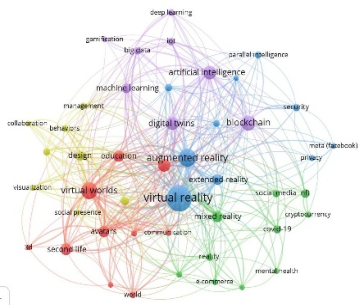
To gain deeper insight into the relationships among keywords, we employed VOSviewer to create a network map and categorize them into distinct clusters. For this analysis, we combined both “author key- words” and “keywords plus” to form cohesive keyword clusters. Corre- sponding to Table 6, Figure 1 displays the interlinked keyword clusters, which coalesce into five distinct groups, each represented by a different colour.
The Past, Present and Future of the Metaverse Research: A Bibliometric Review 711
Table 6. Keywords clusters.
Table available in the original PDF paper.
Cluster Keywords 1 (red) 3D; Avatars; Communication; Education; Internet; Second Life; Students; Virtual Environments; Virtual Words; World 2 (green) Covid-19; Cryptocurrency; E-Commerce; Environments; Mental Health; Mixed Reality; NFT; Reality; Social Media; Telepresence 3 (blue) Augmented Reality; Extended Reality; Games; Meta (Facebook); Parallel Intelligence; Privacy; Security; Solid Modeling; Virtual Reality 4 (yellow) Behaviors; Collaboration; Design; Immersion; Management; Performance; Social Presence; Visualization 5 (purple) Artificial Intelligence; Big Data; Blockchain; Deep Learning; Digital Twins; Gamification; IOT; Machine Learning
Figure 1: Keywords clusters.
Cluster one, highlighted in red, delves into avatars and the sociology of metaverses. On one hand, avatars in the metaverse represent human users (Qi et al., 2022). They have evolved from mere emblematic symbols, akin to the two-dimensional profile photos commonly used online today, into three- dimensional virtual “puppets” that mirror users’ body language, gestures, tone, and even attitudes (Cho et al., 2022). This provides a depth to inter- actions in the metaverse, making them richer than those on the traditional internet and more akin to real-life interactions. Conversely, the virtual com- munities formed by these avatars also mirror characteristics of human society (Bibri, 2022). Within this space, users can engage in a plethora of activities ranging from work and education to communication and commerce. This includes buying virtual real estate, running schools, selling virtual goods, and even establishing families in the virtual realm. Personal spaces can be designed and constructed, friends invited over for games and social interactions. And with the advancement of 3D technology, facial expressions and body lan- guage of avatars can be discerned in detail, making interactions more vivid and lifelike.
The second research stream, highlighted in green, delves into the busi- ness and financial models within the metaverse. Central to this cluster
712 Lei and Du
are keywords such as “cryptocurrency”, “non-fungible token (NFT)”, and “e-commerce”. Within the metaverse’s electronic business model, cryptocur- rencies function as the circulating currency (Vidal-Tomas, 2022). Asset rights are solidified in the form of NFTs. The blend of blockchain and NFT technologies paves the way for near-indisputable, traceable, and dis- tributed ledgers. Within these ledgers, crypto-tokens and smart contracts are orchestrated to function seamlessly (Dai, 2022). The recorded transactions pertaining to the transfer of cryptocurrencies not only indicate ownership chains of specific virtual assets, such as art and land, but also validate the transaction’s authenticity on the blockchain. This equips e-commerce plat- forms with enhanced tools to fortify user security and privacy. Essentially, the metaverse can be conceptualized as a vast, accessible digital realm where individuals can acquire and safeguard virtual assets.
The third cluster, highlighted in blue, explores the nexus between the meta- verse and reality, coupled with the ethical dimensions within the metaverse. The metaverse is recognized as a simulation, enhancement, and reimagining of the tangible world. Central to the metaverse’s framework is augmented reality (AR), a technology that melds virtual elements with the real world, typically facilitated by electronic devices, like smartphone or tablet apps (Rauschnabel et al., 2022). A common application infuses the real-world environment with added information, entertainment, or experiences to ele- vate the user’s sensory journey. Pokémon Go stands as a testament to AR’s successful deployment. Conversely, virtual reality seeks to employ computer algorithms to sculpt an enveloping virtual realm for uninhibited exploration. Broadening the scope, extended reality encompasses an array of metaverse technologies, including virtual reality, augmented reality, and mixed reality, with a vision to fuse the physical and virtual domains. Beyond technological innovations, it’s imperative to mull over ethical and legal implications. Foun- dational to the metaverse should be robust privacy and security measures. Historically, momentous technological leaps invariably usher in a cascade of societal and legal challenges (Kshetri, 2022). Prospective metaverse research might pivot to harnessing novel technologies to fortify individual user secu- rity and privacy. Clear directives from governing bodies on the collection, utilization, and ownership of voluminous data are essential.
The fourth cluster, highlighted in yellow, delves into the abstract philoso- phies underpinning the metaverse. Emphasizing terms such as “behaviour”, “collaboration”, “design”, “management”, and “social presence”, this grouping encapsulates a user-centric design ethos. With the rising ubiquity of the metaverse, both researchers and product managers are pivoting towards tailoring virtual landscapes and interactions to human inclinations and pat- terns. This entails drawing insights from a myriad of social science fields including anthropology, psychology, sociology, and management. Through a deep dive into human behavioural ecology, scholars are equipped to unravel the intricacies of human comportment, subsequently enabling them to dig- itally replicate these behaviours (Shen et al., 2021). Probing the dynamics of human collaboration paves the way for pioneering interfaces, tools, and algorithms that bolster remote teamwork and elevate efficiency. Further- more, understanding the nuances of human social interactions offers the
The Past, Present and Future of the Metaverse Research: A Bibliometric Review 713
potential to craft logical social frameworks that promote mutual engage- ment and synergy amongst users (Zhang et al., 2022). This paradigm champions the ethos of user-centric design, underscoring the premium on user experience and enriching the genuineness of human-computer interfaces.
The fifth cluster, represented in purple, delves into the interplay between big data, machine learning, artificial intelligence (AI), and the metaverse. Employing big data technologies, vast volumes of data, spanning user behaviours to transactional records, can be culled from the metaverse’s milieu (Zhou, 2022). Leveraging this treasure trove of information, software experts are pioneering deep learning architectures, such as intricate neural networks tailored for virtual spaces and applications (Cho et al., 2022). Riding on this big data wave, AI algorithms are honing their prowess in natural language processing and computational aptitude through deep learning. Currently, AI’s foray into domains like voice and facial recognition, content genesis, and board games like chess has reached a notable degree of maturation. The research trajectory is poised to veer towards intricate endeavours, such as logic-driven problem-solving. These cutting-edge technological evolutions are primed to propel the metaverse into arenas as diverse as mathematics, finance, computing, and defence.
CONCLUSION
In a comprehensive bibliometric analysis of metaverse-related literature, this study found that computer science dominates, accounting for 40% of pub- lications. The journal “Sustainability” has distinguished itself since 2021 in terms of volume and h-index, becoming indispensable for metaverse stakeholders. While China leads in research output, the UK has the most citations, and the Korean government provides significant funding support. Our scientific mapping delineated five keyword clusters that encapsulate the metaverse’s multifaceted essence. These clusters weave together technological innovations, societal dynamics, ethical concerns, and commerce. Key areas include the sociology of avatars, the economics of virtual assets, advance- ments in AR, VR, MR, and XR, legal considerations for user safety and privacy, and the human-centric design philosophy. Furthermore, the nexus of big data, machine learning, and artificial intelligence with the metaverse highlights the importance of an interdisciplinary approach, especially the incorporation of social sciences.
REFERENCES
Abbate, S., Centobelli, P., Cerchione, R. et al. (2022). “A first bibliometric literature review on Metaverse”, proceedings of the 2022 IEEE Technology and Engineering Management Conference (TEMSCON Europe), pp. 254–260. Aria, M., Cuccurullo, C. (2017). Bibliometrix: An R-Tool for Comprehensive Science
Mapping Analysis, JOURNAL OF INFORMETRICS Volume 11 pp. 959–975. Bibri, S. E. (2022). The Social Shaping of the Metaverse as an Alternative to the Imaginaries of Data-Driven Smart Cities: A Study in Science, Technology, and Society, SMART CITIES Volume 5 pp. 832–874.
714 Lei and Du
Cho, Y., Hong, S., Kim, et al. (2022). DAVE: Deep Learning-Based Asymmetric Virtual Environment for Immersive Experiential Metaverse Content, ELECTRON- ICS Volume 11. Dai, W. (2022). Optimal Policy Computing for Blockchain Based Smart Con-
tracts Via Federated Learning, OPERATIONAL RESEARCH Volume 22 pp. 5817–5844. Feng, X., Wang, X. and Su, Y. (2022). An Analysis of The Current Status of Metaverse Research Based on Bibliometrics, LIBRARY HI TECH Volume ahead-of-print. Han, E., Miller, M. R., DeVeaux, C., et al. (2023). People, Places, and Time: A Large-
Scale, Longitudinal Study of Transformed Avatars and Environmental Context in Group Interaction in The Metaverse, JOURNAL OF COMPUTER-MEDIATED COMMUNICATION Volume 28. Kshetri, N. (2022). Policy, Ethical, Social, and Environmental Considerations of Web3 and the Metaverse, IT PROFESSIONAL Volume 24 pp. 4–7. Qi, Y., Zou, Y., Peng, K., et al. (2022). The Avatar-Prioritization Effect Among
Online Gamers: A Perspective from Self-Avatar Identity Relevance, JOURNAL OF APPLIED RESEARCH IN MEMORY AND COGNITION Volume ahead-of- print. Rauschnabel, P. A., Babin, B. J., Dieck, M. C. T. et al. (2022). What is Augmented Reality Marketing? Its Definition, Complexity, and Future, JOURNAL OF BUSINESS RESEARCH Volume 142 pp. 1140–1150. Sharma, G., Qiang, Y. and Wenjun, S. (2010) “Communication Behavior and
E-Business Opportunities in Virtual Environment: A Case Study in Second Life”, proceedings of the Ninth Wuhan International Conference on E-Business, Wuhan, CHINA. Shen, B., Tan, W., Guo, J. et al. (2021). How to Promote User Purchase in Metaverse?
A Systematic Literature Review on Consumer Behavior Research and Virtual Commerce Application Design, APPLIED SCIENCES-BASEL Volume 11. Tas, N., Bolat, Y. I. (2022). Bibliometric Mapping of Metaverse in Education, INTERNATIONAL JOURNAL OF TECHNOLOGY IN EDUCATION Volume 5 pp. 440–458. Tlili, A., Huang, R., Shehata, B. et al. (2022). Is Metaverse in Education a Blessing or
a Curse: A Combined Content and Bibliometric Analysis, SMART LEARNING ENVIRONMENTS Volume 9. van Eck, N. J., Waltman, L. (2010). Software Survey: VOSviewer, a Computer Program for Bibliometric Mapping, SCIENTOMETRICS Volume 84 pp. 523-538. Vidal-Tomas, D. (2022). The New Crypto Niche: NFTs, Play-To-Earn, and Meta-
verse Tokens, FINANCE RESEARCH LETTERS Volume 4. Zhang, G., Cao, J., Liu, D. et al. (2022). Popularity of the Metaverse: Embodied Social Presence Theory Perspective, FRONTIERS IN PSYCHOLOGY Volume 13. Zhou, M. (2022). Evolution from AI, IoT and Big Data Analytics to Metaverse,
IEEE-CAA JOURNAL OF AUTOMATICA SINICA Volume 9 pp. 2041–2042.
LISTED IN THE AHFE DIGITAL BOOKSTORE CATALOGUE
Explore the complete digital volume
Human-Centered Design and User Experience
Read this individual research paper free through the original publisher, or explore the full digital proceedings book.
ISBN 978-1-958651-90-2
Explore this ISBN in the AHFE Bookstore ↗Listed in the July 2026 bookstore catalogue; search by ISBN to confirm current availability · Digital book purchase optional