Adrian Flowers, Arthur Wollocko, Caroline Kingsley, Elizabeth Thiry, Michael Jenkins (2023). Degradation in dynamic visual perception with waveguide-based augmented reality displays. In: Augmented, Virtual and Mixed Reality Simulation. AHFE Open Access, vol. 118, pp. 184–195. https://doi.org/10.54941/ahfe1004453
We investigated the degradation in visual perception that can occur using augmented reality displays to interact with and interpret real-world reading and spatial response tasks.Background: Stereoscopic augmented reality displays can degrade a user’s visual perception. To distinguish the components of this degradation that result from hardware and software differences, an analysis of this visual degradation for contemporary augmented reality displays is necessary.Method: Participants performed real-world (i.e., not projected in augmented reality) eyechart tests of visual acuity and contrast sensitivity to characterize the degradation of static visual perception caused by each headset in the study (Microsoft HoloLens, Magic Leap One, and DAQRI Smart Glasses), and took a measure of useful field of view to characterize any potential degradation in spatial awareness.Results: From our analysis of user performance, we observed that unlike the headsets previously used for this type of characterization, the majority of contemporary augmented reality displays do not significantly degrade visual perception. However, we did observe slight decreases in visual performance introduced by the Magic Leap One.Conclusions: We defined a methodology to employ real-world measures of visual perception to rapidly characterize degradation of visual perception in augmented reality.Applications: This analysis can inform headset selection and visual stimulus design strategies based on operational requirements and inform future headset development efforts.
Augmented Reality (AR) is the augmentation or enhancement of the real world with simulated sensory stimuli. AR, in the context of this article, will refer to stereoscopic visual augmented reality, where a head-mounted dis- play will overlay virtual visual objects into a real-world scene. These displays use a variety of approaches and techniques to provide the illusion of depth
to increase the realism of these combined virtual and real-world settings. In providing the capability for users to interact with virtual objects in a real- world setting, AR has several uses in multiple domains. Key examples include medical training skills (Birkfellner et al., 2002; Moult et al., 2013; Webel et al., 2011), where trainees are able to practice surgical techniques at a low cost in a real-world environment, and maintenance training (Webel et al., 2011), where virtual stimuli are presented and sensing technologies can track training performance and provide real-time feedback. Beyond the usage for training, there is also interest in the use of AR to provide real-time guidance for complex processes (Henderson & Feiner, 2009; Webel et al., 2011), in which AR could enable a medic or technician to have critical information available to them at all times.
AR is known to impair visual perception. The breadth of these percep- tual impairments differs across AR headsets and the technology that drives them (M. Livingston, 2006; M. A. Livingston et al., 2013), but the impact they have on user performance can be catastrophic depending on the use case. This is particularly true for the use of AR for real-time guidance, which can be applied for emergency medical care and on military battlefields. If medical care practitioners make use of an AR system to provide unobtrusive assessment during an emergency medical operation (Wu et al., 2014) and it degrades their ability to detect minute abnormalities in a patient, it can lead to a life-threatening situation. Similarly, if military Warfighters make use of AR in a tactical environment and the use of AR degrades the Warfighters’ ability to respond to new and emergent threats in their surroundings, it can put their lives and the lives of others at risk.
It is likely that, as a consequence of reducing a user’s ability to parse visual information and to understand the space around them, the use of AR headsets will also degrade a user’s spatial awareness, reducing their ability to recognize and reason about visual content. If this is the case, it could have potentially hazardous results in any industry that requires rapid response to emergent threats acquired visually.
This degradation in visual perception can occur for both software design and hardware reasons. From a software and technology perspective, one of the major inducers of visual discomfort with stereoscopic AR HMDs is the way such technologies simulate stereoscopic depth. This simulation of depth, while potentially convincing, does not fully account for the way that the human eye focuses on real-world visual stimuli. When this process occurs naturally, we observe two phenomena: vergence and accommodation. Ver- gence is the process by which both eyes rotate in opposite directions such that the fovea of each eye points toward the target visual stimuli. Accommo- dation is the process by which the lens of each eye will converge or diverge to absorb the expected amount of light coming from the target visual stimuli. When focusing on real-world stimuli, these two processes occur simultane- ously in what is known as the Vergence-Accommodation Reflex. AR HMDs vary the perceived spatial location of virtual objects between the retinae, which will trigger vergence, but the degree of light coming from the target virtual visual stimuli may not match the perceived distance. This requires the brain to process vergence and accommodation separately. The added diffi- culty of processing visual stimuli where vergence and accommodation are
not fused, known as Vergence-Accommodation Conflict (VAC), will result in visual discomfort (Shibata et al., 2011).
From a hardware perspective, this degradation in visual performance is evident in the study by Ren et al. (2016) on the effect of a low field of view on task completion. In this study, participants were asked to complete a set of tasks using a reduced field of view, which resulted in an increase in task com- pletion. However, this study cannot generalize to contemporary commercial augmented reality displays. The study by Ren et al. (2016) used a simulated augmented reality display, which is not reflective of the design of a real-world display. Furthermore, this simulated display was based on a cellphone dis- play rather than a Stereoscopic AR display, which introduces a unique set of challenges caused in part by the visual strain required for the human opti- cal system to resolve stereoscopic virtual stimuli (Hoffman et al., 2008). For testing of user performance in AR to be ecologically valid, a stereoscopic AR headset is necessary.
All users of stereoscopic displays (stereoscopic 3D monitors, VR, and AR) are vulnerable to optical issues if VAC is induced. Certain populations, how- ever, are expected to exhibit more issues with AR than the general population (e.g., those with stereoblindness or who are prone to migraines). Further- more, the populations that are at increased risk of VAC-induced issues are highly prevalent in military medic populations. One of the optical issues known to negatively impact stereoscopic displays is stereoblindness, the par- tial or complete inability to perceive stereoscopic depth (Lambooij et al., 2009). Stereoblindness affects 10% of the population and can occur as a result of a traumatic brain injury (TBIs). While easily detectable, stereoblind- ness is not commonly screened in non-pilot populations. Users prone to migraines are also prone to experiencing issues with visual discomfort (Mar- cus & Soso, 1989). Roughly 13% of the general population experiences migraines. However, the prevalence of migraines can be significantly higher among military populations. A study on Warfighters returning from Oper- ation Iraqi Freedom noted that 19% of the Warfighters screened exhibit migraines, and an additional 17% exhibit possible migraines (Theeler, Mer- cer, and Erickson, 2008). Furthermore, due to the comorbidity of balance disorders and anxiety with the prevalence of migraines (Balaban et al., 2012), users with balance and anxiety disorders will also be at an increased risk of experiencing AR-induced visual fatigue and eyestrain. These factors put mili- tary populations at a significantly higher risk of suffering AR-induced optical issues than the general population, creating a powerful invisible danger in the implementation of AR technology.
Mitigation strategies for VAC and other factors that can result in the degra- dation of visual perception can be performed at the hardware level; however, there is no commercially available universal solution, and modern HMDs mitigate (or worsen) these factors in different ways in their current designs. The method used to project holographic imagery onto a user’s retina will impact the expression of VAC within a stereoscopic AR display (Kramida, 2016). In particular, the projection method will determine the perceived accommodation depth for the AR display. One popular strategy to expand the range of the perceived accommodation distance is the use of dual depth
Degradation in Dynamic Visual Perception 187
planes; this is the mitigation technique used by the Microsoft HoloLens. When using dual depth planes, there are two optimal distances to display virtual stimuli, enabling users to safely focus on virtual stimuli at either depth plane. However, in forcefully attempting to simulate the infinite depth planes of real life into two compressed, predefined depth planes, the approach introduces visual artifacts at regions between the depth planes (Turner et al., 2018). In this study, we researched the effects of modern AR headsets’ mitiga- tion techniques on perceptual capability in depth. No current commercially available method mitigates VAC effectively.
Software-based mitigation strategies involve the placement of virtual stim- uli. Manufacturers of AR displays commonly instruct developers to limit the projection of virtual stimuli to the perceived accommodation distance (Turner et al., 2018). This approach gives the virtual stimuli the appearance of properly fused stimuli because the vergence and accommodation depths will match, reducing optical strain (Lambooij et al., 2009). However, most of the time, virtual stimuli cannot be placed exactly at an AR display’s per- ceived accommodation depth. Particularly within domains that require highly specialized stimuli, such as military medical training, the application sim- ply cannot tailor to perceived accommodation depth requirements. One key advantage of AR is the opportunity to align virtual stimuli with real-world objects (e.g., presenting virtual stimuli that represent wounds on a real-world patient), which is dependent on precise spatial orientation with respect to those real-world objects. Furthermore, research also suggests that certain design strategies will increase the strain on the optical system, such as virtual stimuli that cause the vergence and accommodation processes to separate at high speeds (Kim et al., 2014). While many factors that affect visual process- ing in stereoscopic AR are known within the research domain, the use of these factors toward the development of targeted application design guidelines for modern AR development is understudied. To support the development of such a guideline, it is necessary to develop a thorough characterization of the impact of AR displays on visual perception from both a hardware and software design perspective.
To characterize these risks and the variance of these risks across head- sets, we performed a set of human-subject research studies focused on the degradation of real-world perceptual capabilities that occurs when using AR. Specifically, this study is concerned with the degradation that occurs due to hardware design and the projection method used by each headset, indepen- dent of software design. In a follow-up study, we plan to characterize how software design and placement of strategies for projected virtual stimuli affect visual perception and spatial awareness.
METHODS
Design of Study To better characterize the visual degradation of visual perception caused by the design of AR displays, we performed two sets of studies that received approval by the New England Institutional Review Board. The first study was based on the work of M. Livingston (2006), wherein we quantified the
degradation of basic perceptual capabilities caused by the use of AR using contemporary AR headsets.
The second study measured the dynamic functional impairment of a user’s spatial awareness through the use of the gaze-contingent useful field of view assessment (Ringer et al., 2016) while participants wore an AR headset.
To ensure that we tested both the effect of the design of the AR display and any potential effects caused by the projection method used by each AR display, if a participant used the headset for a trial, the headsets would project a blank, transparent canvas during the trial. This research complied with the American Psychological Association Code of Ethics and was approved by the New England Independent Review Board. Informed consent was obtained from each participant.
Equipment For both studies, AR headsets were used with waveguide optical combin- ers. Specifically, we used the Microsoft HoloLens, which uses a diffractive waveguide; the Magic Leap One, which also uses a diffractive waveguide; and the DAQRI Smart Glasses, which use a reflective waveguide. For the baseline condition, we had participants perform the task on a desktop PC with a traditional 2D monitor.
Laboratory Conditions The laboratory was lit with two 120V Photoflood Lamps with a 3200K tung- sten color temperature. The environment was kept in photopic conditions.
Study 1 Our first study focused on analyzing the degradation of a user’s basic visual perceptual capabilities when using AR using real-world measures of contrast sensitivity and visual acuity. Unlike previous studies on the degradation of visual perception in AR, we did not find a significant degradation in visual perception for AR headsets other than the Magic Leap One.
This study is based on a study by M. Livingston (2006) to measure these same basic perceptual characteristics in augmented reality. In Livingston’s original study, users looked through see-through augmented reality headsets at a 2D computer monitor. They performed the Landolt-C test to mea- sure their visual acuity and a custom experimental task to measure contrast sensitivity.
Unlike the Livingston study, we made use of physical eye charts that would be used to measure visual acuity and contrast sensitivity. This increases the reliability and repeatability of the task because experimenters are not required to perform monitor and resolution-specific configurations to ensure proper task configuration.
Methodology
This study was a repeated measure study with 27 participants. All par- ticipants reported that they had 20/20 vision. Participants were randomly assigned one of three AR headsets: a Microsoft HoloLens, a Magic Leap One,
Degradation in Dynamic Visual Perception 189
or DAQRI Smart Glasses. Participants read from both eye charts using the assigned AR headset and without the headset (i.e., the control). Participants’ initial trial, beginning either with the control or AR, was randomized.
To measure contrast sensitivity, participants read from a Pelli-Robson chart. The Pelli-Robson chart presents rows of letters with decreasing lev- els of contrast every three letters. When using this chart, participants read all the letters they were able to see. The last triple in which a participant can read two-thirds of the letters determines the participant’s contrast sensitivity.
The eye chart used to evaluate visual acuity was a tumbling E chart. A tumbling E chart presents rows of rotated Es, where the size of the Es in each row is smaller than the previous row. Participants must read through the chart and identify the orientation of the Es in each row. The participant’s contrast sensitivity was determined by the final row in which said participant could correctly identify the orientation of over half of the Es.
Results
To analyze the impact of AR on basic visual perception, we took the differ- ence between a user’s score from the control trial and their score with the headset. We then used the Mann-Whitney test on this difference to see if the user’s contrast sensitivity or visual acuity had degraded through use of the headset. We did not find evidence that the DAQRI Smart Glasses or the Microsoft HoloLens caused a significant degradation of real-world visual capabilities; however, we did find that with a 0.05 significance level, the Magic Leap One will likely degrade a user’s contrast sensitivity. Similarly, we found that at a 0.1 significance level, the Magic Leap One will likely degrade real-world visual acuity. The user characteristics for the contrast sensitivity and visual acuity tasks are provided in Table 1 and Table 2, respectively.
Table 1. Contrast sensitivity characteristics.
Table available in the original PDF paper.
Headset Sample Size Mean Standard Deviation Smart Glasses 8 0 0.756 Magic Leap One 10 −0.7 0.67 HoloLens 9 −0.111 0.333
Table 2. Visual acuity characteristics.
Table available in the original PDF paper.
Headset Sample Size Mean Standard Deviation Smart Glasses 8 0.143 0.69 Magic Leap One 10 −0.5 0.97 HoloLens 9 0 0.5
DISCUSSION
Other than the Magic Leap One, which reduced both contrast sensitivity and visual acuity, both the HoloLens and the Smart Glasses had no large impact on basic visual perception capabilities. This finding is encouraging because
previous studies on visual perception in AR using similar methods suggest significant degradation. It suggests that when users are expected to purely interact with and process real-world visual stimuli while wearing an AR headset in a non-time-limited setting, they can be expected to do so without impairment.
STUDY 2 The impact of improperly designed AR displays on spatial awareness is well known among designers of heads-up displays (HUDs) for pilots (Foyle et al., 2005), who follow specific design characteristics for AR displays to keep pilots safe. Relevant information is well documented in literature on the Use- ful Field of View (UFOV), a test that evaluates how well participants can resolve visual stimuli in their periphery while simultaneously focusing on a primary visual stimulus (Ren et al., 2016). UFOV studies suggest that primary visual stimuli that result in a high cognitive foveal load can induce tunnel vision (Ringer et al., 2016), significantly reducing an individual’s ability to react to stimulus the further it is from the primary stimulus.
Cognitive foveal load is cognitive load that is induced through stimuli that require an individual to focus the fovea of their vision. AR in particular is known to be taxing on the visual system, quickly causing users eyestrain and visual fatigue (Hoffman et al., 2008), which is exacerbated when users are required to rapidly switch between real-world and virtual visual stimuli.
UFOV sees extensive use in studies on driver safety and has been directly correlated with drivers’ accident risk changing over time (Park & Reed, 2010) through evaluation of their ability to respond to unexpected visual events.
In this study, we used the UFOV to measure the potential degradation in spatial awareness that results from the use of an AR headset. This analysis enables us to baseline the performance of users on multiple contemporary AR headsets without the induction of VAC to assist in a future study on the impact of increased foveal load caused by AR-induced VAC.
Useful Field of View Task Design The UFOV task used in this study consisted of two simultaneous sub-tasks: a peripheral vision response task and an attentional task on a non-visual modality. For the peripheral vision response task, participants were tasked with focusing on a central fixation point during the study while secondary visual stimuli appeared in their periphery. The attentional task was an audi- tory n-back task, where participants were asked to listen to a series of numbers and provide a response if matching numbers were presented.
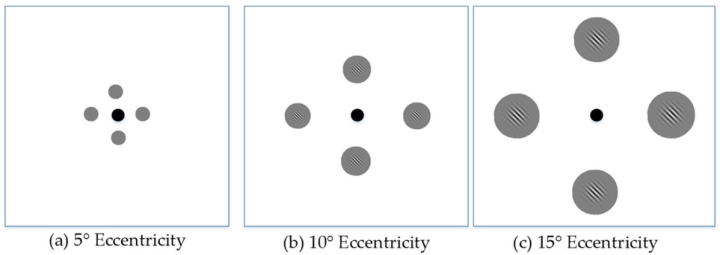
Peripheral Vision Response Task The peripheral vision task was designed to evaluate the amount of time required for participants to resolve stimuli in their periphery. To investigate this, participants were instructed to focus on a dot placed at the center of the screen. While the participant focused on this dot, at a random interval between one and three seconds, a set of four Gabor patches would appear at either a 5
, 10
, or 15
eccentricity from the fovea of the participant’s
Degradation in Dynamic Visual Perception 191
vision. An example of the stimuli for each of the three eccentricities is shown in Figure 1.
Figure 1: Example visual stimuli in periphery response task.
When presented to the participant, Gabor patches were rotated to the left or right by 45
, and the participant was required to resolve the direction of the patch. Because objects in the visual periphery are more difficult to resolve the further they are from the fovea, the size of the Gabor patches presented to participants was scaled based on offset the eccentricity of the patch. The equations used to determine the size and frequency used for the Gabor patches at the 5
, 10
, and 15
eccentricities matched those used in Gaspar et al. (2016) and Ringer et al. (2016).
When the Gabor patches appeared to participants, the length of time they would remain visible on the screen was dynamic and determined using an interleaved staircase model, with one staircase per eccentricity. This staircase model was used to determine the minimum processing time required for the participant to correctly resolve the orientation of the Gabor patches at each eccentricity. The three staircases were randomly interleaved. The minimum time a Gabor patch would remain on the screen was 50ms, and the maximum time 500ms. The step size was 16ms, and the initial time was 150ms. The staircases used a 3-down 1-up model. Each staircase terminated after three reversals.
Auditory n-Back An auditory n-back was necessary for this study to increase the difficulty of the peripheral vision response task. Without the use of a task to increase the cognitive load of participants, not only is it likely that many participants would finish the task, but using a simultaneous task also increases the realism of a task that would be performed by an end-user who had to be aware of their real-world surroundings while working in AR. A non-visual attentional task had to be used because studies show that visual attentional tasks that increase foveal load can introduce a tunnel vision effect.
The auditory n-back task was a 2-back number recall task. For this task, participants would hear a series of spoken numbers in random order. If the most recent number stated was identical to the number two previous, the
participants were required to press a button to confirm that the numbers were identical. The numbers were stated to participants in a randomized order, with a 25% chance for every other number to be identical.
Methodology
Participants took this study on a 2D desktop monitor. The study was a repeated measure, where participants would both view the monitor while wearing an AR headset and without wearing an AR headset (e.g., the con- trol). The AR headsets were configured to project a transparent canvas over the monitor that displayed the visual stimuli. The headsets used for this study were the Microsoft HoloLens, the DAQRI Smart Glasses, and the Magic Leap One. The headset used by each participant was randomly selected. Whether a participant began the study wearing an AR headset or without a headset was randomized. Thirty-four participants completed this study.
Results
Our null hypothesis for this investigation was that the use of AR headsets would not impair a participant’s useful field of view (UFOV). The alternate hypothesis was that the use of an AR headset, even if no virtual content is actively being projected to the participant, would degrade the participant’s ability to rapidly respond to visual stimuli in their periphery. Because the data may not follow a normal distribution, we investigated the results using a one-tailed non-parametric paired Wilcoxon ranked sum test.
We began this study with an initial preliminary analysis with 24 partici- pants used to direct a power analysis, which suggested that we would need 13 participants per sample group to identify whether there was a degradation of spatial awareness as a result of display unique hardware.
Upon increasing our participant count to 34, we used a one-tailed, non- parametric Wilcoxon Ranked Sum test to investigate whether the use of each headset decreased a participant’s ability to respond to stimuli in their periph- ery (Table 3). We found that the Smart Glasses and the HoloLens did not result in such a degradation. However, we did identify a strong trend for the Magic Leap One that suggests that the participants may suffer from a degraded ability to respond to real-world visual stimuli at a 5
eccentricity.
Table 3. Results of useful field of view task.
Table available in the original PDF paper.
P-Value
Headset Eccentricity Sample size
Mean time required (desktop)
Mean time required (headset)
Standard deviation (desktop)
Standard deviation (headset) Smart Glasses 5
8 0.119 0.147 0.07 0.082 0.3 Smart Glasses 10
8 0.093 0.103 0.059 0.07 0.47 Smart Glasses 15
8 0.097 0.112 0.049 0.094 0.7 Magic Leap One 5
13 0.124 0.171 0.087 0.123 0.11 Magic Leap One 10
13 0.110 0.113 0.067 0.075 0.42 Magic Leap One 15
13 0.119 0.158 0.077 0.130 0.24 HoloLens 5
13 0.098 0.116 0.07 0.082 0.81 HoloLens 10
13 0.107 0.085 0.059 0.069 0.69 HoloLens 15
13 0.091 0.082 0.049 0.095 0.49
Degradation in Dynamic Visual Perception 193
DISCUSSION
Unlike previous studies on the degradation of visual performance that occurs with the usage of AR displays, we found no major degradation of visual per- formance when using the DAQRI Smart Glasses or Microsoft HoloLens. The same was not true for the Magic Leap One, which we found degraded con- trast sensitivity and visual acuity and exhibited a strong trend that suggests that it could also degrade a user’s ability to respond to visual stimuli in their periphery. This finding suggests a great improvement in the underlying tech- nology used in the majority of contemporary AR displays compared to older AR displays such as the Sony Glasstron or the Nomad, which saw significant visual degradation across the board.
Because the Magic Leap One still exhibits a tendency towards visual degra- dation, it demonstrates that there is still a necessity for this type of testing to be performed on the hardware and display unique projection methods. Fur- thermore, it is likely that when headsets are in active use, the degradation of a user’s ability to respond to peripheral stimuli will further degrade as their foveal load increases (e.g., VAC induction). Without a full understanding and characterization of this risk, both from a hardware and software design per- spective, the use of these headsets could endanger users by masking hidden risks in the environment.
KEY POINTS The first study shows that, unlike previous AR headsets, many contemporary headsets do not induce a significant degradation of visual acuity and contrast sensitivity.
The second study demonstrates the use of the UFOV test to characterize the degradation in spatial awareness caused by an AR headset’s hardware design specifications (e.g., reduced FOV, etc.).
ACKNOWLEDGEMENT
This material is based upon work supported by C5ISR under Contract No. W56KGU-18-C-0002. Any opinions, findings, and conclusions, or recom- mendations expressed in this material are those of the author(s) and do not necessarily reflect the views of C5ISR.
REFERENCES
Balaban, C., Jacob, R., & Furman, J. (2012). Neurologic bases for comorbidity of balance disorders, anxiety disorders and migraine: Neurotherapeutic implications. Expert Review Neurotherapeutics, 11(3), 379–394. Birkfellner, W., Figl, M., Huber, K., Watzinger, F., Wanschitz, F., Hummel, J., Hanel,
R., Greimel, W., Homolka, P., Ewers, R., & Bergmann, H. (2002). A head- mounted operating binocular for augmented reality visualization in medicine— Design and initial evaluation. IEEE Transactions on Medical Imaging, 21(8), 991–997. https://doi.org/10.1109/TMI.2002.803099
Foyle, D., Andre, A., & Hooey, B. (2005, July). Situation Awareness in an Augmented Reality Cockpit: Design, Viewpoints and Cognitive Glue. Proceedings of the 11th International Conference on Human Computer Interaction. Human Computer Interaction, Las Vegas, NV. Gaspar, J. G., Ward, N., Neider, M. B., Crowell, J., Carbonari, R., Kaczmarski, H.,
Ringer, R. V., Johnson, A. P., Kramer, A. F., & Loschkey, L. C. (2016). Measuring the Useful Field of View During Simulated Driving with Gaze-Contingent Displays. Human Factors, 58(4). https://www.k-state.edu/psych/vcl/publications /Gaspar_et_al_2016_Measuring_the_Useful_Field_of_View_During_Simulated_ Driving_With_Gaze-Contingent_Displays.pdf Henderson, S. J., & Feiner, S. (2009). Evaluating the benefits of augmented reality for task localization in maintenance of an armored personnel carrier turret. Mixed and Augmented Reality, 2009. ISMAR 2009. 8th IEEE International Symposium On, 135–144. https://ieeexplore.ieee.org/abstract/document/5336486/ Hoffman, D. M., Girshick, A. R., Akeley, K., & Banks, M. S. (2008). Vergence-
accomodation Conflicts Hinder Visual Performance and Cause Visual Fatigue. Journal of Vision, 8(3). Kim, J., Kane, D., & Banks, M. S. (2014). The rate of change of vergence– accommodation conflict affects visual discomfort. Vision Research, 105, 159–165. Kramida, G. (2016). Resolving the Vergence-Accommodation Conflict in Head
Mounted Displays: A review of problem assessments, potential solutions, and evaluation methods. IEEE Transactions on VIsualization and Computer Graphics, 22(7), 1912–1931. Lambooij, M., Ijsselsteijn, W., Fortuin, M., & Heynderickx, I. (2009). Visual Discomfort and Visual Fatigue of Stereoscopic Displays: A Review. Visual Discomfort and Visual Fatigue of Stereoscopic Displays: A Review, 53(3), 030201–1–030201– 030214. Livingston, M. (2006). Quantification of visual capabilities using augmented reality
displays. 3–12. https://doi.org/10.1109/ISMAR.2006.297788 Livingston, M. A., Gabbard, J. L., Swan, J. E., Sibley, C. M., & Barrow, J. H. (2013).
Basic Perception in Head-Worn Augmented Reality Displays. In W. Huang, L. Alem, & M. A. Livingston (Eds.), Human Factors in Augmented Reality Envi- ronments (pp. 35–65). Springer New York. https://doi.org/10.1007/978-1-4614- 4205-9_3 Marcus, D., & Soso, M. (1989). Migraine and stripe-induced visual discomfort.
Archives of Neurology, 46(10), 1129–1132. Moult, E., Ungi, T., Welch, M., & Fichtinger, G. (2013). Ultrasound-guided facet joint injection training using Perk Tutor. International Journal of Computer Assisted Radiology and Surgery, 8(5), 831–836. Park, G. D., & Reed, C. L. (2010). Distribution of Peripheral Vision for a Driving
Simulator Functional Field of View Test. Proceedings of the Human Factors and Ergonomics Society Annual Meeting, 54, 1526–1530. Ren, D., Goldschwendt, T., Chang, Y., & Höllerer, T. (2016, March). Evaluating wide-field-of-view augmented reality with mixed reality simulation. The Proceed- ings of the IEEE Virtual Reality Annual Symposium. Virtual Reality, Greenville, South Carolina. Ringer, R. V., Throneburg, Z., Johnson, A. P., Kramer, A. F., & Loschkey, L. C.
(2016). Impairing the Useful Field of View in Natural Scenes: Tunnel Vision Versus General Interference. Journal of Vision, 16(2).
Degradation in Dynamic Visual Perception 195
Turner, A., Zeller, M., Cowley, E., & Bray, B. (2018, March 21). Hologram Stability.
Windows Dev Center. https://docs.microsoft.com/en-us/windows/mixed-reality/h ologram-stability Webel, S., Bockholt, U., Engelke, T., & Peveri, M. (2011, October). Augmented Reality Training for Assembly and Maintenance Skills. BIO Web of Conferences: SKILLS. Wu, J.-R., Wang, M.-L., Liu, K.-C., Hu, M.-H., & Lee, P.-Y. (2014). Real-time
advanced spinal surgery via visible patient model and augmented reality system. Computer Methods and Programs in Biomedicine, 113(3), 869–881.
LISTED IN THE AHFE DIGITAL BOOKSTORE CATALOGUE
Explore the complete digital volume
Augmented, Virtual and Mixed Reality Simulation
Read this individual research paper free through the original publisher, or explore the full digital proceedings book.
ISBN 978-1-958651-94-0
Explore this ISBN in the AHFE Bookstore ↗Listed in the July 2026 bookstore catalogue; search by ISBN to confirm current availability · Digital book purchase optional