Michael Jenkins, Caroline Kingsley, Richard Stone, Sean Kelly (2023). Small UXS-Squad Teaming: Military Operational Use Cases. In: Human-Centered Design and User Experience. AHFE Open Access, vol. 114, pp. 514–523. https://doi.org/10.54941/ahfe1004270
The proliferation of small unmanned systems (i.e., drones) being deployed at the squad or small unit level for military applications continues to increase (e.g., the use of both commercial and bespoke custom drones in the conflict in Ukraine has been a headlining story since the start of the conflict). The reliability and capabilities these low-cost platforms offer pose numerous potential benefits for squad level operations, particularly for Special Operations Forces (SOF). This paper and associated poster present a summary of current operational use cases for commercially available small unmanned systems based on feedback from a cohort of representative military end users. The purpose of this summary is to provide designers and developers of unmanned systems, payloads, autonomy, and other related capabilities with an operationally grounded set of use cases to better inform their efforts from the perspective of the users who must make the decision to rely on these technologies, noting that this population is typically one that is challenging to access.
The proliferation of small unmanned systems (UXS), commonly referred to as “drones,” in deployment at the squad and/or small unit level for military applications continues to witness a remarkable increase. This trend can be observed through the utilization of both commercial and bespoke custom drones in the conflict in Ukraine, which has consistently captured headlines since the conflict’s inception. The reliability and capabilities offered by these low-cost platforms present numerous potential benefits for squad level opera- tions, particularly for Special Operations Forces (SOF) and small unit squads of dismounted ground forces involved in military missions.
This paper, along with its associated poster, aims to provide a summary of the current operational use cases for commercially available and unmod- ified small unmanned systems. These insights have been gathered through feedback obtained from a cohort of representative military end users that have direct experience training on and employing drones for operational use cases within the military. By understanding the perspectives and experiences
Small UXS-Squad Teaming: Military Operational Use Cases 515
of these users, this summary seeks to offer designers and developers of unmanned systems, payloads, autonomy, and other related capabilities with a robust and operationally grounded set of use cases.
The primary objective of this endeavor is to enhance the knowledge of designers and developers, enabling them to create unmanned systems and associated technologies that are better suited to address the specific require- ments and challenges faced by military users. By bridging the gap between the users and the technology developers, these preliminary findings and exem- plar use cases emphasize the importance of incorporating the needs and preferences of the end users in the design and development process.
It is crucial to note that accessing this population of military end users can often prove to be challenging, though imperative for gathering the neces- sary insight. Their expertise, operational understanding, and perspectives are invaluable in ensuring the successful integration of unmanned systems into military operations. By examining the various use cases identified through feedback from military end users, this summary delves into the practical applications and advantages of small unmanned systems. It highlights how these technologies can be leveraged effectively in squad level operations, par- ticularly in the context of SOF. The insights shared in this summary shed light on the operational realities faced by military personnel, enabling design- ers and developers to better understand the critical factors that influence the adoption and reliance on unmanned systems.
This work was motivated by multiple research and development efforts being conducted by the respective authors’ organizations that sought to develop novel, drone-related technologies and/or novel applications of exist- ing drone technologies in support of military end users.
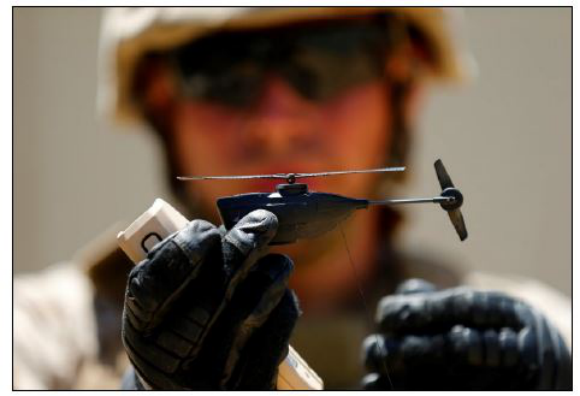
Figure 1: Small drones like the Teledyne/FLIR Black Hornet can get close to a person or area of interest without being seen or heard but are particularly challenging to control and highly susceptible to environmental conditions (e.g., wind).
METHODS
Our collective team drew on the extensive body of knowledge we have devel- oped over the past several years conducting demonstrations, informal user testing, and applied technology development and evaluations for various commercial and military drone platforms and human-computer interface technologies (e.g., ground control software, immersive VR flight goggles, control / interaction peripherals). Based on our own experience gained through these efforts, as well as the network of military end users that we established providing us with unique access to these end user populations, we conducted semi-structured interviews with various end users that sought to investigate:
What unclassified platforms are currently used in the field today?
How are these platforms currently controlled (i.e., interfaces, modalities)?
What system controls, features, and information outputs are important to dismounted operators?
What are the limitations of existing systems and/or control modalities?
How are UXS currently used in the field?
What are the current and future mission contexts / use cases for UXS at the dismounted/squad level?
What are the current and/or envisioned UXS-Operator workflows at the dismounted/squad level?
What operating conditions/environments are important to support?
What are critical considerations for use of UXS at the dismounted/squad level?
We began broad with informal demonstrations of emerging commercial UXS technologies, and then narrowed through targeted semi-structured one- on-one and group/panel interviews (n=25), as shown in Table 1.
For the 1:1 and group interviews, two different interview protocols were developed–a long-form set of questions and a short-form set of questions. Determination of which to use was based on the window of availability that a given end user had to engage, as well as their responses to initial questions. Table 2 provides these interview questionnaires.
Using the responses gathered from the user engagements, we developed a set of high-level themes, use-case classes and mission contexts, and exem- plar UXS-squad teaming mission scenarios. Each of these results were then reviewed with at least five (5) different representative end users who partic- ipated in the above user interviews as a subjective form of validation of the developed artifacts.
RESULTS
UXS Platforms
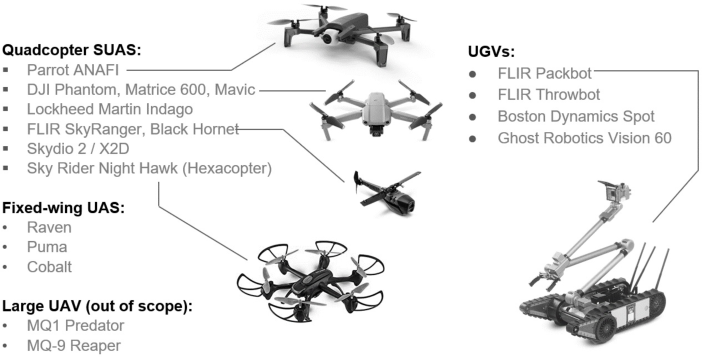
Figure 2 presents a summary of UXS platforms that were identified as mission-capable for at least a subset of needs across at least two users that were interviewed. While this list is not exhaustive, it is worth noting that only 6 of the 16 small unit UXS platforms (i.e., all but the large UAVs listed) men- tioned were dual-use consumer/commercial platforms; the rest were bespoke UXS designed exclusively for military / law enforcement applications.
Small UXS-Squad Teaming: Military Operational Use Cases 517
Table 1. Summary of end user engagements providing insights to exemplar UXS use cases.
Table available in the original PDF paper.
Event End Users Qualifications 10 8 Active-Duty Army; 2 Active-Duty Air Force personnel WFX 21–4 Technology Demonstration and Discussions
Group Interview 2 Active-Duty USASOC Electronic Warfare (EW) Operator with UXS experience 1:1 Interview 1 Former Special Recon Operator, current JTAC with UXS experience 1:1 Interview 1 US Navy stakeholder and subject-matter expert (SME) conducting research events involving UXS operations 1:1 Interview 1 Active-Duty USASOC EW Operator with UXS experience 1:1 Interview 1 USAF Weapons Officer JTAC leading UXS Modernization of Air National Guard Air Force Special Warfare personnel 1:1 Interview 1 Air National Guard Special Reconnaissance Operator with UXS experience Group Interview 4 EW/IW SOF Operators with UXS reconnaissance experience Group Interview 2 EW/IW SOF Operators with UXS tactical experience 1:1 Interview 1 Science & Technology Lead overseeing investments in emerging commercial UXS technologies for SOF 1:1 Interview 1 Essential Research Program Lead overseeing investments in UXS technologies for multidomain operation (MDO) applications
Figure 2: The image above depicts UXS platforms that were discussed during inter- views by at least 2 different end users, noting that discussions of applications of these platforms focused exclusively on the small UAS and UGV platforms, as these are the only ones that can be organically controlled by small unit teams (vs. the large UAV platforms that are controlled by reachback ground stations).Table 2. Interview question outlines that were used to guide the semi-structured end user interviews, with additional contextual drill-downs used based on information a given end user provided.
a. What is your familiarity, if any, with unmanned air and/or ground vehicle systems (i.e., UAS, UGV; e.g., drones, ground robots)? b. Have you ever used a UAS or UGV in the context of your role in the military? c. Have you ever used a UAS or UGV for personal interests (e.g., camera drones)? d. If prior experience:
1. What is your experience with UAS/UGV? And in what con- text? 2. If you could implement an unmanned air/ground vehicle system to improve one aspect of your normal operational role, what would it be? 3. If you were operating an unmanned system like a drone or ground robot out in the field, how would you expect to control it?
a. How might you want to control these systems?
i. Describe the context in which you used the UAS/UGV (why were they using it?) ii. How useful was the system for accomplishing your goal? iii. Were you the one controlling it? If so, how easy or difficult was it to control? What type of control interface were you using?
4. Are there any conditions in which you would not want to use a drone on a mission?
2. Does your unit, or any other unit you are aware of, currently use unmanned air and/or ground vehicle systems to accomplish mission objectives?
a. If so, describe how these systems are currently used (to your knowledge).
3. Thinking about your specific role in the [service], how do you think unmanned air and/or ground vehicle systems could help you do your job?
a. Mission execution? b. Training? c. Other aspects?
4. Describe a mission context in which you think an unmanned air or ground vehicle system could improve current operations. 5. If you could implement an unmanned air or ground vehicle system to improve one aspect of military operations tomorrow, what would it be and why? 6. If you were operating an unmanned system like a drone or ground robot out in the field, how would you expect to control it?
a. In a perfect world, how might you want to control these systems? b. Thinking about the gear you wear, the environments you operate in, and the overall field use context, what are some of the constraining factors that control interfaces should account for?
7. What concerns do you have, if any, regarding the use of UAS/UGV at the operational level? 8. Are there specific mission contexts in which you would not want to see the use of UAS/UGVs?
Small UXS-Squad Teaming: Military Operational Use Cases 519
High-Level Themes Based on a review of all responses collected across the end user engagements, we extracted five high-level themes that characterized the most common rea- sons that small unit teams / dismounted Operators relied on UXS platforms. Table 3 presents exemplar high-level use cases that align with these themes– intended to be used by designers/developers to inform technology/capability development at the highest levels.
1. UXS are effectively used at the dismounted/squad level to situationally replace human Operators to improve safety and/or lethality. 2. Operators are most often using UXS to accomplish a specific and time- oriented task. 3. Use cases predominately involve UXS as covert tools/teammates for intelligence, surveillance, and reconnaissance (ISR) to bolster situational awareness (SA). 4. Currently, there are few dismounted units using UXS operationally– making quick, on the ground decisions, not up the chain of command. 5. Use cases will always vary by unit/group, and each unit/group will likely have a specific and narrow use for UXSs within their mission context.
Table 3. Exemplar high-level use cases.
Table available in the original PDF paper.
High-Level Use Case Description “Soak” Single UXS or multiple UXS (e.g., in “yo-yo” ops) to “soak” a target by providing continuous sensor observation (noting this is most commonly video, but continuous electromagnetic spectrum monitoring is also a valid application) to establish a pattern of life over an area of interest (AOI). Positive Identification (PID)
Maneuver one or more UXS close to a person or entity of interest to confirm PID, make a decision, conduct a follow-on mission, and/or prosecute the target. Troops-in-Contact (TIC) Response
UXS is positioned in a perched or static elevated hover position to help identify locations of threats during a fight (e.g., ensure enemies are not attempting to flank friendly positions).
Squad-Level UXS Use Cases With high-level themes identified, our analysis shifted to establishing more detailed exemplar use cases to provide additional contextualization of the tasks for which UXS are employed, and when and how they are used to accomplish those tasks. Based on current capabilities of UXS platforms that are available at the time users were engaged, these use cases were split into three primary categories: (i) ISR Use Cases; (ii) Non-ISR Use Cases; and (iii) envisioned Future Use Cases. These classes were established based on ISR use cases being far more common than non-ISR use cases (though as press has shown covering the conflict in Ukraine, non-ISR use cases have become more prevalent, or at least more public). Table 4 provides a summary of these use
cases. The sections that follow provide more detailed context for each of the ISR use cases, noting that our focus was on the ISR use cases, given that the significant majority of end users (all but 2) focused on this class of use cases as currently-used UXS tactics.
Table 4. Use-case classes and mission contexts summary.
Table available in the original PDF paper.
ISR Use Cases Non-ISR Use Cases Future Use Cases Build SA/expectations prior to mission (geographical, large areas) Munitions/Fire delivery Megacity/Swarm operations Investigate specific POIs (vehicles, garages, hangars)
Sensor-based munition detection
Mid-mission resupply Real-time SA on an area or POI – “eyes on”
Ad hoc comms relay/repeater Long-term surveillance via teleoperation Person/vehicle tracking and following Building and area clearance Establish shared SA (laser designators, spotlights, drones as markers, audio output)
ISR Use Cases Mission Reconnaissance / Intel Gathering at specific POIs: Investigate specific objects/buildings of interest to conduct recon and gather intel to inform an upcoming mission.
Example: Fly into a garage and see some vehicles and weapons that Oper- ators were looking for; fly into an airplane hangar and see if there are aircrafts in there
Example: Fly to a cargo truck with a canopy and look at what’s under the canopy Mission Reconnaissance at the geographical level: UXS to gather imagery, photos, terrain data, building geometry, etc., that can be used to build models/maps and understand a geospatial area prior to a mission.
Example: UXS scans of a compound can be used to reproduce and print a 3D model of that compound to help Operators understand the ins and outs before going on mission
Example: Pulling a 10-digit grid as early validation of a targeted air strike area that can be passed up the chain of command and verified later closer to strike time Real-time/Continuous SA: Position UXS to actively monitor a specific point of interest, such as a door that people might exit, a vehicle people might enter, perch or hide behind a wall to watch a building front, and/or a road or boundary people might cross
Example: Patrol a specific area for enemy activity (fixed patrol, drive up/down road)
Small UXS-Squad Teaming: Military Operational Use Cases 521
Example: UXS (often larger hybrid gas/electric) to fly higher and provide continuous SA of an area of interest to monitor for changes, enemies, etc., (stay and hover or orbit)
Example: Combinations of UXS for a “layered effect,” flying lower and higher
Example: Send out UXS flying in the same route, one after another, in “yoyo operations” to maintain SA along a set route (e.g., orbiting a few waypoints)
Example: Mount a UXS on an object to access an area (e.g., a taxi) Long-term SA/Surveillance: Teleoperate stationed UXS to look at an area and report back (no time pressure)
Example: Operators may leave a UXS while on a mission and, as they are falling back, teleoperate the system to execute a mission set or maintain SA in the area Person/Vehicle Tracking and Following: Manually operate a UXS or lever- age onboard computer vision (for more advanced UXS platforms) to provide continuous tracking of a person or vehicle on the move to establish patterns of life or to prevent loss of SA on its position or near proximity to them/it.
Example: UXS to follow a person or vehicle of interest during a given mission (e.g., enemy/targeted person) or to conduct recon
Example: UXS “follow me” functions to follow the Operator to continu- ously scan in front or behind position
Example: Use the UXS “standoff”capabilities to provide a buffer between the UXS and person of interest to maintain secrecy and then use the camera to zoom in
Example: Fly UXS to discreetly follow an enemy convoy back to a specific location Building and Area Clearance: UXS to observe and clear the back sides of buildings, roofs, tree lines, brush, etc.
Example: Perch or hover a UXS to monitor windows or doors of a facil- ity to detect individuals departing/entering beyond line of sight from the front/interior of the building.
Example: UGV used as first to enter a building with potential threats to keep Operators out of harm’s way and bolster SA of what they will encounter (both the physical layout and potential obstacles) before Operators enter.
Shared SA: On-board features on UXS to establish shared SA across multiple operators.
Example: Operators may use a laser designator or spotlight to mark a specific POI
Example: Operators may fly drones to act as a physical marker/waypoint they can reference
Example: Operators may use on-board speaker capability to broadcast audio commands Finally, working with two of the engaged users after reviewing the use cases above, we developed three examples of mission scenario sequences. These sequences, provided in Table 5, are meant to provide an example of how these use cases can be expanded to provide a more distinct UXS-squad teaming workflow, providing general contextualization for designers/developers of UXS technologies.
Enter with UGVs and UXS Send UGV and UXS on patrol Persistent UXS put in orbit for “steady stare” camera
Breach the door of the subterranean environment
Send the UGVs in to start mapping the environment, moving left/right
Monitor feeds for anyone crossing East to West because intel suggests no friendly forces on East side
Drive up and down a specific road and fly a predefined mission with 4 waypoints perimeter UXS launched to clear area via manual flight to check backs of buildings, roofs, tree lines, brush (anywhere someone could be / Operators don’t want to go) Move forces into the area once clear Operator detects a person crossing and sets drone to follow that person at standoff distance
Once UGV provides understanding of the environment, fly the UXS in to clear the area and provide eyes out front Then move forces up in the subterranean environment
Forces reorient to area person of interest is heading towards
CONCLUSION
Engaging with end users is crucial for technology designers when products or solutions will eventually be relied upon or otherwise interact with or serve those same end users. By involving end users throughout the design process, designers gain valuable insights into user needs, preferences, and behaviors. This understanding allows them to create technology solutions that align with user expectations and deliver meaningful experiences.
Early contextualization of how a candidate technology or solution will be used is particularly valuable as it informs design and implementation deci- sions. By gaining a deep understanding of the context in which the technology will operate, designers can identify potential challenges, opportunities, and constraints. This information helps in tailoring the technology to specific user requirements, optimizing usability, and ensuring it integrates seamlessly into
Small UXS-Squad Teaming: Military Operational Use Cases 523
users’ workflow(s) and environment(s). Additionally, early contextualization enables designers to anticipate user behaviors and interactions, making it eas- ier to predict potential usage patterns and identify possible usability issues. By involving end users early on, designers have more opportunity to iterate on their designs, leading to more user-centered and performant technology solutions.
The increasing deployment of small UXS at the squad or small unit level in military applications is only going to increase in coming years; however, access to these limited and at-risk user populations is challenging for most developers of potentially relevant UXS technology (e.g., platform, autonomy, computer vision, AI, HCI controls). This paper presents a summary of opera- tional use cases (current as of the time of this publication) for UXS, based on feedback from representative military end users. The purpose is to provide designers and developers of UXS technologies with operationally-grounded use cases to help provide at least an initial contextualization, informing their efforts to serve these populations.
ACKNOWLEDGMENT
The authors would like to acknowledge all of the military end users who provided their invaluable insights in support of these efforts.
LISTED IN THE AHFE DIGITAL BOOKSTORE CATALOGUE
Explore the complete digital volume
Human-Centered Design and User Experience
Read this individual research paper free through the original publisher, or explore the full digital proceedings book.
ISBN 978-1-958651-90-2
Explore this ISBN in the AHFE Bookstore ↗Listed in the July 2026 bookstore catalogue; search by ISBN to confirm current availability · Digital book purchase optional